
Global Smart Luggage Market Forecast 2025–2032: AI Integration, Connected Travel Solutions, and Digital Luggage Innovation
Overview
The Global Smart Luggage Market is witnessing rapid adoption, driven by rapid digital transformation in the travel industry, increasing demand for connected consumer products, and rising global tourism. The market was valued at USD 2.45 Billion in 2025 and is projected to reach USD 5.94 Billion by 2032, expanding at a CAGR of 13.5% during the forecast period (2026–2032).
Smart luggage integrates advanced technologies such as GPS tracking, IoT connectivity, USB charging ports, biometric locks, and weight sensors, transforming traditional luggage into intelligent travel companions. The increasing preference for convenience, security, and real-time tracking among travelers significantly accelerated market adoption.

To know about the Research Methodology :- Request Free Sample Report
Global Smart Luggage Market: IoT Integration, GPS Tracking & Digital Travel Evolution
The Smart Luggage Market has evolved from traditional travel bags into technology-integrated travel solutions, driven by increasing demand for convenience, security, and connected travel experiences. Features such as GPS tracking, remote locking, and built-in charging systems have enhanced product value, supporting market growth.
The market expansion was fueled by rising global air travel, business mobility, and tourism activities, along with the growing adoption of IoT-enabled devices and mobile applications. Additionally, the growth of e-commerce channels and increasing preference for premium travel accessories further strengthened market penetration. Looking ahead, the market is expected to benefit from opportunities such as AI-enabled smart luggage, integration with smart airport ecosystems, expansion in emerging markets, and development of sustainable materials, driving long-term growth and innovation. The Intelligent Luggage Industry is rapidly expanding due to increasing adoption of connected travel technologies and premium smart baggage solutions.
Smart Luggage Market Key Highlights
| Market Parameter | Value / Insight | Trend |
| Global Smart Luggage Market Size (2025) | USD 2.45 Billion | ↑ Steady Growth |
| Projected Market Size (2032) | USD 5.94 Billion | ↑ Rapid Expansion |
| Forecast CAGR (2026–2032) | 13.5% | ↑ High-Growth Market |
| Dominant Product Type (2025) | Hard-Shell Smart Luggage | ↑ Market Leader |
| Second Largest Segment | Soft-Shell Smart Luggage | ↑ Rising Demand |
| Third Largest Segment | Backpacks & Smart Carry-ons | ↑ Growing Adoption |
| Primary Application | Travel & Tourism | ↑ Core Demand Driver |
| Business Traveler Adoption | Increasing use for convenience & tech-enabled travel | ↑ Strong Growth |
| IoT Integration in Smart Luggage Market | Features like GPS tracking, remote locking, and charging ports | ↑ Transformational Growth |
| Airline Regulations Impact | Restrictions on removable batteries influencing design | ↑ Market Challenge |
| E-commerce Distribution | Rising online sales channels | ↑ Expanding Reach |
| Sustainable Smart Luggage | Use of eco-friendly and lightweight materials | ↑ Emerging Trend |
Global Smart Luggage Market Drivers
The increasing demand for connected travel solutions significantly drove the Smart Luggage Market. Consumers increasingly preferred luggage equipped with tracking systems, remote locking, and charging capabilities, which enhanced travel convenience and security. The rapid expansion of global tourism and business travel also fueled demand. Moreover, advancements in IoT and smart sensor technologies supported the development of innovative luggage solutions.
Global Smart Luggage Market Restraints
High product cost remained a major barrier to widespread adoption, particularly in price-sensitive markets. Additionally, stringent airline regulations regarding lithium-ion batteries created challenges for manufacturers and consumers. Concerns related to battery safety and product durability also limited market penetration.
Global Smart Luggage Market Opportunities
The introduction of affordable smart luggage models and modular designs created significant growth opportunities, particularly in price-sensitive and emerging markets. Manufacturers increasingly focused on developing detachable battery systems and upgradeable components, which improved product lifecycle and regulatory compliance. The rapid expansion of e-commerce platforms further enabled companies to reach a broader global consumer base, reducing dependency on traditional retail channels and lowering distribution costs.
Furthermore, the integration of advanced technologies such as AI-based tracking, biometric authentication, and IoT-enabled connectivity is expected to enhance product value and differentiation. Growing demand from frequent travelers, business professionals, and digital nomads also supported market expansion. In addition, rising investments in smart travel ecosystems and connected devices are likely to create new revenue streams, including app-based services and subscription models for tracking and security features.
Strategic Opportunities Shaping the Smart Luggage Market: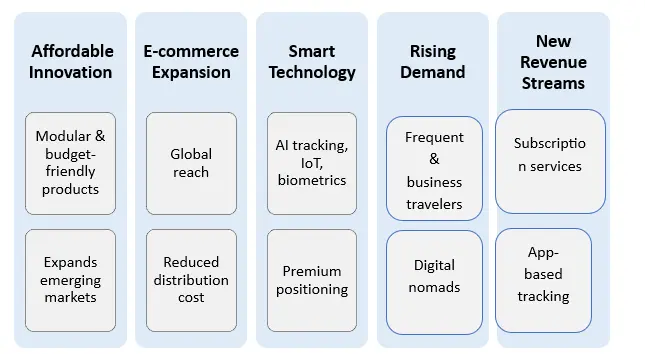
Global Smart Luggage Market Challenges
Rapid technological obsolescence and intense market competition posed significant challenges for market players, as frequent product upgrades increased R&D costs and shortened product lifecycles. Maintaining product reliability while integrating advanced electronic components remained a key concern, particularly in terms of battery performance, durability, and after-sales service.
Regulatory compliance across different regions increased operational complexity, especially due to strict airline restrictions on lithium-ion batteries and safety standards. Variations in international travel regulations often required product modifications, adding to manufacturing costs. Data privacy and cybersecurity risks associated with connected luggage also emerged as growing concerns among consumers. Moreover, high product pricing and limited awareness in developing regions continued to restrict widespread adoption, impacting overall market penetration.
Smart Luggage Market Technology & Innovation Analysis
The Smart Luggage Market evolved rapidly with continuous technological advancements, particularly in IoT integration, AI-enabled tracking, and smart security systems. Features such as GPS tracking, Bluetooth connectivity, biometric locks, and anti-theft alarms became key differentiators.
Innovation also focused on app-based control systems, allowing users to track, lock, and manage luggage remotely. Additionally, integration with airline systems and smart travel ecosystems enhanced user convenience. Companies investing in R&D gained a competitive edge through differentiated product offerings and improved user experience.
Smart Luggage Market Supply Chain & Distribution Analysis
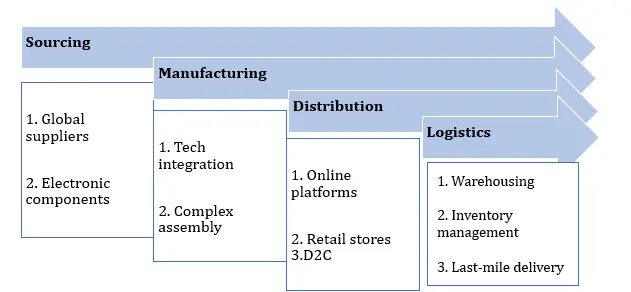
The supply chain in the Smart Luggage Market became increasingly complex due to the integration of electronic components with traditional luggage manufacturing. Sourcing of batteries, sensors, and chips required coordination with global electronics suppliers.
Distribution channels expanded beyond traditional retail to include e-commerce platforms, direct-to-consumer (D2C) models, and airport retail stores. Efficient logistics and inventory management became critical due to high product value and technological sensitivity.
Companies also focused on regional warehousing and last-mile delivery optimization to enhance customer satisfaction and reduce lead times.
Smart Luggage: Integrated Supply Chain & Distribution Model
Smart Luggage Market Sustainability & Environmental Impact Analysis
Sustainability emerged as a key focus area, with manufacturers adopting eco-friendly materials such as recycled plastics and lightweight metals.
Efforts were made to reduce carbon footprints through optimized manufacturing processes and sustainable packaging solutions. Energy-efficient components and longer battery life also contributed to environmental goals.
Companies aligning with global sustainability standards gained a competitive advantage and improved brand perception among environmentally conscious consumers.
Smart Luggage Market Cost Structure & Pricing Evaluation
The cost structure of the Smart Luggage Market was largely driven by the use of premium materials such as polycarbonate, aluminum, and durable fabrics, along with the integration of electronic components including lithium-ion batteries, GPS modules, and sensors. The addition of advanced technologies like IoT connectivity, tracking systems, and built-in charging increased manufacturing complexity, requiring specialized processes and skilled labor, which raised overall production costs.
Smart luggage products were positioned in the premium segment, typically priced 20% to 40% higher than conventional luggage due to their enhanced functionality and technological features. The final pricing structure included raw materials, electronic integration, manufacturing, logistics, and retail margins, resulting in higher retail prices compared to traditional luggage.
Strategic Cost & ROI Analysis in the Smart Luggage Market
From a strategic perspective, the Smart Luggage Market demonstrated strong ROI potential due to increasing adoption of smart travel solutions and premium product positioning. Recurring demand from frequent travelers and business professionals contributed to consistent revenue streams. Additionally, product differentiation through advanced features enabled higher pricing power and improved profitability. Automation in manufacturing and optimized supply chain management helped reduce operational costs and enhance efficiency. Continuous innovation and integration with digital travel ecosystems further strengthened long-term growth prospects.
Smart Luggage Market Segment Analysis
By Product Type and Technology
The market was segmented into smart suitcases, smart backpacks, and smart travel bags, where smart suitcases accounted for the largest share due to their high adoption among business travelers and frequent flyers who prioritize convenience, security, and advanced features. These suitcases were widely preferred for long-haul and international travel as they offered integrated functionalities such as GPS tracking, digital locks, and built-in charging ports. Smart backpacks gained significant traction among younger consumers, students, and daily commuters owing to their compact design, affordability, and multifunctional usage, including device charging and anti-theft features. Meanwhile, smart travel bags emerged as a versatile option, catering to short trips and hybrid usage, thereby supporting steady segment growth.
Based on technology, the market included GPS tracking, Bluetooth connectivity, USB charging systems, biometric locks, and weight sensors, each contributing to enhanced user experience and product differentiation. GPS-enabled luggage held a prominent share due to rising concerns over baggage loss and increasing demand for real-time tracking solutions, particularly in international travel. Bluetooth-enabled features supported proximity alerts and remote access via mobile applications, improving security and convenience. USB charging systems became a standard feature across mid-range and premium products, reflecting the growing dependency on electronic devices during travel. Additionally, biometric locks and weight sensors gained popularity as value-added features, addressing safety concerns and helping travelers avoid excess baggage charges, thereby strengthening the overall appeal of smart luggage solutions.
Smart Luggage Market Competitive Landscape Analysis
• The Smart Luggage Market was characterized by intense competition among established luggage brands and emerging tech-driven startups. Market players competed based on innovation, pricing strategies, durability, and smart features.
• Strategic initiatives such as product launches, partnerships, and acquisitions were common to strengthen market position. Established brands leveraged strong distribution networks, while startups focused on niche innovation and premium offerings.
• Brand differentiation through design, technology, and customer experience played a crucial role in gaining market share.
Smart Luggage Market Scope: Inquire before buying
| Smart Luggage Market | |||
|---|---|---|---|
| Report Coverage | Details | ||
| Base Year: | 2025 | Forecast Period: | 2026-2032 |
| Historical Data: | 2020 to 2025 | Market Size in 2025: | USD 2.45 Bn. |
| Forecast Period 2026 to 2032 CAGR: | 13.5% | Market Size in 2032: | USD 5.94 Bn. |
| Segments Covered: | by Product Type | Smart Suitcases Smart Backpacks Smart Travel Bags Smart Duffel Bags Smart Trolley Bags |
|
| by Technology | GPS Tracking Bluetooth Connectivity USB Charging Biometric Locks Weight Sensors RFID Blocking |
||
| by Security Feature | Biometric Security Digital Locks RFID Blocking Anti-theft Systems |
||
| by End-User | Business Travelers Frequent Flyers Corporate Professionals Leisure Travelers Solo Travelers Family Travelers |
||
| by Distribution Channel | Online Stores Brand Websites E-commerce Platforms Specialty Stores Supermarkets/Hypermarkets Airport Retail |
||
Smart Luggage Market, by region
North America (United States, Canada, and Mexico)
Europe (United Kingdom, France, Germany, Italy, Spain, Sweden, Russia, Ukraine, Austria, Poland, Portugal, Ireland, Switzerland, Romania, and Rest of Europe)
Asia Pacific (China, India, Japan, South Korea, Australia, Indonesia, Malaysia, Philippines, Thailand, Vietnam, and the rest of Asia Pacific)
Middle East and Africa (UAE, South Africa, Saudi Arabia, Egypt, Israel, and Rest of ME&A)
South America (Brazil, Argentina, Chile, Colombia, and the rest of South America)
Key Players/Competitors Profiles Covered in the Smart Luggage Market Report in Strategic Perspective
Global Leaders & Established Brands
1. Samsonite International S.A.
2. Tumi Holdings Inc.
3. Delsey Paris
4. Rimowa GmbH
5. Travelpro International Inc.
6. American Tourister
7. Away Travel Inc.
Smart & Tech-Focused Luggage Companies
8. Horizn Studios
9. Bluesmart Inc.
10. Arlo Skye
11. Samsara Luggage
12. ForwardX Robotics
13. Cowarobot
14. Modobag
15. Trunkster
16. Barracuda Luggage
17. Kabuto Luggage
18. Néit Luggage
19. TraxPack
20. E-Case
Emerging / Innovative Smart Luggage Brands
21. LEVEL8
22. July (Australia)
23. FUGU Luggage
24. G-RO (Travel-Light Ltd.)
25. Planet Traveler
26. Kopack
27. Diplomat Luggage
28. Dreamin Luggage
29. Arista Vault
30. Luggit
Traditional Brands Adding Smart Features
31. Heys International Ltd.
32. ECBC
33. Raden
34. LugLoc
35. Herschel Supply Co.
36. Antler Ltd.
37. Bric’s
38. Victorinox Travel Gear
39. IT Luggage
40. Carlton Travel Goods
Premium / Niche & Luxury Tech-Integrated Brands
41. Paravel
42. Globe-Trotter
43. SteamLine Luggage
44. Roam Luggage
45. Calpak
46. Beis Travel
47. Floyd Luggage
48. Mark & Graham Travel
49. T. Anthony
50. Away Aluminum Editions