
Smart Greenhouse Market Size by Type, Component, End User and Region – Segment-Level Market Assessment, Growth Opportunity Analysis, Competitive Mapping & Forecast to 2032
Overview
Global Smart Greenhouse Market was valued at USD 2.51 Bn in 2025 and is expected to reach USD 4.7 Bn by 2032, growing at a CAGR of 9.4% during the forecast period.
Smart Greenhouse Market Overview:
The report explores the Smart Greenhouse market's segments (Type, component, End User and Region). Data has been provided by market participants and regions (North America, Asia Pacific, Europe, Middle East & Africa, and South America). This market report provides a thorough analysis of the rapid advances that are currently taking place across all industry sectors. 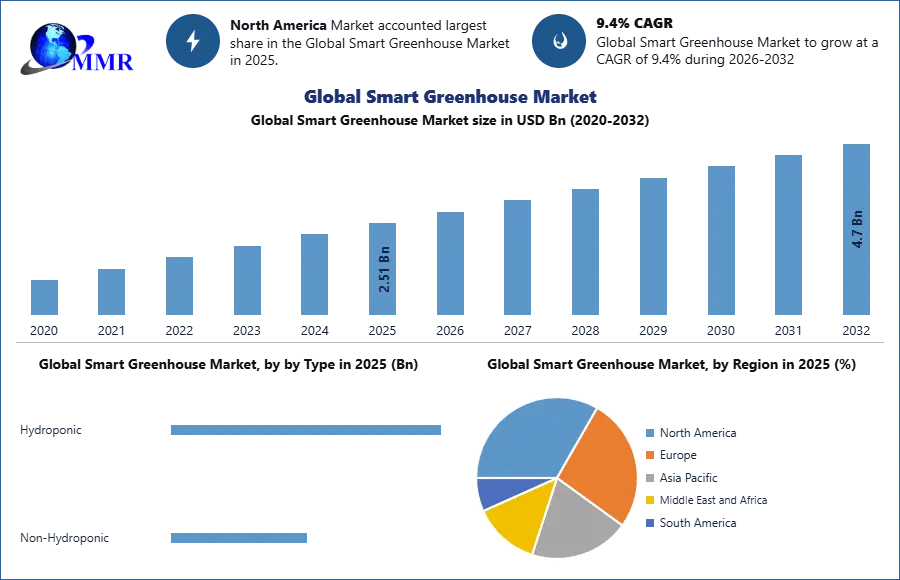 To know about the Research Methodology:- Request Free Sample Report
Smart Greenhouse Market Dynamics:
Growing Adoption of Smart Greenhouse across the Globe:
A smart greenhouse is an agricultural revolution of creating a self-regulating microclimate that will be suitable for growing plants through the use of sensors, actuators, monitoring, and control systems that can optimize the growing conditions and automate the growing process. Greenhouse provides a controlled environment for the customization of the vegetation that needs to be cultivated inside. The smart greenhouse has equipped with modern sensors and communication technologies that can automatically capture and deliver information 24/7 on the crop.
The data which is collected from these sensors and communication technologies is fed into the Internet of Things (IoT). Platforms where analytical algorithms convert into actionable intelligence for identifying the bottlenecks. Continuous data monitoring provides the development of predictive models for identifying crop diseases and infection risks. By gathering information about a crop, a smart greenhouse allows the cultivators to reduce labor work and increase the efficiency of resources and the uses of chemicals while optimizing the yield rate. The micro-suppressors and sensors are used to perform different functions like controlling temperature and irrigation systems. Any type of fruit, plant, and vegetable can be grown at any time of the year in a smart greenhouse. This system is low cost and increases the efficiency and versatility of the greenhouse. These smart greenhouses are raising the adoption of indoor farming, and the increasing number of government initiatives are the major drivers of the growing market.
High Installation and Maintenance Cost:
The smart greenhouse concept may give many advantages to the cultivator, but the investment of high cost is owing to the deployment of expensive systems is restraining the market growth. Also, there is a global rise in vertical farming technology, which is an energy-intensive system of cultivating crops that involves a combination of multiple technologies like big data analysis, robotics, the Internet of Things, artificial intelligence, etc. To improve the efficiency of crop growth. Smart greenhouses require the deployment of expensive systems such as HVAC, control systems, LED grow lights, and sensors. LED grow light unit contains an array of LEDs which is specially designed for the application of smart greenhouse. LED grow lights are expensive and an important part of a smart greenhouse. The units contain different types of LED lights, which differ in terms of wattage and wavelengths, which are required for providing the required light for the specific plant species. Thus, this expansive lighting system is a restraining factor that delays the incorporation of LED technology for smart greenhouses.
Growing Adoption of Rooftop Farming:
The immersing practices of rooftop cultivation have become a current trend across the world. It is the practice of cultivating vegetables, fruits, and flowers on the rooftop of a building known as rooftop farming. This farming requires green roofs, hydroponics, and an aeroponics system. This technique of farming is mostly adopted in urban areas due to the scarcity of arable land. Mostly, the rooftops of high-rise buildings are used for the development of rooftop farms. These farms hold rainwater, reduced pests and human interference in crop cultivation, and provide good quality air present. All these factors are creating the upcoming opportunity for the growth of rooftop farming which will significantly increase the smart greenhouse market.
Absence of Standard Industry Rules and Regulations:
Industry-standard is absent for the management of farm data. The data which is obtained from the systems which are present in the smart greenhouse is of high importance as it has micro-suppressors and sensors that are used to perform different functions like controlling temperature and irrigation systems. Any type of fruit, plant, and vegetable can be grown at any time of the year in a smart greenhouse. These data are used for making a productive decision required for the cultivation of a particular crop, these data must be stored and managed properly as the successful and smart farming technique depends on this data for evaluating the condition of the farm. To improve the decisions which are taken for the proper farm operation. It is important to manage the data properly. Also, many farmers and cultivators are not aware of the effective use of this data for effective decision-making. Hence, it has become a challenge to provide proper knowledge to the farmers and cultivators about data management of tools and techniques so that they can be used effectively.
Smart Greenhouse Market Trends:
Green Houses are equipped with microsensors and communication technologies that are used in recording data. The data which is collected from these sensors and communication technologies is fed into the Internet of Things (IoT). Platforms where analytical algorithms convert into actionable intelligence for identifying the bottlenecks. Continuous data monitoring provides the development of predictive models for identifying crop diseases and infection risks. HVAC and LED grow lighting operators are used for controlling crops properly. Rooftop cultivation has become a current trend across the world. Rooftop farming is a technique of farming is mostly adopted in urban areas due to the scarcity of arable land. All these are increasing the demands for the Smart Greenhouse Market.
| Exact Date | Company | Development | Impact |
|---|---|---|---|
| 18 February 2026 | Argus Control Systems | Argus announced the full-scale deployment of its Axia on-premises analytics platform, designed to optimize greenhouse climate control without relying on cloud-based latency. | The system significantly reduces network latency and minimizes energy consumption peaks, allowing for more stable growing environments in remote locations. |
| 20 January 2026 | BrightFarms | The company successfully operationalized a new one-hectare multi-tunnel smart greenhouse featuring advanced AI-driven environmental sensors. | This facility expansion leverages real-time automation software to enhance crop yields for leafy greens while addressing labor shortages through robotics. |
| 15 December 2025 | Motorleaf | Motorleaf integrated its AI-based harvest prediction software with commercial greenhouse cloud platforms to provide predictive yield analytics. | The integration achieves a 95% accuracy rate in harvest timing, helping growers optimize labor allocation and reduce post-harvest waste. |
| 28 October 2025 | Spread Co., Ltd. | Spread Co. launched its next-generation high-tech smart greenhouse models, supported by a ¥700 million strategic investment in automated planting. | The investment facilitates the scaling of fully automated nutrient management systems, lowering the marginal cost of production for hydroponic vegetables. |
| 12 May 2025 | Brio Hydroponics | Brio Hydroponics expanded its smart cultivation footprint by launching the 100-acre Unnati Hi-Tech Hydroponics Park in India. | This massive commercial park serves as a hub for investor-driven smart farming, utilizing closed-loop irrigation to achieve up to 90% water savings. |
| 18 March 2025 | Netafim (Orbia) | Netafim partnered with Virridy to integrate precision irrigation sensors with a new carbon credit program for smart greenhouse operators. | The partnership creates a new revenue stream for growers by quantifying reduced methane and carbon emissions through precision water management. |
Smart Greenhouse Market Segment Analysis:
In 2025, the Type segment shows the highest adoption for Hydroponic Greenhouses, driven by their water-efficient and space-saving advantages. Hydroponic systems allow year-round cultivation and precise nutrient management, making them preferred for commercial growers and research institutes. Non-Hydroponic greenhouses continue to serve traditional cultivation practices but exhibit slower growth due to higher resource requirements and lower automation potential. Overall, Hydroponic solutions represent the strategic focus for companies aiming to optimize yield and sustainability.
Based on Component, Irrigation Systems and LED Grow Lights show the fastest growth and highest demand in 2025. Smart irrigation technologies reduce water consumption while maintaining optimal plant health, and LED grow lights enhance crop growth cycles with energy-efficient lighting. HVAC Systems and Control Systems remain essential for environmental management, especially in larger commercial operations, but their adoption is comparatively stable. AI-based monitoring and integrated control platforms are emerging trends that further enhance operational efficiency.
| Global Smart Greenhouse Market | |||
|---|---|---|---|
| Report Coverage | Details | ||
| Base Year: | 2025 | Forecast Period: | 2026-2032 |
| Historical Data: | 2020 to 2025 | Market Size in 2025: | 2.51 USD Bn |
| Forecast Period 2026-2032 CAGR: | 9.4% | Market Size in 2032: | 4.7 USD Bn |
| Segments Covered: | by Type | Hydroponic Non-Hydroponic |
|
| by Component | HVAC Systems Irrigation Systems Control System LED Grow Light |
||
| by End User | Commercial Growers Research & Educational Institutes Retail Gardens Others |
||
Smart Greenhouse Market Regional Insights:
Based on Region, North America leads the global smart greenhouse market in 2025, driven by high technological adoption, strong government support for sustainable agriculture, and increasing consumer demand for fresh produce. Europe follows closely, supported by regulatory initiatives promoting controlled environment agriculture and energy-efficient solutions. Asia Pacific is the fastest-growing region, fueled by the expansion of commercial horticulture, population growth, and investment in agri-tech innovations. MEA and South America show moderate adoption, influenced by agricultural modernization trends and regional infrastructure development.
The objective of the report is to present a comprehensive analysis of the global Smart Greenhouse Market to the stakeholders in the industry. The past and current status of the industry with the forecasted market size and trends are presented in the report with the analysis of complicated data in simple language. The report covers all the aspects of the industry with a dedicated study of key players that include market leaders, followers, and new entrants.
PORTER, PESTEL analysis with the potential impact of micro-economic factors of the market have been presented in the report. External as well as internal factors that are supposed to affect the business positively or negatively have been analyzed, which will give a clear, futuristic view of the industry to the decision-makers.
The reports also help in understanding the Smart Greenhouse Market dynamic and structure by analyzing the market segments and projecting the Smart Greenhouse Market size. Clear representation of competitive analysis of key players by Design, price, financial position, product portfolio, growth strategies, and regional presence in the Smart Greenhouse Market make the report investor’s guide.
Smart Greenhouse Market Scope: Inquire before buying
Smart Greenhouse Market, by Region
North America (United States, Canada and Mexico)
Europe (UK, France, Germany, Italy, Spain, Sweden, Austria and Rest of Europe)
Asia Pacific (China, South Korea, Japan, India, Australia, Indonesia, Malaysia, Vietnam, Taiwan, Bangladesh, Pakistan and Rest of APAC)
Middle East and Africa (South Africa, GCC, Egypt, Nigeria and Rest of ME&A)
South America (Brazil, Argentina Rest of South America)
Smart Greenhouse Market Key Players are:
1. Heliospectra AB
2. Postscapes
3. Lumiglow Limited
4. Certhon
5. Hort Americas
6. Sensaphone
7. Cultivar Ltd.
8. Desert Growing
9. Kubo
10. Agrowtek Inc.
11. Argus’s control sty’s ltd
12. Netafim
13. Rough Brothers, Inc.
14. Lumigrow
15. Unilever
16. Coty
17. Jahwa
18. 3M