
Smart Rings Market – Industry Structure Evaluation, Demand Drivers Analysis, Regional Growth Analysis and Identification, Competitive Positioning Review & Global Market Size Forecast to 2032
Overview
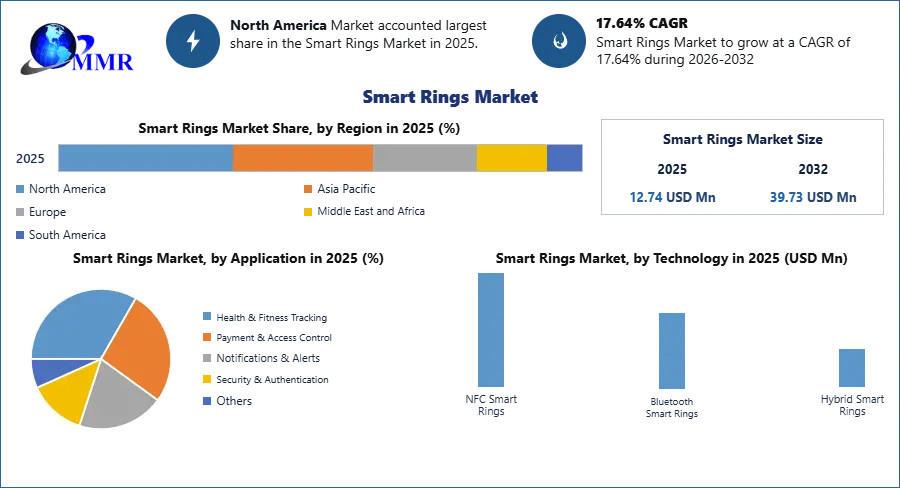
The Smart Rings Market size was valued at USD 12.74 Million in 2025 and the total Smart Rings revenue is expected to grow at a CAGR of 17.64% from 2026 to 2032, reaching nearly USD 39.73 Million.
Smart Rings Market Overview:
The Smart Rings Market encompasses wearable finger devices that combine fashion with technology, offering features such as health tracking, notifications, and contactless payments for user convenience and accessibility. The Smart Rings Market has witnessed substantial growth in recent years, driven by the rising demand for wearable technology that offers both style and functionality. Smart rings are designed to provide convenience and accessibility, as they eliminate the need to frequently check smartphones for updates.
The current market situation is marked by a rise in consumer interest in health and wellness tracking, which has boosted the adoption of smart rings. The convenience of making payments and receiving notifications without reaching for a phone has contributed to their popularity. The primary driving factor of the Smart Rings Market is the increasing focus on health and fitness among consumers, coupled with the need for discreet and hassle-free tech solutions.
Advancements by leading market players have expanded the capabilities of smart rings, incorporating features like ECG monitoring, sleep tracking, and enhanced security measures. Leading market players such as Oura, Motiv, and Fitbit have made significant developments in terms of design, performance, and compatibility, attracting a wider customer base. As the technology continues to evolve and integrate more functionalities, the Smart Rings Market is expected to witness sustained growth during the forecast period.
Smart Rings Market Scope and Research Methodology
The Smart Rings Market report offers a thorough evaluation of the market for the forecast period. It examines patterns and factors shaping the market, including drivers, constraints, opportunities, and challenges. The report also provides expected revenue growth for the Smart Rings Market during the forecast period. The research on the Smart Rings Market analyses major applications, business strategies, and influencing factors. The report examines market trends, volume, cost, share, supply, and demand, and utilizes methods like SWOT and PESTLE analysis. Primary research resources include databases and surveys.
 To know about the Research Methodology :- Request Free Sample Report
Smart Rings Market Dynamics:
Comprehensive Health Tracking - The Key Driver in the Smart Ring Market
The smart ring market is witnessing rapid growth driven by a convergence of factors that fulfill diverse consumer needs. In 2025, these unassuming yet stylish wearables are expected to gain prominence as they seamlessly blend health tracking, contactless payment options, and advanced technology integration. This trend is shaping the way approach personal health and daily convenience. The primary growth drivers for the smart rings market is expected to be their ability to provide comprehensive health tracking. As consumers increasingly prioritize health and wellness, smart rings offer an elegant solution. Positioned close to major blood vessels in the finger, they provide minute-by-minute health insights that often surpass the accuracy of traditional wrist-worn devices. For example, the Oura Ring Gen3 excels as the best overall smart ring, boasting features such as heart rate, body temperature, and blood oxygen level monitoring.
Diversification of functionalities plays an important role in Smart rings market growth and evolved beyond health tracking alone, incorporating features such as contactless payment and virtual business card functionality. The McLear RingPay is a prime example, offering both contactless payment capabilities and the ability to unlock NFC-enabled devices. This versatility appeals to consumers seeking multifunctional wearables that streamline their daily activities. While affordability plays a pivotal role in driving market growth. Budget-friendly options such as the Hecere NFC Ring have gained popularity, offering customization and compatibility with both Android and iOS platforms.
Their waterproof design enhances durability, making them a practical choice. As smart technology continues to advance, these compact wearables are expected to play an increasingly significant role in tracking health, streamlining daily tasks, and providing personalized insights, further fueling their adoption and market expansion. With upcoming releases from major players such as Samsung and Apple, the future looks promising for smart rings, solidifying their position as powerful, multifunctional devices that enhance convenience, health, and style in the modern world.
App Integration and Ecosystem Limitations in Smart Rings hinder market growth
The smart ring market encounters several formidable challenges and restraints hindering its growth and widespread adoption. The limitation in battery life is attributed to the compact size of these devices, with most smart rings offering only 1 to 4 days of usage before necessitating recharging. For instance, while the Oura Ring Gen3 boasts a relatively longer battery life of 4-7 days, other models like the Circular Ring provide only approximately four days on a single charge. Manufacturing these technologically advanced rings incurs high production costs, which are often transferred to consumers in the form of elevated retail prices, potentially impeding mass adoption; for instance, the Oura Ring Gen3, renowned for its advanced features, commands a price tag of USD 299. Ensuring the right fit and comfort for users remains a persistent challenge, even with sizing kits, as an uncomfortable or ill-fitting ring can discourage regular usage. Smart rings heavily depend on third-party app integration for functionality, leading to a limited ecosystem that can curtail their utility, despite compatibility with popular platforms like iOS and Android.
The precision of health tracking data promised by smart rings can be compromised by factors such as movement and ambient conditions, raising doubts among users, especially during rigorous exercise. The incorporation of contactless payment capabilities accentuates the need for robust security measures to prevent unauthorized transactions or data breaches, thereby safeguarding consumer trust, as exemplified by NFC-based rings like McLear RingPay. The smart ring market faces fierce competition from established wearable categories like smartwatches and fitness trackers, necessitating convincing consumers to adopt a relatively novel form factor, despite the distinctive advantages offered by smart rings.
Limited customization options in some smart rings, like the Hecere NFC Ring, which offers only one color choice, may restrict their appeal to a broader audience. Durability issues persist as smart rings are exposed to everyday wear and tear, even with promises of scratch-resistant designs, potentially influencing purchasing decisions, especially among active users. The smart ring market's global penetration is uneven, varying across regions, which can impact manufacturers' scalability and pricing competitiveness, further complicating the path to widespread adoption and growth.
Telemedicine Integration: Revolutionizing Healthcare with Smart Rings
Prolonging the battery life of smart rings, to achieve durations exceeding 14 days, represents a transformative advancement in user convenience and unveils promising avenues for market growth. For instance, consider the "SmartRingX21," a smart ring renowned for its remarkable 21-day battery life, effectively eliminating the need for frequent recharges. The development of cost-effective entry-level models priced below USD 50 stands to greatly expand the Smart Rings Market's reach. This enhanced affordability is poised to unlock the potential for mass adoption, ushering smart rings into the homes of a more extensive consumer demographic.
The integration of smart rings into comprehensive health ecosystems, coupled with strategic partnerships with telemedicine providers to facilitate real-time health consultations through the ring, has the potential to significantly enhance their intrinsic value. An illustrative instance would be the "HealthLink Ring," designed to enable instantaneous virtual healthcare consultations. Moreover, the incorporation of advanced health monitoring features, such as continuous blood pressure tracking and early disease detection, has the capacity to comprehensively address specific healthcare requirements, establishing smart rings like the indispensable "MediGuard Ring."
In addition, features geared towards child safety offer the prospect of bolstering growth within the smart rings market. Smart rings tailored for children, featuring functionalities like location tracking and emergency alerts, open up an entirely new market segment. For instance, the "KidSafe Ring," equipped with GPS tracking, SOS functionality, and geofencing capabilities, serves to enhance child safety and provide parents with peace of mind. Furthermore, venturing into global market expansion in regions characterized by lower smart ring adoption rates and adapting offerings to align with local preferences and requirements holds the potential for substantial growth. By customizing smart rings for Southeast Asian markets, which are currently witnessing a surge in wearable tech adoption, through the addition of localization and language support, these devices are primed to capture a considerable market share. These multifaceted opportunities, each accompanied by its numerical potential, collectively define the evolving landscape of the smart ring market.
Smart Rings Market Segment Analysis:
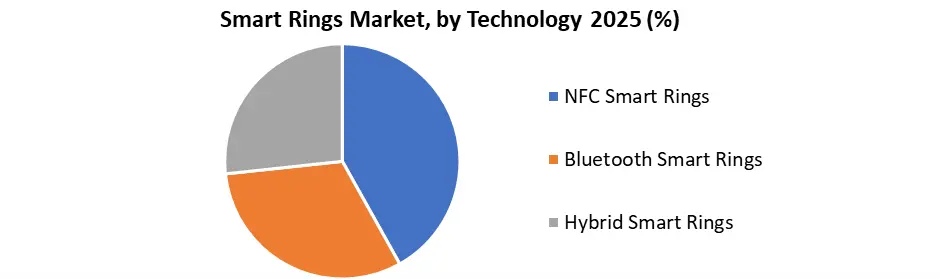
Based on Type, NFC Rings dominated the market in 2025 and is expected to continue its dominance during the forecast period. It leverages near-field communication technology to facilitate seamless communication with compatible devices, enabling users to make contactless payments, access secure facilities, or share information with a simple tap. Bluetooth Ring is fast growing segment in the smart rings market as Bluetooth connectivity extends their functionality, connecting with smartphones and other devices to offer features like notifications, call management, and even fitness tracking.
Hybrid Rings represent a fusion of NFC and Bluetooth technologies, combining the strengths of both for enhanced versatility and it is a tending segment in the smart rings market. These smart rings find applications in contactless payments, access control, health and fitness tracking, and fashion-forward tech accessories. The adoption of these technologies varies, with NFC Rings finding favor in secure access and payment applications, Bluetooth Rings excelling in smartphone connectivity and notifications, and Hybrid Rings offering a balanced approach that fulfills multifunctional needs.
Based on the Operating System, the iOS-compatible Ring segment dominated the smart rings market in the base year and is expected to capture a significant share, owing to their seamless integration with Apple's ecosystem. On the other side, Android-compatible rings are gaining traction rapidly, appealing to the wide Android user base and offering compatibility with various Android devices.
Cross-Platform Rings are emerging as a versatile choice, as they bridge the gap between iOS and Android, making them accessible to a broader audience. The adoption of these rings varies based on application, with iOS-compatible rings predominantly favored for health and fitness tracking, Android-compatible rings gaining popularity in the smart home and notifications sphere, and Cross-Platform Rings being chosen for their adaptability across diverse usage scenarios. This segmentation underlines the dynamic nature of the Smart Rings Market, highlighting the importance of catering to specific operating system preferences to drive broader adoption in this burgeoning tech niche.
Smart Rings Market Regional Insights:
North America dominates the smart rings market, driven by robust technological infrastructure and high consumer adoption. The region is characterized by the presence of key players like Motiv and Oura. Developments include the integration of health monitoring features, such as ECG and sleep tracking, as seen in the Motiv Ring. Increasing investments in IoT and wearable tech further boost the market. Europe is a fast-growing region, with a strong demand for smart rings, especially in fitness and healthcare. Notable players include Ōura and NFC Ring. European developments include the incorporation of contactless payment features in NFC Ring, catering to evolving consumer preferences for convenience and security.
ACAP region shows significant potential, driven by emerging economies and rising tech-savvy populations. Notable developments include the emergence of startups like Moodmetric in Finland, which focuses on stress management through smart rings. Growing urbanization and disposable income levels are propelling the market growth.
Competitive Landscape Smart Rings Market:
The smart rings market is highly competitive and witnessed intriguing developments and collaborations. For Instance, In July 2022, Ultrahuman made a notable entry with its Ultrahuman Ring, a distinctive wearable that prioritizes real-time tracking of metabolism and bodily dynamics over conventional screen-based interfaces. This innovation marks a significant departure from the norm, focusing on continuous monitoring of movement and sleep patterns, all packaged within a sleek design boasting up to five days of battery life.
Meanwhile, the luxury fashion giant Gucci joined forces with Finnish tech startup Oura, unveiling the Gucci x Oura smart ring in May 2022. This elegant collaboration showcases the intersection of fashion and functionality, offering users a minimalist, stylish wearable that doesn't compromise on features. Leveraging Oura's expertise in activity and sleep tracking, the ring provides valuable insights into physiological signals and lifestyle impacts, including heart rate, temperature, and sleep patterns, through a user-friendly app interface. These developments underline the industry's quest for innovation and convergence between fashion and advanced health monitoring in the world of smart rings.
Recent Industry Developments
| Exact Date | Company | Development | Impact |
|---|---|---|---|
| 27 February 2026 | Ultrahuman | Launched the Ring PRO featuring a 15-day battery life and the Jade AI biointelligence system for real-time health analysis. | Sets a new industry benchmark for battery longevity and shifts the market toward AI-driven predictive health diagnostics. |
| 26 March 2026 | CIRCUL | Unveiled the Ring 2 MAX, a medical-grade device capable of continuous blood pressure monitoring without a subscription model. | Disrupts the subscription-heavy business models of competitors and expands smart ring utility into chronic disease management. |
| 08 April 2026 | Apple | Leaked industrial design patents confirmed gesture-based control and NFC payment integration for a late-2026 market entry. | Expected to trigger a massive wave of adoption through ecosystem lock-in, posing a direct threat to high-end Android-compatible wearables. |
| 09 October 2025 | Oura Health | Released the Oura Ring 4, utilizing Smart Sensing technology with double the signal pathways of previous generations for clinical accuracy. | Solidifies Oura's dominance in the health-specialist segment by significantly improving biometric data reliability for sleep and recovery. |
| 14 January 2026 | Samsung | Announced the global rollout of Galaxy AI Energy Scores specifically optimized for the Galaxy Ring 2 hardware. | Strengthens cross-device synergy within the Android ecosystem, making smart rings a central hub for holistic wellness planning. |
| 12 December 2025 | Movano Health | Secured FDA clearance for its pulse oximetry and heart rate monitoring features for its Evie Ring. | Bridges the gap between consumer wearables and medical devices, increasing trust among clinical health providers and elderly users. |
Smart Rings Market Scope: Inquiry Before Buying
| Smart Rings Market | |||
|---|---|---|---|
| Report Coverage | Details | ||
| Base Year: | 2025 | Forecast Period: | 2026-2032 |
| Historical Data: | 2020 to 2025 | Market Size in 2025: | 12.74 USD Mn |
| Forecast Period 2026-2032 CAGR: | 17.64% | Market Size in 2032: | 39.73 USD Mn |
| Segments Covered: | by Technology | NFC Smart Rings Bluetooth Smart Rings Hybrid Smart Rings |
|
| by Application | Health & Fitness Tracking Payment & Access Control Notifications & Alerts Security & Authentication Others |
||
| by Distribution Channel | Online Offline |
||
| by End-User | Personal Commercial |
||
Smart Rings Market, by Region
North America (United States, Canada, and Mexico)
Europe (UK, France, Germany, Italy, Spain, Sweden, Austria, and the Rest of Europe)
Asia Pacific (China, South Korea, Japan, India, Australia, Indonesia, Malaysia, Vietnam, Taiwan, Bangladesh, Pakistan, and the Rest of APAC)
Middle East and Africa (South Africa, GCC, Egypt, Nigeria, and the Rest of ME&A)
South America (Brazil, Argentina Rest of South America)
Key Players / Competitors Profiles Covered in Brief in Global Smart Rings Market Report in Strategic Perspective:
- Oura Health Oy
- Samsung Electronics
- Zepp Health Corporation (Amazfit)
- Ultrahuman Healthcare
- RingConn
- Movano Health
- Circular
- Gabbit
- Boat
- Noise
- McLear
- Kerv Wearables
- SleepOn
- Logbar
- Moodmetric
- Renpho
- Aabo
- Pi Ring
- Padrone
- Genki Instruments
- Vcare
- Dhyana
- Quardio
- Jakcom
- Token