
Semi-Trailer Market Size by Type, Length, Tonnage, Axles, End-Use Analysis and Region – Segment-Level Market Assessment, Growth Opportunity Analysis, Competitive Mapping & Forecast to 2030
Overview
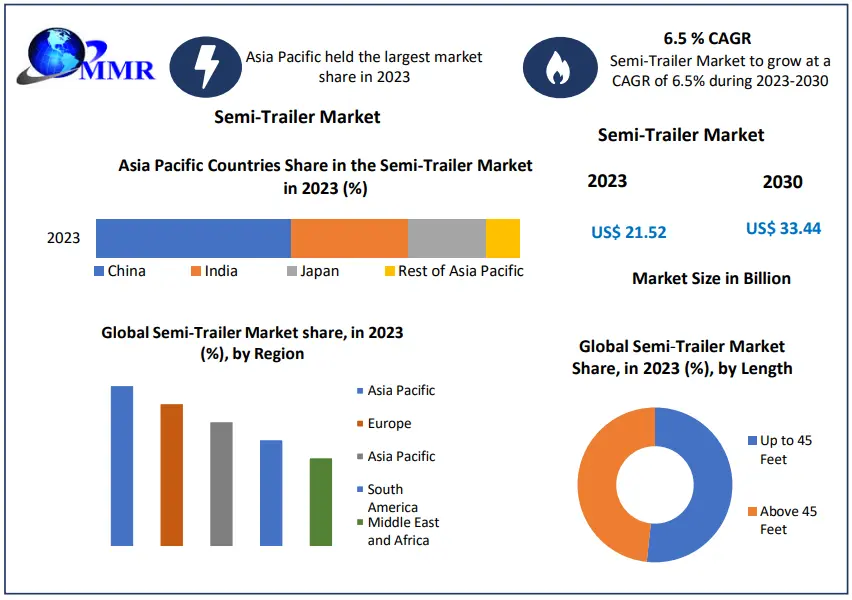
The Semi-Trailer Market size was valued at US 21.52 Bn in 2023 and market revenue is growing at a CAGR of 6.5 % from 2023 to 2030, reaching nearly USD 33.44 Bn by 2030.
Semi-Trailer Market Overview:
The semi-trailer market reflects a dynamic interplay of factors that shape the modern transportation industry. Within this domain, the important role of semi-trailers in facilitating freight logistics and distribution networks globally cannot be overstated. the imperatives of globalization, the surge in e-commerce, and the quest for more efficient transportation solutions boost the growth of the semi-trailer market. The exponential rise of online shopping, has prompted a seismic shift in the demand for freight transportation services. With retailers and logistics firms racing to meet the escalating needs of consumers, there's been a corresponding upswing in investments aimed at fortifying transportation infrastructure, with an intense focus on semi-trailers equipped with innovative features to optimize performance and minimize operational costs.
 To know about the Research Methodology :- Request Free Sample Report
A discernible trend towards sustainability and environmental stewardship has been gaining momentum within the semi-trailer market. Governments worldwide are tightening emissions regulations, compelling manufacturers to explore alternative fuels and lightweight materials to curtail environmental impact. This has spurred innovation in semi-trailer design, with a growing emphasis on eco-friendly models boasting enhanced fuel efficiency and reduced carbon footprints. Te advent of autonomous driving technologies promises to revolutionize the industry, heralding a future where semi-trailers are in the realm of fully autonomous freight transportation.
Semi-Trailer Market: Dynamics
Driver
Growth in Automotive and FMCG Industries Boost the Semi-Trailer Market Growth
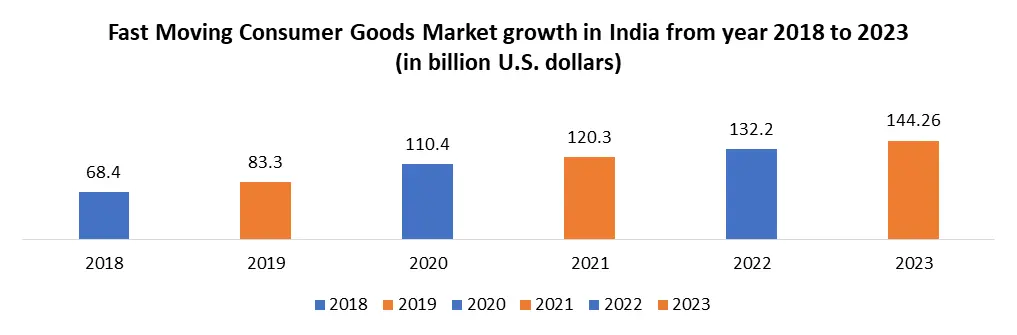
The semi-trailer market is currently undergoing substantial growth, primarily due to the growth of the automotive and fast-moving consumer goods (FMCG) industries. Within the automotive sector, the demand for semi-trailers is on the rise for several reasons. The increase in global trade and e-commerce activities has led to a surge in the transportation of vehicles and automotive parts. This necessitates the use of semi-trailers to ensure efficient logistics management. The advancements in technology have spurred the development of specialized trailers capable of transporting specific automotive components. This has boosted the growth of the Semi-Trailer market. Also, the growing trend of outsourcing logistics services by automotive manufacturers has resulted in increased demand for semi-trailers. Third-party logistics providers are investing in increasing their fleets to provide for this demand.
Similarly, in the FMCG sector, the growing consumer demand for packaged goods and perishable items is driving the need for efficient transportation solutions. This, in turn, is increasing the demand for semi-trailers. FMCG companies heavily rely on the transportation of goods from production facilities to distribution centers and retail outlets. Semi-trailers are used in their supply chain infrastructure. The adoption of advanced refrigeration and temperature-controlled trailers enables the transportation of perishable goods over long distances.
Restrain
Fluctuating Fuel Prices limit the Semi-Trailer Market Growth
The Fluctuating fuel prices present a significant challenge to the growth of the semi-trailer market. These fluctuations directly impact operating costs for fleet operators, as fuel expenses often constitute a substantial portion of their overall expenditure. When fuel prices rise, operators face increased operational expenses, which lead to reduced profitability and financial strain. In response, operators seek to mitigate these costs through strategies such as adjusting freight rates or optimizing routes, but these measures not fully offset the impact of higher fuel prices.
The uncertainty surrounding fuel prices reduce potential investors from entering the market or growing their fleet, as the volatility introduces risk and makes long-term financial planning more challenging. Higher fuel costs ultimately translate to higher prices for end-users, potentially reducing demand for transportation services and affecting Semi-Trailer Market growth. To address this challenge, industry stakeholders explore alternative fuel sources or invest in fuel-efficient technologies to minimize reliance on traditional fossil fuels. Additionally, advocating for stable energy policies and exploring hedging strategies to manage fuel price risk help mitigate the impact of fluctuating fuel prices on the semi-trailer market growth trajectory.
Opportunity
Infrastructure Development Projects create lucrative growth opportunities for the Semi-Trailer Market
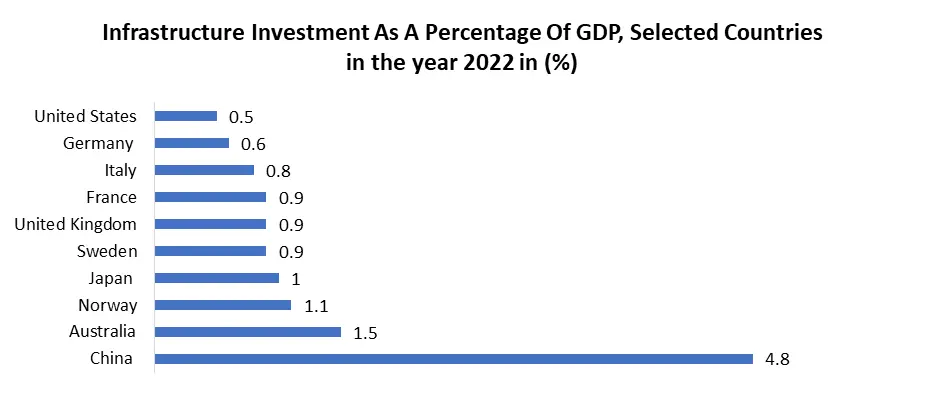
Governments are investing extensively in increasing and modernizing transportation networks, such as highways, railways, ports, and terminals. These investments are expected to significantly boost the demand for transportation services, including semi-trailers this factor significantly boosts the Semi-Trailer Market Growth. Enhanced road infrastructure facilitates more efficient transportation of goods over long distances, reducing transit times and costs. This efficiency spurs demand for semi-trailers, which become essential for the movement of goods. Similarly, the development of new ports and terminals amplifies international trade opportunities, leading to increased demand for semi-trailers to transport cargo from ports to inland destinations.
Infrastructure projects often include the construction of logistics parks and intermodal facilities, providing integrated freight transportation solutions. Semi-trailers are important in last-mile transportation within these hubs, connecting ports, railways, and warehouses. Also, infrastructure development projects in emerging markets create substantial growth potential for the semi-trailer market. Rapid urbanization and industrialization in these regions drive the need for modern transportation infrastructure to support economic growth. As a result, governments are investing heavily in infrastructure to address transportation bottlenecks and enhance trade competitiveness, providing a conducive environment for the growth of the Semi-Trailer Market.
Semi-Trailer Market Segment Analysis
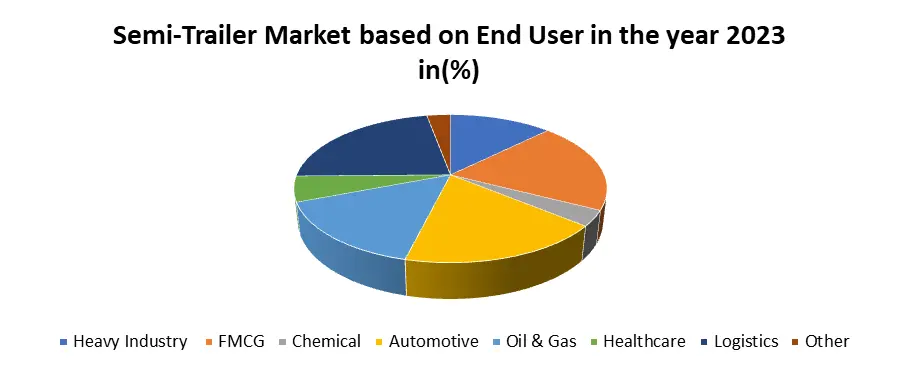
Based on End User, the Logistics sub-segment dominated the End User segment of the Semi-Trailer Market in the year 2023. Logistics companies form the backbone of modern supply chains, responsible for the movement of goods from production facilities to distribution centers and ultimately to end consumers. Semi-trailers are important in this process, offering the flexibility and capacity needed to transport a wide range of products efficiently. Logistics companies prioritize the use of semi-trailers due to their versatility and ability to accommodate various cargo types, from perishable goods to oversized equipment. Additionally, semi-trailers are integral to intermodal transportation systems, seamlessly transitioning between different modes of transport such as road, rail, and sea.
The advancements in semi-trailer technology have enhanced their performance and boosted efficiency, aligning with the logistics industry's goals of reducing costs and environmental impact. Features such as aerodynamic designs, lightweight materials, and telematics systems contribute to improved efficiency and operational effectiveness. In an increasingly competitive market, logistics providers seek to optimize their supply chain operations and differentiate themselves through superior service and reliability. The utilization of high-quality semi-trailers enables them to achieve these objectives, thus solidifying the logistics sub-segment's dominance in the Semi-Trailer Market's end-user segment.
Semi-Trailer Market: Regional Analysis
Asia Pacific region dominated the Semi-Trailer Market in the year 2023. The Asia Pacific region's dominance in the Semi-Trailer Market is attributed by the region's strong economic growth due to industrialization and urbanization, leading to increased demand for transportation and logistics services. As a result, there's a significant need for efficient and reliable semi-trailers to support the movement of goods across vast distances this factor significantly boosts the Semi-Trailer Market growth.
The growing e-commerce sector in countries like China, India, and Southeast Asian nations has further fueled demand for semi-trailers to facilitate the delivery of online purchases. Additionally, government initiatives aimed at infrastructure development and trade facilitation have contributed to the growth of the transportation sector, driving the adoption of semi-trailers. Also, manufacturers in the Asia Pacific region benefit from lower production costs and access to a skilled workforce, allowing them to offer competitive pricing and high-quality products in the global Semi-Trailer Market These factors combined make the Asia Pacific region a dominant force in the Semi-Trailer industry, with continued growth expected as the region's economies further develop and integrate into the global supply chain.
Semi-Trailer Market Scope: Inquire before buying
| Semi-Trailer Market | |||
|---|---|---|---|
| Report Coverage | Details | ||
| Base Year: | 2023 | Forecast Period: | 2024-2030 |
| Historical Data: | 2018 to 2023 | Market Size in 2023: | US $ 21.52 Bn. |
| Forecast Period 2024 to 2030 CAGR: | 6.5 % | Market Size in 2030: | US $ 33.44 Bn. |
| Segments Covered: | by Type | Flatbed Lowboy Dry Van Refrigerated Tankers Others |
|
| by Length | Up to 45 Feet Above 45 Feet Agriculture Industry and Machinery |
||
| by Tonnage | Below 25 T 25 T-50 T 51 T-100 T Above 100 T |
||
| by Axles | <3 axles 3-4 axles 4 axles |
||
| by End-Use | Heavy Industry FMCG Chemical Automotive Oil & Gas Healthcare Logistics Others |
||
Semi-Trailer Market, by Region
North America (United States, Canada and Mexico)
Europe (UK, France, Germany, Italy, Spain, Sweden, Austria and Rest of Europe)
Asia Pacific (China, South Korea, Japan, India, Australia, Indonesia, Malaysia, Vietnam, Taiwan, Bangladesh, Pakistan and Rest of APAC)
Middle East and Africa (South Africa, GCC, Egypt, Nigeria and Rest of ME&A)
South America (Brazil, Argentina Rest of South America)
Semi-Trailer Market Key Players
North America
1. Wabash National Corporation (USA)
2. Utility Trailer Manufacturing Company (USA)
3. Great Dane Trailers (USA)
4. Hyundai Translead (USA)
5. Fontaine Trailer Company (USA)
6. Trail King Industries (USA)
7. Manac Inc(Canada)
8. Heil Trailer International (USA)
9. Vanguard National Trailer Corporation (USA)
10. MAC Trailer Manufacturing (USA)
11. Doepker Industries Ltd. (Canada)
12. Reitnouer Inc. (USA)
13. East Manufacturing Corporation (USA)
14. Stoughton Trailers, LLC (USA)
15. Transcraft Corporation (USA)
Europe
1. Lamberet SAS (France)
2. Krone Commercial Vehicle Group - Werlte, Germany
3. Kögel Trailer GmbH & Co. KG - Burtenbach, Germany
Asia Pacific
1. CIMC ( China International Marine Containers) - Shenzhen, Guangdong, China
Frequently Asked Question:
1] What segments are covered in the Global Semi-Trailer Market report?
Ans. The segments covered in the Semi-Trailer Market report are based on, Type, Length, Tonnage, Axles, and End-Use, and Regions.
2] Which region is expected to hold the highest share of the Global Semi-Trailer Market?
Ans. The Asia Pacific region is expected to hold the highest share of the Semi-Trailer Market.
3] What is the market size of the Global Semi-Trailer Market by 2030?
Ans. The market size of the Semi-Trailer Market by 2030 is expected to reach US$ 33.44 Bn.
4] What was the market size of the Global Semi-Trailer Market in 2023?
Ans. The market size of the Semi-Trailer Market in 2023 was valued at US$ 21.52 Bn.
5] Key players in the Semi-Trailer Market.
Ans. Wabash National Corporation (USA), Utility Trailer Manufacturing Company (USA), Great, Dane Trailers (USA), and Hyundai Translead (USA)