
Seed Treatment Market - Industry Structure Evaluation, Demand Drivers Analysis, Regional Growth Analysis and Identification, Competitive Positioning Review & Global Market Size Forecast to 2032
Overview
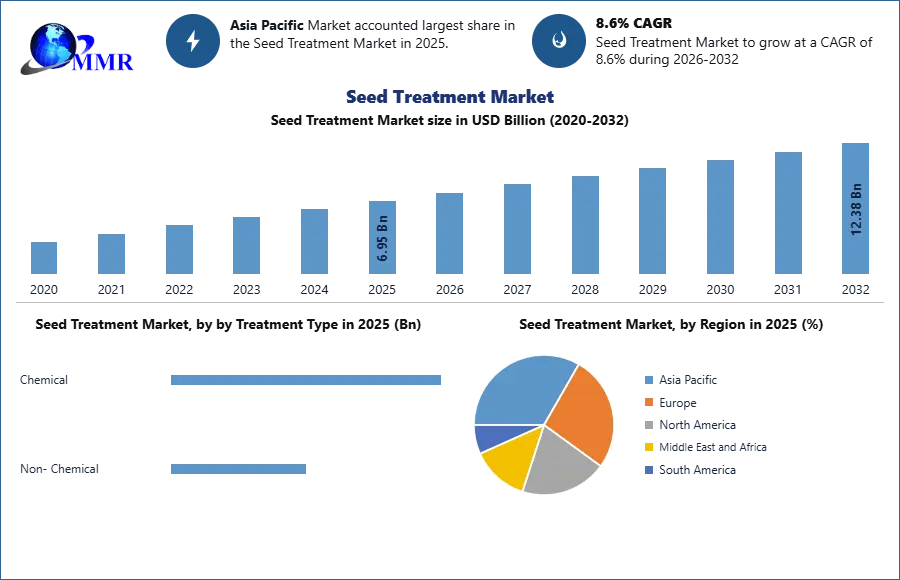
Global Seed Treatment Market size was valued at USD 6.95 Bn. in 2025 and the total Seed Treatment Market revenue expected to grow by 8.6 % from 2026 to 2032, reaching nearly USD 12.38 Bn.
Seed Treatment Market Overview:-
To know about the Research Methodology :- Request Free Sample Report
Seed Treatment Market Dynamics :
Seed Treatment Market Drivers:-.
Increasing demand for high-quality crops boosts the seed treatment market
High-qualitycrop demand increases the market day by day thanks to healthy food is very necessary for health and it comes from agriculture industries ultimately high-quality crops play an important role in good health. Global Demand for high-quality crops grow at 1.2% per year over the coming decade. Agriculture industry depends on the production of high-quality crops that produce more profit, as a result, the agriculture sector will grow. When crops are of low quality it leads to decrease the profit and unable to complete customers need. People are more tend to consume organic food which helps to keep their health well. High-qualitycrops arealso necessary for maintaining soil health and biodiversity.
High-quality crops provide nutrients and vitamins which very essential for maintaining good health and controlling various types of chronic diseases and overall well-being ultimately it help in maintaining food safety. High-quality crops help to support local economies by providing jobs and income for farmers. seed treatment prevents the spreading of diseases and improves germination which leads to increased production of high-quality food. Hence all these factors increase the market and are expected to exhibit the highest growth rate during the forecast period
Seed Treatment Market Restraints:-
Development of Resistance to seed treatment and government regulations are the major restraint to the seed treatment market
Seed treatments are used as an effective remedy against seed-borne and soil-borne diseases, the soil-born diseases get infected the whole plant. According to MMR analysis,most pesticides, and insects are capable of developing resistance to seed treatment which develops restraint to the seed treatment market. Repeated use of chemicals is used as a treatment that occurs resistance to the seed treatment hence it is important to use different varieties of seed treatment.The seed treatment market is regulated by different government bodies like USDA, Health Canada, European Commission, and Pacific Seed Association. The rising involvement of the agriculture industry in a developing country is exhibiting a vasteffect on the market demand in the global market. All companies involved in the seed treatment market should follow all guidelines it is sometimes not beneficial for growth these are restraints on the growth of the market during the forecast period.
Seed Treatment Market Opportunities:-
Advancement in seed treatment technologies is an opportunity for Seed Treatment Market
New advancements in seed treatment technologies are used forthe control of target pests and diseases and ensure the establishment of healthy and vigorous plants. their formulation and industrial application also contribute to improvement in farmer safety. Innovations of seed coating formulations technologies Like Microemulsion gel technology is a type of seed treatment delivery system that uses a gel matrix to cover active ingredients. This technology provides improved seed coverage and adhesion. Also, it is resistant to rain and wind.the introduction of a new fungicide seed treatment is used to protect corn, soybean, canola, oilseed rape, and cereal seedlings from diseases.Seed treatments are chemically intensive processes that can have a negative impact on consumers and the environment. The risks of climate change have increased consumer awareness about the factors causing these changes. Consumers are now more conscious of the negative impact of chemicals in farming on their health and the environment. They are demanding sustainable and environmentally friendly farming practices. The seed treatment industry is responding to these demands by developing biodegradable, sustainable, and nature-friendly seed treatments. Technological advancements are facilitating these product innovations. Therefore, technological advancements and product innovations in the seed treatment market will offer lucrative opportunities for market players and the industry.
Seed Treatment Market Segment Analysis:-
Based on Treatment Type, The seed treatment market is divided into chemical and non-chemical segments. The non-chemical segment is expected to grow at the fastest CAGR in 2026-2032. Non-chemical treatments are popular due to being biodegradable, sustainable, and environmentally friendly, There is a growing prominence on sustainable development methods to control the temperature rise and reduce the impact of climate change, which consumes encouraged institutions globally to focus on non-chemical treatments. The increasing demand for organic food products is also driving the segment's growth. Government institutions promoting non-chemical seed treatments are also helping in the segment's growth. Non-Chemical Treatment is expected to exhibit the highest growth rate during the forecast period. In year 2022 ,Chemical segment was dominated and in year also dominated 2025.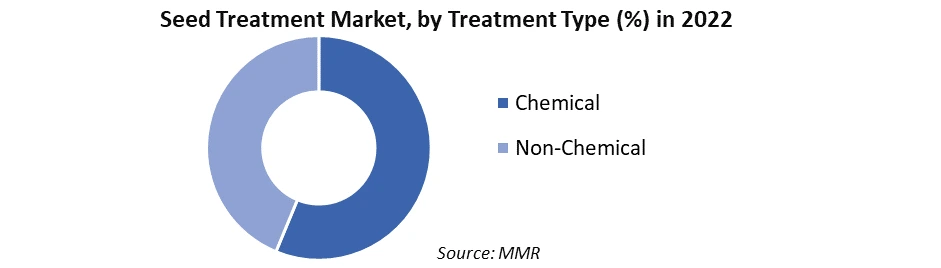
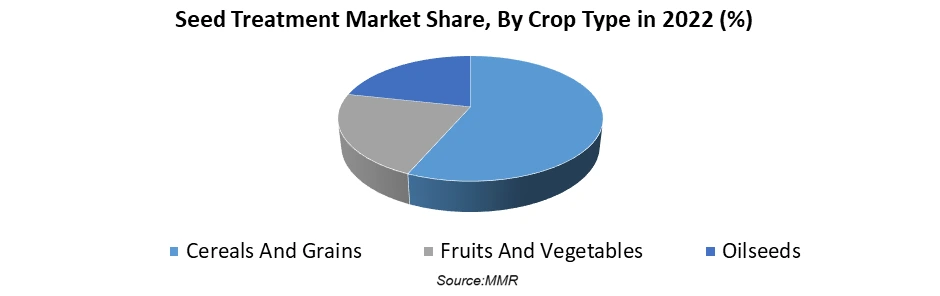
Based on the Crop Type, the Cereals and grains segment dominated the market in the year 2025 and also dominated in 2025 and is expected to reach the highest revenue share during the forecast period 2026-2032.Based on the crop type, crops are classified into Oilseeds, Cereals and grains, fruits and vegetables. The cereals and grains segment is projected to hold the largest share of the seed treatment market in 2025. This is due to the increasing demand for higher cereal and grain production, the need to minimize crop loss from pests, and their growing use in animal feed, biofuel, and starch and ethanol production. As a result market for the cereals and grains segment is expected to grow in the forecast period.
Seed Treatment Market Region:
The Asia-Pacific region dominated the global seed treatment market in 2025, accounting for more than 32% of total market revenue. The region continues to maintain a strong position due to its large agricultural base, expanding population, and increasing demand for high-quality food production. Countries such as China, India, and Japan are witnessing rising adoption of advanced seed treatment technologies to improve crop productivity and protect seeds from pests and soil-borne diseases. Government initiatives supporting modern farming practices and the growing use of hybrid seeds are also contributing to regional market expansion. As a result, the Asia-Pacific market is expected to maintain steady growth during the forecast period.
Meanwhile, Europe represents another significant market driven by strong agricultural infrastructure and increasing focus on sustainable crop protection solutions. The use of seed treatment products in fruit and vegetable cultivation is rising across countries such as Germany, France, United Kingdom, and Italy. Ongoing agricultural modernization programs and investments in high-value crop production continue to support market growth across the region.
Seed Treatment Market Recent Developments:
-
Bayer (2025): Launched Yoalo, a Bacillus velezensis-based biostimulant seed treatment for corn, improving early-stage crop performance and reinforcing Bayer’s expansion in sustainable and biological agrochemical solutions.
-
UPL (2025): Introduced ArtoForce, a biopesticide seed treatment for cotton that enhances crop resilience and reduces pest-related vulnerability, strengthening UPL’s biological crop protection portfolio.
-
FMC Corporation (2024): Partnered with Novonesis to expand its biological crop protection platform and scale distribution of biosolutions in key markets such as Canada, accelerating penetration in sustainable agriculture inputs.
-
Corteva Agriscience (2023): Acquired Symborg and Stoller to enhance its biologicals portfolio, enabling integrated, farmer-centric productivity solutions and strengthening its position in the global agri-biologicals market.
-
UPL (2021): Entered a strategic collaboration with Chr. Hansen to develop microbial-based biosolutions aimed at improving pest and disease resistance, while enhancing crop quality and yield outcomes.
Seed Treatment Market Scope: Inquire before buying
| Seed Treatment Market | |||
|---|---|---|---|
| Report Coverage | Details | ||
| Base Year: | 2025 | Forecast Period: | 2026-2032 |
| Historical Data: | 2020 to 2025 | Market Size in 2025: | 6.95 USD Billion |
| Forecast Period 2026-2032 CAGR: | 8.6% | Market Size in 2032: | 12.38 USD Billion |
| Segments Covered: | by Treatment Type | Chemical Non- Chemical |
|
| by Crop Type | Oilseeds Cereals and grains Fruits and vegetables Others |
||
| by Function | Seed protection Seed enhancement Plant growth regulator Seed Priming Seed Disinfection |
||
| by Application Technique | Seed Coating Seed Dressing Seed pelleting |
||
Seed Treatment Market, by Region
North America (United States, Canada and Mexico)
Europe (UK, France, Germany, Italy, Spain, Sweden, Austria and Rest of Europe)
Asia Pacific (China, South Korea, Japan, India, Australia, Indonesia, Malaysia, Vietnam, Taiwan, Bangladesh, Pakistan and Rest of APAC)
Middle East and Africa (South Africa, GCC, Egypt, Nigeria and Rest of ME&A)
South America (Brazil, Argentina Rest of South America)
Seed Treatment Market Key Players:-
- Syngenta AG
- BASF SE
- Bayer AG
- Corteva Agriscience
- UPL Limited
- FMC Corporation
- Nufarm Limited
- Sumitomo Chemical Co., Ltd.
- Croda International Plc
- ADAMA Agricultural Solutions Ltd.
- Germains Seed Technology
- Novozymes A/S
- Valent BioSciences LLC
- Verdesian Life Sciences
- Precision Laboratories LLC
- Advanced Biological Marketing Inc.
- Brettyoung Limited
- Tagros Chemicals India Ltd.
- Locus Agricultural Solutions
- Plant Health Care Plc
- Bioworks Inc.
- Koppert Biological Systems
- BrettYoung Seeds Ltd.
- Bayer CropScience
- Arysta LifeScience
- Chemtura Corporation
- Monsanto Company
- DuPont de Nemours Inc.
- Clariant AG
- Incotec Group BV