
Second hand Product Market by Product, End Users, Distribution Channel and Region - Global Market Size Estimation, Industry-Wide Analysis, Competitive Landscape Assessment & Long-Term Forecast to 2032
Overview
The Second-hand Product Market size was valued at USD 594.45 Billion in 2025 and the total Second-hand Product revenue is expected to grow at a CAGR of 13.6% from 2025 to 2032, reaching nearly USD 1451.34 Billion by 2032.
Second Hand Product Market Overview:
The growing demand for sustainable consumption practises across numerous businesses is one of the key drivers fueling this expansion. In order to reduce waste and increase product longevity, people are increasingly choosing to acquire and use used goods as they become more environmentally conscious.
The demand for used items has also been influenced by economic variables including income inequality and rising new product costs. In order to get high-quality goods at lesser prices, many buyers look for affordable alternatives to pricy new products. the increasing trend of upcycling, repurposing and vintage fashion has boosted the popularity of second-hand products. Consumers are embracing the uniqueness and character of vintage or retro items as well as the creativity and sustainability associated with repurposing or upcycling pre-owned goods.
The report has given historical market size at actuals from 2020 to 2025. The estimated year is 2025 and market is forecasted through 2032.
 To know about the Research Methodology :- Request Free Sample Report
Second Hand Product Market Research Methodology:
The research methodology employed to study the second hand product market involves a comprehensive approach that incorporates primary and secondary data sources. The research process includes a thorough examination of various factors that may impact the market which have been validated through primary research to derive valuable conclusions. Factors such as economic indicators regulatory and policy changes technological advancements and market trends are considered in the market forecasts for top level markets and subsegments.
To estimate the market size and forecasts for the second hand product market a bottom-up approach has been utilized along with multiple data triangulation methodologies. The segmentation of the market is determined by assigning weights to each segment based on factors such as market demand, product categories and geographic regions resulting in percentage splits market shares and breakdowns. Country wise analysis of the market and its subsegments is based on the adoption or utilization percentage of the market size in the respective regions or countries.
To identify the major players in the second hand product market secondary research has been conducted. This involves gathering information from various sources such as market revenue, price, product applications, advancements, mergers and acquisitions and industry collaborations. Extensive primary research has been conducted to verify and confirm the crucial numbers obtained through comprehensive market engineering, calculations for market statistics, size estimations, forecasts and data triangulation.
The analysis provided in the report also takes into account external and internal factors that may affect the business positively or negatively with a specific focus on the impact of recent technological advancements and market trends. This provides decision makers with a clear understanding of the industry's future prospects. The report also includes a competitive analysis of key players, considering factors such as price, financial position, growth strategies and regional presence, making it a valuable resource for investors.
In the secondary research phase, existing publications across the web are synthesized to gather insights on the current market situation, technological developments and other relevant market-related information. Sources include online marketplaces, industry websites, blogs, magazines, trade information, conference proceedings and association publications. Industry experts across the value chain including consultants and freelancers, are consulted to obtain real-time insights on the market. Primary research methods are employed to validate data points obtained from secondary research and fill any data gaps. The primary research techniques utilized in this report include industry expert reviews, personal interviews, telephonic interviews, surveys and questionnaires conducted via email and fieldwork, as well as social media monitoring. The insights obtained through primary research help ascertain critical market dynamics, market distribution across segments, market entry opportunities for new companies and provide an understanding of the competitive landscape.
By following this comprehensive research methodology, the report on the second hand product market aims to provide accurate and reliable information to industry stakeholders, enabling them to make informed decisions and capitalize on market opportunities.
Second hand product Market Scope:
The report provides a comprehensive analysis of the global second hand product market, encompassing the current market size, future growth prospects, key drivers, restraints and opportunities influencing the market. It offers an in-depth analysis of the competitive landscape, market trends and product innovations within the second hand product market. The scope of the report includes a detailed segmentation analysis of the market based on product type, condition, distribution channel, end-use industry and region.
The second hand product market caters to various industries and consumer segments including electronics, fashion and apparel automobiles, furniture books and others where individuals or businesses sell their used products to other interested buyers. The market for second-hand products has gained significant traction in recent years due to factors such as cost savings sustainability and the growing popularity of online platforms for buying and selling used goods.
The second hand product market encompasses a wide range of product types including electronics and gadgets clothing and accessories, vehicles, home appliances, furniture, books and more. These products are offered in various conditions ranging from like-new or gently used to moderately used or refurbished providing options for different budget preferences and quality requirements. The report provides market size and forecast data for each product type, condition, distribution channel and end-use industry segment along with a market share analysis of key players in each segment. It also includes regional analysis covering market trends, challenges and opportunities that are likely to shape market growth in the forecast years.
The growth of the second hand product market is driven by factors such as increasing consumer awareness about sustainability and the circular economy rising demand for cost-effective alternatives and the availability of online platforms for buying and selling used goods. Second-hand products offer advantages such as reduced prices unique or vintage items, and environmental benefits thereby attracting a growing number of consumers. challenges related to product quality assurance trust issues between buyers and sellers and competition from low-cost alternatives may impact market growth.
The report provides a comprehensive analysis of the global second hand product market including its current and future market size key drivers and restraints, competitive landscape and regional trends. It aims to assist industry stakeholders, including sellers, buyers, online platforms and investors in making informed decisions and formulating strategies to capitalize on the market opportunities in the second-hand product industry.
Second hand Products Market Dynamics:
Second hand Product Market is influenced by various drivers, restraints, opportunities and trends. Understanding these dynamics is crucial for stakeholders in making informed decisions and capitalizing on market growth potential.
Second hand Product Market Drivers:
Cost-effectiveness: The affordability that used goods offer to customers is one of the key variables influencing the market for them. Buyers on a tight budget could find second hand items to be a tempting alternative because they are typically significantly less expensive than their brand-new equivalents.
Environmental concerns and sustainability: Consumer interest in second hand goods has increased as a result of growing environmental and sustainability consciousness. Given that consumers are increasingly looking for strategies to reduce waste and lengthen the lifecycle of items, the second-hand market is an attractive alternative for those who care about the environment.
An increase in the number of online marketplaces and platforms created expressly for buying and selling second-hand goods has led to a major industry expansion. These platforms provide a convenient and accessible way for individuals to connect and trade their used goods.
Second hand Products Market Opportunities:
Niche markets and specialized products: The second-hand products market presents opportunities for niche markets and specialized products. Collectibles, vintage items and unique products often find a significant demand among collectors and enthusiasts, creating lucrative opportunities for sellers and buyers alike. Rental and subscription models: Another emerging opportunity in the second-hand market is the adoption of rental and subscription models. Some businesses are exploring the rental of second-hand products such as clothing, furniture or electronic devices, providing consumers with access to items without the need for long-term ownership.
Second hand Products Market Trends
Thrifting and vintage culture: The rise of thrifting and the popularity of vintage culture have become significant trends in the second-hand market. Many consumers now actively seek out second-hand stores and online platforms to find unique retro-inspired fashion home decor and accessories driving demand and shaping the market's aesthetics. Increased acceptance and normalization: The stigma once associated with purchasing second-hand products has significantly diminished. As sustainability gains traction buying used goods is increasingly seen as a responsible and socially acceptable choice. This cultural shift towards acceptance has fuelled the growth and mainstream appeal of the second-hand market.
Second hand Products Market Restraints
Quality and condition concerns: A key restraint in the second-hand market is the issue of quality and condition. Some consumers may hesitate to purchase used products due to concerns about their functionality durability or hygiene. Addressing these concerns through quality control measures and transparent product descriptions remains a challenge for sellers. Limited availability and inventory challenges: The availability of specific second-hand products can be limited, particularly for rare or highly sought-after items. This scarcity can pose a challenge for buyers who are looking for specific goods. maintaining a consistent and diverse inventory can be challenging for sellers impacting the overall market experience.
Second hand Products Market Segment Analysis:
By Product Type:
Vehicles: This segment includes cars, motorcycles, bicycles and other modes of transportation available in the second-hand market.
Furniture: It encompasses used home furniture, office furniture and other related items.
Clothing: Second-hand clothing covers a wide range of apparel, including casual wear, formal wear, accessories and vintage clothing.
Electronics: This category includes pre-owned electronic devices such as smartphones, laptops, televisions, gaming consoles and other consumer electronics.
Sporting Goods: It consists of second-hand sports equipment, fitness gear, outdoor gear and accessories.
By End User:
Individuals: Second-hand products are commonly bought by individuals seeking cost-effective options or unique items.
Businesses: Some businesses especially small enterprises opt for second-hand items like furniture or electronics to reduce costs.
Institutions: Educational institutions, hospitals, government organizations and other institutions may purchase second-hand products to meet their needs.
Price: Low-cost Segment: This category includes second-hand products that are priced affordably making them accessible to budget-conscious customers.
Mid-range Segment: These are slightly higher-priced second-hand products that offer better quality features or condition compared to the low-cost segment.
High-end Segment: This segment consists of premium second-hand products that are priced significantly higher due to their brand rarity or condition.
By Distribution Channel
The E-Commerce segment in the second-hand product market is growing rapidly, as online platforms provide a convenient shopping experience, wide product selection, and competitive pricing. increased consumer trust in online transactions, secure payment options, and faster delivery options have further bolstered E-commerce sales, outpacing traditional brick-and-mortar stores. Online resale platforms and peer-to-peer marketplaces are driving this growth, especially among younger consumers seeking sustainable, budget-friendly alternatives.
By Geography:
North America: This market segment encompasses the United States, Canada and Mexico where the second-hand products market is influenced by factors such as a strong consumer culture technological advancements and shifting consumer preferences towards sustainable consumption.
Europe: The European market segment includes countries like the United Kingdom, Germany, France, Italy and Spain. In this region the second-hand products market is driven by a combination of economic factors, environmental consciousness and a desire for unique and vintage items.
Asia-Pacific: This segment covers countries such as China, Japan, India, South Korea and Australia. In this region the second-hand products market is influenced by a large population, rising disposable incomes, increasing e-commerce penetration and the growing popularity of sustainable lifestyles.
Latin America: The Latin American market segment includes countries like Brazil, Argentina, Mexico and Chile. In this region the second-hand products market is driven by factors such as price conscious consumers, economic conditions and an increasing awareness of the environmental impact of consumption.
Second hand Product Market Regional analysis:
The report provides a comprehensive analysis of the growth, trends and opportunities in the Second hand Product market across different regions. The market is segmented by region, product type and end-use industry.
North America dominates the Second hand Product market benefiting from a strong consumer base and a high demand for affordable and sustainable products. The region has a well-established culture of thrift and recycling which contributes to the growth of the second-hand market. North America's favourable economic conditions widespread e commerce platforms and increasing awareness of environmental sustainability drive the market expansion. Major players in the region offer a wide range of second-hand products, including electronics, clothing, furniture and automobiles catering to diverse consumer preferences.
Europe holds a significant share in the Second hand Product market driven by the region's focus on sustainability and circular economy principles. European countries have well developed regulations and infrastructure for recycling and reusing products fostering a thriving second-hand market. The region's emphasis on reducing waste and carbon footprint along with stringent environmental regulations encourages consumers to opt for second-hand goods. The market growth is further supported by the presence of established online marketplaces and brick-and-mortar thrift stores that offer a wide variety of pre owned items.
The Asia-Pacific region emerges as a rapidly growing market for Second Hand Products, fuelled by factors such as rapid urbanization population growth and increasing consumer awareness of sustainable consumption. Countries like China, India and Southeast Asian nations are witnessing a rising middle class with changing consumption patterns driving the demand for affordable second-hand products. E-commerce platforms and online marketplaces have gained significant popularity in the region, providing convenient channels for buying and selling used goods. The market potential in Asia-Pacific is further augmented by the expansion of sharing economy models and the growing popularity of rental services.
Latin America and the Middle East and Africa experience moderate growth rates in the Second hand Product market. These regions are gradually recognizing the benefits of second-hand goods, including cost savings reduced environmental impact and access to a wider range of products. The market growth is supported by the increasing presence of online platforms and dedicated thrift stores. In Latin America the informal economy and local marketplaces play a significant role in the second-hand sector. In the Middle East and Africa the market potential is driven by urbanization a young population and the increasing availability of e commerce platforms.
Second hand Product Market Competitive landscape:
The report provides an analysis of the competitive landscape in the second-hand products market highlighting key players and their strategies. Companies such as Thrift World and Second-hand Solutions are prominent players in this market offering a wide range of second-hand products and services.
Thrift World is a leading player in the second-hand products market providing a comprehensive range of used goods for consumers. The company operates thrift stores across various locations, offering clothing, furniture, electronics, books and more. Thrift World focuses on maintaining a vast inventory of high-quality products by carefully curating and sorting the items they receive. They also invest in marketing and advertising to attract customers and promote their unique value proposition of affordable and sustainable shopping. With a commitment to customer satisfaction and a vast network of stores Thrift World establishes itself as a strong competitor in the second-hand products market.
Second-hand Solutions is another major player in the second-hand products market specializing in online platforms for buying and selling used goods. The company operates a user-friendly website and app that connects buyers and sellers enabling them to trade a wide range of pre-owned items. Second-hand Solutions emphasizes safety and security in their transactions by implementing verification processes and secure payment methods. They also provide tools and features to enhance the buying and selling experience such as detailed product descriptions, images and user reviews.
By focusing on convenience trust, and seamless user experience Second-hand Solutions establishes itself as a competitive force in the second-hand products market. Both Thrift World and Second-hand Solutions contribute to the growth of the second-hand products market by providing diverse and sustainable options for consumers. Their strategic approaches including curation and sorting processes, marketing efforts, user-friendly platforms, and emphasis on safety enable them to maintain a competitive edge in the industry. they both contribute to the broader goal of promoting a circular economy and reducing waste by extending the lifecycle of products through resale and reuse.
Second hand Product Market Recent Industry Developments (2025–2026)
| Date | Company | Development | Impact |
|---|---|---|---|
| 20 March 2026 | eBay Inc. | Entered into a definitive agreement to acquire Depop, Inc. from Etsy in an all-cash transaction valued at $1.2 billion. | The acquisition significantly strengthens eBay's reach among Gen Z consumers and expands its footprint in the C2C fashion marketplace. |
| 26 February 2026 | The RealReal, Inc. | Announced that the company surpassed $2 billion in GMV and delivered positive Adjusted EBITDA for every quarter of the previous fiscal year. | This milestone reinforces the profitability of the luxury resale model and positions the company as a definitive authority in authenticated resale. |
| 10 February 2026 | Poshmark, Inc. | Launched Smart Sell automation and increased the minimum buyer offer threshold to 40% of the listing price. | These AI-powered updates streamline negotiations and protect seller margins, aimed at faster inventory turnover. |
| 30 January 2026 | ThredUp Inc. | Partnered with Lands' End to launch a Resale-as-a-Service (RaaS) clean-out program. | The collaboration incentivizes circular fashion by allowing customers to exchange used items for shopping credit. |
| 17 November 2025 | Vinted | Surpassed a GMV milestone of 10 billion euros and achieved an annual revenue growth of 40%. | The company's expansion into electronics and home goods across Europe has solidified its position as a global recommerce ecosystem. |
| 15 September 2025 | eBay Inc. | Acquired Tise, a Nordic-based C2C social marketplace specializing in second-hand fashion. | The deal expands eBay’s presence in the Nordic region and enhances its social commerce capabilities. |
Second hand Product Market Scope: Inquire before buying
| Second-hand Product Market | |||
|---|---|---|---|
| Report Coverage | Details | ||
| Base Year: | 2025 | Forecast Period: | 2026-2032 |
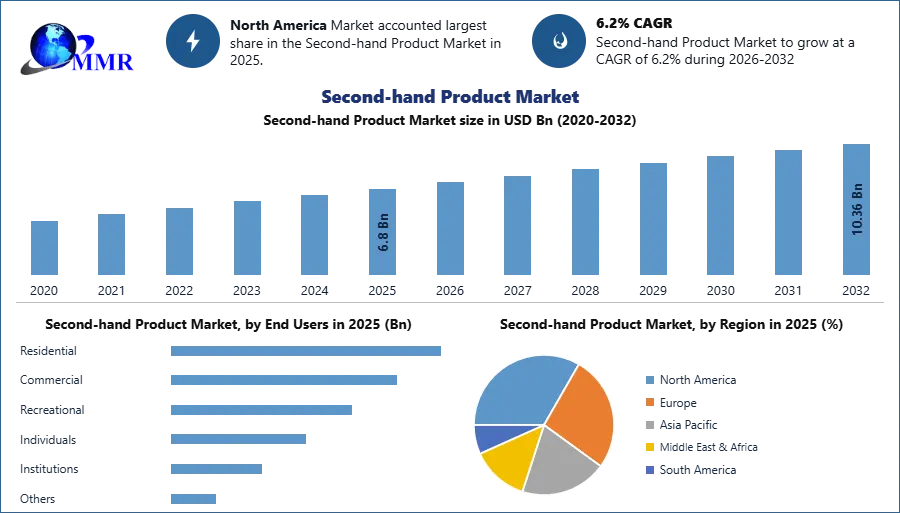
| Historical Data: | 2020 to 2025 | Market Size in 2025: | 6.8 USD Bn |
| Forecast Period 2026-2032 CAGR: | 6.2% | Market Size in 2032: | 10.36 USD Bn |
| Segments Covered: | by Product | Furniture Clothing Electronics Others |
|
| by Brand Type | Branded Products Non-branded Products Luxury Branded Resale |
||
| by Pricing Tier | Budget Segment Mid-range Segment Premium Segment Luxury Resale Segment |
||
| by End Users | Residential Commercial Recreational Individuals Institutions Others |
||
| by Distribution Channel | E-Commerce Brick & Mortar |
||
Second hand Product Market, by Region
North America (United States, Canada and Mexico)
Europe (UK, France, Germany, Italy, Spain, Sweden, Austria and Rest of Europe)
Asia Pacific (China, South Korea, Japan, India, Australia, Indonesia, Malaysia, Vietnam, Taiwan, Bangladesh, Pakistan and Rest of APAC)
Middle East and Africa (South Africa, GCC, Egypt, Nigeria and Rest of ME&A)
South America (Brazil, Argentina Rest of South America)
Second hand Product Market, Key Players:
The report has in detail information about the Second-hand Products Market strategies adopted by the following key players to sustain and grow in the market. These players covered in the report are selected on the basis of certain criteria.
1. Thrift World
2. eBay
3. Amazon Marketplace
4. Craigslist
5. Facebook Marketplace
6. Etsy
7. Poshmark
8. thredUP
9. OfferUp
10. Letgo
11. Mercari
12. Depop
13. Vinted
14. StockX
15. Carousell
16. Rebag
17. Grailed
18. Vestiaire Collective
19. The RealReal
20. Tradesy
21. Chairish
22. Bonanza
23. Gumtree
24. VarageSale
25. Ruby Lane
26. 5miles
Frequently Asked Questions:
1] What segments are covered in the Second hand Product Market report?
Ans. The segments covered in the Second-hand Products Market report are based on product type, price, application, end-user and geography.
2] Which region is expected to hold the highest share in Second hand Product Market?
Ans. The North America region is expected to hold the highest share in Second-hand Products Market.
3] What is the market size of the Second hand Product Market by 2032?
Ans. The market size of the Second-hand Products Market by 2032 is expected to reach USD 1451.34 billion.
4] What is the forecast period for the Second hand Product Market?
Ans. The Forecast period for the Second-hand Products Market is 2026-2032.
5] What was the market size of the Second hand Product Market in 2025?
Ans. The market size of Second-hand Products Market in 2025 was USD 594.45 billion.