
Global Scopolamine Market Size by Dosage Type, Route of Administration, Application, Distribution Channel and Enduser
Overview
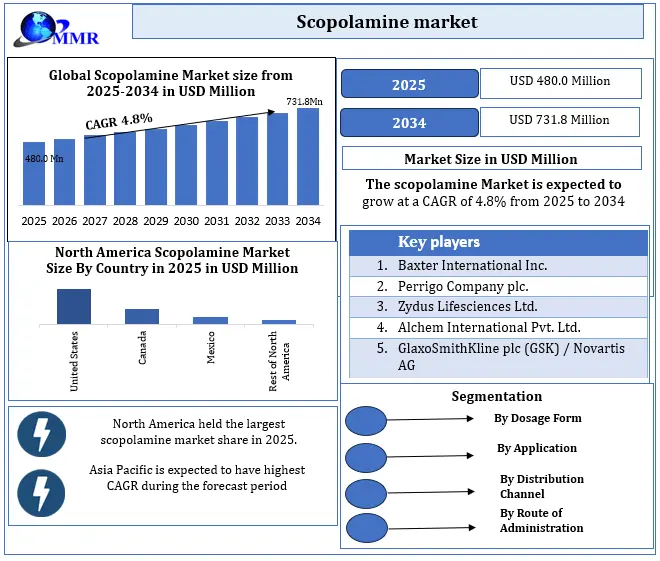
The Global Scopolamine Market size was valued at USD 480.0 million in 2025, and the total revenue is expected to grow at a CAGR of 4.8% from 2025 to 2034, reaching nearly USD 731.8 Million.
Scopolamine Market Overview
Scopolamine, also known as hyoscine, is an anticholinergic drug used primarily to prevent and manage motion sickness and postoperative nausea and vomiting (PONV). It works by blocking specific neurotransmitter signals in the nervous system that trigger nausea and vomiting responses, making it a widely relied-upon option in both perioperative care and everyday travel-related use.
For patients dealing with motion sickness or undergoing surgical procedures, managing nausea has traditionally relied on established formulations such as tablets and injectables administered under clinical supervision. However, the treatment landscape continues to evolve, with transdermal patches emerging as the leading dosage form due to their prolonged drug delivery and ease of use. This shift toward more convenient delivery formats is creating new possibilities for broader patient adoption, both in clinical and outpatient settings.
The Scopolamine Market Report reflects this shift from conventional dosage forms toward more convenient, patient-friendly delivery systems. The report explores the market size, growth outlook, product formulations, distribution channels, and competitive dynamics shaping the scopolamine market. It also examines key drivers, regional demand patterns, and commercial opportunities across hospital and retail pharmacy channels. The scopolamine market presents opportunities for pharmaceutical manufacturers, API suppliers, formulation companies, and healthcare distributors across motion-sickness management and perioperative care. North America remains a major regional market due to established healthcare infrastructure, while Asia Pacific is expected to record faster growth as healthcare expenditure, surgical volumes, and access to pharmaceutical therapies increase.
Key highlight
• Transdermal delivery remains the leading formulation segment, with transdermal patches accounting for 46.44% of the global scopolamine market in 2025. Their ability to provide controlled drug delivery for up to 3 days supports adoption in motion-sickness prevention and perioperative nausea management.
• Pharmaceutical safety and regulatory oversight are reshaping product management, with the FDA adding a 2025 warning for serious heat-related complications associated with scopolamine transdermal systems. The update is encouraging manufacturers and healthcare providers to strengthen prescribing information, patient monitoring, and risk-management practices, particularly for vulnerable population
Global Scopolamine Market Size and Share Analysis
To know about the Research Methodology :- Request Free Sample Report
Scopolamine Market Dynamics:
Rising Travel Activity and Persistent Motion Sickness Burden to Drive Scopolamine Market Growth
The continued need for effective motion-sickness prevention is a major growth driver for the global scopolamine market, particularly across air, sea, road, and recreational travel. Motion sickness can occur across cars, buses, trains, aircraft, boats, simulators, roller coasters, and virtual-reality environments, giving scopolamine a broad addressable patient base. The drug's established role is strengthened by its long-standing approval for motion-sickness prevention and the convenience of the transdermal patch, which delivers 1 mg of scopolamine over 3 days.
Generic Competition and Anticholinergic Safety Concerns to Restrain Scopolamine Market Growth
Rising availability of generic scopolamine products is increasing pricing pressure in mature pharmaceutical markets, while the drug’s anticholinergic safety profile requires careful patient selection and prescribing. FDA labeling updates highlight risks such as acute angle-closure glaucoma, cognitive and neuropsychiatric reactions, blurred vision, urinary and gastrointestinal effects, and drug interactions. The 2025 FDA hyperthermia warning, involving 13 serious cases including hospitalizations and deaths, further increases safety concerns, particularly among children and older adults. These factors can limit broader adoption and increase the monitoring and risk-management burden across the scopolamine industry.
Growing Surgical Volumes and PONV Management Create New Opportunities for Scopolamine Market
Increasing surgical volumes are creating new Scopolamine Market opportunities for scopolamine in postoperative nausea and vomiting (PONV) management, where PONV affects around 30%–50% of surgical patients and up to 80% of high-risk patients. The transdermal patch offers a practical advantage by providing continuous drug delivery for up to three days, supporting both preoperative and postoperative care. As hospitals focus on effective and convenient antiemetic protocols, expanding PONV use can strengthen scopolamine market potential beyond traditional motion-sickness applications. This shift is opening additional growth avenues for manufacturers and healthcare providers.
Genericization and Transdermal Formulation Complexity Create Challenges for the Scopolamine Market
The scopolamine industry faces a key market challenge from genericization alongside the technical complexity of transdermal drug delivery systems. Manufacturers must maintain consistent drug release, adhesion, stability, and product quality, while addressing issues such as leakage, bursting, cold flow, and skin adhesion identified in FDA research. At the same time, the 2025 FDA safety action increases the need for stronger risk communication, patient selection, and post-market monitoring. These requirements can raise manufacturing and compliance costs and create a Scopolamine Market gap for reliable, high-quality transdermal formulations.
Scopolamine Market Current Trends
Advancement in Transdermal Drug Delivery Systems
Transdermal delivery is continuing to dominate scopolamine formulations, with patches providing controlled drug release for up to 72 hours. Manufacturers are focusing on improving patch adhesion, drug permeation, and patient comfort, supporting better compliance in motion-sickness and PONV management.
Growing Adoption of Scopolamine for PONV Management
Scopolamine is gaining greater adoption in postoperative nausea and vomiting (PONV) prevention as hospitals and ambulatory surgical centers are strengthening multimodal antiemetic protocols. Rising surgical volumes and demand for effective prophylactic therapies are supporting this application.
Increasing Development of Injectable and Controlled-Release Formulations
Pharmaceutical companies are continuing to develop formulations that provide faster onset, controlled dosing, and prolonged therapeutic effects. Injectable scopolamine is gaining importance in hospital-based care, while controlled-release approaches are supporting more consistent drug exposure.
Shift Toward Synthetic and Fermentation-Based API Production
Scopolamine manufacturers are increasingly exploring synthetic, semi-synthetic, and fermentation-based production routes to improve API supply reliability. These approaches are helping reduce dependence on plant-derived raw materials and are supporting more scalable pharmaceutical manufacturing.
Intensifying Generic Competition and Pharmaceutical Safety Monitoring
Generic scopolamine products are increasing competitive pressure, encouraging manufacturers to compete on pricing, product availability, formulation quality, and supply efficiency. The regulatory agencies are strengthening safety monitoring, particularly for transdermal products and heat-related adverse events.
Expansion of Online Pharmaceutical Distribution
Online pharmacies are gaining traction as patients increasingly prefer convenient prescription fulfillment and home delivery. The shift is creating additional distribution opportunities for scopolamine products, particularly in markets with established e-pharmacy and digital prescription infrastructure.
Scopolamine Market Segment Analysis
By Application: Motion sickness dominated the global scopolamine market in 2025, supported by persistent demand for preventive treatment among air, road, and marine travelers, while the postoperative nausea and vomiting (PONV) segment is expanding at a faster pace as hospitals and ambulatory surgical centers are strengthening multimodal antiemetic protocols. Gastrointestinal spasms and IBS are maintaining a smaller application base, while ophthalmic indications are being supported by the use of scopolamine for pupil dilation and cycloplegia in selected clinical settings. Palliative care and drooling control are remaining niche applications, creating a market opportunity for specialized formulations and hospital-based use. In the forecast period, the growing surgical patient pool and broader adoption of prophylactic antiemetic therapy are continuing to create Scopolamine Market potential for PONV, while the relative maturity of motion-sickness treatment is creating a market gap for differentiated delivery systems and longer-acting formulations.

Scopolamine Market Segment Analysis by Distribution Channel

A natural outcome given scopolamine's heavy use in surgical and perioperative settings, where physicians need close control over dosing. This keeps the real competition among manufacturers focused on hospital procurement and formulary access rather than retail marketing. Retail pharmacies are driven largely by prescription transdermal patches like Transderm Scop, used for planned travel and chronic motion-sickness management. Online pharmacies are the fastest-growing channel; digital prescriptions and home delivery reshape access, though the same regulatory oversight that keeps hospital pharmacies dominant is also what's slowing online growth. The online pharmacies are more likely to pull share from retail's patch-based prescriptions than from hospital pharmacies, since perioperative use will always require a clinical setting.

Scopolamine Market Regional Insights:
North America dominated the Scopolamine Market in 2025 and is expected to dominate the market growth during the forecast period. The region's leadership is supported primarily by the United States, where scopolamine has an established position in motion-sickness prevention and postoperative nausea and vomiting (PONV) management, supported by a large surgical base, mature hospital infrastructure, established pharmaceutical distribution, and strong physician familiarity with transdermal delivery. According to the FDA, 1.73 million prescriptions for scopolamine patches were dispensed through U.S. outpatient pharmacies in 2023, demonstrating a substantial existing prescription base. The 2025 FDA safety communication on scopolamine-associated hyperthermia is becoming an important consideration for prescribing, particularly among pediatric and older-adult populations. FDA identified 13 worldwide cases, including 7 in the U.S., with 6 cases resulting in hospitalisation or death, which is likely to encourage more cautious patient selection and safety monitoring.
In Asia Pacific, the expansion is being supported by increasing healthcare expenditure, rising surgical volumes, expanding pharmaceutical manufacturing, growing travel activity, and broader adoption of convenient transdermal drug-delivery systems. The region's market opportunity is especially strong in PONV management, where increasing elective and hospital-based surgical procedures can expand scopolamine use beyond its traditional motion-sickness application. At the same time, the market gap remains significant in developing Asian economies, where uneven healthcare access, limited awareness of transdermal scopolamine, regulatory differences, and affordability can restrict penetration. Expansion of hospital pharmacies, retail pharmacy networks, e-pharmacy channels, and local pharmaceutical manufacturing can gradually narrow these gaps.

Scopolamine Market Country Analysis
United States
The United States continues to represent the largest country-level market for scopolamine, anchored by an exceptionally high volume of inpatient and ambulatory surgical procedures that sustain baseline demand for PONV prophylaxis protocols. A 2025 FDA safety communication on scopolamine-associated hyperthermia, however, is prompting more cautious prescribing, particularly in pediatric and geriatric populations.
Germany
Germany leads the European scopolamine market, with growth driven by rising motion-sickness incidence among travelers and expanding pharmaceutical use in managing nausea and vomiting. Ongoing R&D activity focused on improving the efficacy and safety profile of scopolamine formulations is supporting steady adoption, alongside growing physician and patient awareness. At the same time, Germany maintains strict regulatory control over scopolamine given its potential for misuse, which shapes a more controlled, prescription-driven distribution environment compared to other therapeutic categories.
China
China is emerging as one of the fastest-growing country markets in Asia-Pacific, supported by expanding healthcare infrastructure and growing domestic pharmaceutical manufacturing capacity. Rising surgical volumes and increasing antiemetic drug approvals are widening scopolamine's clinical use beyond its traditional motion-sickness application into PONV management. China's scale as both a manufacturing base and a large patient population makes it a key volume driver for the region, even as regulatory and distribution infrastructure continues to mature.
Scopolamine Market Competitive Landscape
The scopolamine market is moderately concentrated, shaped by an ongoing shift from branded to generic dominance. GlaxoSmithKline's Transderm Scōp once led the transdermal patch segment, but that hold has loosened fast — Zydus, Amneal, Perrigo, and Rhodes Pharmaceuticals rolled out six AB-rated generics between late 2024 and mid-2025, together taking around 58% of U.S. patch dispenses. Zydus's Ahmedabad SEZ plant is a good marker of how far India has come in complex transdermal manufacturing, while Perrigo's Aveva platform has helped keep supply steady whenever branded stock runs short. On the injectable side, players like Baxter, Fresenius Kabi, Novartis, Pfizer, and Hikma compete in a market driven less by brand loyalty and more by GPO tender pricing.
Further upstream, the raw material story is just as telling. Natural plant-extracted scopolamine still dominates supply, led by players like Alchem International and Alkaloids Corporation in India and Guangzhou Hanfang in China, but synthetic biology is quietly gaining ground — Hyasynth Bio's fermentation-based approach could become the preferred route once its production costs undercut traditional extraction, offering a hedge against crop-related supply disruptions. The next real disruption may come from delivery innovation rather than manufacturing: intranasal and microneedle formats are still early-stage, but NASA's INSCOP program could prove decisive in pushing these formats toward wider clinical and commercial use.
Recent Developments
FDA Issues Hyperthermia Warning for Transderm Scop (June 2025)
The FDA added a new safety warning to Transderm Scop's label after identifying 13 worldwide cases of hyperthermia linked to the scopolamine patch, including cases in children under 17 and adults over 60. The update instructs patients to remove the patch immediately if they notice signs of overheating or reduced sweating, since absorption continues even after removal.
Zydus Lifesciences Receives USFDA Approval for Scopolamine Transdermal Patch
Zydus Lifesciences secured final USFDA approval to market its scopolamine transdermal system (1 mg/3 days dosage), manufactured at its transdermal facility in Ahmedabad, Gujarat. This marked the company's fifth ANDA approval in its transdermal portfolio and reinforced India's growing role in complex drug-device manufacturing.
Wave of Generic Launches Reshapes the U.S. Patch Market (2024–2025)
Six AB-rated generic scopolamine patches entered the U.S. market between late 2024 and mid-2025 from manufacturers including Zydus, Amneal, Perrigo, and Rhodes Pharmaceuticals, collectively capturing about 58% of U.S. patch dispenses and pushing down average wholesale acquisition cost by nearly 35%.
Emerging Delivery Innovation: Intranasal and Microneedle Formats
Beyond patches, companies are exploring intranasal sprays and microneedle-based delivery systems to improve absorption and reduce skin irritation. NASA's INSCOP program is seen as a key reference point for broader adoption of these newer formats, pointing toward the next generation of motion-sickness treatment options.
Scopolamine Market Scope: Inquire before buying
| Scopolamine Market | |||
|---|---|---|---|
| Report Coverage | Details | ||
| Base Year: | 2025 | Forecast Period: | 2026-2034 |
| Historical Data: | 2020 to 2025 | Market Size in 2025: | USD 480 Mn. |
| Forecast Period 2026 to 2034 CAGR: | 4.8% | Market Size in 2034: | USD 731.8 Mn. |
| Segments Covered: | by Dosage Form | Tablets Syrups / Liquids Transdermal Patches Injections Others |
|
| by Route of Administration | Oral Transdermal Parenteral Others |
||
| by Application | Motion Sickness Postoperative Nausea and Vomiting (PONV) Gastrointestinal Spasms and Irritable Bowel Syndrome (IBS) Ophthalmic Indications Palliative Care and Drooling Control Others |
||
| by Distribution Channel | Hospital Pharmacies Retail Pharmacies Online Pharmacies Others |
||
| by End User | Ambulatory Clinics Homecare Settings Others |
||
Scopolamine Market by region:
North America (United States, Canada, Mexico)
Europe (United Kingdom, France, Germany, Italy, Spain, Sweden, Russia, Rest of Europe)
Asia Pacific (China, South Korea, India, Japan, Australia, Indonesia, Philippines, Malaysia, Vietnam, Thailand, Rest of Asia Pacific)
Middle East and Africa (Saudi Arabia, United Arab Emirates (UAE), Qatar, Kuwait, Oman, Bahrain, Rest of ME&A)
South America (Brazil, Argentina, Chile,Colombia, Rest of South America)
Scopolamine Key Players
North America
1. Pfizer Inc.
2. Baxter International Inc.
3. Baxter Healthcare Corp
4. Amneal Pharmaceuticals
5. Rhodes Pharmaceuticals
6. Mylan (Viatris)
7. Actavis Laboratories UT Inc.
8. Padagis US
9. Riconpharma LLC
10. Par Pharmaceutical
11. Hyasynth Bio
Europe
12. GlaxoSmithKline plc
13. Novartis AG
14. Perrigo Company plc
15. Fresenius Kabi
16. Hikma Pharmaceuticals
17. Opella Healthcare Group SAS
18. Boehringer Ingelheim
19. Sandoz
20. Teva Pharmaceutical Industries
21. Centroflora-CMS
22. Chemelco International B.V.
Asia-Pacific
23. Zydus Lifesciences
24. Aurobindo Pharma
25. Cipla Ltd.
26. Sun Pharmaceutical Industries
27. Dr. Reddy's Laboratories
28. Lupin Limited
29. Torrent Pharmaceuticals
30. Alchem International
31. Alkaloids Corporation
32. Sarv Biolabs
33. Guangzhou Hanfang Pharmaceutical
34. Myungmoon Pharma Co. Ltd.
35. Caleb Pharmaceuticals, Inc.
36. Alkaloids of Australia
37. Phytex Australia
Middle East & Africa
38. Fine Chemicals Corporation
39. Global Alkaloids
South America
40. Laboratorio RAAM de Sahuayo
41. Centroflora Group