Scaffolding Market Size by Type, Material, End User Industry and Region - Segment-Level Market Assessment, Growth Opportunity Analysis, Competitive Mapping & Forecast to 2032

6.18%
CAGR (2026-2032)
66.31 USD Bn.
Market Size
306
Report Pages
149
Market Tables

Overview

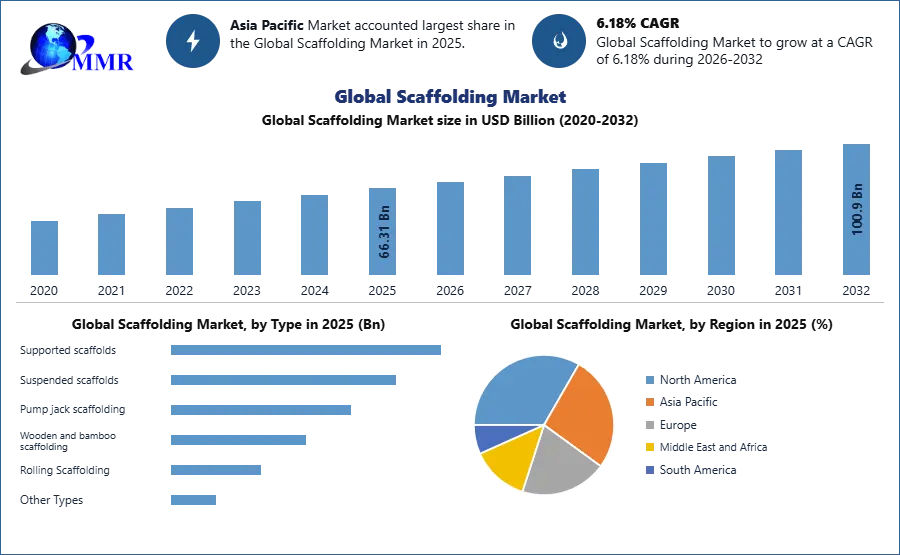
The Scaffolding Market size was valued at USD 66.31 Billion in 2025 and the total Scaffolding revenue is expected to grow at a CAGR of 6.18% from 2026 to 2032, reaching nearly USD 100.90 Billion.

COVID-19 impact on market:

COVID-19 has the potential to have three major effects on the global economy: directly impacting production and demand, causing supply chain and market disruption, and having a financial impact on businesses and financial markets. Our analysts, who are monitoring the situation throughout the world, believe that the market would provide producers with lucrative opportunities following the COVID-19 dilemma.Global Scaffolding MarketTo know about the Research Methodology:-Request Free Sample Report

Global Scaffolding Market Dynamics:

Scaffolding is a transitory structure either outside or inside the building used by workers while building, cleaning, or repairing the building construction. Scaffoldings are generally made of wooden planks and metal poles such as steel or aluminum. These are broadly used on construction site to advance access to heights or areas which would be hard to reach. Scaffoldings are mostly used to install staging systems, support structures, grid systems, mobile stages, seating, and barricades.

The rising construction sector, infrastructural investments, government initiatives, continued privatization are some of driving factor for the growth of global scaffolding market. Supportive government principles and policies regarding labor safety are one of the key drivers of the global scaffolding market. Maintenance which involves cleaning, painting jobs repairs, electrical installations, and other activities will boost the demand for supported or suspended scaffoldings during the forecast period.

Scaffolding is the safety assistance it brings to any construction project. Its Structures offer a stable platform for workers, safeguarding protection even at great heights. Many construction projects are based on the external structure of a building, which can be complex to access without scaffold structure. Temporary stages are mostly built with the help of scaffolding for various indoor and outdoor events, which expected to dominate the construction industry end-user segment.

Global Scaffolding Market Segment Analysis:

The supported scaffolding segment is estimated to hold xx % significant growth in the global scaffolding market. It offers the feature such as easy installation, safety, and cost-effectiveness, which turns to increase the demand for it. This type of scaffolding is mostly used across all construction requirements. Furthermore, rolling scaffolding is favored commonly for projects which have a short-term duration that essentials to be carried out at many locations over a longer distance. It is mainly used in electrical and mechanical trades.

Aluminum is light in weight than steel. Scaffoldings require them to be manually lifted & put in place where it requires. Aluminum is ideal over steel as the scaffolding can be built faster, in this manner reducing the labor cost. In some emerging countries, labor cost is extremely affordable consequently, a convention of bamboo and wooden poles is common. Bamboo scaffoldings are generally used in the Asia Pacific where it is preferred for flexibility, strength, and eco-friendliness.

External scaffolding is expected to dominate global scaffolding market during the forecast timeline. External scaffoldings are used about 50% of the overall construction of a building or ship whereas internal scaffolding is primarily used for maintenance requirements.

Regional Insights:

The Asia Pacific is expected to lead global scaffolding market owing to growing industrialization and rapid urbanization. Enhancement in residential infrastructure along with new construction activities such as high-speed rail project in Japan and Trans-Sumatra Toll Road in Indonesia is supporting the demand for scaffolding. Growing FDI in construction and supportive government regulations concerning labor safety are expected to lead the scaffolding market globally. New residential properties that are being developed in developing economies such as China and India are boosting the growth in the global scaffolding market.

Key profiled and analysed in the Global Scaffolding Market ULMA Construction, MJ-Gerüst GmbH, Waco Kwikform Limited, Stepup Scaffold, LLC, ADTO Industrial Group Co., Ltd., Changli XMWY Formwork Scaffolding Co., Ltd. Beijing Kangde, Cangzhou Weisitai Scaffolding Co.Ltd., Wilhelm Layher Holding GmbH & Co. KG, Safway Group Holding LLC, PERI GmbH, Altrad Group Instant Upright, Tianjin Wellmade Scaffold Co. ., Youying Group Rapid Scaffolding Engineering Co. , Tianjin Gowe Industrial Co. ., Entrepose Echafaudages Itsen Construction Equipment (Guangzhou) Co. ., Rizhao Fenghua Scaffolding Co. . and KHK Scaffolding & Formwork LLC.

The objective of the report is to present comprehensive analysis of Global Scaffolding Market including all the stakeholders of the industry. The past and current status of the industry with forecasted market size and trends are presented in the report with the analysis of complicated data in simple language. The report covers all the aspects of industry with dedicated study of key players that includes market leaders, followers and new entrants by region. PORTER, SVOR, PESTEL analysis with the potential impact of micro-economic factors by region on the market have been presented in the report. External as well as internal factors that are supposed to affect the business positively or negatively have been analyzed, which will give clear futuristic view of the industry to the decision makers.

The report also helps in understanding Global Scaffolding Market dynamics, structure by analyzing the market segments, and project the Global Scaffolding Market size. Clear representation of competitive analysis of key players by Global Scaffolding Market Type, price, financial position, product portfolio, growth strategies, and regional presence in the Global Scaffolding Market make the report investor’s guide.

Recent Industry Developments

Exact Date Company Development Impact
15 January 2026 BrandSafway Launched the Spider SC1000 Voyager battery-powered traction hoist, eliminating the need for on-site power cords. Enhances operational flexibility and safety by reducing trip hazards and power constraints on high-rise sites.
26 January 2026 Doka Officially joined the United Nations Global Compact to align scaffolding operations with international sustainability principles. Strengthens ESG positioning and attracts eco-conscious infrastructure contracts globally.
01 July 2025 BrandSafway Expanded its national footprint by opening new rental counters and facilities across the United States. Increases local availability of specialized access equipment for commercial and industrial markets.
07 April 2025 PERI SE Debuted the Genio robotic system at bauma 2025, designed to autonomously handle and position scaffolding components. Addresses labor shortages and improves worker safety by automating physically demanding assembly tasks.
04 February 2025 Renny Strips Pvt. Ltd. Commissioned a 22MW solar power plant to provide renewable energy for its green steel scaffolding production. Reduces the carbon footprint of scaffolding manufacturing by up to 50% to meet green building standards.
27 February 2025 Alimak Launched the STS 300 Scaffold Transportation System in India to optimize vertical material movement. Improves logistical efficiency and assembly speed for large-scale urban infrastructure projects.

Global Scaffolding Market Scope: Inquire before buying

Scaffolding Market
Report Coverage Details
Base Year: 2025 Forecast Period: 2026-2032
Historical Data: 2020 to 2025 Market Size in 2025: 66.31 USD Bn
Forecast Period 2026-2032 CAGR: 6.18% Market Size in 2032: 100.9 USD Bn
Segments Covered: By Product Type Supported Scaffolding
    Frame/Fabricated
    Pole/Wood Pole
    Mobile
    Specialty
    Others (Mast Climber, Pump Jack, etc.)
Suspended Scaffolding
Rolling Scaffolding
Cantilever Scaffolding
Others (Trestle Scaffolding, etc.)
By Material Type Wood
Steel
Aluminum
Bamboo
By Location External
Internal
By Design Type Modular / System Designs
Custom-Built Designs
By Load Capacity Light Duty (<25 lbs/ft²)
Medium Duty (25–50 lbs/ft²)
Heavy Duty (>50 lbs/ft²)
By Distribution Channel Offline
Online
By End-use Industry Construction
Ship Building
Oil & Gas
Electrical Maintenance
Others (Temporary Stage, etc.)

Global Scaffolding Market, by Region

Asia Pacific (China, South Korea, Japan, India, Australia, Indonesia, Malaysia, Vietnam, Taiwan, Bangladesh, Pakistan and Rest of APAC)
Europe (UK, France, Germany, Italy, Spain, Sweden, Austria and Rest of Europe)
North America (United States, Canada and Mexico)
Middle East and Africa (South Africa, GCC, Egypt, Nigeria and Rest of ME&A)
South America (Brazil, Argentina Rest of South America)

Key Players / Competitors Profiles Covered in Brief in Global Scaffolding Market Report in Strategic Perspective:

  1. Wilhelm Layher Holding GmbH & Co. KG Layher
  2. PERI GmbH
  3. ULMA Construction
  4. Doka Group
  5. Waco Kwikform Limited
  6. Acrow Group Limited
  7. Alsina Formwork & Scaffolding
  8. Pilosio S.p.A.
  9. MJ-Gerüst GmbH
  10. MJ-Gerüstsysteme GmbH
  11. ADTO Industrial Group Co. Ltd.
  12. Changli XMWY Formwork & Scaffolding Co. Ltd.
  13. Tianjin Wellmade Scaffold Co. Ltd.
  14. Cangzhou Weisitai Scaffolding Co. Ltd.
  15. Tianjin Gowe Industrial Co. Ltd.
  16. Guangdong Youying Group
  17. Rapid Scaffolding Engineering Co. Ltd.
  18. Rizhao Fenghua Scaffolding Co. Ltd.
  19. Wm-Scaffold
  20. KHK Scaffolding & Formwork LLC
  21. Unispan
  22. Stepup Scaffold LLC
  23. Entrepose Échafaudages Manufacturing Operations
  24. Beijing Kangde Scaffolding Co. Ltd.
  25. Wilhelm Schäfer GmbH System Scaffolding Manufacturer
  26. Others

Table of Contents

1. Scaffolding Market : Market Introduction 1.1. Executive Summary 1.2. Market Size (2025) & Forecast (2026-2032) 1.3. Market Size (USD Million and Square Feet ) and Market Share (%) - By Segments, Regions and Country 2. Competitive Landscape 2.1. MMR Competition Matrix 2.2. Competitive Analysis of key players 2.3. Key Players Benchmarking 2.3.1 Company Name 2.3.2 Headquarter 2.3.3 Business Portfolio 2.3.4 Manufacturing Capacity 2.3.5 R&D Investment 2.3.6 Revenue (2025) by Region 2.3.7 Revenue Growth Rate (Y-O-Y) 2.3.8 Profit Margin (%) 2.3.9 Market Share (%) by Region 2.3.10 Geographical Presence 2.4. Market Structure 2.4.1 Market Leaders 2.4.2 Market Followers 2.4.3 Emerging Players 2.5. Strategic Initiatives & Expansion Plans 2.5.1 Mergers, acquisitions, and joint ventures 2.5.2 Regional and global expansion strategies 2.5.3 Partnerships with contractors, distributors, and rental companies 2.5.4 Capacity expansion, fabrication facility investments 2.5.5 Project-based contract wins and infrastructure participation 3. Scaffolding Market Dynamics 3.1. Scaffolding Market Trends 3.2. Scaffolding Market Dynamics 3.2.1 Drivers 3.2.2 Restraints 3.2.3 Opportunities 3.2.4 Challenges 3.3. PORTER’s Five Forces Analysis 3.4. PESTLE Analysis 4. Pricing, Cost Structure & Rental Economics Analysis 4.1 Average Selling Price (ASP) trends by scaffold type and material 4.2 Rental vs purchase economics across construction 4.3 Cost structure breakdown (raw materials, fabrication, logistics, labor) 4.4 Impact of steel and aluminum price volatility on margins 4.5 Regional price differentials and contract-based pricing models 4.6 Payback period and utilization-rate sensitivity analysis 5. Supply Chain, Procurement & Trade Dynamics 5.1 Upstream raw material sourcing and supplier concentration 5.2 Manufacturing footprint and import vs local production trends 5.3 Logistics intensity and transportation cost implications 5.4 Lead time variability and supply bottlenecks 5.5 Role of distributors, rental companies, and system integrators 5.6 Import/export flows, tariffs, and geopolitical risks 6. Safety Standards, Compliance & Regulatory Impact 6.1 Global and regional scaffolding safety standards (OSHA, EN, ISO) 6.2 Compliance costs for manufacturers and contractors 6.3 Inspection, certification, and load-rating requirements 6.4 Impact of stricter safety enforcement on demand quality 6.5 Regional regulatory differences between developed and emerging markets 6.6 Liability, insurance, and contractor accountability trends 7. Demand Drivers & Project-Based Consumption Analysis 7.1 Correlation between construction activity cycles and scaffold demand 7.2 Infrastructure pipeline analysis and project execution timelines 7.3 Industrial shutdowns, maintenance turnarounds, and outage-driven demand 7.4 Urbanization, high-rise construction, and refurbishment trends 7.5 Public vs private sector project contribution 7.6 Short-term vs long-term demand visibility assessment 8. Urbanization, High-Rise & Retrofit Impact Analysis 8.1 High-rise construction density and scaffold height requirements 8.2 Retrofitting and renovation activity in aging infrastructure 8.3 Urban space constraints influencing scaffold design 8.4 Demand differences between greenfield and brownfield projects 8.5 Regulatory pressure in dense urban environments 8.6 Long-term retrofit-driven demand outlook 9. Technology Evolution & Product Innovation Trends 9.1 Shift from tube-and-coupler to modular systems 9.2 Lightweight and high-load aluminum system adoption 9.3 Mechanized and automated climbing scaffold solutions 9.4 Digital tools for load calculation, planning, and site safety 9.5 Design innovations improving assembly time and labor efficiency 9.6 Adoption barriers and cost–benefit trade-offs of advanced systems 10. Sustainability & Environmental Impact Assessment 10.1 Material recyclability and lifecycle environmental footprint 10.2 Reuse cycles and durability advantages of steel and aluminum scaffolds 10.3 Emission impact of fabrication and transportation 10.4 Sustainable construction mandates influencing scaffold selection 10.5 Green building certifications and compliance implications 10.6 Manufacturer initiatives toward low-waste and circular models 11. Rental Market Dynamics & Service-Based Business Models 11.1 Growth of scaffolding rental vs ownership models 11.2 Service bundling: erection, dismantling, inspection, maintenance 11.3 Regional penetration of organized rental providers 11.4 Capital intensity and ROI analysis for rental operators 11.5 Contract structures in infrastructure and industrial projects 11.6 Impact of rental models on overall market value growth 12. Project Execution & Installation Complexity Analysis 12.1 Scaffold configuration requirements by project scale and height 12.2 Installation time variability across supported, suspended, and rolling systems 12.3 Labor skill intensity and crew productivity benchmarks 12.4 Site constraints influencing scaffold design and layout decisions 12.5 Impact of weather and environmental conditions on execution efficiency 12.6 Cost overruns and delay risk assessment linked to scaffold planning 13 Labor Availability & Workforce Productivity Assessment 13.1 Skilled vs unskilled labor dependence in scaffold erection 13.2 Regional labor cost differentials and productivity ratios 13.3 Training requirements and certification penetration rates 13.4 Labor safety incidents and downtime implications 13.5 Contractor workforce capacity constraints 13.6 Automation and mechanization impact on labor productivity 14. Capital Investment & Asset Lifecycle Analysis 14.1 Initial capital intensity by scaffold type and material 14.2 Asset lifespan, fatigue cycles, and replacement rates 14.3 Maintenance frequency and lifecycle cost comparison 14.4 Utilization benchmarks across construction and industrial projects 14.5 Depreciation practices and asset write-off timelines 14.6 ROI analysis for owned vs leased scaffold assets 15. Contractor Buying Behavior & Decision Criteria Analysis 15.1 Key decision factors: cost, safety, speed, compliance 15.2 Influence of contractors vs project owners in procurement 15.3 Brand loyalty vs price sensitivity patterns 15.4 Tender-based vs relationship-driven procurement models 15.5 Rental provider selection criteria 15.6 Switching barriers and long-term contract behavior 16. Regional Market Maturity & Penetration Assessment 16.1 Organized vs unorganized scaffold supply penetration 16.2 Adoption gap between developed and emerging markets 16.3 Regulatory maturity and enforcement intensity by region 16.4 Equipment standardization levels across regions 16.5 Rental market penetration benchmarks 16.6 Growth headroom assessment by market maturity 17. Global Scaffolding Project Pipeline & Future Demand 17.1 Key upcoming global construction and infrastructure projects 17.2 Projected scaffolding demand driven by global construction rates 17.3 Long-term outlook for industrial and infrastructure scaffolding 17.4 Regional analysis of high-value project demand 17.5 Project pipeline segmentation by industry and application 18. Global Scaffolding Market Size and Forecast by Segmentation (by Value USD Million and Volume in Square Feet ) (2025-2032) 18.1. Global Scaffolding Market Size and Forecast, By Product Type 18.1.1 Supported Scaffolding 18.1.2 Frame/Fabricated 18.1.3 Pole/Wood Pole 18.1.4 Mobile 18.1.5 Specialty 18.1.6 Others (Mast Climber, Pump Jack, etc.) 18.1.7 Suspended Scaffolding 18.1.8 Rolling Scaffolding 18.1.9 Cantilever Scaffolding 18.1.10 Others (Trestle Scaffolding, etc.) 18.2. Global Scaffolding Market Size and Forecast, By Material Type 18.2.1 Wood 18.2.2 Steel 18.2.3 Aluminum 18.2.4 Bamboo 18.3. Global Scaffolding Market Size and Forecast, By Location 18.3.1 External 18.3.2 Internal 18.4. Global Scaffolding Market Size and Forecast, By Design Type 18.4.1 Modular / System Designs 18.4.2 Custom-Built Designs 18.5. Global Scaffolding Market Size and Forecast, By Load Capacity 18.5.1 Light Duty (<25 lbs/ft²) 18.5.2 Medium Duty (25–50 lbs/ft²) 18.5.3 Heavy Duty (>50 lbs/ft²) 18.6. Global Scaffolding Market Size and Forecast, By Distribution Channel 18.6.1 Offline 18.6.2 Online 18.7. Global Scaffolding Market Size and Forecast, By End-use Industry 18.7.1 Construction 18.7.2 Ship Building 18.7.3 Oil & Gas 18.7.4 Electrical Maintenance 18.7.5 Others (Temporary Stage, etc.) 18.8. Global Scaffolding Market Size and Forecast, by Region 18.8.1 North America 18.8.2 Europe 18.8.3 Asia Pacific 18.8.4 Middle East and Africa 18.8.5 South America 19. North America Scaffolding Market Size and Forecast by Segmentation (by Value USD Million and Volume in Square Feet ) (2025-2032) 19.1. North America Market Size and Forecast, By Product Type 19.2. North America Market Size and Forecast, By Material Type 19.3. North America Market Size and Forecast, By Location 19.4. North America Market Size and Forecast, By Design Type 19.5. North America Market Size and Forecast, By Load Capacity 19.6. North America Market Size and Forecast, By Distribution Channel 19.7. North America Market Size and Forecast, By End-use Industry 19.8. North America Market Size and Forecast, by Country 19.8.1 United States 19.8.2 United States Market Size and Forecast, By Product Type 19.8.3 United States Market Size and Forecast, By Material Type 19.8.4 United States Market Size and Forecast, By Location 19.8.5 United States Market Size and Forecast, By Design Type 19.8.6 United States Market Size and Forecast, By Load Capacity 19.8.7 United States Market Size and Forecast, By Distribution Channel 19.8.8 United States Market Size and Forecast, By End-use Industry 19.8.9 Canada 19.8.10 Mexico 20. Europe Scaffolding Market Size and Forecast by Segmentation (by Value USD Million and Volume in Square Feet ) (2025-2032) 20.1. Europe Market Size and Forecast, By Product Type 20.2. Europe Market Size and Forecast, By Material Type 20.3. Europe Market Size and Forecast, By Location 20.4. Europe Market Size and Forecast, By Design Type 20.5. Europe Market Size and Forecast, By Load Capacity 20.6. Europe Market Size and Forecast, By Distribution Channel 20.7. Europe Market Size and Forecast, By End-use Industry 20.8. Europe Market Size and Forecast, by Country 20.8.1 United Kingdom 20.8.2 France 20.8.3 Germany 20.8.4 Italy 20.8.5 Spain 20.8.6 Sweden 20.8.7 Russia 20.8.8 Rest of Europe 21. Asia Pacific Scaffolding Market Size and Forecast by Segmentation (by Value USD Million and Volume in Square Feet ) (2025-2032) 21.1. Asia Pacific Market Size and Forecast, By Product Type 21.2. Asia Pacific Market Size and Forecast, By Material Type 21.3. Asia Pacific Market Size and Forecast, By Location 21.4. Asia Pacific Market Size and Forecast, By Design Type 21.5. Asia Pacific Market Size and Forecast, By Load Capacity 21.6. Asia Pacific Market Size and Forecast, By Distribution Channel 21.7. Asia Pacific Market Size and Forecast, By End-use Industry 21.8. Asia Pacific Market Size and Forecast, by Country 21.8.1 China 21.8.2 Japan 21.8.3 South Korea 21.8.4 India 21.8.5 Australia 21.8.6 Malaysia 21.8.7 Thailand 21.8.8 Vietnam 21.8.9 Indonesia 21.8.10 Philippines 21.8.11 Taiwan 21.8.12 Rest of Asia Pacific 22. Middle East and Africa Scaffolding Market Size and Forecast by Segmentation (by Value USD Million and Volume in Square Feet ) (2025-2032) 22.1. Middle East and Africa Market Size and Forecast, By Product Type 22.2. Middle East and Africa Market Size and Forecast, By Material Type 22.3 Middle East and Africa Market Size and Forecast, By Location 22.4 Middle East and Africa Market Size and Forecast, By Design Type 22.5. Middle East and Africa Market Size and Forecast, By Load Capacity 22.6. Middle East and Africa Market Size and Forecast, By Distribution Channel 22.7. Middle East and Africa Market Size and Forecast, By End-use Industry 22.8. Middle East and Africa Market Size and Forecast, by Country 22.8.1 South Africa 22.8.2 GCC 22.8.3 Nigeria 22.8.4 Egypt 22.8.5 Turkey 22.8.6 Rest of ME&A 23. South America Scaffolding Market Size and Forecast by Segmentation (by Value USD Million and Volume in Square Feet ) (2025-2032) 23.1. South America Market Size and Forecast, By Product Type 23.2. South America Market Size and Forecast, By Material Type 23.3. South America Market Size and Forecast, By Location 23.4 South America Market Size and Forecast, By Design Type 23.5. South America Market Size and Forecast, By Load Capacity 23.6 South America Market Size and Forecast, By Distribution Channel 23.7. South America Market Size and Forecast, By End-use Industry 23.8. South America Market Size and Forecast, by Country 23.8.1 Brazil 23.8.2 Argentina 23.8.3 Colombia 23.8.4 Chile 23.8.5 Peru 23.8.6 Rest Of South America 24. Company Profile: Key Players 24.01 Wilhelm Layher Holding GmbH & Co. KG (Layher) 24.01.1 Overview 24.01.2 Business Portfolio 24.01.3 Financial Overview 24.01.4 SWOT Analysis 24.01.5 Strategic Analysis Recent Developments 24.02 PERI GmbH 24.03 ULMA Construction 24.04 Doka Group 24.05 Waco Kwikform Limited 24.06 Acrow Group Limited 24.07 Alsina Formwork & Scaffolding 24.08 Pilosio S.p.A. 24.09 MJ-Gerüst GmbH 24.10 MJ-Gerüstsysteme GmbH 24.11 ADTO Industrial Group Co., Ltd. 24.12 Changli XMWY Formwork & Scaffolding Co., Ltd. 24.13 Tianjin Wellmade Scaffold Co., Ltd. 24.14 Cangzhou Weisitai Scaffolding Co., Ltd. 24.15 Tianjin Gowe Industrial Co., Ltd. 24.16 Guangdong Youying Group 24.17 Rapid Scaffolding (Engineering) Co., Ltd. 24.18 Rizhao Fenghua Scaffolding Co., Ltd. 24.19 Wm-Scaffold 24.20 KHK Scaffolding & Formwork LLC 24.24 Unispan 24.22 Stepup Scaffold, LLC 24.24 Entrepose Échafaudages (Manufacturing Operations) 24.24 Beijing Kangde Scaffolding Co., Ltd. 24.25 Wilhelm Schäfer GmbH (System Scaffolding Manufacturer) 24.25.1 Others 25. Key Findings 26. Strategic Recommendations 27. Global Scaffolding Market : Research Methodology

Custom Market Research Services

We Will Customise The Research For You, In Case The Report Listed Above Does Not Meet With Your Requirements