
Sand Control Systems Market – Global Market Size, Strategic Growth Drivers, Risk Assessment Framework, Regulatory Landscape Review, Competitive Intensity Mapping & Long-Term Industry Outlook to 2032
Overview
Sand Control Systems Market is expected to reach US$ 5.79 Bn. by 2032 with a CAGR of 8.9%, during the forecast period.
The migration of sand in good production is the major aspect of the reservoir; if the sand generated inside the reservoir is the major obstacle, which may cause erosion machinery, sand bridging, sand removal, and sand disposal which may all slow down the production rate. Sand control systems optimize performance and prolong completion lifetime by preventing reservoir sand and fines from migrating into a wellbore, stabilizing the reservoir, and increasing productivity.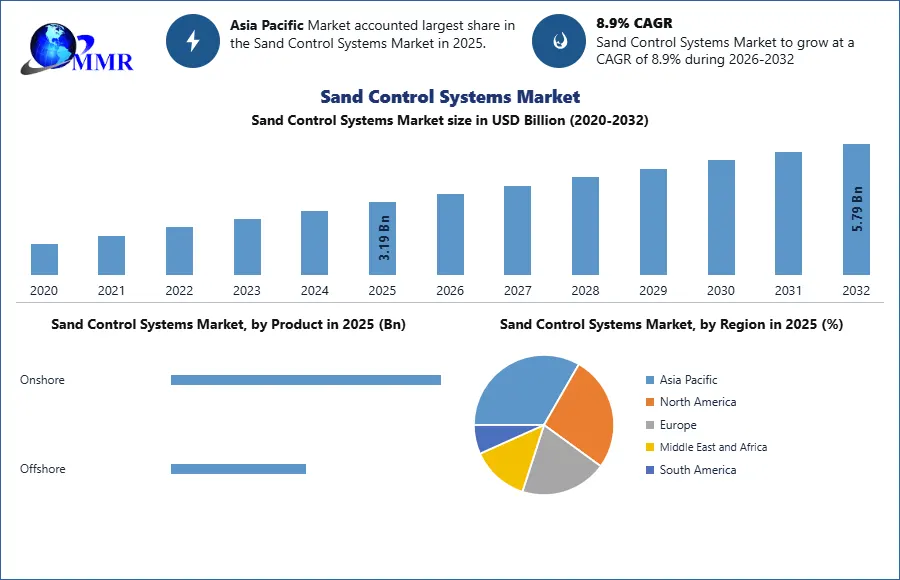 To know about the Research Methodology :- Request Free Sample Report
Sand Control Systems Market Dynamics:
Intensifying efforts to improve the reserve-to-production ratio of existing/mature wells to drive sand control systems market
The industry has benefited from technological advancements, as well as a rise in reserves and costs. The sand control systems market is also being driven by an increase in the reserves-to-production ratio from wells, as well as rising investment in shale exploration activities. The reserves-to-output ratio is a calculation that determines how long a natural resource's site will be profitable based on current production rates. With the drop in crude oil prices, oil firms are concentrating on improving the reserve to output ratio.
The sand control systems market is showing a North-ward trend as many new explorations of natural resources and oil fields are found also, many oil and gas explorer are constantly identifying new natural resources to dig up this has made a positive impact on the reserve-to-output ratio.
Newer techniques make it possible to extract oil that was previously thought to be difficult to obtain at a reasonable price because of traditional techniques. The number of global reserves and the size of the ratio was effectively adjusted as a result of these techniques. For example, 3D seismic imaging this technological advancement allows scientists to see miles underneath the seabed floor, allowing them to discover previously undiscovered reserves at sea.
Another factor that the ratio fails to account for is the continually increasing demand for natural resources as the global population grows and new economic powerhouses emerge. The number of mature oilfields is currently very high, and it is growing as a result of rising oil and gas production, which leads to the rapid depletion of new fields. New supply sources, technology advances, and shifting consumption of natural resources. However, factors such as fluctuating crude oil prices negatively impacting drilling activities.
The report has profiled key players in the market from different regions. However, the report has considered all market leaders, followers, and new entrants with investors while analyzing the market and estimation the size of the same. The manufacturing environment in each region is different and focus is given on the regional impact on the cost of manufacturing, supply chain, availability of raw materials, labor cost, availability of advanced technology, trusted vendors are analysis and report has come up with recommendations for a future hot spot in the North America. Major country’s policies about manufacturing and their impact on Sand Control Systems demand are covered in the report.
Sand Control Systems Market Segment Analysis
The onshore segment is expected grow at a CAGR of xx% during the forecast period.
Based on the location, in 2025, the onshore segment holds the largest market share of xx% in 2025 and it is estimated to reach USD$ xx Mn by 2032. Increasing demand for oil & gas and thanks to the presence of vast onshore oil & gas as the most prolific, convenient, and most profitable ways to meet the energy demand. Gravel packs are typically used in onshore applications. In onshore locations, these systems are installed in the wellbore to process sand during extraction. Oil output from basins like the Permian is rising, which explains the growing demand for onshore applications. During the forecast period, such factors are expected to fuel demand for sand control solutions for onshore locations.
Recent Development: Sand Control Systems Market
| Exact Date | Company | Development | Impact |
|---|---|---|---|
| 30 March 2026 | Research and Markets | Released a 2026-2032 global forecast confirming the Sand Control Solutions Market grew from $3.45 billion to $3.77 billion between 2025 and 2026. | This growth highlights a structural shift toward modular product architectures and digital monitoring to mitigate solids management risks in complex reservoirs. |
| 12 February 2026 | Weatherford | Awarded a multi-year integrated completions contract in Denmark, covering a suite of sand control and well integrity services. | The contract reinforces the market demand for integrated services over standalone product sales, ensuring long-term well productivity in North Sea offshore fields. |
| 03 February 2026 | Weatherford | Announced full-year 2025 financial results, reporting strong revenue growth driven by advanced completion technologies and sand management systems. | Increased profitability in the Completions segment demonstrates high operator adoption of specialized sand screens and inflow control devices (ICDs). |
| 28 January 2026 | Baker Hughes | Commenced its 26th Annual Meeting (AM2026), focusing on "The Energy Equation" and Intelligent Industry applications for offshore operations. | The event highlighted the commercialization of digitalized sand control diagnostics, enabling operators to move from reactive repairs to predictive maintenance. |
| 10 February 2026 | Intel Market Research | Verified that ceramic media filters and expandable sand screens have reduced well installation times by 30-40% as of early 2026. | These material science breakthroughs are driving market efficiency by lowering the Total Cost of Ownership (TCO) for aging offshore infrastructure. |
Sand Control Systems Market Regional Insights:
Asia Pacific to witness high market growth rate and is expected to grow at a CAGR of xx% by 2029
The central aspect driving the market growth in the Asia Pacific is increasing oil and gas output. Furthermore, Asia Pacific market for Sand Control Systems is expected to rise at a faster pace than the rest of the world by 2029, owing to increased energy demand, rising construction, and mining operation. The growing use of sand control systems in the oil and gas industries is propelling market growth in this region. Other factors driving market growth in the Asia Pacific include the need to build new resources and increase production from existing fields. The United States has the most refining power, thanks to nearly equal contributions from productive refinery expansions and new-build programmers. Other factors that are boosting the market growth include the region's rapid economic growth, which contributes to a rise in power demand. In the Asia Pacific, China accounted for xx.17% of the demand for sand controls solutions in 2023.
The objective of the report is to present a comprehensive analysis of the global Sand Control Systems market to the stakeholders in the industry. The past and current status of the industry with the forecasted market size and trends are presented in the report with the analysis of complicated data in simple language. The report covers all the aspects of the industry with a dedicated study of key players that include market leaders, followers, and new entrants.
PORTER, SVOR, PESTEL analysis with the potential impact of micro-economic factors of the market have been presented in the report. External as well as internal factors that are supposed to affect the business positively or negatively have been analyzed, which will give a clear futuristic view of the industry to the decision-makers.
The report also helps in understanding the global Sand Control Systems market dynamics, structure by analyzing the market segments and project the global Sand Control Systems market size. Clear representation of competitive analysis of key players by product, price, financial position, product portfolio, growth strategies, and regional presence in the global Sand Control Systems market make the report investor’s guide.
COVID-19 Impact on the Global Sand Control Solutions Market
The entire power industry is negatively hit by the COVID-19 outbreak. Production activity and oil & gas exploration have significantly impacted by the COVID -19 according to IEA the major declining factors are supply chain disruptions, delay in construction project activity. Imposed of strict lockdown by many countries and preventive measures such as social distancing which has a probe to financial difficulties and lack of workers availability slow down the market growth.
For around two months, China, the world's largest user of oil, coal, and refined petroleum products were under siege. As a result, oil prices began to fall in February 2021. Furthermore, in March 2021, Saudi Arabia and Russia engaged in an oil price war in response to Russia's refusal to curb demand in order to keep prices stable. This lasted for days, resulting in a springtime decline in oil prices.
Sand Control Solutions Market, Key Highlights:
• Global Sand Control Solutions Market analysis and forecast, in terms of value.
• Comprehensive study and analysis of market drivers, restraints and opportunities influencing the growth of the Global Sand Control Solutions Market
• Global Sand Control Solutions Market segmentation on the basis of type, source, end-user, and region (country-wise) has been provided.
• Global Sand Control Solutions Market strategic analysis with respect to individual growth trends, future prospects along with the contribution of various sub-market stakeholders have been considered under the scope of study.
• Global Sand Control Solutions Market analysis and forecast for five major regions namely North America, Europe, Asia Pacific, the Middle East & Africa (MEA) and Latin America along with country-wise segmentation.
• Profiles of key industry players, their strategic perspective, market positioning and analysis of core competencies are further profiled.
• Competitive developments, investments, strategic expansion and competitive landscape of the key players operating in the Global Sand Control Solutions Market are also profiled.
Covid-19 Impact:
COVID-19 Impact on the Global Sand Control Solutions Market
The entire power industry is negatively hit by the COVID-19 outbreak. Production activity and oil & gas exploration have significantly impacted by the COVID -19 according to IEA the major declining factors are supply chain disruptions, delay in construction project activity. Imposed of strict lockdown by many countries and preventive measures such as social distancing which has a probe to financial difficulties and lack of workers availability slow down the market growth.
For around two months, China, the world's largest user of oil, coal, and refined petroleum products were under siege. As a result, oil prices began to fall in February 2021. Furthermore, in March 2021, Saudi Arabia and Russia engaged in an oil price war in response to Russia's refusal to curb demand in order to keep prices stable. This lasted for days, resulting in a springtime decline in oil prices.
Sand Control Systems Market Scope: Inquire before buying
| Sand Control Systems Market | |||
|---|---|---|---|
| Report Coverage | Details | ||
| Base Year: | 2025 | Forecast Period: | 2026-2032 |
| Historical Data: | 2020 to 2025 | Market Size in 2025: | 3.19 USD Billion |
| Forecast Period 2026-2032 CAGR: | 8.9% | Market Size in 2032: | 5.79 USD Billion |
| Segments Covered: | by Product | Onshore Offshore |
|
| by Type | Horizontal Vertical |
||
| by Application | Open hole Cased hole |
||
| by End-User | Gravel pack Frac pack Sand screens Inflow control devices Others |
||
Global Market, by Region
• North America (United States, Canada and Mexico)
• Europe (UK, France, Germany, Italy, Spain, Sweden, Austria and Rest of Europe)
• Asia Pacific (China, South Korea, Japan, India, Australia, Indonesia, Malaysia, Vietnam, Taiwan, Bangladesh, Pakistan and Rest of APAC)
• Middle East and Africa (South Africa, GCC, Egypt, Nigeria and Rest of ME&A)
• South America (Brazil, Argentina Rest of South America)
Sand Control Systems Market Key Players are:
- Schlumberger Limited
- Halliburton Company
- Baker Hughes Company
- Weatherford International
- Superior Energy Services
- National Oilwell Varco
- Oil States International
- Tendeka
- RGL Reservoir Management
- Packers Plus Energy Services
- Welltec A/S
- Variperm
- Anton Oilfield Services Group
- China Oilfield Services Limited
- Interwell Norway AS
- Mitchell Industries
- KATT GmbH
- MiddleEast Oilfield Services
- Siao Petroleo
- Dialog Group
- Expro Group
- ChampionX
- ANDRITZ AG
- 3M Company
- Tatweer Petroleum Services
- Hebei Shengkai
- Grit Industries
- Sand Control Solutions Inc.
- Completion Technologies Inc.
- Well Completions LLC
Frequently Asked Questions:
1. Which region has the largest share in Global Sand Control Systems Market?
Ans: Asia Pacific region held the highest share in 2025.
2. What is the growth rate of Global Sand Control Systems Market?
Ans: The Global Sand Control Systems Market is growing at a CAGR of 8.9% during forecasting period 2026-2032.
3. What is scope of the Global Sand Control Systems Market report?
Ans: Global Sand Control Systems Market report helps with the PESTEL, PORTER, COVID-19 Impact analysis, Recommendations for Investors & Leaders, and market estimation of the forecast period.
4. Who are the key players in Global Sand Control Systems Market?
Ans: The important key players in the Global Sand Control Systems Market are – Schlumberger,Halliburton,Baker Hughes Company,Weatherford,Superior Energy Services,Oil States International,Anton Oilfield Services,China Oilfield Services.
5. What is the study period of this Market?
Ans: The Global Sand Control Systems Market is studied from 2025 to 2032.