
Global Revolving Doors Market Size by Type, Mechanism, Material, Diameter and End User
Overview
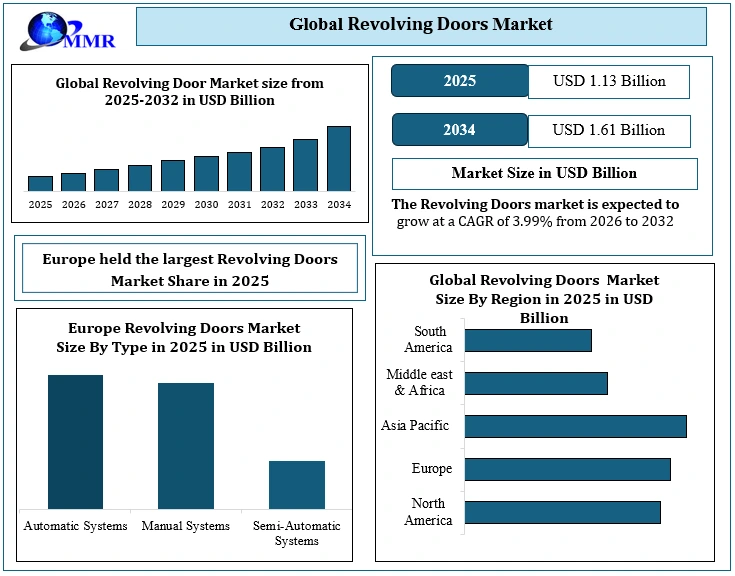
The Global Revolving Doors Market is experiencing profound market growth as modern architectural designs increasingly prioritise sustainable, energy-efficient building envelopes alongside premium aesthetic appeal. Driven by evolving infrastructure requirements, the industry market size was estimated at USD 1.13 Billion in 2025 and is projected to reach a forecast market size of USD 1.61 Billion by 2034, moving forward at a steady and reliable CAGR of 3.99% over the 2025-2034 forecast period.
Revolving Doors Market Overview
A revolving door is a special main entrance door with wings that turn inside a round glass frame to stop outside air from rushing into a building. The global revolving doors market is growing because of new city buildings, eco-friendly construction plans, and the need for easy pedestrian entryways. These doors are much better at blocking cold drafts than regular swinging store doors, making them the top choice for busy public places.
Most new corporate office buildings use these automatic doors to stop heat from escaping and to save money on power bills. The long-term expansion of the revolving doors industry ensures that the overall market size, unlocking massive market potential within developing smart city commercial complexes and public infrastructure terminals worldwide. From a production standpoint, Europe stands as the highest manufacturing region for global engineering and high-end automated assembly lines, with Germany acting as the leading country hub for technical component fabrication and structural safety innovations.
Revolving Doors Market Growth Outlook
To know about the Research Methodology :- Request Free Sample Report
Global Revolving Doors Market Dynamics
The global revolving doors market is driven by strict building design codes, urban infrastructure expansions, and the integration of high-performance security hardware at building thresholds. As commercial real estate developers focus on total lifecycle cost, market dynamics depend heavily on maximizing thermal envelope protection to reduce HVAC loads, optimizing pedestrian volume throughput limits, and deploying 3D laser curtains or Time-of-Flight (ToF) ceiling sensors to prevent tailgating. These advanced entrance lines face strong revolving doors market demand across high-traffic corporate office complexes, premium hospitality venues, public transportation terminals, healthcare infrastructure hubs, and large-scale retail centers.
Global Revolving Doors Market Drivers
• Increased Demand for Building Energy Savings: Corporate property owners are investing heavily in entrance systems that reduce monthly heating and cooling bills. These circular structures stop outdoor air from leaking inside, which lowers electricity waste and keeps indoor temperatures steady.
• Strong Shift Toward Long-Term Building Sustainability: More businesses are prioritizing eco-friendly construction practices to lower their environmental impact. Installing these specialized entrance systems helps commercial facilities reduce carbon footprints and easily meet strict national green building standards.
• Expanding Infrastructure and Urbanization : The continuous building of massive commercial plazas, airport extensions, and transit centers creates an immediate need for robust entryway systems. These high-volume buildings use multi-wing setups to handle large crowd movements safely every day.
• Higher Need for Visual Customization and Premium Styling: Modern architecture relies on unique, high-end building facades to improve corporate branding. Manufacturers are winning major project contracts by offering custom metallic finishes, curved glass shapes, and tailored framing sizes that match the design of luxury lobbies.
• Rapid Adoption of Automated Entryway Technology: Property managers are replacing old mechanical entrances with smart, touchless door systems. Incorporating automated sensor networks, hands-free operation, and smart safety sensors makes these modern setups much more practical for busy public buildings.
• Enhanced Safety and Emergency Solutions: Modern automated systems are built with advanced safety electronics to protect users from injury. The inclusion of instant collision detection, emergency speed controls, and automatic wings that fold outward during a fire evacuation makes these doors essential for high-occupancy public safety.
Global Revolving Doors Market Restraints
• High Initial Investment and Setup Expenditures: The complex engineering and material requirements make these entryways significantly more expensive to purchase and install than basic sliding storefront entries.
• Specialized Long-Term Servicing and Upkeep Requirements: Electronic security sensors and moving parts need regular calibration by trained technicians, adding constant maintenance costs to facility budgets.
• Strict Regional Safety Standards and Building Codes: Companies face slow approval timelines because door designs must continuously adapt to meet varying local laws regarding emergency escape breakouts and pedestrian safety.
Global Revolving Doors Market Trends
• Growing Shift Towards Customization and Design Flexibility: Architects and builders are moving away from standard entrance setups to find solutions that match a building's overall look. Manufacturers are actively innovating by offering a highly diverse range of personalized styles, framing materials, and surface finishes to meet this specific project aesthetics.
• Rapid Integration of Smart Features and Advanced Technology: Entryway designs are evolving quickly to improve user convenience and building security. Modern configurations are increasingly incorporating touchless automated operators, precise safety sensors, and smart access control software to upgrade older commercial main thresholds.
• Heavy Emphasis on Sustainable and Energy-Saving Structures: The global revolving doors market is experiencing an ongoing push to enhance the eco-friendly performance of entry systems. As corporate buyers focus on reducing carbon footprints, product development is centering around layouts that minimize air leakage to maximize long-term building energy conservation
• Shift Toward Full-Glass and Minimalist Framing Designs: Current architectural designs favor clean, transparent looks, prompting manufacturers to produce structures with invisible metal joints and curved structural glass panels.
• Development of Environmentally Friendly and Clean Power Features: Door brands are exploring next-generation green innovations, such as testing solar film coatings on circular roof frames to help entryways create their own electricity.
Global Revolving Doors Market Opportunities
• Preventing Unauthorized Access and Improving Entry Security: Businesses highly value the strong security protection that circular doors offer over basic sliding or swinging entries. These entrance structures are exceptionally effective at stopping unauthorized entry, making them a preferred choice for companies looking to secure main lobby areas.
• Replacing Aging and Outdated Entrance Infrastructure: A large number of older commercial properties currently operate with worn, inefficient entryways. This creates a major commercial opportunity for manufacturers to step in and replace these old setups with higher-performing, modern entrance systems.
• Optimizing Controlled Airflow and Interior Air Management: These entrance designs are superior at controlling building airflow and completely stopping unwanted external wind drafts. Property managers are increasingly adopting them to maintain highly stable internal building conditions.
| Key Opportunity Area | Primary Growth Driver |
| Entry Security | Replaces sliding options to stop unauthorized lobby access. |
| Infrastructure | Upgrades aging, worn, and inefficient entryway systems. |
| Air Management | Controls internal airflow and completely stops wind drafts. |
Global Revolving Doors Market Challenges
• High Total Cost of Equipment Procurement and System Installation: Buying and setting up circular entrance systems requires a much higher initial financial investment compared to standard swinging or sliding glass doors. These high up-front expenses can prevent budget-conscious property developers from choosing them.
• Complex Structural Requirements and Integration Limitations: Fitting large, heavy circular enclosures into older building facades often requires major structural changes to the entryway architecture. If a facility has low ceilings or limited entry space, installing these systems becomes difficult and expensive.
• Special Servicing Needs and Ongoing Maintenance Costs: The electronic security sensors, automated motor drives, and specialized weather-stripping seals require regular expert calibration. Finding qualified technicians can be hard in some regions, which increases long-term building upkeep costs.
Global Revolving Doors Regional Insights
• Europe held the largest Revolving Doors Market in 2025 due to Strict Green Standards. European cities heavily prioritize permanent airlock entrances to prevent thermal loss in commercial properties, ensuring steady sales for retrofitting older structures and installing systems in new office hubs due to early and widespread adoption of strict building energy regulations.
• North America Retains a Stable and Mature Corporate Infrastructure Share: Supported by continuous construction of premium Grade-A commercial office towers and strict corporate facility security upgrades, building managers across the region are focusing heavily on integrating smart access systems to protect corporate entrances, keeping replacement sales strong.
• Asia-Pacific is the Fastest-Growing Commercial Ecosystem Globally: Driven by rapid urbanization across China, India, and South Korea, this region is expanding at the quickest pace. Massive investments in smart cities, high-end retail plazas, and international airport terminals are driving a huge demand for high-capacity pedestrian entry systems to handle heavy daily foot traffic.
• South America is an Emerging Growth Area Driven by Infrastructure Modernization: This region represents a developing the global revolving doors market territory where investments are shifting toward high-end commercial properties. The market is expanding steadily as major economic centers update their infrastructure with premium corporate offices, expanded airports, and upscale retail malls that require professional, energy-saving main entryway systems.
• Middle East and Africa Opens Up Steady Long-Term Project Pipelines: The Middle East and Africa represent emerging territory pipelines for specialized entrances. The rapid development of luxury hospitality resorts, modern government office complexes, and new international transportation centers is driving gradual growth as local builders adopt premium entrance designs.

Global Revolving Market Segment Analysis
By Type:
Automatic Systems: This design setup drives growth in the global revolving doors market, due to broad corporate adoption and high hands-free utility.
Manual Systems: This configuration captures a notable market slice, serving as a reliable entry option for budget-conscious properties or secondary building exits.
Semi-Automatic Systems: This niche operational type offers powered assistance upon manual pushing, expanding across high-end care facilities and heritage renovations.
By Mechanism:
Swing: This core mechanical style functional system choices by ensuring smooth, continuous rotation inside corporate portals.
Sliding: This layout captures a strategic share by incorporating center sliding leaves that open automatically during heavy traffic spikes or emergency evacuations.
Folding: This flexible structural configuration targets compact lobby boundaries where wings need to collapse flat for open programmatic space.

• By Material:
Glass: This choice experiences rapid gains as modern transparent facades set the trend for upscale retail and premium office entrance designs.
Aluminum: This heavy-duty structural framework holds the highest volume footprint globally due to its balance of low weight and cost-efficiency.
Stainless Steel: This high-strength material captures specialized project contracts by offering maximum wear resistance for high-occupancy transit portals.
Bronze: This premium customized aesthetic division targets luxury hotel branding and signature heritage landmark restorations.
By Diameter:
Standard Size Framing (2m to 4m): This dimension segment dominates global procurement checklists.
Large High-Capacity Diameters (Above 4m): This expansive layout scales up within specialized public transport terminals to manage heavy luggage and automated cart flows.
By End-Users:
Commercial Complexes & Corporate Office Towers: This sector drives the highest commercial revenue, capturing nearly 80% of active procurement contracts to lower thermal building energy waste.
Industrial, Transportation, & Healthcare Hubs: This division builds continuous sales channels focused on international aviation expansions and barrier-free hospital thresholds.

Global Revolving Doors Market: Competitive Analysis
ASSA ABLOY Group (Sweden): Holds a leading position in the global revolving doors market by executing an aggressive corporate acquisition strategy to absorb smaller regional door brands and instantly scale up its international service network.
Dormakaba Holding AG (Switzerland): Expands its commercial presence in the global revolving doors market by utilizing a direct architectural specification strategy, partnering with prominent real estate design firms to ensure their entrance products are written into new building plans early.
Royal Boon Edam International B.V. (Netherlands): Captures premium value across the global revolving doors market by deploying a highly focused product customization strategy, building bespoke, luxury glass configurations tailored specifically for high-end hospitality and signature corporate lobbies.
GEZE GmbH (Germany): Drives business growth through a dedicated technological integration strategy, developing advanced electronic door control systems that seamlessly connect with intelligent central building management software.
Record / Landert Group AG (Switzerland): Increases its footprint in the global revolving doors market by pursuing a niche market diversification strategy, launching specialized touchless and hygienic entrance solutions targeted directly at modern medical and healthcare complexes.
Stanley Black & Decker, Inc. (USA): Secures steady revenue by implementing a long-term service contract strategy, locking in multi-year maintenance and hardware modernization agreements with established corporate business plazas.
Global Revolving Doors Market: Recent Developments
Product Innovation Drives Global Revolving Doors Market Expansion: Leading manufacturers are actively introducing next-generation touchless and automatic door systems to capture premium architectural projects. Companies are launching smart entrance lines focusing on hands-free functionality to satisfy high-traffic demands in commercial buildings, airports, and public spaces.
Strategic Collaborative Alliances Fuel Technical Upgrades: Key industry participants in the global revolving doors market are establishing fresh strategic partnerships to maintain their competitive edge. These corporate alliances focus on combining hardware manufacturing with advanced software to embed artificial intelligence into motion sensor networks.
Sustained Urbanization drive Commercial Infrastructure Growth: Rapidly expanding city infrastructure and massive public transport developments are driving major volume orders. Main players in the global revolving doors market are securing high-volume installation contracts by offering rugged, high-capacity entrance systems engineered specifically to handle dense pedestrian crowd movements safely.
Global Revolving Doors Market Scope: Inquire before buying
| Revolving Doors Market | |||
|---|---|---|---|
| Report Coverage | Details | ||
| Base Year: | 2025 | Forecast Period: | 2026-2034 |
| Historical Data: | 2020 to 2025 | Market Size in 2025: | USD 1.13 Bn. |
| Forecast Period 2026 to 2034 CAGR: | 3.99% | Market Size in 2034: | USD 1.61 Bn. |
| Segments Covered: | by Type | Automatic Systems Manual Systems Semi-Automatic Systems |
|
| by Mechanism | Swing Sliding Folding |
||
| by Material | Glass Aluminum Stainless Steel Bronze |
||
| by Diameter | Standard Size Framing (2m to 4m) Large High-Capacity Diameters (Above 4m) |
||
| by End-Users | Commercial Complexes & Corporate Office Towers Industrial, Transportation, & Healthcare Hubs Others |
||
Global Revolving Doors Market: by Region
North America: United States, Canada, Mexico
Europe: Germany, United Kingdom, France, Italy, Spain, Netherlands, Switzerland, Belgium, Sweden, Poland, Rest of Europe
Asia-Pacific: China, India, Japan, South Korea, Australia, Singapore, Malaysia, Thailand, Indonesia, Vietnam, Rest of Asia Pacific
South America: Brazil, Argentina, Colombia, Chile, Peru, Ecuador, Venezuela and Rest of South America
Middle East and Africa: Saudi Arabia, United Arab Emirates, South Africa, Egypt, Israel, Turkey, Qatar, Kuwait, Rest of Middle East and Africa
Global Revolving Doors Key Players:
1. ASSA ABLOY Group
2. Royal Boon Edam International
3. dormakaba Holding
4. GEZE
5. Stanley Black & Decker
6. Horton Automatics
7. Record / Landert Group
8. Nabtesco Corporation
9. Sanwa Holdings Corporation
10. Shanghai Yupeng Glass Products Co., Ltd.
11. Shijiazhuang Depuer Automatic Door Control Co., Ltd.
12. Nanjing Maosong Automatic Door Co., Ltd.
13. Beijing Hongtai Dingcheng Automatic Door Technology Co., Ltd.
14. Hefei Tongsheng Doors and Windows Co., Ltd.
15. Qingdao Kaibisheng Automatic Door Engineering Co., Ltd.
16. Hualong Dingsheng Technology Co., Ltd.
17. Zhuhai Jiaxin Building Materials Co., Ltd.
18. Hörmann
19. Hafele
20. Portalp
21. Manusa
22. Grupsa Door System
23. Deutschtec
24. ERREKA Automatic Doors
25. Auto Ingress
26. Tormax USA
27. KBB Automatic Door Group
28. DSS Automatic Doors
29. Gilgen Door Systems
30. FAAC Group
31. Rite-Hite
32. Entrematic Group
33. KONE Corporation
34. Allegion
35. CoMETA SpA
36. Tormax Automatic Door Systems
37. Axis Entrance Systems
38. Gretsch-Unitas Group
39. Label SpA
40. Besam Entrance Solutions
Frequently Asked Questions:
Q1: What is the projected market size and growth rate for the Global Revolving Doors Market?
Ans: The global revolving doors market value was USD 1.13 Billion in 2025 and is projected to expand to USD 1.61 Billion by 2034.
Q2: Which subsegments are driving growth within the building entry market?
Ans: Automatic operating systems drive global growth through high-volume commercial adoption because of hands-free convenience. For wing configurations, three-wing types lead product sales due to balanced spatial geometry and excellent airlock performance.
Q3: What are the primary structural forces pushing sales up for door manufacturers?
Ans: The global revolving doors market is growing fast due to an increased need for building energy savings to stop outdoor air leaks. Other major drivers include a strong shift toward long-term building sustainability, expanding global infrastructure, and enhanced pedestrian safety features.
Q4: Which regional ecosystem is expanding at the fastest pace globally?
Ans: Asia-Pacific is the fastest-growing commercial ecosystem in global revolving doors market. Heavy investments in smart cities, high-end retail plazas, and major airport expansions across China, India, and South Korea are driving high crowd-management demand.
Q5: What major operational challenges do entryway companies face?
Ans: The global revolving doors market industry faces high total costs of equipment procurement and complex structural integration requirements in older building facades. Specialized servicing needs and ongoing maintenance costs for automated electronic safety sensors also present constant challenges.