
Retail E-Commerce Market - Industry Structure Evaluation, Demand Drivers Analysis, Regional Growth Analysis and Identification, Competitive Positioning / Landscape Review & Global Market Size Forecast to 2032
Overview
The Retail E-Commerce Market size was valued at USD 7.31 Trillion in 2025 and the total Retail E-Commerce revenue is expected to grow at a CAGR of 9.6% from 2026 to 2032, reaching nearly USD 13.88 Trillion by 2032.
Retail E-Commerce Market Overview:
Retail E-Commerce is the activity of buying products through the internet by using a browser or online services. The usage of smartphones is increasing and the convenience to buy products online that requires in day-to-day life. The growth in online shopping has been increasingly creating more unique businesses. The Retail E-Commerce Market has a wide range of industries and companies where customers find it easy to buy the product according to their needs.
The ease of purchasing everyday basics and luxury items or goods from the comfort of one’s own home. The availability of numerous similar products, reduced or discounted prices compared to physical shops or stores has increased the demand for online retailing. The Retail E-Commerce Market offers various buying options for products with easy availability and reduced prices. As a result, the demand for retail e-commerce is growing rapidly.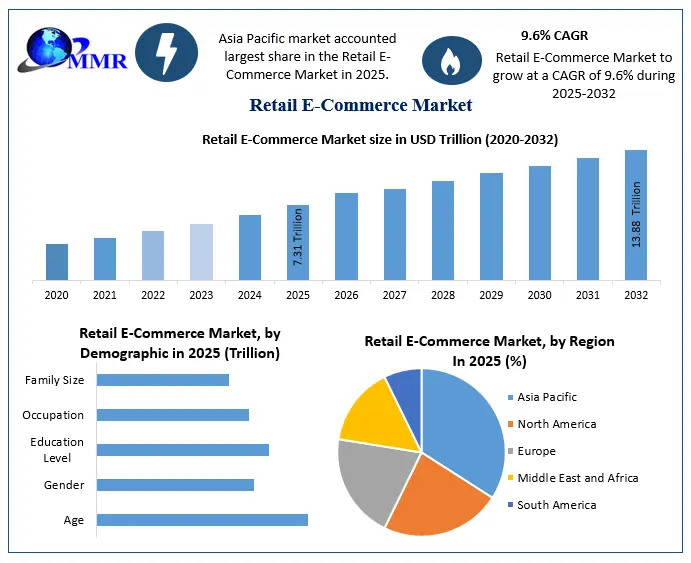 To Know About The Research Methodology :- Request Free Sample Report
Retail E-Commerce Market Dynamics
Ease of availability and affordable pricing drives the Retail E-Commerce Market
The key player contributes to the growth and success of the market drivers of retail e-commerce companies. E-commerce allows customers to compare prices across multiple platforms and price transparency. Offers competitive pricing because of the low overhead costs compared to stores. E-commerce platforms frequently provide promotional offers, discounts, and coupons, to customers. The logistics and delivery infrastructure has advanced and contributed to the growth of the market.
Faster and more reliable delivery options like efficient shipping networks, delivery solutions, and reliable courier services have made it possible for online retailers. Online retailers use social media for marketing strategies and collaborate with influencers to promote their products and engage with potential customers. Social media platforms have been very helpful for e-commerce businesses because of advertisements, growing usage of smartphones, increasing penetration of the internet, and rising income levels are driving the global market.
Restraints
Security and Privacy can hamper retail e-commerce adoption
The market is largely competitive, with various key players, competing for customer attention and to achieve the highest market share. Security and privacy concerns are the imperative complications of e-commerce adoption. Customers are commonly doubtful of sharing information personal or financial, fraud activities, and fear data breaches. Retail e-commerce type of businesses needs to advance in resilient security measures and give surety to customers to protect the data to build trust. Retail E-Commerce businesses must fulfill various protocols or regulations and legal requirements, including consumer rights, taxation, and data protection. Directing these complex supervisory landscapes can be a challenge, especially for new entrants or small and medium-sized enterprises entering the e-commerce market.
Retail E-Commerce Market Opportunity
Global Expansion and Increase in Mobile Internet Usage
Retail e-commerce businesses present several opportunities for growth and innovation. It offers to expand its reach beyond internal markets. With advancements in logistics, e-commerce businesses can explore new markets targeting international customers with that it increases the revenue and customer base. Smartphones and mobile internet users have a wide range of retail e-commerce businesses as they used to buy the product online. Mobile commerce allows businesses to reach out to customers and provide smooth shopping experiences through mobile applications and particular company websites. Businesses that capitalize on these opportunities can drive innovation, increase market share, and build successful e-commerce ventures.
Retail E-Commerce Market Segment Analysis:
Based on Product Type,
Apparel and Accessories have dominated the market in the year 2025 and are expected to dominate during the forecast period. There is a wide variety of clothes and clothing brands in the global retail market. Affordable or discounted pricing on clothes, availability of convenient payment methods, and the return policy of products are the reason for the growth of this segment. An electronic segment is likely to increase during the forecast period due to the rising demand for electronic items and the availability of a large variety of products. The easy return policy, offers, discounts on original costs, and convenient payment methods will advance the segment’s growth. The Electronic Goods segment is anticipated to increase significantly during the forecasted period, making it easier to compare various items as it has huge demand.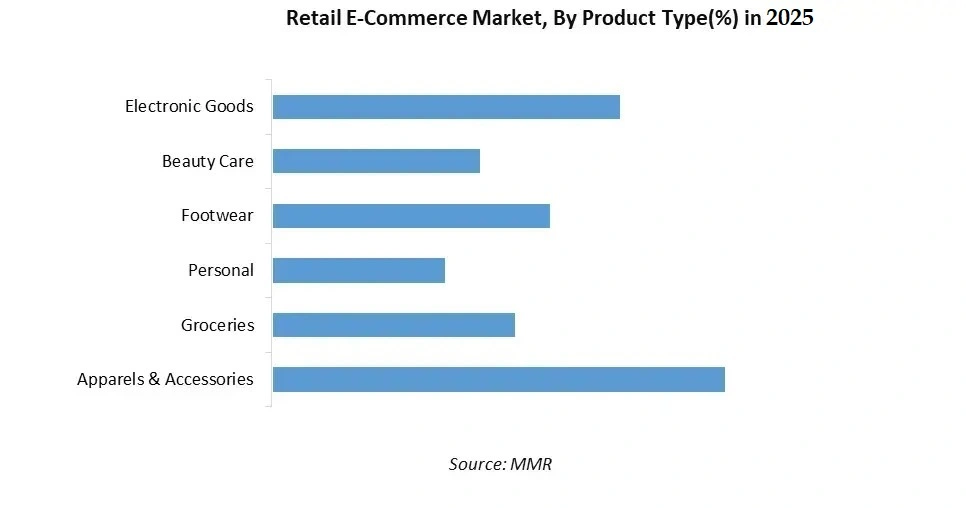
Based on the Distribution Channel,
Direct Channels have dominated the market in the year 2025 and are expected to grow during the forecast period. As direct channels, the company is totally taking responsibility for delivering the product to customers. Goods do not go through intermediaries before reaching their final destination, this model provides total control to manufacturers over the distribution channel.
Direct distribution channel offers lower prices or discounted prices since the company does not have to pay for intermediates. Whereas indirect channels are expected to grow as it has the benefit to sell larger volumes of products to a different location. Products are delivered by third parties or intermediaries like wholesalers, distributors, retailers, etc. It has the benefit of sending products of larger volumes and selling to a range of customers in different locations and products have higher prices due to the commissions paid to third parties. Hybrid channels are nothing but, a mix of direct and indirect channels.
Retail E-Commerce Market Regional Insights:
Asia Pacific dominated the market and has the largest revenue share in the year 2025. The usage of mobile internet is increasing, hence Asia-Pacific region is expected to witness rapid growth over the forecast period. Consumers from this region are acquiring electronic goods over the e-commerce platform. China has the largest manufacturing companies where Asian manufacturers have been selling their products entirely over the Internet. Whereas North America is expected to grow over the forecast period. Secured money transactions online, change purchase patterns, and increased consumer awareness. Europe region advances in High-speed internet facilities and a well-organized supply chain for goods delivery. However, market is expected to grow in the Europe region as well.
Retail E-Commerce Market Recent Industry Developments (2025–2026)
| Date | Company | Development | Impact |
|---|---|---|---|
| 15 January 2025 | Standard AI | Launched a Next-Generation AI Smart Cart System designed to bridge the gap between physical and digital retail. | The system aims to reduce checkout friction and improve real-time inventory tracking for hybrid retailers. |
| 06 May 2025 | DoorDash | Announced the acquisition of Deliveroo for approximately $3.7 billion to expand its international footprint. | This merger strengthens last-mile delivery capabilities and market share within the European e-commerce sector. |
| 22 August 2025 | Apple Inc. | Confirmed a massive $500 billion investment program in the U.S. to bolster domestic tech and retail infrastructure. | The initiative focuses on enhancing digital content services and e-commerce payment processing via Apple Pay. |
| 14 November 2025 | Kimberly-Clark | Announced the $48.7 billion acquisition of Kenvue to scale its health and wellness brand portfolio. | The deal enhances direct-to-consumer (DTC) reach and omnichannel distribution for essential consumer goods. |
| 12 January 2026 | Shopify Inc. | Acquired Vantage Discovery to integrate AI-powered search and personalization tools into its merchant platform. | The acquisition is expected to boost conversion rates by 94% through advanced 3D product visualization. |
| 19 March 2026 | Prosus | Finalized the $4.3 billion takeover of Just Eat Takeaway.com to create a European technology champion. | This consolidation scales cross-border logistics and improves operational efficiency for online food retail. |
Retail E-Commerce Market Scope : Inquire Before Buying
| Retail E-Commerce Market | |||
|---|---|---|---|
| Report Coverage | Details | ||
| Base Year: | 2025 | Forecast Period: | 2026-2032 |
| Historical Data: | 2020 to 2025 | Market Size in 2025: | 7.31 USD Trillion |
| Forecast Period 2026-2032 CAGR: | 9.6% | Market Size in 2032: | 13.88 USD Trillion |
| Segments Covered: | by Product | Apparels & Accessories Groceries Personal Footwear Beauty Care Electronic Goods |
|
| by Demographic | Age Gender Education Level Occupation Family Size |
||
| by Platform Type | Marketplace Platforms Brand-owned Websites Social Commerce Platforms |
||
| by Delivery Type | Standard Delivery Same-day Delivery Next-day Delivery Click & Collect |
||
| by Distribution Channel | Direct Indirect Hybrid |
||
Retail E-Commerce Market by Region
North America (United States, Canada, and Mexico)
Europe (UK, France, Germany, Italy, Spain, Sweden, Austria, and the Rest of Europe)
Asia Pacific (China, South Korea, Japan, India, Australia, Indonesia, Malaysia, Vietnam, Taiwan, Bangladesh, Pakistan, and the Rest of APAC)
Middle East and Africa (South Africa, GCC, Egypt, Nigeria, and the Rest of ME&A)
South America (Brazil, Argentina Rest of South America)
Retail E-Commerce Market Key Players
1. Alibaba Group Holding Limited
2. Amazon.com Inc.
3. Apple Inc.
4. Target
5. B2W Companhia Digital
6. eBay Inc.
7. Groupon Inc.
8. Walmart In
9. Albertsons Companies, Inc.
10. Coupang Corp.
11. Ebates Inc. dba Rakuten
12. Inter IKEA Systems B.V.
13. Otto (GmbH & Co KG)
14. Taobao
15. The Kroger Co.
16. Best Buy
17. BigCommerce
18. Zappos
19. Asos
20. Mercari
Frequently Asked Questions:
1] What segments are covered in the Global Retail E-Commerce Market report?
Ans. The segments covered in the Retail E-Commerce Market report are based on Distribution Channels, Demographic, Psychographic, and Regions.
2] Which region is expected to hold the highest share in the Global Retail E-Commerce Market?
Ans. The Asia-Pacific region is expected to hold the highest share of the Retail E-Commerce Market.
3] What is the market size of the Global Retail E-Commerce Market by 2032?
Ans. The market size of the Retail E-Commerce Market by 2032 is expected to reach USD 13.88 Trillion.
4] What is the forecast period for the Global Retail E-Commerce Market?
Ans. The forecast period for the Retail E-Commerce Market is 2026-2032.
5] What was the Global Retail E-Commerce Market size in 2025?
Ans: The Global Retail E-Commerce Market size was USD 7.31 Trillion in 2025.