
Preclinical Imaging Market Size – Industry Structure Evaluation, Demand Drivers Analysis, Regional Growth Analysis and Identification, Competitive Positioning Review & Global Market Size Forecast to 2032
Overview
The Global Preclinical Imaging Market size was valued at USD 7.69 Billion in 2025 and the market is expected to grow at a CAGR of 8.36% throughout 2026 to 2032, reaching nearly USD 13.49 Billion by 2032.
Preclinical Imaging Market Overview
The preclinical Imaging market is moving at a steady growth, due to technological innovation and increasing drug discovery and biomedical research in accurate, non-invasive imaging methods. High-resolution imaging technologies, such as micro-CT, PET, and MRI, are bringing revolution to the region by allowing a wide view of organic processes at molecular and cellular levels in animal models. Integration in imaging platforms of artificial intelligence (AI) and machine learning is increasing data interpretation through better image processing, division, and pattern recognition, which accelerates the speed of preclinical studies. Research institutes and academic centers are adopting imaging systems, trying to meet rigorous recognition standards. This change focuses on the research quality and animal welfare of a comprehensive industry. For example, in November 2025, the Advanced Preclinical Imaging Center (APIC) at the Lilehei Heart Institute obtained an ideal score from the Institutional Animal Care and Use Committee (IACUC), highlighting the compliance with USDA guidelines for moral and safe animal research.
Innovation remains the foundation stone for the development of the industry. In May 2022, Fujifilm Visualsonics Inc. launched the Vivo F2, the first preclinical ultrasound and photoacoustic imaging system that is capable of working in a broad frequency range (71 MHz to 1 MHz). This system increases the image clarity and frame rate through HD image processing and a new signal passage, which is through advanced multi-line processing. Strategic mergers and acquisitions are shaping Preclinical imaging market dynamics. In February 2025, the Bruker Corporation acquired Spectral Instruments Imaging LLC, strengthened its preclinical imaging portfolio within the Bruker BioSpin, and addressed a major technology difference in in vivo optical imaging. Geographical expansion is another defined trend. Healthcare investment, favorable regulatory development, and increasing population growth are encouraging companies and institutions to expand globally through cooperation, new facilities, and regional participation.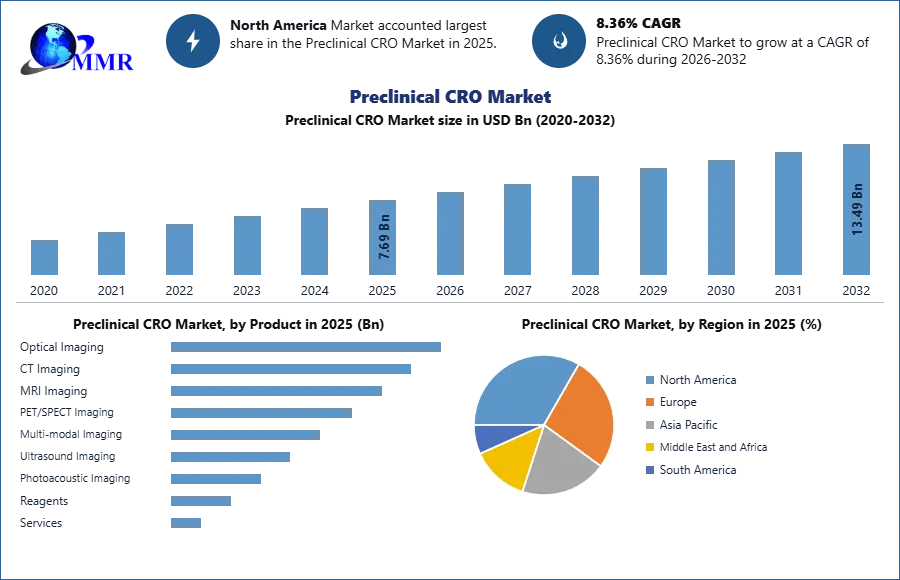 To know about the Research Methodology :- Request Free Sample Report
Preclinical Imaging Market Dynamics
Growing Preclinical Imaging Market Demand for Non-Invasive Small Animal Imaging Techniques:
Imaging technology is an important driver for the growth and development of the Preclinical imaging market for non-invasive small animal imaging techniques. Preclinical imaging involves the use of imaging technologies to study disease processes and use animal models, mainly mice and rats, before they are used in humans. Inventory imaging techniques reduce the need to give euthanasia to animals to study the progression of diseases and treatment effects. It aligns with the principles of 3Rs (replacement, lack, and refinement) in animal research, aimed at reducing animal use and pain. It also allows for longitudinal studies, where the same animal can be imaged several times during a study.
This enables researchers to monitor the progression of the disease in real time and monitor the treatment reactions, providing more comprehensive data than the endpoint analysis. Pushing towards non-invasive small animal imaging is inspired by the requirement of moral, efficient, and detailed Preclinical research methods that provide valuable insight by reducing dependence on aggressive processes. This trend is expected to continue driving progress in Preclinical imaging technologies and functioning.Growing Imaging System for Preclinical Purposes:
The drug and biotechnology industry is constantly looking for new drug candidates so that they meet medical requirements. Preclinical imaging increase the understanding of these potential drug candidates by imaging their effects on living organisms. This ability helps to identify the promising candidates and abandon people with the first adverse characteristics in the drug development process, saving time and resources.
Additionally, a change towards individual medicine requires a deep understanding of the conditions of individual patients. Preclinical imaging assess the asymmetry of the disease and adapt the approach to treatment, leading to more effective treatment. Preclinical imaging techniques are mainly non-invasive or minimally invasive, which gives an advantage to both the research animals and the accuracy of the data collected. It enables non-invasive longitudinal studies, which reduces the need to sacrifice animals at many time points. Therefore, increasing the imaging system for Preclinical purposes is likely to increase Preclinical imaging market growth in the forecast period.
Preclinical Imaging Market Segment Analysis
Based on Product, the market is segmented into optical imaging, CT imaging, MRI imaging, PET/SPECT imaging, multi-modal imaging, ultrasound imaging, photoacoustic imaging, reagents, and services. The optical imaging segment holds the largest market share in 2025 and is expected to increase during the forecast period due to its widespread use in small animal imaging and new drug search projects. Increasing adoption of optical preclinical imaging is attributed to many factors. Technological innovation in molecular imaging brought revolution to the region, providing researchers with more sophisticated and accurate imaging abilities.
Also, there is a increasing demand for non-invasive small animal imaging techniques in preclinical studies owning to its ability to study biological processes in living subjects without the need for invasive procedures. Both private and public organizations are invested in pre-pricing research, which increases the requirement for advanced imaging tools like optical preclinical imaging systems. The preclinical imaging market growth affected by the increase in healthcare expenses, which plays an important role in increasing the healthcare infrastructure. Furthermore, different government organizations aim to actively increase funding and increase healthcare infrastructure, which has effect on the preclinical imaging market mobility.
Also, the multimodal segment is likely to grow at the fastest rate during the forecast period. Integration of many imaging types increases the sensitivity and uniqueness of preclinical imaging studies. Each modality has its own strengths and limitations, and mixing them allows researchers to remove individual boundaries, resulting in more accurate and informative data. As technology continues to move and research requirements are developed, multimodal imaging is expected to play an important role in understanding the disease system and developing new treatments in preclinical imaging.
Based on Application, the market is segmented into Research and Development, and Drug Discovery. In 2025, research and development (R&D) segment was responsible for the largest revenue share in preclinical imaging market. This dominance is largely powered by the active participation of government agencies, educational institutions, and contract research organizations (CROs) in advancing biomedical science. For example, National Institutes of Health (NIH) performs clinical research on many conditions, including Alzheimer's disease, neurological disorders, allergies, cancer, & infectious diseases.
Cooperation between CROs & academic health systems is becoming increasingly common, providing strategic benefits through access to bigger patient pools & wider infrastructure. Such a partnership increases operational capacity and accelerates the development and verification of imaging technologies. Constant R&D efforts play an important role in expanding capabilities of imaging technologies, promoting innovation, and allowing new medical discoveries that eventually improve patient outcomes.
Also, the drug discovery segment is expected to dominate during the forecast period. Preclinical imaging is important in early-phase drug development; a drug provides valuable insight into candidate's safety, efficacy, and pharmacokinetic profile. These technologies support identification and verification of novel drug goals and facilitate assessment of medical responses in animal models. They also contribute to medicine by allowing evaluation of individual treatment responses based on disease-specific characteristics. Their treatment is successful in validating effectiveness and highlighting role of preclinical imaging in refining therapeutic approaches.
Preclinical Imaging Market Regional Analysis
North America holds the largest preclinical imaging market share in 2025 and expected to keep its dominance during the forecast period, driven by a well-established research ecosystem driven by a high concentration of skilled professionals and a high concentration of preclinical projects. Strong infrastructure in the region, mainly in the United States, has promoted rapid adoption of imaging technologies. These progresses have allowed researchers to achieve high resolution and sensitivity in preclinical studies, paving the way for more accurate disease modelling and drug development initiatives.
Research on the spread of funds and state-of-the-art health facilities further secures the position of North America as a pioneer in the Preclinical imaging market. In particular, American Preclinical Imaging is responsible for the largest revenue share in the region in the Preclinical imaging market. This leadership is attributed to the country's unique healthcare infrastructure and comprehensive research investments. Comprehensive integration of advanced imaging formats supported by innovative technological capabilities strengthens the dominance of American stakeholders in driving Preclinical imaging market development. This progress increases the quality of data and improves the efficiency of preclinical studies, contributing to advancements in translational medicine.
Europe also holds a significant market share of the preclinical imaging market in 2025, which has seen due to a strong appearance of major pharmaceutical companies, educational research institutes, and well-equipped health facilities. In the United Kingdom, the research and development ecosystem is characterized by the contribution of leading academic and pharmaceutical organizations, is ready to expand, which creates a favorable landscape for proof-of-innovation. In Germany, the government's initiative and strong funding structures continuously increase technological advancement and Preclinical imaging market growth. This innovation facilitates intensive visuals of biological processes at the molecular level, increasing the scope of preclinical research throughout the region.
Preclinical Imaging Market Competitive Landscape
The global preclinical imaging market features a competitive landscape shaped by technological innovation, multimodal imaging capabilities, and expanding research applications in oncology, neurology, and cardiology. Leading markets, Bruker Corporation, Siemens AG, and General Electric (GE) offer imaging platforms integrating MRI, PET, and CT modes, showing high-resolution data important to translational research. PerkinElmer Inc. is operating under Revvity, Inc., and Agilent Technologies delivers powerful optical and molecular imaging solutions with more sensitivity for early-stage drug development. FUJIFILM SonoSite, Viewworks, and Mediso Ltd. increase market with innovative ultrasound and hybrid imaging systems tailored to preclinical environments.
Emerging players such as TriFoil Imaging, MILabs B.V., Molecubes, and Cubresa Inc. are receiving traction through compact, modular systems, offering cost-effective imaging for academic and pharmaceutical labs. In addition, companies such as ICONEUS, Scintica Instrumentation, MR Solutions, and Aspect Imaging bring niche power to neuroimaging, cryogen-free MRI, and portable imaging platforms. These players run innovation, focus on AI integration, increase image processing, and increase real-time data acquisitions and preclinical imaging market status for a significant increase in accurate medical and drug discovery.
Recent Industry Developments (2025–2026)
| Exact Date | Company | Development | Impact |
|---|---|---|---|
| 15 September 2025 | Revvity | Launched the Living Image Synergy AI platform to unify analysis across multiple imaging modalities. | The software accelerates the drug discovery process by streamlining cross-modal data comparison and automation. |
| 22 June 2025 | FUJIFILM VisualSonics | Commercially introduced the Vevo F2 LAZR-X20, a multi-modal photoacoustic and ultra-high frequency ultrasound platform. | This launch strengthens the company's competitive position in high-resolution non-invasive preclinical cardiovascular and oncology research. |
| 10 February 2025 | Bruker Corporation | Finalized the global rollout of its multimodal optical/PET/MRI platform designed for synchronized pharmacokinetic studies. | The platform reduces animal anesthetic events and provides superior multi-parametric insights for complex disease inquiries. |
Preclinical Imaging Market Scope: Inquire before buying
| Preclinical CRO Market | |||
|---|---|---|---|
| Report Coverage | Details | ||
| Base Year: | 2025 | Forecast Period: | 2026-2032 |
| Historical Data: | 2020 to 2025 | Market Size in 2025: | 7.69 USD Bn |
| Forecast Period 2026-2032 CAGR: | 8.36% | Market Size in 2032: | 13.49 USD Bn |
| Segments Covered: | by Product | Optical Imaging CT Imaging MRI Imaging PET/SPECT Imaging Multi-modal Imaging Ultrasound Imaging Photoacoustic Imaging Reagents Services |
|
| by Application | Research and Development Drug Discovery |
||
| by End User | Pharma and Biotech Companies Research Institutes Others |
||
Preclinical imaging Market, by region
North America (United States, Canada and Mexico)
Europe (UK, France, Germany, Italy, Spain, Sweden, Austria and Rest of Europe)
Asia Pacific (China, South Korea, Japan, India, Australia, Indonesia, Malaysia, Vietnam, Taiwan, and Rest of APAC)
Middle East and Africa (South Africa, GCC, and Rest of the MEA)
South America (Brazil, Argentina, and Rest of South America)
Key players/ competitors profile covered in brief in Preclinical imaging Market report in strategic perspective
- Bruker Corporation
- Revvity
- Siemens Healthineers AG
- FUJIFILM VisualSonics
- Mediso Ltd.
- MILabs B.V. (Rigaku Corporation)
- MR Solutions
- Aspect Imaging Ltd.
- TriFoil Imaging
- Miltenyi Biotec
- LI-COR Biosciences
- Agilent Technologies, Inc.
- General Electric Company (GE HealthCare)
- Koninklijke Philips N.V.
- Hitachi, Ltd.
- Canon Medical Systems Corporation
- Rigaku Corporation
- United Imaging Healthcare
- Scanco Medical AG
- Cubresa Inc.
- Spectral Instruments Imaging
- Vieworks Co., Ltd.
- SOPAT GmbH
- Thorlabs, Inc.
- PerkinElmer