
Precision Oncology Market – Global Market Size, Strategic Growth Drivers, Risk Assessment Framework, Regulatory Landscape Review, Competitive Intensity Mapping & Long-Term Industry Outlook to 2032
Overview
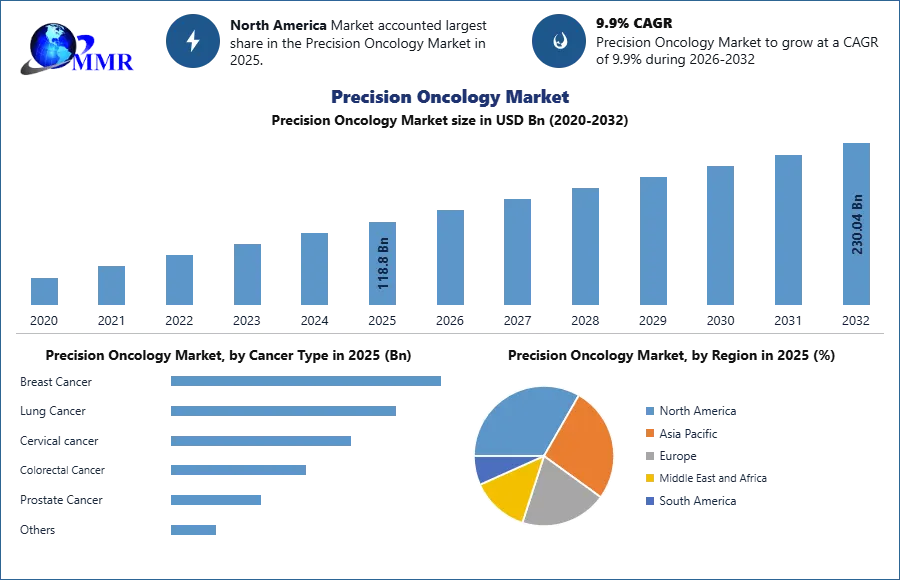
Global Precision Oncology Market is worth USD 118.8 billion in 2025 and is estimated to grow at a CAGR of 9.9% in the forecasted period. The forecasted revenue hints at a growth of around 230.40 billion USD by 2032.
Precision Oncology is increasingly essential in modern cancer care. Globally, cancer remains a leading cause of death, with an estimated 20 million new cases and 9.7 million deaths in 2024. Around 53.5 million people survived cancer within 5 years of diagnosis, but mortality rates remain concerning, with about 1 in 9 men and 1 in 12 women succumbing to the disease. Precision oncology involves analyzing tumor molecular profiles to target specific alterations and tailoring treatment plans to individual genetic characteristics. This approach, leveraging patients' genetics for personalized treatment, marks a significant advancement in cancer therapy. As precision oncology gains prominence, it is expected to play an increasingly central role in mainstream oncology practice, driven by the growing global cancer burden. Hence, the rising prevalence of cancer across the globe is anticipated to augment the need for precision oncology, thereby driving the precision oncology market growth during the forecast period.
 To know about the Research Methodology :- Request Free Sample Report
In addition, Continuous advancements in genomic sequencing technology drive the precision oncology industry growth. The United States leads the global precision oncology market thanks to its advanced healthcare infrastructure along with substantial investments in research and development. Canada is expected to be a world leader by 2030 in the precision medicine cancer therapies sector, presumed governments ease access hurdles. The precision oncology market in Canada holds significant promise due to its advanced research infrastructure and public healthcare system. However, barriers to accessing precision therapies and biomarker testing hinder the Canadian precision oncology market size. Fragmented healthcare delivery across provinces and territories leads to unequal access to treatments, while delays in clinical trial processes impede innovation. Streamlining health systems, aligning funding with value-based care, and fostering collaboration between governments and patient groups are essential for Canada to realize its potential as a lucrative region for precision oncology advancements.
Growth Drivers in Precision Oncology Market
The global prevalence of cancer has risen, which has been an important driver for the market. Precision oncology offers the potential to tailor the treatments based on the unique characteristics of individual tumours, leading to improved treatment outcomes. Technologies like Immunotherapy and Gene editing have shown tremendous progression which indirectly impacted the Precision Oncology market in a positive way. The understanding of biology and molecular mechanisms behind cancer genesis and progression has considerably improved. With more information, it is now possible to identify particular genetic mutations, changes, and biomarkers that can be specifically targeted by precision oncology treatments. Thus, precision and accuracy in oncology medicines have given the market a positive boost. To support the growth and development of precision oncology market many government organisations have offered help and assistance in various researches. Example - The United States government is investing in precision oncology through a number of initiatives, including the Cancer Moonshot, the Precision Medicine Initiative, and the National Cancer Institute, while European Union government is investing in Innovative Medicines Initiative and the Horizon 2020 research program.
Challenges in Precision Oncology Market
The most crucial challenge for the Precision Oncology market is cost. The high cost of these technologies and treatments can limit their accessibility, particularly in resource-limited healthcare settings. Affordability and reimbursement issues present challenges for patients, healthcare systems which becomes a challenge for the market. Another concern the industry faces is regarding Data interpretation and analysis. Precision oncology generates vast amounts of complex genomic data, which requires sophisticated bioinformatics tools and expertise for interpretation. Analysing and integrating these large datasets is a significant challenge. The challenge here is not in analysing the complex data, but also in building sustainable bioinformatics tools which can simplify all this data. Also, tumours are highly heterogeneous, thus they harbour multiple genetic alterations and evolve over time, leading to treatment resistance and disease progression. Developing strategies to address tumour heterogeneity and overcome resistance mechanisms is a significant challenge in precision oncology.
Trends in Precision Oncology Market
The use of AI is going to be the most crucial phase of the precision oncology market. AI-driven tools can aid in biomarker discovery, drug development, and treatment optimization. AI can also help in simplifying the complex data at ease and also can function in analysing patterns, possible treatments, outcomes. AI powered treatment planning is assisting in predictive analysis. AI is being used to develop new algorithms that can predict how cancer cells will respond to treatment. Thus, the future of the market will depend on how AI can merge with the current market scenario. Immunotherapy has transformed cancer treatment, and ongoing research aims to enhance its efficacy and broaden its application. Combination therapies, such as combining immune checkpoint inhibitors with other targeted therapies hold promise in improving response rates. Gene editing plays a huge part in precision oncology and with advancements in the Gene editing technologies, they offer the potential to directly modify cancer-related genes and correct genetic abnormalities. Gene editing techniques can be used to develop novel therapies, enhance the effectiveness of existing treatments, and explore gene function. Thus, AI, gene editing technologies and Combination therapies will dictate the trend of the precision oncology market in the future.
Precision Oncology Market Segmentation:
Therapeutics held the largest share for Precision Oncology Market in 2025. delivering personalized cancer treatments based on the genetic and molecular characteristics of a patient’s tumor. Targeted therapies, immunotherapies, and molecularly guided drugs are widely used to improve treatment effectiveness and reduce side effects compared to conventional chemotherapy. The rapid development of biomarker-based drugs and the increasing number of regulatory approvals for targeted oncology therapies have further strengthened this segment. Pharmaceutical companies are heavily investing in research and development of precision-based cancer drugs, which is accelerating innovation and adoption in hospitals and cancer treatment centers. Additionally, the growing use of genomic testing to guide therapy selection is boosting demand for precision therapeutics. As a result, the therapeutics segment continues to dominate the precision oncology market due to its direct role in personalized cancer treatment and improved patient outcomes.
Breast Cancer is the dominated segment in the Precision Oncology Market in 2025. The high global prevalence of breast cancer and extensive research activities focused on this disease have contributed to its leading position. Precision oncology approaches such as genetic testing, biomarker identification, and targeted therapy are widely used in breast cancer diagnosis and treatment. Technologies including next-generation sequencing and companion diagnostics help identify specific genetic mutations, enabling physicians to select the most effective personalized therapies for patients. The availability of several targeted drugs and hormone-based treatments for breast cancer has further increased the adoption of precision medicine in this segment. In addition, strong screening programs and growing awareness about early cancer detection support the demand for precision oncology solutions in breast cancer management. Due to continuous advancements in personalized therapies and diagnostics, breast cancer remains the most dominant application segment in the precision oncology market.
Precision Oncology Market Regional Insights
North America dominated Precision Oncology Market in 2025. The strong market presence of key players like Illumina, Thermo Fisher Scientific has made it sure that the market leader remains the same. The region has advanced laboratory facilities, cutting-edge technologies, and a strong ecosystem of clinicians, researchers, and industry players. Its application use has been one of the best which has helped them sustain the market force. Next-generation sequencing (NGS) technologies, which are essential to precision oncology, were first used in North America. Comprehensive genomic profiling and the detection of useful genetic changes in cancer patients are made possible by NGS. Canada and Mexico have smaller market share as compared to US but are emerging markets in market.
Asia Pacific has been a growing market, especially after huge investments into the market. China, Japan, India have emerged as leaders in the market. According to the World Health Organization, China had an estimated 3.9 million new cancer cases and 2.3 million cancer deaths in 2024. Thus, China has huge market share of the industry. Increase in population and increase in patients both have made sure that the precision oncology market increase in Asia Pacific. Europe has been a traditional market for precision oncology. Developed countries like UK and Germany have made huge technological progress which have helped the market grow and sustain in a competitive environment. The growing adoption of molecular diagnostics is expected to drive the growth of the market in Europe. European Union has also invested heavily into the market which has made Europe a dominant force into research. Cancer is one of the leading causes of death in Switzerland, which is an emerging market in the oncology market.
The Middle East and Africa does not have a huge market share. There has been focus on developing a research environment especially in Saudi Arabia and UAE. The Saudi government launched the Saudi National Precision Medicine Strategy to accelerate the development and application of precision medicine in Saudi Arabia. The major players in the Saudi Arabia precision oncology market are Roche, Novartis, Pfizer, AstraZeneca, and Merck. These companies are investing in research and development to develop new precision oncology products. They are also expanding their geographic reach to tap into the growing market opportunities in Saudi Arabia. South America is an emerging market. Brazil has a well-established pharmaceutical and biotechnology industry, supported by strong research and development capabilities. Argentina has focused on innovation, research and development, and quality manufacturing process. Columbia has been investing in healthcare from past decade, which gives it an opportunity to have similar market share as of that of Brazil and Argentina. Other countries like Peru, Chile are also slowly gaining a higher market share.
Precision Oncology Market: Competitive Landscape
The precision oncology market has seen huge growth, especially after increase in oncological studies. The market has seen a positive growth and many emerging markets like India and Japan have made sure that the market diversifies. North America is the market leader as US has nearly 44% of market share due to heavy infrastructural investments. Top companies like Pfizer, Johnson & Johnson have made sure that US holds onto that market share. Europe has 2nd highest market share after US and countries like UK (AstraZeneca), Germany (Merck) and Switzerland (Roche) have made sure that the precision oncology market progresses in Europe. Asia Pacific has shown the highest market growth and is expected to rise in future.
Recent Developments
15 January 2026 – Illumina, Inc.
Illumina announced advancements in its next-generation sequencing (NGS) platforms aimed at expanding the adoption of precision oncology in clinical settings. The company introduced improved genomic testing solutions that enable faster and more accurate identification of cancer-related genetic mutations. These developments support oncologists in selecting personalized treatment strategies for patients. The initiative strengthens Illumina’s role in precision medicine by enhancing genomic analysis capabilities, which are essential for targeted therapy selection and the development of personalized cancer treatment approaches.
10 October 2025 – Guardant Health, Inc.
Guardant Health reported progress in the adoption of its liquid biopsy tests used for early cancer detection and treatment monitoring. The company expanded clinical applications of its blood-based genomic testing platforms that analyze circulating tumor DNA. These technologies allow physicians to identify genetic alterations without invasive tissue biopsies. The development supports the broader growth of precision oncology by improving real-time cancer monitoring and enabling personalized treatment decisions based on a patient’s evolving tumor genetic profile.
Precision Oncology Market Scope: Inquire before buying
| Precision Oncology Market | |||
|---|---|---|---|
| Report Coverage | Details | ||
| Base Year: | 2025 | Forecast Period: | 2026-2032 |
| Historical Data: | 2020 to 2025 | Market Size in 2025: | 118.8 USD Bn |
| Forecast Period 2026-2032 CAGR: | 9.9% | Market Size in 2032: | 230.04 USD Bn |
| Segments Covered: | by Product Type | Diagnostics Therapeutics |
|
| by Cancer Type | Breast Cancer Lung Cancer Cervical cancer Colorectal Cancer Prostate Cancer Others |
||
| by Biomarker Type | Genomics Transcriptomics Proteomics Epigenomics Pharmacogenomics Others |
||
| by Therapy Type | Targeted Therapy Immunotherapy Hormone Therapy Chemotherapy Radiotherapy Others |
||
| by Application | Diagnostics Prognostics Therapeutics Drug Development & Clinical Trials Monitoring & Recurrence Detection Others |
||
| by End User | Pharmaceutical & Biotechnology Companies Diagnostic Centres Healthcare Data Companies Others |
||
Precision Oncology Market, by Region
North America (United States, Canada and Mexico)
Europe (UK, France, Germany, Italy, Spain, Sweden, Austria and Rest of Europe)
Asia Pacific (China, South Korea, Japan, India, Australia, Indonesia, Malaysia, Vietnam, Taiwan, Bangladesh, Pakistan and Rest of APAC)
Middle East and Africa (South Africa, GCC, Egypt, Nigeria and Rest of ME&A)
South America (Brazil, Argentina Rest of South America)
Key players/Competitors profiles covered in the Precision Oncology Market report in a strategic perspective
1. Illumina, Inc. (United States)
2. Thermo Fisher Scientific, Inc. (United States)
3. Agilent Technologies, Inc. (United States)
4. Invitae Corporation (United States)
5. NeoGenomics Laboratories, Inc. (United States)
6. Bristol Myers Squibb Company (United States)
7. Pfizer Inc. (United States)
8. Amgen Inc. (United States)
9. Merck & Co., Inc. (United States)
10. Eli Lilly and Company (United States)
11. Genomic Health, Inc. (United States)
12. Foundation Medicine, Inc. (United States)
13. Guardant Health, Inc. (United States)
14. Myriad Genetics, Inc. (United States)
15. Exact Sciences Corporation (United States)
16. NanoString Technologies, Inc. (United States)
17. Guardant Health, Inc. (United States)
18. F. Hoffmann-La Roche Ltd (Switzerland)
19. Bayer AG (Germany)
20. AstraZeneca plc (United Kingdom)
21. Novartis AG (Switzerland)
22. Roche Holding AG (Switzerland)
23. Qiagen N.V. (Netherlands)
24. Sysmex Corporation (Japan)
25. Dasa (Brazil)