
Polyfluoroalkyl Substances (PFAS) Waste Management Market – Global Market Size, Strategic Growth Drivers, Risk Assessment Framework, Regulatory Landscape Review, Competitive Intensity Mapping & Long-Term Industry Outlook to 2032
Overview
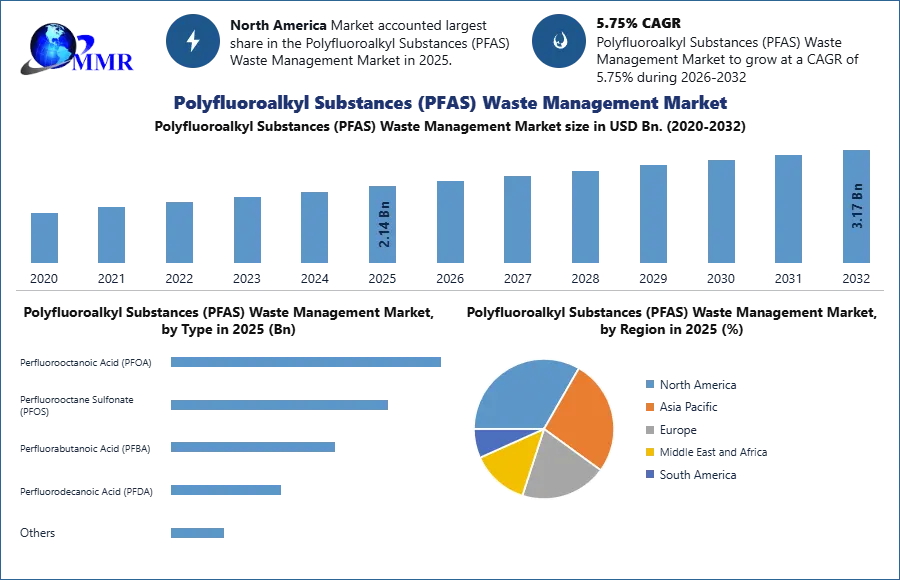
Polyfluoroalkyl Substances (PFAS) Waste Management Market size was valued at USD 2.14 billion in 2025 and is expected to reach USD 3.17 billion by 2032, at a CAGR of 5.75%.
Polyfluoroalkyl Substances (PFAS) Waste Management Market Overview
Per- and polyfluoroalkyl substances (PFAS) are man-made chemicals that have been used in various consumer products. They are found in items like non-stick cookware, stain-resistant fabrics, food packaging, and firefighting foam. PFAS are known for their strong carbon-fluorine bonds, which make them very resistant to breaking down in the environment.
The Polyfluoroalkyl Substances (PFAS) Waste Management Market is witnessing substantial growth driven by the development of advanced remediation technologies and increasing regulatory pressures. Traditional methods like incineration and landfilling have proven inadequate for breaking down PFAS compounds due to their strong carbon-fluorine bonds, leading to persistent environmental contamination. This has spurred significant research and development efforts, resulting in the adoption of innovative technologies such as advanced oxidation processes (AOPs), ion exchange, and granular activated carbon (GAC) filtration, which are more effective in capturing and eliminating PFAS.
The polyfluoroalkyl substances (PFAS) waste management market is segmented based on type, process, and source. Among the types, Perfluorooctanoic Acid (PFOA) held the largest market share in 2025, driven by its widespread use in industrial applications and the extensive environmental contamination it causes. PFOA is widely used in products like non-stick cookware, waterproof coatings, and stain-resistant fabrics, and its high toxicity and persistence in the environment have necessitated comprehensive waste management efforts.
Regionally, North America dominated the PFAS Waste Management Market in 2025, holding a significant market share due to its rigorous regulatory environment and proactive measures to manage PFAS contamination. The United States, in particular, has implemented stringent regulations for PFAS levels in drinking water, soil, and waste, leading to increased demand for advanced waste management solutions. Key players like Veolia North America and Clean Harbors are leading the market with their sophisticated treatment methods, such as GAC and high-pressure reverse osmosis (RO).
To know about the Research Methodology :- Request Free Sample Report
Polyfluoroalkyl Substances (PFAS) Waste Management Market Dynamics:
Development Of Advanced PFAS Remediation Technologies Drives the Growth of Polyfluoroalkyl Substances (PFAS) Waste Management Market
The development of advanced PFAS remediation technologies significantly drives the growth of the Polyfluoroalkyl Substances (PFAS) Waste Management Market. Traditional waste management methods, such as incineration and landfilling, have been largely ineffective in breaking down PFAS compounds due to their strong carbon-fluorine bonds, which are among the strongest in organic chemistry. This limitation has prompted significant research and development efforts to create more advanced and specialized remediation technologies capable of effectively removing or degrading PFAS from contaminated environments. Emerging technologies like advanced oxidation processes (AOPs), ion exchange, and granular activated carbon (GAC) filtration have shown greater efficacy in capturing and eliminating PFAS from water sources, which makes them increasingly popular in both industrial and municipal applications. Additionally, innovative approaches such as plasma treatment and electrochemical oxidation are being developed to degrade PFAS at the molecular level, offering the potential for complete mineralization of these compounds. The adoption of these cutting-edge technologies is driving market growth by enabling more efficient and cost-effective remediation solutions, thereby meeting the growing demand for effective PFAS waste management in response to stringent environmental regulations and public health concerns.
Moreover, combining different treatment technologies into a “treatment train” is emerging as an effective strategy. This approach integrates both non-destructive and destructive methods to achieve more thorough and efficient PFAS removal. Additionally, advancements in artificial intelligence and machine learning are being applied to optimize these treatment processes, making them more effective and tailored to specific PFAS contamination scenarios. These developments represent a promising step forward in the fight against PFAS pollution, offering more effective ways to protect both human health and the environment.
Challenges And Innovative Solutions in Polyfluoroalkyl Substances (PFAS) Waste Management
The growing regulations around per- and polyfluoroalkyl substances (PFAS) reflect rising concerns about their widespread use and environmental impact. Since their development in the 1930s, PFAS have been used in a variety of consumer products due to their heat resistance, oil repellence, and waterproofing qualities. However, these same properties make PFAS resistant to degradation, leading to their accumulation in the environment. Landfills and wastewater treatment plants, while crucial for managing waste, are often the "passive receivers" of PFAS-containing waste. They face significant challenges in managing PFAS due to the difficulty of breaking down these substances. For instance, while municipal solid waste (MSW) landfills do a good job of isolating PFAS, they still deal with PFAS in leachate and landfill gas, which need proper treatment to prevent environmental contamination.
To address these challenges, landfill and wastewater treatment plant operators are adopting various strategies. One key step is testing leachate (the liquid that drains from landfills) for PFAS levels, which helps them get ready for future regulations. Advanced treatment methods are also being used to remove PFAS more effectively. These methods include using granular activated carbon (GAC), high-pressure reverse osmosis (RO), and foam fractionation. These techniques concentrate on PFAS, which then need to be properly disposed of. In New York, Parsons Corp. has been investigating PFAS contamination in groundwater around inactive landfills, highlighting the widespread presence of these substances. Additionally, establishing formal partnerships between landfills and wastewater treatment plants could improve PFAS management. Such collaborations might involve landfills managing biosolids from treatment plants in exchange for leachate treatment, supporting more effective and coordinated PFAS remediation efforts.
Effective management of polyfluoroalkyl substances (PFAS) in landfills and wastewater treatment plants is essential to address the environmental and regulatory challenges of the polyfluoroalkyl substances (PFAS) waste management market.
Polyfluoroalkyl Substances (PFAS) Waste Management Market Segment Analysis:
Based On Type, Polyfluoroalkyl Substances (PFAS) Waste Management Market is segmented into Perfluorooctanoic Acid (PFOA), Perfluorooctane Sulfonate (PFOS), Perfluorabutanoic Acid (PFBA), Perfluorodecanoic Acid (PFDA) and Others. The Perfluorooctanoic Acid (PFOA) segment dominated the PFAS Waste Management Market in 2025 with the largest market share . This is due to its widespread use in industrial applications and extensive environmental contamination. PFOA is widely used to produce non-stick cookware (Teflon), waterproof coatings, and stain-resistant fabrics. Its high toxicity and long-term persistence in the environment have required comprehensive waste management efforts, making PFOA a major focus in the Polyfluoroalkyl Substances (PFAS) waste management market.
PFOA is extremely persistent in the environment and is now detectable in bodies of water, soils, and even human blood. This Widespread contamination requires significant waste management efforts to mitigate the impact of PFOA on the environment and public health. Regulatory agencies particularly in US and Europe, have established strict guidelines and regulations to manage PFOA contamination. For Instance, The US Environmental Protection Agency (EPA) has set a drinking water health advisory limit of 70 parts per trillion for PFOA and PFOS combined, which has led to an increased demand for waste management services to clean contaminated water sources.
Polyfluoroalkyl Substances (PFAS) Waste Management Market Regional Analysis:
In 2025, North America dominated the Polyfluoroalkyl Substances (PFAS) Waste Management Market, holding a significant market share. North American Polyfluoroalkyl Substances (PFAS) Waste Management industry has seen significant growth due to the region’s rigorous regulatory environment and proactive measures to manage PFAS contamination. The United States has implemented string regulations and guidelines to manage PFAS levels in drinking water, soil, and waste. For instance, The US Environmental Protection Agency (EPA) has set a drinking water health advisory limit of 70 parts per trillion for PFOA and PFOS combined, which has led to an increased demand for waste management services to clean contaminated water sources. Large companies such as Veolia North America and Clean Harbors play crucial role with their sophisticated methods such as granular activated carbon (GAC) and high-pressure reverse osmosis (RO).
Recent Industry Developments (2025–2026)
| Exact Date | Company | Development | Impact |
|---|---|---|---|
| 11 December 2025 | Thailand DPC | Thailand’s Department of Pollution Control launched a nationwide groundwater survey to map PFAS levels and prepare for new waste management regulations. | This initiative signals a regulatory shift in Southeast Asia, opening new opportunities for global remediation technology providers. |
| 29 September 2025 | Gradiant | Gradiant deployed its ForeverGone PFAS destruction platform at Munich International Airport to eliminate "forever chemicals" at the source. | The deployment validates on-site electrochemical oxidation as a viable alternative to traditional "capture and dispose" methods like GAC. |
| 12 August 2025 | Axine Water Technologies | Axine secured a Can$30 million funding round to accelerate the global commercialization of its electrochemical PFAS destruction technology. | This capital injection scales the competitive availability of non-incineration destruction technologies for industrial wastewater treatment. |
Polyfluoroalkyl Substances (PFAS) Waste Management Market Competitive Landscape
The Polyfluoroalkyl Substances (PFAS) Waste Management Market is highly competitive, with global and regional players vying for market share. Some of the major key players are Veolia North America, Clean Harbors, Inc., Evoqua Water Technologies LLC, and OPEC Systems. These companies have extensive experience in waste management and environmental services. They are known for their robust infrastructure, advanced processing technologies, and full-service offering which include GAC and RO and other innovative methods for PFAS remediation. Emerging players in the Market are small businesses and startups that are rapidly gaining attention due to their innovative approaches. They Often Focus on specialized areas such as advanced filtration, PFAS detection, or environment-friendly disposal methods.
Polyfluoroalkyl Substances (PFAS) Waste Management Market Scope: Inquire Before Buying
| Polyfluoroalkyl Substances (PFAS) Waste Management Market | |||
|---|---|---|---|
| Report Coverage | Details | ||
| Base Year: | 2025 | Forecast Period: | 2026-2032 |
| Historical Data: | 2020 to 2025 | Market Size in 2025: | 2.14 USD Bn. |
| Forecast Period 2026-2032 CAGR: | 5.75% | Market Size in 2032: | 3.17 USD Bn. |
| Segments Covered: | by Type | Perfluorooctanoic Acid (PFOA) Perfluorooctane Sulfonate (PFOS) Perfluorabutanoic Acid (PFBA) Perfluorodecanoic Acid (PFDA) Others |
|
| by Process | Landfilling Incineration Chemical Oxidation Others |
||
| by Source | Industrial Construction Municipal Others |
||
Polyfluoroalkyl Substances (PFAS) Waste Management Market, by Region:
North America (United States, Canada, Mexico)
Europe (UK, France, Germany, Italy, Spain, Sweden, Austria, Turkey, Russia and Rest of Europe)
Asia Pacific (India, China, Japan, South Korea, Australia, ASEAN, and Rest of APAC)
Middle East and Africa (South Africa, GACC, Egypt, Nigeria, and Rest of ME & A)
South America (Brazil, Argentina, Columbia, and Rest of South America)
Key Players / Competitors Profiles Covered in Brief in Global Polyfluoroalkyl Substances (PFAS) Waste Management Market Report in Strategic Perspective:
- Veolia North America
- Clean Harbors, Inc.
- Evoqua Water Technologies LLC
- OPEC Systems Pty Ltd
- Clean Management Environmental Group, Inc.
- Wanless Waste Management
- Newterra
- WSP
- Republic Services, Inc.
- Tetra Tech Inc.
- Jacobs Engineering Group
- Arcadis NV
- AECOM
- Golder Associates
- Wood PLC
- Ship and Shore Environmental Inc.
- BETA Group
- Enviropacific
- TRS Group
- GWT (Genesis Water Technologies)
- Ventia
- Clean Earth
- Synergen Met Ltd
- Revive Environmental
- Saltworks Technologies Inc.