Pocket Knives Market – Industry Structure Evaluation, Demand Drivers Analysis, Regional Growth Analysis and Identification, Competitive Positioning Review & Global Market Size Forecast to 2034

5.7%
CAGR (2026-2034)
698.63 USD Bn.
Forecast Market Size
313
Report Pages
120
Market Tables

Overview

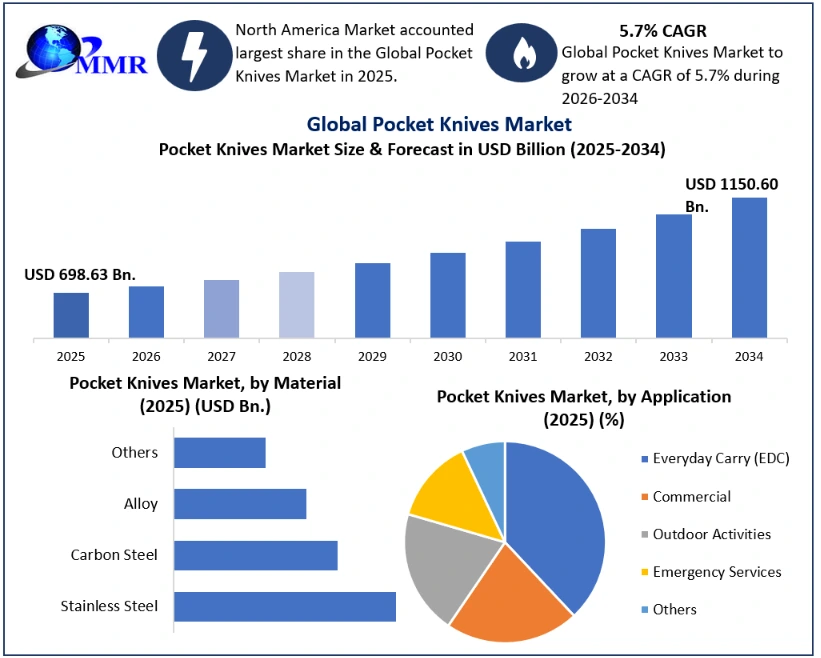
Pocket Knives Market size was valued at USD 698.63 Bn. in 2025 and the total Pocket Knives revenue is expected to grow by 5.7 % from 2026 to 2034, reaching nearly USD 1150.60 Bn.

Pocket Knives Market Overview:

The Pocket Knives are folded, small, with one or more blades, also known as penknife and folding knives. The length of the blade typically ranges from 2 inches to 6 inches. It is mostly used as same as a knife but with the advantages of folding and carrying in a pocket easily with the blade not exposed. Pocket knives have remained a popular piece of equipment for mankind, few things are more useful and versatile as it uses for household, cooking, outdoor activities, and others. Pocket knives are used as an emergency tool for self-defense, opening packages, and envelopes, fishing, hunting, cutting rope, etc. As a result, the demand for the Pocket Knives Market increases.

Pocket Knives Market Growth OutlookPocket Knives Market Growth
To know about the Research Methodology :- Request Free Sample Report

Pocket Knives Market Dynamics

Inclusion of multi-purpose features drives the Pocket Knives Market

Pocket knife manufacturers include many multi-purpose features like magnifying glasses, compasses, forks and spoons, USBs, wrenches, etc. These are made for specific tasks, pocket knives give durability, portable, appealing designs, and sharpness which rises the popularity. Cutting food, rope, and packaging, opening boxes, scraping off stickers, pruning shrubs, digging in the dirt, cleaning fish, and whatever else might require an all-purpose tool which required for mankind. Multi-tools are pocket-sized tools & Swiss Army Knives that feature a variety of fold-out blades and other tools such as screwdrivers, bottle openers, scissors, saws, and more.

It is made up of stainless steel and has different shapes and styles. Swiss Army Knives & Multi-tools are designed to be lightweight and portable which has been used in a variety of tasks. A pocket knife is made up of high-quality materials that are widely available, a pocket knife can also save one's life. The easy availability of knives increases market growth As a result, there is an increasing demand for Pocket Knives Market.

Restraints

Affecting the growth of the market because it’s illegal to use

Improper use of a pocket knife results in injury or harm to oneself or others. A folding knife is not as safe or strong as a regular knife. In some countries, carrying a pocket knife is restricted or even illegal. It requires regular maintenance for preventing corrosion or rust and to keep the blade sharp. Many pocket knives have a blade length limit, which is insufficient for some tasks. In some places, pocket knives are illegal. For instance, in Japan, you’re not allowed to carry or own a knife with a blade longer than 6 cm. These are factors that affect the Pocket Knives Market growth.

Opportunities

Growing Demand for Personalised and Lightweight Pocket Knives

Demand for Pocket Knives Market is growing because the market’s key players have customized pocket knives that are very convenient for consumers. Pocket knives are used in camping vacations because of their versatility. Consumers prefer smaller folding knives and larger multi-blade tools while camping. Manufacturers create knives made from lightweight raw materials such as High-Quality Stainless Steel, ceramic, titanium, plastic blade, etc. Single-blade pocket knives, multi-blade pocket knives, and Swiss army knives are versatile and handy which makes a popular choices among consumers. Advancements in the technology of pocket knives with enhanced features such as LED lights, GPS, and built-in fire starters. Outdoor activities like hiking, camping, and fishing increase the popularity and demand of the Pocket Knives Market. The major players that operating in the global pocket knives are Spyderco, Microtech Knives, etc.

Pocket Knives Market Segment Analysis:

Based on Type, Single-blade pocket knives have dominated the year 2025 and are expected to dominate during the forecast period. Single-blade knives are focusing on the design of a single but bigger blade. The benefit of single-blade pocket knives is that it has larger blades because the focus is on one blade only. Single-blade knives are ideal for the ones who searching for a strong knife. Single-blade pocket knives have durability, easy usage, and lightweight features, which are convenient to carry around as compared to multi-tool. Considering the locking mechanism that gives reliable strength, and safety enables it to use for tasks that require a lot of force. These factors help the growth of the market Pocket Knives Market.

Based on the Distribution Channel, Offline channels had the largest market share revenue in the year 2025 and are expected to have the largest share during the forecast period. Pocket knives are easily available for customers. A variety of stores have a presence of pocket knives domestically and internationally. Types of knives such as both single-blade and multiple-blade models are available in this type of store. Manufacturers encourage supermarket and hypermarket chains to sell their own products through these channels and offer special discounts as a result, which helps boost the demand for pocket knives. As a result, the growth of offline channels in various areas opens up lucrative opportunities for the expansion of the Pocket Knives Market.

Pocket Knives Market Regional Insights:

North America has the highest market share in the year 2025 and is expected to dominate during the forecast period. The U.S. owned a high demand for pocket knives and consumers are increasingly adopting Multi-tools and Swiss Army Knives because of their functionality along with single or multiple blades which are used for different tasks like cutting ropes, opening cans, etc. Asia-Pacific is expected to grow the Pocket Knives Market as the number of crimes is increasing in many countries like Malaysia, China, India, and Japan. The Asia-Pacific region has an increasing market across the world which means a rise in the demand for Pocket Knives Market after North America.

Pocket Knives Market Recent Development

Date Company Development Impact
13 January 2025 Victorinox Victorinox officially rolled out its Alox Limited Edition 2025 pocket knife series, debuting a distinctive "Stone Red" colorway across its Classic SD, Pioneer X, and Evoke models. This launch addresses consumer demand for premium everyday carry tools by incorporating embossed, anodized aluminum scales that offer exceptional wear and corrosion resistance.
14 July 2025 Leatherman Leatherman announced the launch of its brand-new Blazer and Glider folding knives, expanding its product line beyond traditional multi-tools into dedicated everyday carry (EDC) pocket knives. This strategic release strengthens the brand's position in the dedicated folding knife segment by offering specialized, USA-made cutting tools tailored for individual portability.
07 October 2025 Leatherman Leatherman unveiled details for its advanced Wave Alpha utility platform, upgrading its bestselling design with a premium MagnaCut steel blade and lightweight G10 handle scales. The adoption of MagnaCut metallurgy significantly elevates the product's edge retention and structural resilience, targeting high-end tool consumers.
08 January 2026 CRKT CRKT (Columbia River Knife & Tool) unveiled its comprehensive 2026 product collection, showcasing the lightweight Counterpart series designed by Ken Onion and the premium Sero pocket knife. The inclusion of CPM S35VN stainless steel and crossbar locks elevates the brand's portfolio into the premium EDC sector, providing improved mechanical durability and smooth deployment.
22 May 2026 Leatherman Leatherman officially introduced the ARC Talos premium multi-tool edition to the market, featuring ultra-durable Cerakote handle finishes. This rollout captures growing consumer interest in ultra-rugged, weather-resistant everyday carry options equipped with premium MagnaCut steel components.

Pocket Knives Market Scope: Inquire before buying

Pocket Knives Market
Report Coverage Details
Base Year: 2025 Forecast Period: 2026-2034
Historical Data: 2020 to 2025 Market Size in 2025: US$ 698.63 Bn.
Forecast Period 2026 to 2034 CAGR: 5.7% Market Size in 2034: US$ 1150.60 Bn.
Segments Covered: by Type Traditional Folding Pocket Knives
Modern Folding Pocket Knives
Slip Joint Pocket Knives
Multi-Blade Pocket Knives
Swiss Army-Style Pocket Knives
Multi-Tool Pocket Knives
Other Pocket Knives
by Distribution Channels Online (E-commerce)
Offline
Hypermarkets/Supermarkets
Convenience Stores
Specialty Stores
Others
by Material Stainless Steel
Carbon Steel
Alloy
Others
by Application Everyday Carry (EDC)
Commercial
Outdoor Activities
Emergency Services
Others

Pocket Knives Market by Region

North America (United States, Canada, and Mexico)
Europe (UK, France, Germany, Italy, Spain, Sweden, Austria, and the Rest of Europe)
Asia Pacific (China, South Korea, Japan, India, Australia, Indonesia, Malaysia, Vietnam, Taiwan, Bangladesh, Pakistan, and the Rest of APAC)
Middle East and Africa (South Africa, GCC, Egypt, Nigeria, and the Rest of ME&A)
South America (Brazil, Argentina Rest of South America)

Pocket Knives Market Key Players

North America
1. Spyderco, Inc.
2. Benchmade Knife Company, Inc.
3. Kai USA Ltd. (Kershaw / Zero Tolerance) (Kai Corporation)
4. Cold Steel, Inc. (GSM Outdoors, LLC — acquired 2020)
5. Buck Knives, Inc.
6. Columbia River Knife & Tool (CRKT)
7. W.R. Case & Sons Cutlery Company (Zippo Manufacturing Company)
8. Gerber Gear (Fiskars Group)
9. Hogue, Inc.
10. SOG Specialty Knives & Tools, LLC
11. Chris Reeve Knives
12. Pro-Tech Knives
13. Knafs LLC
14. Leatherman Tool Group, Inc.
15. Al Mar Knives, Inc.
16. Ontario Knife Company
17. Schrade (Taylor Brands LLC)
18. Rosecraft Blades
19. Jack Wolf Knives
20. Microtech Knives, Inc.
21. TOPS Knives
22. ESEE Knives (Randall's Adventure & Training, LLC)
Others
Europe
23. Victorinox AG
24. Wenger SA (Victorinox AG — acquired 2005)
25. Opinel SA
26. Böker (Heinrich Böker Baumwerk GmbH & Co. KG)
27. Fällkniven AB
28. Morakniv (Mora of Sweden AB)
29. Allday Goods
30. Martor KG
31. Lionsteel S.r.l.
32. Extrema Ratio S.r.l.
Others
Asia Pacific
33. Kai Corporation
34. WE Knife Co., Ltd.
35. Civivi (WE Knife Co., Ltd.)
36. Kizer Cutlery
37. Reate Knives
38. QSP Knife
39. Bestech Knives
40. Sanrenmu (Zhejiang Sanmu Industry & Trade Co., Ltd.)
41. GANZO (Fujian Ganzo Group)
Others

Frequently Asked Questions:

1] What segments are covered in the Global Pocket Knives Market report?
Ans. The segments covered in the Pocket Knives Market report are based on Type, Distribution Channels, Materials, Applications, and Regions.

2] Which region is expected to hold the highest share in the Global Pocket Knives Market?
Ans. The North American region is expected to hold the highest share of the Pocket Knives Market.

3] What is the market size of the Global Pocket Knives Market by 2034?
Ans. The market size of the Pocket Knives Market by 2034 is expected to reach US$ 1150.60 Bn.

4] What is the forecast period for the Global Pocket Knives Market?
Ans. The forecast period for the Market is 2026-2034.

5] What was the market size of the Global Pocket Knives Market in 2025?
Ans. The market size of the Pocket Knives Market in 2025 was valued at US$ 698.63 Bn.

Table of Contents

1.SECTION A – GLOBAL POCKET KNIVES MARKET INTRODUCTION 1.1 Executive Market Landscape and Industry Overview 1.1.1 Global Pocket Knives Market Size (Value USD Billion & Volume in 000' Units), 2025–2034 1.1.2 Historical Market Size Trends and Growth Momentum Across Pocket Knives Industry 1.1.3 Global Pocket Knives Market Development from Traditional Utility to Modern EDC Applications 1.1.4 Evolution of Everyday Carry (EDC) Pocket Knives as a Distinct Market Segment 1.1.5 Historical Emergence and Commercial Significance of the EDC Pocket Knives Segment 1.1.6 U.S. EDC Pocket Knives Market Development and Adoption Trends 1.1.7 Global EDC Culture Expansion and Influence on Pocket Knife Demand 1.1.8 CAGR Analysis of Global Pocket Knives Market (2025–2034) 1.2 Pocket Knives Market Dynamics 1.2.1 Pocket Knives Market Trends 1.2.2 Pocket Knives Market Dynamics 1.2.3 Drivers 1.2.4 Restraints 1.2.5 Opportunities 1.2.6 Challenges 1.2.7 PORTER’s Five Forces Analysis 1.2.8 PESTLE Analysis 1.3 Pocket Knife Pricing Structure and Value Chain Profitability Assessment 1.3.1 Comprehensive Breakdown of Pocket Knife Cost Structure Across Value Chain 1.3.2 Margin Distribution Among Knife Manufacturers, Component 1.3.3 Suppliers, Distributors, Retailers, and E-Commerce Platforms 1.3.4 Impact of Steel, Handle Materials, and Component Costs on Pocket Knife Pricing 1.3.5 Influence of Blade Steel Grade and Manufacturing Complexity on Pricing 1.3.6 Premiumization and High-End EDC Knife Pricing Trends 1.3.7 Impact of Customization and Limited-Edition Production on Pricing 1.3.8 Role of Direct-to-Consumer Sales in Value Chain Profitability 1.4 Knife Materials, Components, and Supplier Ecosystem Dynamics 1.4.1 Blade Steel Sourcing and Supplier Dependency Assessment 1.4.2 Stainless Steel, Carbon Steel, Powder Steel, and Specialty Steel Demand 1.4.3 Handle Material Trends Across G10, Micarta, Carbon Fiber, Titanium, Aluminum, and Polymer 1.4.4 Pocket Clip, Pivot, Locking Mechanism, and Hardware Component Supply 1.4.5 Heat Treatment and Blade Finishing Technology Ecosystem 1.4.6 Supplier Concentration and Component Procurement Risks 1.4.7 Impact of Material Quality on Blade Performance and Durability 1.5 Everyday Carry (EDC) Pocket Knives Market Development and Significance 1.5.1 Definition and Scope of Everyday Carry (EDC) Pocket Knives 1.5.2 Historical Development of EDC Culture and Pocket Knife Adoption 1.5.3 Transition from Traditional Pocket Utility to Modern EDC Lifestyle 1.5.4 Timeline of EDC Pocket Knife Market Development 1.5.5 Key Milestones in U.S. EDC Market Commercialization 1.5.6 Expansion of EDC Culture Across Global Markets 1.5.7 EDC Enthusiast Communities and Influence on Product Demand 1.6 EDC Pocket Knife Demand Drivers and Consumer Adoption 1.6.1 Growing EDC Culture and Daily Utility-Oriented Consumer Behavior 1.6.2 Demand for Compact and Portable Utility Tools 1.6.3 Increasing Interest in Functional Everyday Gear 1.6.4 Outdoor Recreation, Hiking, Camping, and Travel Activities 1.6.5 Growth of E-Commerce and Direct-to-Consumer Knife Brands 1.6.6 Social Media and Online EDC Communities Influencing Purchase Decisions 1.6.7 Premiumization and Consumer Willingness to Pay for Advanced Materials 1.7 EDC Consumer Preferences, Usage Patterns, and Purchase Behavior 1.7.1 Preferred Blade Length and Compact Knife Designs 1.7.2 Manual Folding Knife Preferences Among EDC Users 1.7.3 Blade Steel Preferences and Performance Expectations 1.7.4 Handle Material and Ergonomic Design Preferences 1.7.5 Pocket Clip and Carry Configuration Preferences 1.7.6 Locking Mechanism Preferences Across EDC Users 1.7.7 Price Sensitivity Across Budget, Mid-Range, and Premium EDC Segments 1.8 Pocket Knife Design Evolution and Product Innovation 1.8.1 Evolution of Traditional Folding Pocket Knife Designs 1.8.2 Modern EDC Folding Knife Design Development 1.8.3 Lightweight and Compact Knife Engineering 1.8.4 Flipper, Thumb Stud, and One-Hand Opening Mechanisms 1.8.5 Liner Lock, Frame Lock, Back Lock, and Compression Lock Innovations 1.8.6 Ergonomic Handle and Grip Design Improvements 1.8.7 Deep-Carry Pocket Clip and Concealed Carry-Oriented Design 1.9 Blade Materials, Manufacturing, and Production Technology 1.9.1 Advanced Powder Metallurgy Steel Adoption 1.9.2 CNC Machining in Premium Pocket Knife Manufacturing 1.9.3 Precision Grinding and Edge Geometry Optimization 1.9.4 Advanced Heat Treatment Technologies 1.9.5 Laser Cutting and Precision Component Manufacturing 1.9.6 PVD, DLC, Stonewash, and Other Blade Finishing Technologies 1.9.7 Additive Manufacturing and Prototyping Applications 1.10 Digital Transformation, E-Commerce, and EDC Community Dynamics 1.10.1 Growth of Online Pocket Knife Sales 1.10.2 Direct-to-Consumer EDC Knife Brand Expansion 1.10.3 Social Media Influence on EDC Product Discovery 1.10.4 YouTube, Instagram, Reddit, and Online Community Influence 1.10.5 Knife Reviews and Influencer Marketing Impact 1.10.6 Crowdfunding and Community-Driven Product Development 1.10.7 Online Limited Drops and Exclusive EDC Releases 1.11 Premiumization, Collectibility, and Lifestyle 1.11.1 Growth of Premium EDC Pocket Knives 1.11.2 Consumer Shift Toward High-Performance Blade Steels 1.11.3 Titanium, Carbon Fiber, and Premium Handle Material Adoption 1.11.4 Limited-Edition and Collaboration Knife Demand 1.11.5 Custom and Mid-Tech EDC Knife Market Development 1.11.6 Collectibility and Secondary-Market Activity 1.11.7 Knife Design as a Lifestyle and Fashion Accessory 1.12 Pocket Knife Installed Base and Replacement Demand 1.12.1 Global Installed Base of Pocket Knives in Active Use 1.12.2 U.S. EDC Pocket Knife User Base and Adoption Trends 1.12.3 Replacement Cycles Across Everyday Carry Users 1.12.4 Upgrade Demand Driven by New Blade Materials and Designs 1.12.5 Repeat Purchases Among EDC Enthusiasts and Collectors 1.12.6 Secondary Knife Ownership and Multi-Knife Carry Behavior 1.12.7 Wear, Damage, and Performance-Driven Replacement Demand 1.13 Pocket Knife Distribution, Retail, and Sales Channel 1.13.1 Specialty Knife Retailer Landscape 1.13.2 Outdoor and Sporting Goods Retail Distribution 1.13.3 Hardware and General Merchandise Retail Channels 1.13.4 E-Commerce and Online Marketplace Expansion 1.13.5 Direct-to-Consumer Brand Sales Models 1.13.6 Specialty EDC Retail and Community-Based Sales 1.13.7 Impact of Brick-and-Mortar Retail on Consumer Discovery 1.13.8 Online-Offline Omnichannel Distribution Strategies 1.14 Investment Trends and Capital Allocation Analysis 1.14.1 Investment Trends Across Pocket Knife Manufacturers 1.14.2 Capital Expenditure in Manufacturing Capacity Expansion 1.14.3 R&D Investment in Advanced Blade Materials and EDC Designs 1.14.4 Investment in Premium and High-Performance EDC Products 1.14.5 Strategic Investment in Regional Manufacturing Facilities 1.14.6 Investment in Direct-to-Consumer and E-Commerce Platforms 1.14.7 Mergers, Acquisitions, and Strategic Partnerships Across Knife Industry 1.15 Pocket Knife Lifecycle, Replacement, and Secondary Market Analysis 1.15.1 Pocket Knife Lifecycle from Design Through End of Use 1.15.2 Average Product Lifespan Across EDC Pocket Knives 1.15.3 Maintenance, Sharpening, and Refurbishment Practices 1.15.4 Replacement Demand Across Frequent EDC Users 1.15.5 Upgrading from Entry-Level to Premium EDC Knives 1.15.6 Secondary Market for Used and Collectible Pocket Knives 1.15.7 Limited-Edition Resale and Collector Value Trends 1.16 Seasonal Demand and Consumer Activity Analysis 1.16.1 Seasonal Pocket Knife Purchase Patterns 1.16.2 Outdoor Recreation and Seasonal EDC Demand 1.16.3 Holiday and Gift-Driven Pocket Knife Purchases 1.16.4 Hunting, Fishing, Camping, and Hiking Season Influence 1.16.5 Product Launch and Limited-Drop Demand Cycles 1.16.6 Black Friday and Promotional E-Commerce Demand 1.16.7 Seasonal Variation Across U.S. and International Markets 1.17 Regulatory Framework, Knife Laws, and Compliance Analysis 1.17.1 Global Regulatory Framework Governing Pocket Knife Ownership and Carry 1.17.2 U.S. Federal Regulations Affecting Pocket Knives 1.17.3 State-Level Knife Laws Across the United States 1.17.4 Blade Length Restrictions and Carry Regulations 1.17.5 Open Carry and Concealed Carry Requirements 1.17.6 Automatic, Assisted-Opening, and Gravity Knife Regulations 1.17.7 Restrictions Across Schools, Government Buildings, Airports, and Other Locations 1.17.8 International Knife Ownership and Carry Regulations 1.17.9 Regulatory Impact on EDC Product Design and Market Availability 1.18 Consumer Segmentation and EDC User Profile Analysis 1.18.1 EDC Enthusiasts and Knife Collectors 1.18.2 General Utility-Oriented Consumers 1.18.3 Outdoor and Recreation Users 1.18.4 Tradespeople and Professional Users 1.18.5 Hunting and Fishing Users 1.18.6 Travel and Adventure Consumers 1.18.7 Premium and Luxury EDC Consumers 1.18.8 Budget-Conscious EDC Users 1.18.9 Demographic and Geographic Characteristics of EDC Consumers 1.19 Emerging EDC Product Trends and Future Market Opportunities 1.19.1 Ultralight EDC Pocket Knife Development 1.19.2 Super-Steel and Advanced Blade Material Adoption 1.19.3 Compact and Low-Profile EDC Designs 1.19.4 Sustainable and Recycled Material Applications 1.19.5 Smart Manufacturing and Customization Technologies 1.19.6 Hybrid Pocket Tools and Multi-Function EDC Products 1.19.7 Growing Premium EDC and Collectible Knife Opportunities 1.19.8 Emerging EDC Communities and International Market Expansion 1.20 Regional Pocket Knives and EDC Market Development 1.20.1 North American Pocket Knife and EDC Market Development 1.20.2 U.S. EDC Pocket Knife Market Size and Adoption Trends 1.20.3 Canadian Pocket Knife Market Development 1.20.4 European EDC Culture and Pocket Knife Demand 1.20.5 Asia Pacific Pocket Knife Manufacturing and Consumer Market Development 1.20.6 Japan and South Korea Premium EDC Market Trends 1.20.7 China Pocket Knife Manufacturing and Export Landscape 1.20.8 India and Emerging Asian EDC Adoption 1.20.9 Latin American Pocket Knife and Outdoor Recreation Demand 1.20.10 Middle East and Africa EDC Market Development 1.21 Pocket Knives Market: Market size and Forecast by Segmentation (by Value USD Million and Volume in 000' Units) (2025-2034) 1.21.1 Pocket Knives Market Size and Forecast, By Type 1.21.1.1 Traditional Folding Pocket Knives 1.21.1.2 Modern Folding Pocket Knives 1.21.1.3 Slip Joint Pocket Knives 1.21.1.4 Multi-Blade Pocket Knives 1.21.1.5 Swiss Army-Style Pocket Knives 1.21.1.6 Multi-Tool Pocket Knives 1.21.1.7 Other Pocket Knives 1.21.2 Pocket Knives Market Size and Forecast, By Material 1.21.2.1 Stainless Steel 1.21.2.2 Carbon Steel 1.21.2.3 Alloy 1.21.2.4 Others 1.21.3 Pocket Knives Market Size and Forecast, By Application 1.21.3.1 Everyday Carry (EDC) 1.21.3.2 Commercial 1.21.3.3 Outdoor Activities 1.21.3.4 Emergency Services 1.21.3.5 Others 1.21.4 Pocket Knives Market Size and Forecast, By Distribution Channel 1.21.4.1 Online (E-commerce) 1.21.4.2 Offline 1.21.4.3 Hypermarkets/Supermarkets 1.21.4.4 Convenience Stores 1.21.4.5 Specialty Stores 1.21.4.6 Others 1.21.5 Pocket Knives Market Size and Forecast, By Region 1.21.5.1 North America 1.21.5.1.1 United States 1.21.5.1.2 Canada 1.21.5.1.3 Mexico 1.21.5.2 Europe 1.21.5.2.1 United Kingdom 1.21.5.2.2 France 1.21.5.2.3 Germany 1.21.5.2.4 Italy 1.21.5.2.5 Switzerland 1.21.5.2.6 Spain 1.21.5.2.7 Sweden 1.21.5.2.8 Russia 1.21.5.2.9 Rest of Europe 1.21.5.3 Asia Pacific 1.21.5.3.1 China 1.21.5.3.2 South Korea 1.21.5.3.3 Japan 1.21.5.3.4 India 1.21.5.3.5 Australia 1.21.5.3.6 Indonesia 1.21.5.3.7 Philippines 1.21.5.3.8 Malaysia 1.21.5.3.9 Vietnam 1.21.5.3.10 Thailand 1.21.5.3.11 Rest of Asia Pacific 1.21.5.4 Middle East And Africa 1.21.5.4.1 South Africa 1.21.5.4.2 Turkey 1.21.5.4.3 Saudi Arabia 1.21.5.4.4 UAE 1.21.5.4.5 Qatar 1.21.5.4.6 Egypt 1.21.5.4.7 Nigeria 1.21.5.4.8 Rest of ME&A 1.21.5.5 South America 1.21.5.5.1 Brazil 1.21.5.5.2 Argentina 1.21.5.5.3 Chile 1.21.5.5.4 Colombia 1.21.5.5.5 Rest Of South America 2. SECTION B – COMPETITIVE INTELLIGENCE & INDUSTRIAL ECOSYSTEM 2.1 Competitive Landscape 2.1.1 MMR Competition Matrix 2.1.2 Competitive Positioning of Leading Key Players [Revenue and Market Share(%)] 2.1.3 Key Players Benchmarking 2.1.4 Company Name 2.1.5 Headquarter 2.1.6 Product Portfolio 2.1.7 Manufacturing Footprint 2.1.8 Blade Material Portfolio 2.1.9 Blade Technology & Innovation 2.1.10 Locking Mechanism Innovation 2.1.11 Product Design & Ergonomics 2.1.12 EDC Design Differentiation 2.1.13 E-Commerce / DTC Strength 2.1.14 Revenue (2025) 2.1.15 Certifications 2.1.16 Geographic Presence 2.1.17 Market Structure 2.1.18 Market Leaders 2.1.19 Market Followers 2.1.20 Emerging Players 2.1.21 Growth Rate/Y-o-Y (%) of Companies 2.1.22 Profit Margin (%) of Companies 2.1.23 R&D Investments (%) of Companies 2.1.24 Mergers and Acquisitions Details 2.1.25 Recent Key Developments 2.2 Competitive Landscape and Industry Structure Analysis 2.2.1 Market Concentration Levels and Competitive Intensity Across Pocket Knife Industry 2.2.2 Competitive Positioning Strategies Among Leading Pocket Knife Manufacturers 2.2.3 Entry Barriers and Challenges for New Participants 2.2.4 Brand Reputation and Design Leadership Influence on Competitive Positioning 2.2.5 Market Share Distribution Among Established and Emerging Players 2.2.6 Competitive Benchmarking Based on Blade Quality, Design, Pricing, Materials, and Innovation 2.2.7 Impact of EDC Community Engagement on Competitive Advantage 2.3 Company Market Share and Positioning Analysis (2024–2025) 2.3.1 Revenue-Based Market Share Comparison Across Leading Pocket Knife Companies 2.3.2 Market Positioning Across Traditional and EDC Segments 2.3.3 Growth Performance of Emerging EDC Brands 2.3.4 Competitive Pricing Benchmarking Across Major Participants 2.3.5 Impact of Premium Materials on Market Positioning 2.3.6 Product Design and Brand Differentiation as Key Competitive Factors 2.3.7 U.S. Versus Global Market Positioning of Major Brands 2.4 Strategic Initiatives and Expansion Strategy Analysis 2.4.1 New Product Launches Across EDC Pocket Knife Brands 2.4.2 Expansion of Premium and High-Performance EDC Portfolios 2.4.3 Global Market Entry and Expansion Strategies 2.4.4 Strategic Partnerships with Outdoor and EDC Communities 2.4.5 Direct-to-Consumer and E-Commerce Expansion 2.4.6 Investment in Advanced Blade Materials and Manufacturing 2.4.7 Limited-Edition and Collaboration Product Strategies 2.4.8 Expansion Across Global EDC Consumer Segments 2.5 Financial Performance and Profitability Benchmarking 2.5.1 Revenue Growth Trends Across Leading Pocket Knife Manufacturers 2.5.2 Profit Margin Analysis and Cost Structure Comparison 2.5.3 R&D and Product Development Investment Trends 2.5.4 Impact of Premium EDC Products on Profitability 2.5.5 Direct-to-Consumer Revenue Contribution 2.5.6 Impact of E-Commerce on Distribution Economics 2.5.7 Brand Premium and Pricing Power Analysis 2.6 Innovation Leadership and EDC Product Development Analysis 2.6.1 Research and Development Investment Trends Across Leading Companies 2.6.2 Advanced Blade Steel Innovation 2.6.3 Ergonomic and Lightweight EDC Design Development 2.6.4 Locking and Opening Mechanism Innovation 2.6.5 Premium Handle Material Innovation 2.6.6 Customization and Limited-Edition Product Development 2.6.7 Collaboration with EDC Communities and Designers 2.6.8 Innovation Pipeline and Future EDC Product Capabilities 2.7 Company Profile: 40+ Key Players 2.7.1 Detailed Profile considering the parameters: 2.7.1 Overview 2.7.2 Business Portfolio 2.7.3 Financial Overview 2.7.4 SWOT Analysis 2.7.5 Strategic Analysis 2.7.6 Recent Developments 2.7.7 North America 2.7.7.1 Spyderco, Inc. 2.7.7.2 Benchmade Knife Company, Inc. 2.7.7.3 Kai USA Ltd. (Kershaw / Zero Tolerance) (Kai Corporation) 2.7.7.4 Cold Steel, Inc. (GSM Outdoors, LLC — acquired 2020) 2.7.7.5 Buck Knives, Inc. 2.7.7.6 Columbia River Knife & Tool (CRKT) 2.7.7.7 W.R. Case & Sons Cutlery Company (Zippo Manufacturing Company) 2.7.7.8 Gerber Gear (Fiskars Group) 2.7.7.9 Hogue, Inc. 2.7.7.10 SOG Specialty Knives & Tools, LLC 2.7.7.11 Chris Reeve Knives 2.7.7.12 Pro-Tech Knives 2.7.7.13 Knafs LLC 2.7.7.14 Leatherman Tool Group, Inc. 2.7.7.15 Al Mar Knives, Inc. 2.7.7.16 Ontario Knife Company 2.7.7.17 Schrade (Taylor Brands LLC) 2.7.7.18 Rosecraft Blades 2.7.7.19 Jack Wolf Knives 2.7.7.20 Microtech Knives, Inc. 2.7.7.21 TOPS Knives 2.7.7.22 ESEE Knives (Randall's Adventure & Training, LLC)  Others 2.7.8 Europe 2.7.8.1 Victorinox AG 2.7.8.2 Wenger SA (Victorinox AG — acquired 2005) 2.7.8.3 Opinel SA 2.7.8.4 Böker (Heinrich Böker Baumwerk GmbH & Co. KG) 2.7.8.5 Fällkniven AB 2.7.8.6 Morakniv (Mora of Sweden AB) 2.7.8.7 Allday Goods 2.7.8.8 Martor KG 2.7.8.9 Lionsteel S.r.l. 2.7.8.10 Extrema Ratio S.r.l. 2.7.8.10.1 Others 2.7.9 Asia Pacific 2.7.9.1 33. Kai Corporation 2.7.9.2 34. WE Knife Co., Ltd. 2.7.9.3 35. Civivi (WE Knife Co., Ltd.) 2.7.9.4 36. Kizer Cutlery 2.7.9.5 37. Reate Knives 2.7.9.6 38. QSP Knife 2.7.9.7 39. Bestech Knives 2.7.9.8 40. Sanrenmu (Zhejiang Sanmu Industry & Trade Co., Ltd.) 2.7.9.9 41. GANZO (Fujian Ganzo Group) Others 3. SECTION C – KEY INSIGHTS, STRATEGIC OUTLOOK & METHODOLOGICAL FRAMEWORK 3.1 Key Findings 3.2 Strategic Moves & Industry Outlook 3.3 Research Methodology

Custom Market Research Services

We Will Customise The Research For You, In Case The Report Listed Above Does Not Meet With Your Requirements