
Pharmaceutical Drug Delivery Market Size by Route of Administration, Application, Facility of Use, Region, Industry-Wide Analysis, Competitive Landscape Assessment & Long-Term Forecast to 2034
Overview
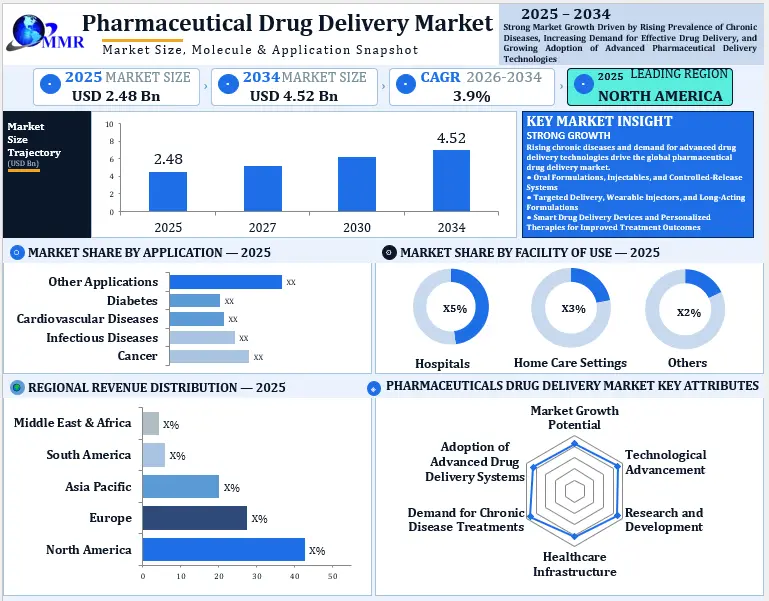
The Global Pharmaceutical Drug Delivery Market was valued at USD 2.48 billion in 2025 and grow at a CAGR of 7% from 2025 to 2034, reaching USD 4.52 billion by 2034.
Pharmaceutical Drug Delivery Market Overview:
A pharmaceutical drug delivery system (DDS) is a formulation or device used to provide a medicinal ingredient to the body. This method works by delivering pharmaceuticals to particular portions of the body via the assistance medium, which can regulate the delivery of the therapy via a physiological or chemical trigger. DDS is used to introduce drug delivery systems into the body, such as oral drug delivery, pulmonary drug delivery, injectable drug delivery, nasal drug delivery, and others, in order to increase the efficacy and safety of an administration.
The rise in awareness about the utilization of pharmaceutical drug delivery systems is a significant factor driving the growth of the pharmaceutical drug delivery industry. Additionally, other factors such as increased health-care spending and increased government funding for drug-delivery research boost the growth of the pharmaceutical drug delivery business. Moreover, the increasing incidence of numerous chronic illnesses, which necessitate the usage of pharmaceutical drug delivery systems, is a key driver driving market growth. An increase in the amount of prescription recalls and drug failures are limiting the pharmaceutical drug delivery market's development. In contrast, strong potential development in developing economies is likely to provide attractive possibilities during the forecast period.
Global Pharmaceutical Drug Delivery Market Growth Outlook
To know about the Research Methodology :- Request Free Sample Report
Global Pharmaceutical Drug Delivery Market: Key Highlights
• Market Growth: The Global Pharmaceutical Drug Delivery Market reaches USD 2.48 billion in 2025 and is projected to reach USD 4.52 billion by 2034, registering a CAGR of 7% during 2025–2034.
• Key Growth Drivers: The increasing prevalence of chronic diseases, rising healthcare expenditure, and advancements in targeted drug delivery, controlled-release formulations, and patient-friendly administration devices support market growth.
• Leading Segment: Oral Drug Delivery holds a significant market position due to its cost-effectiveness, ease of administration, patient convenience, and suitability for large-scale pharmaceutical manufacturing.
• Regional Leadership: North America dominates the market, supported by advanced healthcare infrastructure, strong pharmaceutical research and development capabilities, and widespread adoption of innovative drug delivery technologies.
• Emerging Market Trends: Long-acting injectable formulations, wearable injectors, prefilled syringes, and advanced drug delivery platforms create opportunities for pharmaceutical companies to improve treatment convenience, dosing efficiency, and patient adherence.
Global Pharmaceutical Drug Delivery Market Dynamics
Global Pharmaceutical Drug Delivery Market Drivers
Rising Prevalence of Chronic Diseases Drives Market Growth
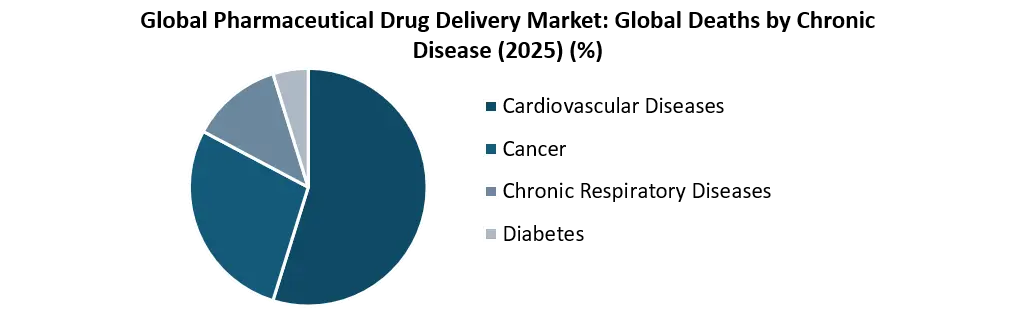
The increasing prevalence of chronic diseases, including cancer, diabetes, and cardiovascular disorders, drives demand for effective pharmaceutical drug delivery systems. Cardiovascular diseases cause an estimated 19.8 million deaths annually worldwide, highlighting the need for effective treatments and reliable medication delivery. Oral formulations, injectable systems, transdermal patches, and controlled-release technologies improve drug administration, treatment adherence, and therapeutic outcomes.
Advancements in Drug Delivery Technologies Support Market Expansion
Technological advancements in nanotechnology, targeted drug delivery, sustained-release formulations, and patient-friendly administration devices strengthen market growth. The increasing use of biologics, personalized medicine, and self-administration technologies drives demand for advanced delivery solutions. Microneedle patches, wearable injectors, and controlled-release systems improve dosing convenience, treatment precision, and patient adherence.
Global Pharmaceutical Drug Delivery Market Restraints
High Development Costs and Regulatory Requirements Limit Adoption
Developing advanced pharmaceutical drug delivery systems requires substantial investment in formulation research, clinical testing, manufacturing equipment, and quality control. Nanoparticle-based carriers and implantable delivery systems require specialized expertise and extensive safety evaluations. Regulatory compliance, drug stability testing, and drug-device compatibility requirements increase development costs and create challenges for smaller manufacturers.
Complex Manufacturing Processes Increase Production Costs
Advanced drug delivery technologies require specialized equipment, precision manufacturing, and strict quality control procedures. Maintaining consistent product quality across large production volumes increases operational expenses and limits the adoption of sophisticated delivery systems among manufacturers with restricted resources.
Global Pharmaceutical Drug Delivery Market Opportunities
Growing Demand for Targeted and Patient-Centric Drug Delivery Creates Opportunities
Increasing demand for targeted therapies, biologics, and minimally invasive administration methods creates opportunities for pharmaceutical drug delivery manufacturers. Microneedle patches, wearable injectors, long-acting formulations, and smart delivery devices support convenient medication administration and improved patient adherence. Expanding home healthcare services and self-administration solutions further strengthen demand for innovative drug delivery technologies.
Expansion of Biologics and Long-Acting Formulations Creates New Opportunities
Growing demand for biologics, monoclonal antibodies, and long-acting injectable medicines encourages the development of advanced delivery platforms. Novel formulation technologies improve drug stability, extend therapeutic action, and reduce dosing frequency. These innovations support treatment convenience and create opportunities for manufacturers to develop differentiated drug delivery solutions.
Global Pharmaceutical Drug Delivery Market Challenges
Drug Stability, Delivery Accuracy, and Manufacturing Complexity Remain Key Challenges
Maintaining drug stability, ensuring accurate dosage delivery, and achieving effective drug absorption remain major challenges. Biologics and sensitive therapeutic compounds require specialized formulation and storage conditions to preserve quality and efficacy. Manufacturers also face challenges related to large-scale production, drug-device compatibility, stringent quality standards, and consistent product performance.
Patient Compliance and Delivery-System Compatibility Pose Challenges
Patient adherence remains a challenge when drug delivery systems involve complex administration procedures, frequent dosing, or specialized handling requirements. Compatibility between pharmaceutical formulations and delivery devices also affects safety, reliability, and treatment effectiveness. Manufacturers must optimize device design, administration convenience, and formulation performance to support consistent patient use.
Global Pharmaceutical Drug Delivery Market Segment Analysis
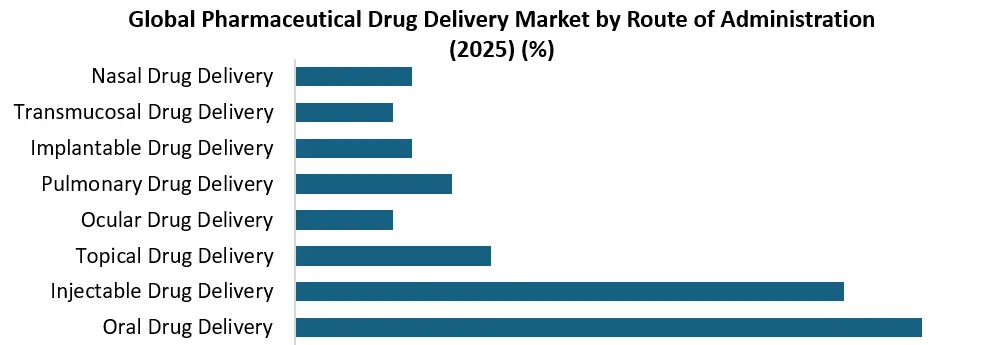
Based on Route of Administration, the Oral Drug Delivery segment holds a significant share of the Global Pharmaceutical Drug Delivery Market in 2025, driven by ease of administration, cost-effectiveness, patient convenience, and suitability for large-scale manufacturing. Tablets, capsules, and oral liquid formulations remain widely used because they support convenient dosing and treatment adherence. Pharmaceutical manufacturers utilize controlled-release formulations and targeted delivery technologies to improve drug absorption and therapeutic effectiveness. Parenteral drug delivery maintains demand for injectable biologics, vaccines, and medicines requiring rapid therapeutic action, while inhalation and transdermal systems address specialized treatment requirements.
Based on Application, the Infectious Diseases segment maintains substantial demand in 2025, supported by the need for antimicrobial therapies, antiviral medicines, vaccines, and advanced drug delivery solutions. Pharmaceutical companies focus on formulations that improve drug stability, absorption, and treatment effectiveness. The cancer segment also contributes significantly to market demand due to the need for chemotherapy, targeted therapies, and biologic treatments. The cardiovascular diseases segment supports demand through oral medications, injectable therapies, and sustained-release formulations used to manage hypertension, heart failure, and other cardiovascular conditions.
Based on Facility of Use, the Hospital segment accounts for a substantial share of the Global Pharmaceutical Drug Delivery Market in 2025, supported by established healthcare infrastructure, high patient volumes, and the administration of injectable medicines, biologics, and specialized therapies. Hospitals provide professional medical supervision, infusion services, and access to complex treatment procedures, supporting demand for reliable drug delivery systems. The home care settings segment also contributes to market demand through self-administration devices, prefilled syringes, wearable injectors, and oral medications. These solutions support convenient treatment, reduce frequent hospital visits, and help patients manage chronic conditions outside healthcare facilities.
Global Pharmaceutical Drug Delivery Market Regional Insights:
North America dominates the Global Pharmaceutical Drug Delivery Market, driven by advanced healthcare infrastructure, high healthcare expenditure, strong pharmaceutical research and development, and widespread adoption of innovative drug delivery technologies. The United States leads regional demand through its established pharmaceutical industry, strong presence of biotechnology companies, and growing use of injectable biologics, prefilled syringes, wearable injectors, and self-administration devices. Canada also contributes through increasing adoption of home-based treatments and advanced drug delivery solutions.
Europe holds a significant position in the Global Pharmaceutical Drug Delivery Market, supported by a well-established pharmaceutical manufacturing industry, advanced healthcare systems, and increasing demand for effective treatment delivery technologies. Germany, France, and the United Kingdom contribute to regional demand through pharmaceutical innovation, biologics manufacturing, and the adoption of oral, injectable, inhalation, and transdermal drug delivery systems. The region also benefits from growing demand for treatments targeting chronic diseases and an aging population.
Asia Pacific demonstrates strong market potential, driven by expanding healthcare infrastructure, increasing pharmaceutical manufacturing capacity, rising healthcare expenditure, and improved access to medicines. China, India, and Japan contribute significantly to regional demand through pharmaceutical production, generic drug manufacturing, biotechnology development, and increasing treatment needs associated with chronic diseases. Improvements in healthcare access and growing investment in advanced drug delivery technologies support regional market expansion.
South America experiences steady market development, supported by improving healthcare access, increasing demand for essential medicines, and expanding pharmaceutical distribution networks. Brazil and Argentina contribute to regional demand through established pharmaceutical industries and growing healthcare requirements. Wider access to generic medicines, improvements in healthcare infrastructure, and increasing demand for treatments for infectious and chronic diseases support the adoption of pharmaceutical drug delivery solutions.
The Middle East and Africa region continues to develop, supported by healthcare infrastructure investments, improving access to pharmaceutical products, and increasing demand for treatments for chronic and infectious diseases. Saudi Arabia, the United Arab Emirates, and South Africa contribute to regional market development through healthcare modernization and pharmaceutical supply-chain improvements. Growing hospital capacity and increasing access to essential medicines support demand for conventional and advanced drug delivery systems.
Global Pharmaceutical Drug Delivery Market Competitive Landscape
The Global Pharmaceutical Drug Delivery Market features strong competition among established pharmaceutical companies and specialized drug delivery technology providers. Key players, including Johnson & Johnson, Pfizer Inc., Becton, Dickinson and Company, Novartis AG, Roche Holding AG, and Merck & Co., Inc., compete through extensive product portfolios, technological innovation, global distribution networks, and investment in research and development.
Market participants focus on developing advanced oral formulations, injectable biologics, controlled-release systems, inhalation therapies, transdermal patches, and patient-friendly self-administration devices. Companies strengthen their competitive positions through strategic partnerships, acquisitions, product innovation, and manufacturing expansion. Increasing demand for targeted drug delivery, long-acting formulations, and home-based treatment solutions encourages manufacturers to improve drug efficacy, safety, treatment adherence, and patient convenience. Competition also depends on regulatory compliance, manufacturing capabilities, product quality, and the ability to deliver cost-effective solutions across global markets.
Global Pharmaceutical Drug Delivery Market Recent Developments
| Date | Company | Recent Development | Impact |
| September 2026 | Novo Nordisk A/S and Nanexa AB | Novo Nordisk enters an exclusive global licensing and collaboration agreement to develop long-acting injectable medicines using Nanexa's PharmaShell technology, targeting monthly and quarterly administration. | Supports the development of long-acting formulations and reduces the potential frequency of injections for patients. |
| July 2026 | Aptar Pharma | Aptar Pharma introduces an integrated system-level framework for injectable drug development, combining collaborative development, system testing, and performance data. | Helps pharmaceutical companies assess injectable delivery systems and address device performance and regulatory requirements. |
| June 2026 | Sanofi | Sanofi receives European Commission approval for subcutaneous Sarclisa administered through an on-body injector for multiple myeloma treatment. | Expands patient-friendly treatment options and supports administration in home and outpatient settings. |
| May 2026 | Aptar Pharma | Aptar Pharma reports progress on its U.S. FDA-funded research into next-generation propellants for metered-dose inhalers. | Supports the development of future inhalation delivery systems and research into comparable product performance. |
| March 2026 | Nanexa AB | Nanexa reports preclinical results demonstrating the potential for quarterly semaglutide administration using its PharmaShell drug delivery platform. | Strengthens research into extended-release injectable formulations that may reduce dosing frequency. |
| January 2026 | West Pharmaceutical Services, Inc. and AbbVie Inc. | West agrees to transfer manufacturing and supply rights for its SmartDose 3.5 mL on-body delivery system to AbbVie for USD 112.5 million, subject to closing conditions. | Supports AbbVie's access to an on-body delivery platform for potential biologic drug administration. |
Pharmaceutical Drug Delivery Market Scope: Inquire before buying
| Pharmaceutical Drug Delivery Market | |||
|---|---|---|---|
| Report Coverage | Details | ||
| Base Year: | 2025 | Forecast Period: | 2026-2034 |
| Historical Data: | 2020 to 2025 | Market Size in 2025: | US$ 2.48 Bn. |
| Forecast Period 2026 to 2034 CAGR: | 7% | Market Size in 2034: | US$ 4.52 Bn. |
| Segments Covered: | by Route of Administration | Oral Drug Delivery Injectable Drug Delivery Topical Drug Delivery Ocular Drug Delivery Pulmonary Drug Delivery Implantable Drug Delivery Transmucosal Drug Delivery Nasal Drug Delivery |
|
| by Application | Infectious Diseases Cancer Cardiovascular Diseases Diabetes Respiratory Diseases Central Nervous System Disorders Autoimmune Diseases Other Applications |
||
| by Facility of Use | Hospitals Ambulatory Surgery Centers Home Care Settings Diagnostic Centers Other |
||
Pharmaceutical Drug Delivery Market by Region
North America (United States, Canada and Mexico)
Europe (UK, France, Germany, Italy, Spain, Sweden, Austria and Rest of Europe)
Asia Pacific (China, South Korea, Japan, India, Australia, Indonesia, Malaysia, Vietnam, Taiwan, Bangladesh, Pakistan and Rest of APAC)
Middle East and Africa (South Africa, GCC, Egypt, Nigeria and Rest of ME&A)
South America (Brazil, Argentina Rest of South America)
Global Pharmaceutical Drug Delivery Market Key Players
1. Johnson & Johnson
2. Novartis AG
3. F. Hoffmann-La Roche AG
4. Pfizer Inc.
5. Bayer AG
6. Antares Pharma, Inc.
7. Becton, Dickinson and Company
8. GSK plc
9. 3M Company
10. Merck & Co., Inc.
11. Sanofi
12. Amgen Inc.
13. AbbVie Inc.
14. Genmab A/S
15. Gilead Sciences, Inc.
16. Boehringer Ingelheim
17. AstraZeneca plc
18. Eli Lilly and Company
19. Teva Pharmaceutical Industries Ltd.
20. Bristol Myers Squibb
21. Gerresheimer AG
22. Boston Scientific Corporation
23. Nimbus Therapeutics
24. Kite Pharma
25. IDEAYA Biosciences, Inc.
26. Baxter International Inc.
27. West Pharmaceutical Services, Inc.
28. Terumo Corporation
29. Ypsomed AG
30. SHL Medical AG
31. AptarGroup, Inc.
32. Catalent, Inc.
33. B. Braun SE
34. Owen Mumford Ltd.
35. Nemera
36. SCHOTT AG
37. Novo Nordisk A/S
38. Medtronic plc
39. Halozyme Therapeutics, Inc.
40. Alkermes plc
41. UCB S.A.
42. Sandoz Group AG
43. Biocon Limited
44. Vetter Pharma-Fertigung GmbH & Co. KG
45. Hovione
46. Nektar Therapeutics
47. Ferring Pharmaceuticals
48. Stevanato Group S.p.A.
49. Recipharm AB
50. Evonik Industries AG
Frequently Asked Questions:
1] What segments are covered in the Global Pharmaceutical Drug Delivery Market report?
Ans. The segments covered in the Pharmaceutical Drug Delivery Market report are based on Route of Administration, Application, Facility of Use, and region.
2] Which region is expected to hold the highest share in the Global Pharmaceutical Drug Delivery Market?
Ans. The North America region is expected to hold the highest share in the Pharmaceutical Drug Delivery Market.
3] What is the market size of the Global Pharmaceutical Drug Delivery Market by 2034?
Ans. The market size of the Pharmaceutical Drug Delivery Market by 2034 is expected to reach US$ 4.52 Bn.
4] What is the forecast period for the Global Pharmaceutical Drug Delivery Market?
Ans. The forecast period for the Pharmaceutical Drug Delivery Market is 2025-2034.
5] What was the market size of the Global Pharmaceutical Drug Delivery Market in 2025?
Ans. The market size of the Pharmaceutical Drug Delivery Market in 2025 was valued at USD 2.48 Bn.