
Passive Electronic Components Market- Industry Structure Evaluation, Demand Drivers Analysis, Regional Growth Analysis and Identification, Competitive Positioning Review & Global Market Size Forecast to 2032
Overview
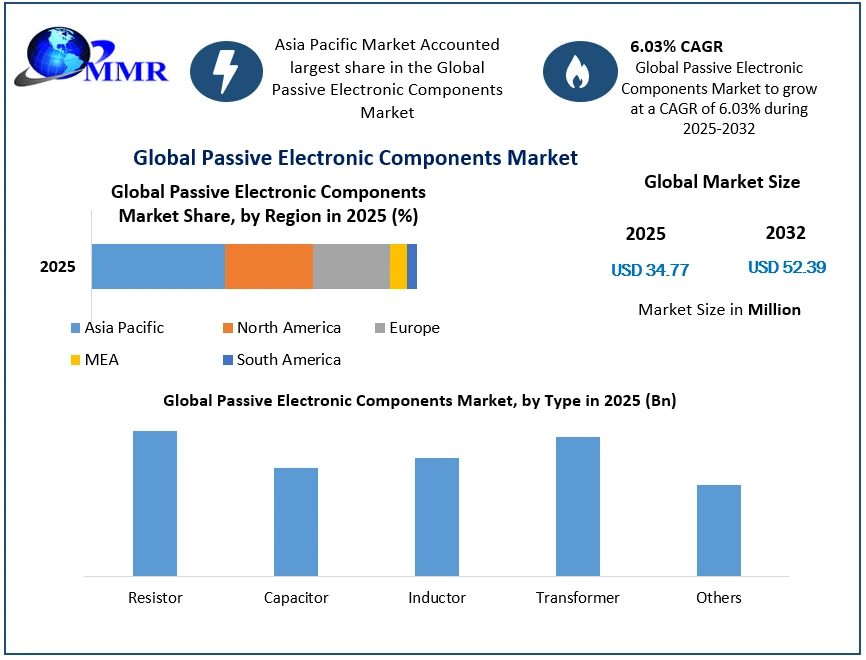
The Passive Electronic Components Market size was valued at USD 34.77 Million in 2025 and the total Passive Electronic Components revenue is expected to grow at a CAGR of 6.03% from 2026 to 2032, reaching nearly USD 52.39 Million by 2032.
Passive Electronic Components Market Overview:
The Passive Electronic Components Market has witnessed growth in recent years due to the extensive use of electronics by several End Users. Passive Electronic Components are essential parts of electronic circuits and include resistors, capacitors, inductors and diodes. The increasing Passive Electronic Component Market Demand for electronic devices such as smartphones, laptops and other consumer electronics, has contributed to the growth of this Passive Electronic Components Market industry. The emergence of new technologies, like IoT and 5G, has further propelled the demand for Passive Electronic Components. The Asia Pacific Passive Electronic Components Market is the largest, with China being the major contributor due to the country's strong manufacturing base.
The automotive industry's shift towards electric vehicles and the continuous innovation in electronic systems within automobiles have spurred the demand for passive components. The emphasis on renewable energy solutions, such as solar and wind power, also contributes to the escalating need for these components in power electronics. Market key players such as Murata Manufacturing Co. Ltd., TDK Corporation, Taiyo Yuden Co. Ltd., Panasonic Corporation, Samsung Electro-Mechanics, etc. are focused on product innovation and development, aimed at offering products with enhanced performance and higher reliability.
To know about the Research Methodology :- Request Free Sample Report
Passive Electronic Components Market Dynamics:
The dynamics of the Passive Electronic Components Market are intricately shaped by a multitude of factors. A primary driving force is the escalating demand for electronic devices, fueled significantly by the proliferation of smartphones, laptops, and various consumer electronics. The market is further propelled by the adoption of cutting-edge technologies such as IoT and 5G, particularly in the telecommunications sector. The automotive industry's growth and the pervasive trend towards automation and robotics across industries contribute to the increasing demand for Passive Electronic Components. Amidst these dynamics, opportunities arise in the realm of high-performance Passive Electronic Components.
The surge in demand for sophisticated electronic devices necessitates components like high-frequency capacitors and inductors. Manufacturers are seizing these opportunities by investing in research and development to create innovative materials and technologies that cater to the evolving needs of the market. The burgeoning electric and hybrid vehicle industry presents a particularly promising avenue for passive electronic component manufacturers. However, the market is not without its challenges. Supply chain disruptions, trade restrictions, and the lingering impacts of the COVID-19 pandemic have led to component shortages and price increases. Manufacturing high-performance components, with their inherent complexity and time-consuming processes, poses a restraint on the market. Additionally, the presence of substitute components and the lack of standardization in the industry hinder overall market growth.
The Passive Electronic Components Market faces threats from various quarters, including the emergence of substitute components such as MEMS and NEMS technologies, which offer superior performance across a broad spectrum of End Users. The growing trend of outsourcing electronic component manufacturing to low-cost countries adds another layer of complexity, potentially impacting the profitability of manufacturers in the market. Navigating these challenges and seizing emerging opportunities will be pivotal for stakeholders in the evolving landscape of the Passive Electronic Components Market.
Passive Electronic Components Market Segment Analysis
Based on the Type, Capacitors are the leading segment of the Passive Electronic Components Market, poised to command the largest share given their extensive End Use in electronic devices like smartphones, laptops, and automotive systems. Capacitors also play a crucial role in power supply circuits and audio systems. The capacitor segment is fueled by the escalating demand for energy-efficient devices and the flourishing automotive industry. Simultaneously, the Resistor segment anticipates substantial growth, finding utility in diverse End Users such as temperature sensing, noise suppression, and voltage regulation.
The Inductor segment projects steady growth, driven by its End Users in power electronics and telecommunications. The "Others" segment, encompassing components like crystals, filters, and transformers, foresees noteworthy growth due to the increasing demand for high-performance electronic components. This type-centric segmentation underscores the varied and evolving nature of the Passive Electronic Components Market.
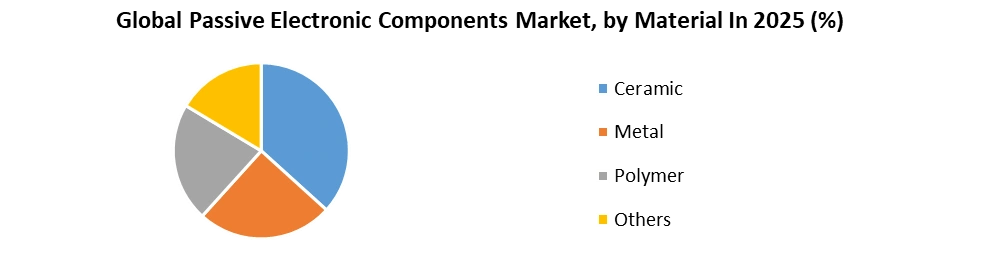
Based on the Material, The Ceramic segment dominated the market in the year 2025, driven by its versatile End Users in smartphones, laptops, automotive, and medical devices. Ceramic capacitors, renowned for high frequency and temperature stability, find utility in power supply circuits and audio systems. Ceramic has a high dielectric constant, low loss factor, and stability over a wide temperature range making it ideal for capacitors, resistors, and inductors, which are crucial in electronic circuits for filtering, energy storage, and noise reduction.
Ceramics are also highly resistant to moisture, corrosion, and environmental stress, ensuring long-term reliability and performance, which is essential in applications ranging from consumer electronics to automotive and aerospace industries. The material's aptitude to be precisely engineered at the microscopic level allows manufacturers to create components with specific characteristics tailored to diverse applications. The widespread adoption of ceramics in multilayer capacitors (MLCCs), which are integral to modern electronics.
Based on the End-User, The dynamics of the Passive Electronic Components Market are intricately shaped by its diverse end-user segmentation. Consumer Electronics segment dominated the market, the Automotive sector anticipates significant growth, propelled by the surge in electric vehicle adoption and the pervasive use of passive components in automotive End Users like lighting, infotainment, and powertrain systems.
In the Healthcare domain, steady growth is foreseen due to the increased utilization of medical devices such as MRI machines, pacemakers, and blood glucose meters, all relying on passive components. The Telecommunications segment is marked for substantial growth, fueled by the rising demand for high-speed internet and the deployment of 5G technology. Similarly, the Aerospace and Defence sectors are poised for steady expansion, given the increasing usage of passive components in crucial End Users like communication, navigation, and radar systems. These dynamic segments underscore the multifaceted and evolving nature of the Market, reflecting diverse industry demands and technological advancements.
Passive Electronic Components Market Regional Insights:
The dynamics of the Passive Electronic Components Market are prominently shaped by regional forces, with the Asia-Pacific region leading the forefront. The region's robust growth is attributed to the soaring demand for consumer electronics and automotive End Users, further fueled by the presence of key manufacturers such as Murata Manufacturing Co. Ltd. and TDK Corporation. North American market, securing the second-highest market share. This increase surge is propelled by the escalating adoption of electric vehicles and the deployment of 5G technology.
Europe claims the third-highest market share, with a parallel trajectory of substantial growth attributed to the increasing adoption of renewable energy and the deployment of smart grid technology. South American Market is on track to experience noteworthy growth, primarily driven by the increasing demand for consumer electronics and automotive End Users. The Middle East and African market, while expected to grow at a steady rate, is propelled by heightened investments in the construction and infrastructure sectors. These regional dynamics underscore the diverse and evolving landscape of the Market, each region contributing uniquely to its overall trajectory.
Passive Electronic Components Market Scope: Inquire before buying
| Passive Electronic Components Market | |||
|---|---|---|---|
| Report Coverage | Details | ||
| Base Year: | 2025 | Forecast Period: | 2026-2032 |
| Historical Data: | 2020 to 2025 | Market Size in 2025: | USD 34.77 Mn. |
| Forecast Period 2026 to 2032 CAGR: | 6.03% | Market Size in 2032: | USD 52.39 Mn. |
| Segments Covered: | by Type | Resistor Capacitor Inductor Transformer Others |
|
| by Material | Ceramic Metal Polymer Others |
||
| by End User Industry | Consumer Electronics Automotive Industrial Telecommunications Healthcare Aerospace & Defense Energy & Power Others |
||
Passive Electronic Components Market, by Region
North America (United States, Canada and Mexico)
Europe (UK, France, Germany, Italy, Spain, Sweden, Austria, Turkey, Russia and Rest of Europe)
Asia Pacific (China, India, Japan, South Korea, Australia, ASEAN and Rest of APAC)
Middle East and Africa (South Africa, GCC, Egypt, Nigeria and Rest of ME&A)
South America (Brazil, Argentina, Columbia and Rest of South America)
Passive Electronic Component Market, Key Players
1. Murata Manufacturing Co., Ltd
2. Panasonic Corporation
3. TDK Corporation
4. Vishay Intertechnology Inc.
5. Kyocera AVX Components Corporation
6. Taiyo Yuden Co., Ltd.
7. Samsung Electro-Mechanics
8. Nippon Chemi-Con Corporation
9. Yageo Corporation
10. Nichicon Corporation
11. Walsin Technology
12. Rubycon Corporation
13. ROHM Co. Ltd.
14. TE Connectivity Ltd.
15. CTS Corporation
16. Pulse Electronics Corporation
17. Bourns Inc.
18. Diodes Incorporated
19. Holy Stone Holdings Co., Ltd.
20. Johanson Technology Inc.
21. Fenghua (HK) Electronics Ltd.
22. 3L Electronic Corp
23. Jameco Electronics
24. Mouser Electronics, Inc.
25. Coilcraft, Inc.
26. Suntan Capacitors
27. KEMET Corporation
28. TSMC
29. samwha Capacitor Group
30. Weishi Innovation
31. Others
Frequently Asked Questions:
1] What segments are covered in the Market report?
Ans. The segments covered in the Market report are based on Type, Material, End-Use Industry, and region
2] Which region is expected to hold the highest share of the Passive Electronic Components Market?
Ans. Asia Pacific region is expected to hold the highest share of the Market.
3] What is the market size of the Passive Electronic Components Market by 2032?
Ans. The market size of the Passive Electronic Components Market by 2032 is USD 52.39 Mn.
4] What is the growth rate of the Passive Electronic Components Market?
Ans. The Global Passive Electronic Components Market is growing at a CAGR of 6.03% during the forecasting period 2026-2032.
5] What was the market size of the Passive Electronic Components Market in 2025?
Ans. The market size of the Passive Electronic Components Market in 2025 was USD 34.77 Mn.