
Orthopedic Biomaterial Market– Industry Structure Evaluation, Demand Drivers Analysis, Regional Growth Analysis and Identification, Competitive Positioning Review & Global Market Size Forecast (2026-2032)
Overview
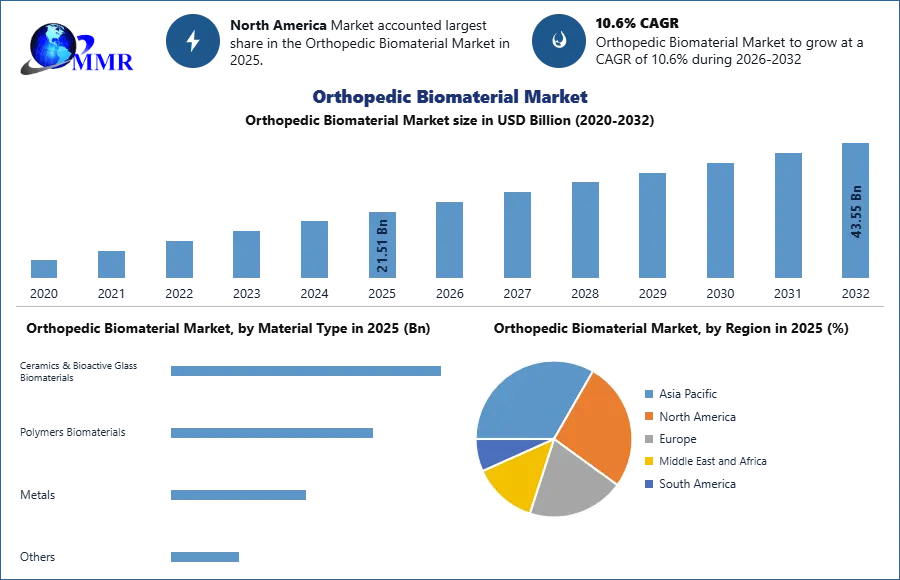
The Orthopedic Biomaterial Market size was valued at USD 21.51 Bn in 2025 and is expected to reach USD 43.55 Bn by 2032, at a CAGR of 10.6 % from forecast 2026-2032
Orthopedic Biomaterial Market Overview
Orthopedic biomaterials started from temporary implants to fix bone to permanent implant materials and bio-absorbable implants. In the future, orthopedic biomaterial will find a place in the regeneration of living tissue, as well as replacing it. The orthopedic biomaterial market is a rapidly growing sector within the healthcare industry, driven by the increasing prevalence of musculoskeletal disorders, the rising geriatric population, and advancements in biomaterial technology. Orthopedic biomaterials are synthetic or natural materials that are used to repair or replace damaged bones, joints, ligaments, and tendons, promoting tissue regeneration and healing. The overview of the Orthopedic Biomaterial Market adds to the market’s objectives. It includes leading competitors and their market value with their current trending skims, strategies, targets, and products. The report put light on the market’s recent growth as well as its informative past. The Orthopedic Biomaterial Market overview presents a brief synopsis of a commercial or industrial market. The aim was to provide a current snapshot of a market in order to better understand its key features.
To know about the Research Methodology :- Request Free Sample Report
Orthopedic Biomaterial Market Scope and Research Methodology
The scope of the research on the orthopedic biomaterial market encompasses the analysis of the global market, including major regions such as North America, Europe, Asia-Pacific, and the Rest of the World. The study focuses on the various types of orthopedic biomaterials used in applications such as joint replacements, fracture fixation, spine surgeries, and tissue engineering. The Orthopedic Biomaterial market analysis includes both synthetic and natural biomaterials used in orthopedics. Furthermore, the research covers the competitive landscape, key market players, market trends, drivers, challenges, and opportunities influencing the orthopedic biomaterial market. The research begins with extensive data collection from various sources, including industry reports, market studies, academic journals, company websites, and government databases. Primary research through interviews with industry experts, orthopedic surgeons, and key opinion leaders may also be conducted to gather insights and validate the information. The research includes a detailed analysis of key market players, their product portfolios, business strategies, and recent developments. This analysis helps in understanding the competitive landscape and market positioning of various companies in the orthopedic biomaterial market.
Orthopedic Biomaterial Market Dynamics
Increasing Adoption of Bioactive Materials: Bioactive materials, such as bioactive glass and ceramics, are gaining traction in the orthopedic biomaterial market. These materials have the ability to bond with living tissues, promoting cellular attachment and facilitating bone regeneration. The increasing adoption of bioactive materials in orthopedic implants and bone grafts is driven by their biocompatibility, osteoconductive properties, and ability to stimulate tissue growth, leading to improved patient outcomes.
Growing Demand for Personalized Medicine: There is a rising demand for personalized medicine in orthopedics, driven by the need for customized solutions that cater to the unique needs of individual patients. Biomaterials play a crucial role in personalized medicine, as they are tailored to specific patient requirements, such as biodegradability, mechanical strength, and surface properties. This demand for patient-specific orthopedic biomaterials is driving research and development efforts in the field and fueling the orthopedic biomaterial market growth.
Expansion of 3D Printing Technology: 3D printing technology has revolutionized the orthopedic biomaterial market by enabling the production of patient-specific implants and scaffolds with precise dimensions and complex geometries. This technology allows for the fabrication of implants that closely mimic natural bone structures, enhancing osseointegration and reducing the risk of implant failure. The expanding applications of 3D printing in orthopedics, coupled with advancements in biomaterials suitable for 3D printing, are driving orthopedic biomaterial market growth.
Rising Focus on Regenerative Medicine: Regenerative medicine, which aims to restore or replace damaged tissues and organs, is gaining prominence in orthopedics. Biomaterials serve as a crucial component in regenerative medicine approaches, providing scaffolds or matrices for tissue regeneration. The growing focus on regenerative medicine for the treatment of musculoskeletal disorders, including tissue engineering, stem cell therapies, and gene therapy, is driving the demand for orthopedic biomaterial market.
Technological Advancements in Surface Modification: Surface modification techniques, such as coating technologies and nanostructuring, are advancing the functionality and performance of orthopedic biomaterials. These techniques enhance the biocompatibility, wear resistance, antibacterial properties, and drug delivery capabilities of biomaterials. The continuous advancements in surface modification technologies are expanding the applications of orthopedic biomaterials and driving the orthopedic biomaterial market growth.
Growing Awareness of Biodegradable Biomaterials: Biodegradable biomaterials are gaining prominence in the orthopedic sector due to their ability to degrade over time, eliminating the need for implant removal surgeries. These biomaterials offer advantages such as reduced risk of infection, improved healing, and avoidance of long-term complications associated with permanent implants. The growing awareness of the benefits of biodegradable biomaterials among healthcare professionals and patients is fueling their adoption and driving orthopedic biomaterial market growth.
Increasing Sports Injuries and Trauma Cases: Sports injuries and trauma cases, such as fractures, ligament tears, and cartilage damage, are on the rise globally. The demand for orthopedic biomaterials used in the treatment of sports injuries and trauma cases is increasing, driven by the need for effective and durable solutions that restore function and mobility. Biomaterials, such as bone grafts, implants, and tissue scaffolds, play a vital role in the repair and regeneration of injured tissues, supporting orthopedic biomaterial market growth.
High Cost of Biomaterials: The cost of orthopedic biomaterials is significantly high, which poses a challenge to widespread adoption, particularly in emerging economies. The high cost of biomaterials can limit their accessibility, especially in resource-constrained healthcare systems, and may hinder orthopedic biomaterial market growth.
Stringent Regulatory Approval Process: The orthopedic biomaterial market is subject to stringent regulatory requirements, including pre-market approvals and extensive clinical trials. These regulatory processes are time-consuming and costly, delaying the introduction of new biomaterial products to the market and adding to the overall development costs.
Increasing Emphasis on Minimally Invasive Procedures: The growing preference for minimally invasive surgical procedures in orthopedics presents opportunities for biomaterials that support these techniques. Biomaterials used in minimally invasive implants, tissue scaffolds, and regenerative therapies can enhance patient outcomes, reduce hospital stays, and minimize scarring. Capitalizing on the demand for minimally invasive procedures can open avenues for orthopedic biomaterial market expansion.
Orthopedic Biomaterial Market Segment Analysis
By Material Type, Ceramics and bioactive glass biomaterials dominated Orthopedic Biomaterial Market in 2025 and are widely used in orthopaedic and dental applications due to their excellent biocompatibility, strength, and ability to integrate with bone. These materials are non-biodegradable and provide long-term support in the body, making them suitable for permanent implants. They form strong bonds with bone tissue, aiding in bone regeneration and healing. Common examples include hydroxyapatite and bioactive glass. Their ability to remain stable and support bone growth makes them indispensable in medical implants that require permanent solutions.
By Biodegradable, Non-biodegradable biomaterials are expected to dominate over the forecast period. They have long-term support and durability, such as in metal implants (titanium) and ceramics. These materials do not degrade within the body, making them ideal for devices that need to last indefinitely without removal. Non-biodegradable biomaterials, while offering excellent mechanical properties, require careful consideration in terms of long-term body compatibility, as their permanence can sometimes lead to complications. However, their use in critical areas like bone replacements and joint implants remains vital due to their reliability and strength in supporting body structures.
Regional Analysis of the Orthopedic Biomaterial Market
North America: North America Orthopedic Biomaterial Market held the largest share in 2025. The presence of established healthcare infrastructure, high healthcare expenditure, and a strong focus on technological advancements contribute to its market leadership. Factors such as a large aging population, increasing prevalence of musculoskeletal disorders, and rising demand for advanced orthopedic treatments drive market growth in North America. Additionally, favorable reimbursement policies and a supportive regulatory environment further propel the market.
Europe: 2nd Largest Market: Europe is a significant market for orthopedic biomaterials, with countries like Germany, the United Kingdom, and France leading the region. The presence of well-developed healthcare systems, high awareness regarding orthopedic advancements, and strong investments in research and development contribute to its market position. The aging population in Europe, coupled with a high incidence of orthopedic conditions, fuels the demand for orthopedic biomaterials. The region also emphasizes the adoption of advanced technologies, such as 3D printing and regenerative medicine, supporting market growth.
Asia Pacific: 3rd Largest Market: Asia Pacific is a rapidly growing market for orthopedic biomaterials, with countries like China, Japan, and India driving regional growth. The increasing healthcare infrastructure, rising disposable income, and a large patient pool contribute to the market's expansion. The growing geriatric population, increasing prevalence of orthopedic disorders, and rising demand for advanced healthcare solutions are key drivers in the Asia Pacific region. Additionally, the presence of a large medical tourism industry in countries like India and Thailand further boosts market growth. Latin America: 4th Largest Market: Latin America holds a significant Orthopedic Biomaterial Market share, with countries like Brazil, Mexico, and Argentina playing a vital role. The region's improving healthcare infrastructure, rising healthcare expenditure, and increasing awareness about advanced orthopedic treatments contribute to its market position. The prevalence of orthopedic conditions, sports injuries, and trauma cases in the region drives the demand for orthopedic biomaterials. Additionally, the adoption of minimally invasive procedures and a growing focus on regenerative medicine offer opportunities for market growth in Latin America.
Orthopedic Biomaterial Market Scope: Inquire before buying
| Orthopedic Biomaterial Market | |||
|---|---|---|---|
| Report Coverage | Details | ||
| Base Year: | 2025 | Forecast Period: | 2026-2032 |
| Historical Data: | 2020 to 2025 | Market Size in 2025: | 21.51 USD Billion |
| Forecast Period 2026-2032 CAGR: | 10.6% | Market Size in 2032: | 43.55 USD Billion |
| Segments Covered: | by Material Type | Ceramics & Bioactive Glass Biomaterials Polymers Biomaterials Metals Others |
|
| by Biodegradability | Non-Biodegradable Biomaterials Biodegradable Biomaterials |
||
| by Condition | Osteoarthritis Osteoporosis Others |
||
| by Application | Joint Replacements Spine Implants Orthobiologics Tissue Fixation Others |
||
Orthopedic Biomaterial Market, by Region
North America (United States, Canada and Mexico)
Europe (UK, France, Germany, Italy, Spain, Sweden, Austria and Rest of Europe)
Asia Pacific (China, South Korea, Japan, India, Australia, Indonesia, Malaysia, Vietnam, Taiwan, Bangladesh, Pakistan and Rest of APAC)
South America (Brazil, Argentina Rest of South America)
Middle East & Africa (South Africa, GCC, Egypt, Nigeria and Rest of ME&A)
Key Players/Competitors Profiles Covered in the Orthopedic Biomaterial Market Report in a Strategic Perspective
- Stryker Corporation
- Zimmer Biomet
- DePuy Synthes (Johnson & Johnson)
- Smith & Nephew
- Medtronic
- Wright Medical Group N.V.
- NuVasive
- Integra LifeSciences
- Orthofix International
- Exactech, Inc.
- Aesculap (B. Braun)
- Conmed Corporation
- Arthrex, Inc.
- DJO Global
- Mimedx Group, Inc.
- Invibio Biomaterial Solutions
- Bone Therapeutics
- CeramTec GmbH
- K2M, Inc.
- Biocomposites Ltd.
- Orthosoft, Inc.
- Geuder AG
- Orthogen
- Xtant Medical
- LimaCorporate
- SuperSurgical, Inc.
- Bacterin International
Frequently Asked Questions about Orthopedic Biomaterial Market
1.What are orthopedic biomaterials?
Ans: Orthopedic biomaterials are materials specifically designed and engineered for use in orthopedic applications, such as joint replacements, bone grafts, fracture fixation, and tissue engineering. These biomaterials possess biocompatibility, and mechanical strength, and have properties that promote tissue regeneration and integration.
2.What factors are driving the growth of the orthopedic biomaterial market?
Ans: The growth of the orthopedic biomaterial market is primarily driven by factors such as the increasing prevalence of orthopedic disorders, a rising aging population, advancements in biomaterial technologies, growing demand for minimally invasive procedures, and the emphasis on regenerative medicine and tissue engineering.
3: What are the main types of orthopedic biomaterials?
Ans: The main types of orthopedic biomaterials include metals and alloys (such as titanium and stainless steel), ceramics (such as hydroxyapatite), polymers (both biodegradable and non-biodegradable), composite materials, and natural biomaterials (such as collagen and hyaluronic acid).
4: What are the key challenges in the orthopedic biomaterial market?
Ans: Some key challenges in the orthopedic biomaterial market include the high cost of biomaterials, stringent regulatory approval processes, concerns about long-term safety and efficacy, limited clinical evidence supporting certain biomaterials, and the need for continuous technological advancements to meet evolving patient needs.
5: How does the orthopedic biomaterial market vary regionally?
Ans: The orthopedic biomaterial market varies regionally based on factors such as healthcare infrastructure, economic development, regulatory frameworks, and population demographics. North America and Europe are leading markets due to established healthcare systems, while the Asia Pacific region is experiencing rapid growth due to rising healthcare investments and an increasing patient population.