
Optical Coatings Market Size by Product Type, Technology Type, End Use Type, Region – Revenue Pool Analysis, Margin Structure Assessment, Capital Flow Trends, Competitive Benchmarking & Forecast to 2030
Overview
The Optical Coatings Market size was valued at USD 10.87 Billion in 2023 and the total Optical Coatings revenue is expected to grow at a CAGR of 5.92 % from 2024 to 2030, reaching nearly USD 16.26 Billion by 2030.
Optical coatings are thin layers applied to optical components (e.g., lenses, mirrors) to modify light reflection and transmission. They enhance performance by minimizing reflection and providing specific optical properties. The Optical Coatings Market is expected rapid growth, driven by the expanding demand for high-performance coatings across various industries such as electronics, healthcare, automotive, and aerospace. Optical coatings play a crucial role in enhancing the efficiency and durability of optical components by minimizing reflection, increasing transmission, and providing resistance to environmental factors. The Optical coatings market is witnessing a surge in demand for anti-reflective coatings, beam splitter coatings, and filters, driven by the rising adoption of advanced optical technologies in applications like consumer electronics, medical devices, and telecommunications. The increasing use of optical coatings to improve the performance of lenses, mirrors, and other optical elements is a key factor driving Optical coatings market growth. The growing emphasis on energy-efficient solutions and the rising trend of miniaturization in electronic devices are contributing to the expansion of the Optical Coatings Market. To know about the Research Methodology:-Request Free Sample Report
Key players in the Optical coatings market, such as Essilor International, Zeiss Group, PPG Industries, DuPont, and Edmund Optics, are actively engaged in strategic initiatives to maintain a competitive edge. Recent developments in the Optical coatings market include a focus on research and development to introduce innovative coatings with enhanced functionalities, such as self-cleaning and anti-fog properties. Collaborations, mergers, and acquisitions are prevalent strategies among key players to strengthen their market presence and expand their product portfolios. Technological advancements, particularly in nanotechnology and thin-film deposition techniques, are also shaping the landscape of the Optical Coatings Market. The market is witnessing a geographical shift in terms of production and consumption, with Asia-Pacific emerging as a prominent region due to the presence of a robust electronics manufacturing sector and increasing investments in research and development activities. As the demand for high-quality optical coatings continues to rise, the market is poised for sustained growth, with ongoing developments and innovations driving its evolution.
Optical Coatings Market Dynamics:
Increasing adoption of optical coatings in medical imaging, such as endoscopes, enhances visibility, driving their uptake in healthcare
Growing demand across diverse industries, shaping the landscape of advanced technologies and driving the growth of Optical Coatings Market. The booming electronic devices market, smartphones and tablets, is a key driver for optical coatings. Exemplified by Corning's Gorilla Glass anti-reflective coatings, this significantly contributes by improving visibility, reducing glare, and elevating the overall user experience, driving market growth. In the healthcare sector, optical coatings find a pivotal role in medical imaging devices like endoscopes, with companies like Olympus incorporating anti-fog coatings on medical lenses. This ensures clear visibility during medical procedures, fostering the adoption of optical coatings in healthcare applications.
Optical Coatings Adoption in Medical Imaging (Endoscopes) - Yearly Growth (2018-2023)

The automotive industry's emphasis on safety has driven increased integration of optical coatings in sensors and camera systems, exemplified by water and dirt-resistant coatings in Bosch's rear-view cameras. This not only enhances the performance of automotive optical components but also underscores the role of optical coatings in supporting the automotive safety paradigm. Furthermore, the surge in 5G networks and the deployment of optical fibers for high-speed data transmission are driving the need for optical coatings that improve signal transmission efficiency, playing a pivotal role in the growth of telecommunications infrastructure. As the world shifts towards energy-efficient lighting solutions, optical coatings are integral to the success of LED technology. Companies like Lumileds leverage coatings on LED lenses to enhance light output and energy efficiency, fostering widespread adoption in the lighting industry. This confluence of demand drivers, spanning industries from aerospace to renewable energy, demonstrates the integral role of optical coatings in shaping the trajectory of advanced technologies and ensuring their efficiency and reliability in various applications.
Intensive R&D investments strain profits and hinder cost-effectiveness, challenging the growth of the Optical Coatings Market
The industry contends with the volatility of raw material prices, a significant challenge exemplified by the fluctuating prices of rare-earth elements. This directly impacts production costs for companies like Apple, who heavily rely on optical coatings for devices like smartphones, potentially leading to increased consumer prices and reduced profit margins. Moreover, technological complexity poses a hurdle for market players as rapid advancements demand sophisticated manufacturing processes. The intricate application of nanocoatings for specific optical functionalities necessitates substantial investments in cutting-edge equipment, potentially limiting market entry for smaller firms without the financial capacity for such technological adaptations.
Stringent environmental regulations also shape the optical coating landscape. Companies like Essilor, focusing on developing eco-friendly coatings, encounter challenges in navigating regulatory landscapes, affecting production efficiency and potentially raising costs to comply with environmental standards. Global supply chain disruptions represent a considerable challenge, as events like natural disasters or geopolitical tensions can impact the availability of key raw materials, affecting production schedules for companies like Corning. Intense market competition is a constant, as major players vie for market share and innovation. Essilor, among others, faces robust competition, driving continuous innovation but also posing challenges in retaining market share and differentiating products. Rapid technological obsolescence is a risk that demands consistent innovation and adaptation for companies to stay relevant in the ever-evolving landscape. The industry's need for substantial initial investment in research and development creates a barrier for new entrants, and existing players, such as Corning, must continuously invest in cutting-edge technologies to maintain competitiveness. The absence of standardized coating processes and specifications complicates industry practices, impacting interoperability and hindering market growth. The risk of product imitation poses a significant challenge, as successful coatings may face imitation by competitors, affecting market share and potentially diluting the uniqueness of proprietary technologies. Lastly, the complexity in customization, as seen in companies like Bosch providing optical coatings for automotive applications, introduces challenges in balancing mass production with the need for tailored solutions, impacting production efficiency and scalability.
Optical Coatings Market Segment Analysis:
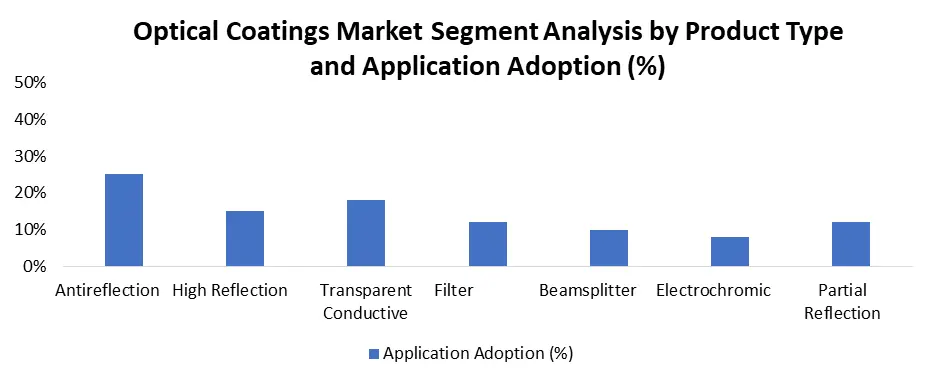
Based on Product Type, Antireflection coatings dominated the Optical Coatings Market in 2023 and is expected to maintain its dominance over the forecast period. Widely adopted in electronic devices such as smartphones and tablets, enhance visibility and user experience. High Reflection coatings find extensive use in optics and mirrors, contributing to efficient light reflection in applications such as telescopes. Transparent Conductive coatings play a pivotal role in touchscreens and solar panels, enabling conductivity without compromising transparency. Filters are essential for applications like camera lenses, ensuring precise wavelength transmission. Beamsplitter coatings facilitate the division of light in optical systems, commonly utilized in microscopy. Electrochromic coatings, with applications in smart windows, dynamically adjust transparency based on environmental conditions. Partial Reflection coatings, crucial in optical communications, enable controlled light reflection. The segment analysis underscores the varied roles these coatings play, emphasizing their application-specific significance in driving the Optical Coatings Market's growth.
Based on Technology Type, Vacuum Deposition dominated the Optical Coatings Market in 2023 and is expected to maintain its dominance during the forecast period. It finds widespread use in antireflection coatings across electronic devices and eyewear. E-Beam Evaporation, prized for precision, dominates applications requiring thin-film depositions, particularly in semiconductor manufacturing. Sputtering, recognized for its efficiency, is extensively employed in the production of optical components like mirrors and filters. Ion-Assisted Deposition, valued for enhancing coating adherence, is instrumental in applications demanding durability, such as aerospace optics. Each technology type presents a unique set of advantages, driving their adoption in diverse applications across industries, from consumer electronics to aerospace, collectively shaping the dynamic landscape of the Optical Coatings Market.
Optical Coatings Market Regional Insights:
Asia-Pacific Dominance in the Optical Coatings Market
Asia-Pacific dominated the Optical Coatings Market in 2023, led by China's strong manufacturing activities and technological advancements. With key industry players such as ZC&R Coatings for Optics, Inc. and Essilor having significant production facilities in the region, China solidifies its position as a powerhouse in optical coatings production. The well-established manufacturing infrastructure and ongoing research and development efforts contribute to its dominance. On the consumption front, North America and Europe play pivotal roles, reflecting heightened demand for optical coatings across various industries. The United States, within North America, stands out as a major consumer, fueled by widespread adoption in electronics, healthcare, and aerospace. Companies like PPG Industries significantly contribute to market consumption. In Europe, countries like Germany and the United Kingdom witness robust demand, propelled by advancements in automotive technologies and the presence of major players like Carl Zeiss AG.
This regional analysis underscores the global nature of the optical coatings market, with Asia-Pacific leading in production and North America and Europe driving substantial consumption. The interplay of regional manufacturing capabilities, technological innovation, and diverse application needs across different industries shapes the market's landscape. As industries evolve, these regional trends are poised to influence the optical coatings market on a global scale. In particular, the Asia-Pacific region is anticipated to dominate the market, driven by escalating demand from sectors like electronics, semiconductors, and aerospace and defense. Specifically, China's aviation sector's anticipated recovery and substantial aircraft purchases signal an upsurge in market demand. India, ranking high in renewable energy capacity, demonstrates a growing market with significant solar power installations. Japan, with a thriving electronics and IT industry, contributes to the global production of optical coatings. These regional nuances exemplify the multifaceted dynamics driving the optical coatings market on a global stage.
Recent Developments in the Optical Coatings Industry (2022-2023)
| Date | Companies Involved | Development |
| June 29, 2023 | PPG Industries Ohio, Inc and Satys | Formed a partnership to offer electrocoating (e-coat) services for OEM aircraft components. |
| May 23, 2023 | PPG and Entrotech Inc. | Established a joint venture for delivering paint films with multi-layered coatings. |
| June 21, 2023 | DuPont and JetCool Technologies Inc. (JetCool) | Formed a collaboration to enhance liquid cooling technology for high-power electronic applications. |
| March 29, 2023 | ZEISS Group | Initiated the expansion of ZEISS Semiconductor Manufacturing Technology (SMT) segment's Wetzlar site. |
| February 02, 2022 | Nippon Sheet Glass Co., Ltd (NSG) | Unveiled MAGNAVI, an innovative glass fiber for use in fiber-reinforced plastics and thermoplastics. |
Optical Coatings Market Report Scope: Inquire before buying
| Optical Coatings Market | |||
|---|---|---|---|
| Report Coverage | Details | ||
| Base Year: | 2023 | Forecast Period: | 2024-2030 |
| Historical Data: | 2018 to 2023 | Market Size in 2023: | US $ 10.87 Bn. |
| Forecast Period 2024 to 2030 CAGR: | 5.92% | Market Size in 2030: | US $ 16.26 Bn. |
| Segments Covered: | by Product Type | Antireflection High Reflection Transparent Conductive Filter Beamsplitter Electrochromic Partial Reflection |
|
| by Technology Type | Vacuum Deposition E-Beam Evaporation Sputtering Ion-Assisted Deposition Other |
||
| by End Use Type | Electronics Automotive Millitary and Defence Solar Medical |
||
Optical Coatings Market, by Region
North America (United States, Canada and Mexico)
Europe (UK, France, Germany, Italy, Spain, Sweden, Austria and Rest of Europe)
Asia Pacific (China, South Korea, Japan, India, Australia, Indonesia, Malaysia, Vietnam, Taiwan, Bangladesh, Pakistan and Rest of APAC)
Middle East and Africa (South Africa, GCC, Egypt, Nigeria and Rest of ME&A)
South America (Brazil, Argentina Rest of South America)
Optical Coatings Market Key Players:
Major Contributors in the Optical Coatings Industry in North America:
1. Edmund Optics: Barrington, New Jersey, USA
2. Newport Corporation (Now part of MKS Instruments): Andover, Massachusetts, USA
3. Thorlabs: Newton, New Jersey, USA
4. Viavi Solutions: San Jose, California, USA
5. II-VI Incorporated: Saxonburg, Pennsylvania, USA
6. Reynard Corporation: San Clemente, California, USA
7. Abrisa Technologies: Santa Paula, California, USA
8. Dover Corporation (Optical Solutions Group): Downers Grove, Illinois, USA
9. Inrad Optics: Northvale, New Jersey, USA
10. Materion Corporation: Mayfield Heights, Ohio, USA
11. Optics Balzers AG: Balzers, Liechtenstein
12. Delta Light & Optics: Silver Spring, Maryland, USA
13. OptoSigma Corporation: Santa Ana, California, USA
14. Dynasil Corporation: Newton, Massachusetts, USA
15. Zygo Corporation (Part of AMETEK): Middlefield, Connecticut, USA
16. Rochester Precision Optics: West Henrietta, New York, USA
Leading players in the Europe Optical Coatings Market:
1. ZEISS Group: Oberkochen, Germany
2. Schott AG: Mainz, Germany
3. Laser Components GmbH: Olching, Germany
4. Jenoptik AG: Jena, Germany
5. Leybold Optics (Part of Atlas Copco): Cologne, Germany
6. Knight Optical: Harrietsham, United Kingdom
FAQs:
1] What Major Key players in the Global Optical Coatings Market report?
Ans. The Major Key players covered in the Optical Coatings Market report are ZEISS Group, Schott AG, Laser Components GmbH, Jenoptik , Leybold Optics
2] Which region is expected to hold the highest share in the Global Optical Coatings Market?
Ans. Asia Pacific region is expected to hold the highest share in the Optical Coatings Market.
3] What is the market size of the Global Optical Coatings Market by 2030?
Ans. The market size of the Optical Coatings Market by 2030 is expected to reach US$ 16.26 Billion.
4] What is the forecast period for the Global Optical Coatings Market?
Ans. The forecast period for the Optical Coatings Market is 2024-2030.
5] What was the market size of the Global Optical Coatings Market in 2023?
Ans. The market size of the Optical Coatings Market in 2023 was valued at US$ 10.87 Billion.