
NLP in Healthcare and Life Sciences Market Size by Component, Application, NLP Type, End-User, Region – Revenue Pool Analysis, Margin Structure Assessment, Capital Flow Trends, Competitive Benchmarking & Forecast to 2030
Overview
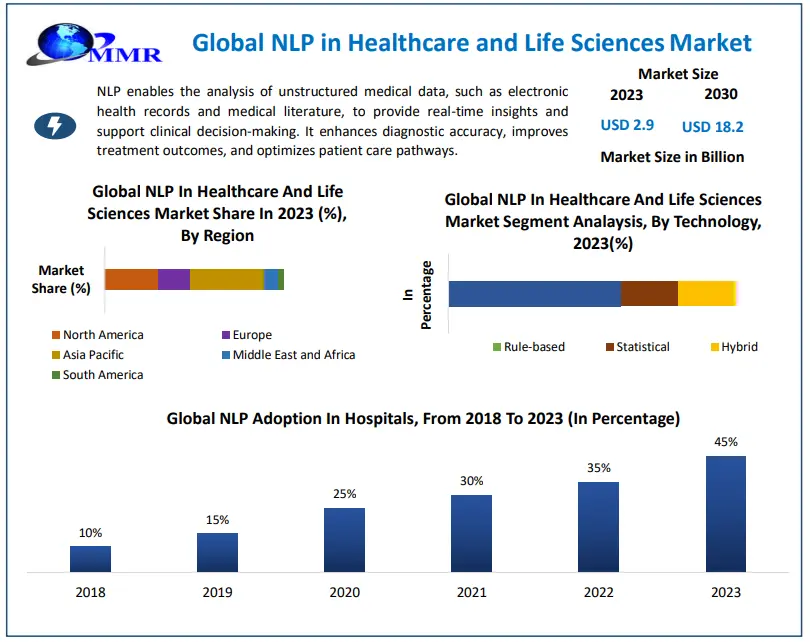
The NLP in Healthcare and Life Sciences Market size was valued at USD 2.9 Billion in 2023 and the total NLP in Healthcare and Life Sciences revenue is expected to grow at a CAGR of 30% from 2024 to 2030, reaching nearly USD 18.2 Billion in 2030.
NLP in Healthcare and Life Sciences Market Overview
The MMR report examines the NLP in Healthcare and Life Sciences market's size, growth rate, and segmentation by type, application, and region. Also, it explores the market's dynamics, identifying drivers, restraints, and opportunities shaping its trajectory. In the subsequent section on market trends and developments, the report highlights technological advancements in NLP, its integration into healthcare IT infrastructure, and emerging applications in the healthcare and life sciences sectors. Developments in AI, machine learning, and deep learning fuel innovation, attracting investment to firms developing specialized NLP solutions. Rising healthcare data volumes and the desire for greater efficiency drive demand for NLP solutions across a wide range of domains. Personalized medicine, drug development, and clinical trial optimization present particularly lucrative investment opportunities, motivating a coordinated focus on these specific areas of the NLP landscape. The rapid growth of healthcare data from electronic health records, clinical trials, and research necessitates the use of natural language processing (NLP) to extract insights and evaluate this huge textual material. Regulatory standards for data protection and healthcare quality require the use of compliant and precise NLP systems. Streamlining workflows, automating operations, and improving coding accuracy with NLP result in significant cost savings for healthcare providers. In addition, NLP allows for the study of specific patient data, promoting personalized medical techniques that result in individualized treatments and improved patient outcomes. North America dominates the NLP market, with Europe and Asia Pacific following behind. However, India and China are rapidly growing. Improvements in AI and machine learning are expected to further strengthen NLP skills, ensuring the global development of increasingly precise and complex solutions.
 To know about the Research Methodology :- Request Free Sample Report
NLP in Healthcare and Life Sciences Market Dynamics
Clinical Documentation Improvement
The increase in healthcare data from sources such as electronic health records (EHRs) and genomics, combined with regulatory demands for precision, propels Natural Language Processing (NLP) in Clinical Documentation Improvement. Manual analysis is impractical owing to data volume, therefore NLP provides efficient coding while eliminating errors and assuring compliance. Regulatory demands incentivize healthcare practitioners to use NLP for accurate recordkeeping and compliance with mandates. The use of this technology not only simplifies coding procedures, but also improves patient care through better coordination, diagnosis, and treatment decisions. Therefore, natural language processing (NLP) is an important tool for managing the growing clinical data landscape while also enhancing quality care delivery and regulatory compliance. Advances in NLP technology, fuelled by deep learning and AI, are improving accuracy and widening applications. It is demonstrated by the increasing use of NLP solutions in hospitals, clinics, and pharmaceutical businesses for tasks such as clinical documentation improvement (CDI) and coding. Also, NLP's breadth includes specific fields such as clinical trial data analysis, medication discovery, and personalized medicine, demonstrating its growing importance and numerous uses in the healthcare business.
1. According to MMR Research, it shows that Over 100 vendors offer NLP solutions for healthcare, with several new entrants in recent years.
Clinical Documentation and EHRs (Electronic Health Records)
The rise of clinical documentation and Electronic Health Records (EHRs) presents a massive opportunity for the Natural Language Processing (NLP) market in healthcare and life sciences. Natural Language Processing (NLP) algorithms automate the extraction of relevant information from a variety of sources, including patient notes, radiology reports, and discharge summaries, saving physicians time while guaranteeing data consistency. The automated technique improves medical coding and invoicing by mapping collected data to standard medical codes, thereby minimizing errors and expediting procedures. Automated data extraction maintains the quality and completeness of patient information by reducing human error, which improves record-keeping accuracy. NLP's search and analytical capabilities allow for quick and precise retrieval of patient data, which aids in diagnosis and treatment decisions. Furthermore, NLP examines large databases to find patient groups with unique features, hence promoting personalized medication. Overall, NLP streamlines operations improves accuracy, and enables personalised medicine in healthcare.
Domain-specific Language and Terminology
Medical language nuances vary by specialty and region, posing a problem for algorithms that require adaption. Clinical writing, which contains domain-specific jargon and acronyms, may confuse ordinary NLP models. Ambiguity in medical words necessitates advanced algorithms to determine contextually accurate interpretations. Access to massive amounts of labeled healthcare data for training big language models is limited due to privacy concerns and data ownership difficulties, which impede algorithm development. Domain-specific adaption increases development costs and timeframes for NLP solutions in healthcare. Standard models are expected to fail in healthcare jobs, reducing market trust and adoption due to linguistic complexities. Niche-focused NLP solutions, designed for certain healthcare tasks or expertise, limit overall market adoption.
1.MMR Studies show that, 25% error rate for standard NLP models on clinical text compared to 7% for domain-adapted models
2.The number of research papers on domain-specific adaptation for NLP in healthcare increased by 50% between 2018 and 2023
NLP in Healthcare and Life Sciences Market Regional Insights
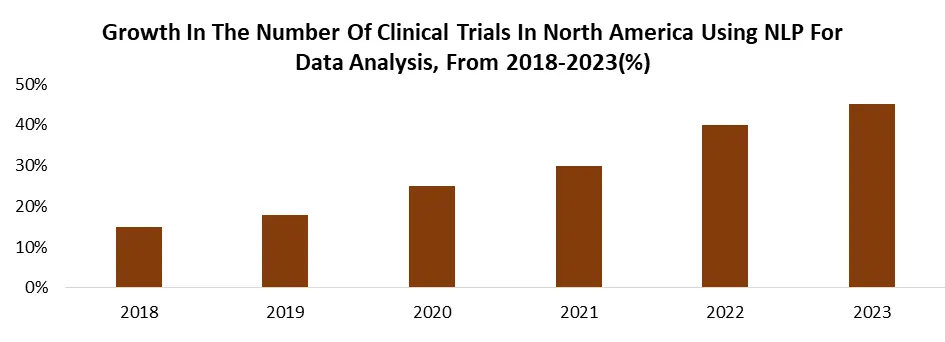
North America, particularly the United States, dominates the NLP in the Healthcare and Life Sciences market because of a variety of factors. Its leading global healthcare expenditure encourages the use of cost-effective NLP solutions. Advanced healthcare infrastructure, including extensive EHR use, makes NLP integration easier. Stringent regulatory regulations for data privacy and healthcare quality are driving demand for accurate and compliant NLP solutions. The region's robust research institutes and technology industries drive NLP innovation, contributing to its market supremacy. North America received significant venture capital funding for NLP healthcare businesses in 2022, totaling USD 1.2 billion. According to an MMR survey found that 55% of hospitals in the United States and Canada use NLP for clinical documentation duties, showing substantial use. NLP applications are gaining popularity in certain fields such as claims processing, drug development, and personalized care. Significant cooperation between major healthcare institutions and technology businesses in North America is driving NLP research and development activities, encouraging innovation and improvement in the field.
In the United States, the National Institutes of Health (NIH) and the Food and Drug Administration (FDA) play an essential part in promoting and enhancing Natural Language Processing (NLP) techniques for healthcare applications. At the same time, in Canada, the Canadian Institute for Health Information (CIHI) aggressively promotes the use of NLP in healthcare for data analysis and quality improvement objectives. The United States dominates the North American NLP market, owing to strong backing from government agencies such as the NIH and FDA, as well as widespread usage of healthcare information technology. Even so, Canada is emerging as a significant player, owing to favorable government regulations and an increasing trend of healthcare IT usage. With initiatives from organizations such as CIHI supporting NLP for healthcare data analysis and quality improvement, Canada has significant growth potential in the NLP healthcare industry of North America.
1. Over 50 NLP vendors cater to the North American healthcare market, with several new entrants focusing on domain-specific solutions.
NLP in Healthcare and Life Sciences Market Segment Analysis
By Application, The Clinical Documentation Improvement (CDI) segment accounts for an estimated 42% of the overall NLP in Healthcare and Life Sciences Market. NLP automates the extraction of relevant information from clinical notes, reducing manual coding errors and increasing accuracy. It also results in faster reimbursement cycles, which improves operational efficiency. NLP performs early chart screenings to discover potential coding anomalies, which improves the Clinical Documentation Improvement (CDI) review process. It helps physicians save time while retaining precision, resulting in improved workflow efficiency. The requirement for comprehensive CDI solutions drives increased demand for NLP capabilities, resulting in market growth for specialist tool vendors. Successful CDI implementations validate NLP technology, resulting in increased investment and innovation in the field. In addition, CDI procedures generate large amounts of tagged healthcare text data, which is critical for improving NLP models and benefiting the overall ecosystem. Also, CDI initiatives promote standardized clinical language and data formats, supporting interoperability and paving the path for more widespread deployment of NLP technologies throughout healthcare systems. CDI-derived insights provide opportunities for sophisticated NLP applications in risk prediction, customized treatment, and population health management.
NLP in Healthcare and Life Sciences Market Competitive Landscape
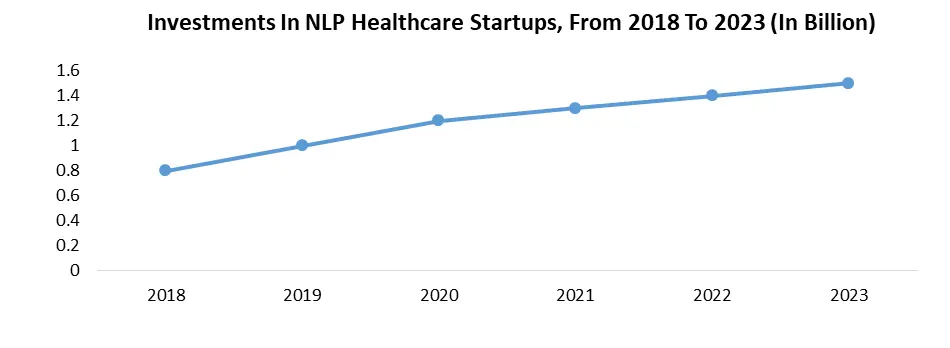
Major IT companies such as IBM (Watson Health), Microsoft (Azure Healthcare), and Google (Cloud Healthcare) invest extensively in research and development, providing comprehensive NLP solutions in healthcare. Dedicated healthcare NLP firms such as Nuance Communications, iFlytek, Galen Healthcare Solutions, and Athenahealth focus on certain sectors of healthcare and invest strategically. Also, several startups, such as Aylien, Docupace, and Berg Health, are entering the market with novel niche NLP solutions, resulting in increased investment and attention. The investment trend continued in 2023, with several businesses winning funding rounds above USD 50 million. Forecasts for 2024 anticipate increased consolidation within the sector via mergers and acquisitions, potentially leading to the development of dominating firms in the NLP market.
In 2021, Google AI released PaLM (Pathway Language Model), a large-scale language model trained on healthcare data that is going to show significant advances in clinical text reading. DeepMind's AlphaFold 2 achieves near-perfect accuracy in predicting protein structures by
2022, possibly revolutionizing drug development and personalized treatment. In 2023, IBM Watson Health added Transformer-based models into its NLP solutions, improving clinical coding accuracy and risk prediction. Looking ahead to 2024, the focus is on building explainable AI (XAI) in NLP to improve transparency and confidence in decision-making algorithms. Rising competition drives innovation and cost efficiency, benefiting both healthcare providers and patients. Consistent improvements in NLP precision and capability enable broader market adoption and new applications. Considerations about data privacy and security demonstrate the need for strong data governance and severe security measures to protect patient confidentiality and create trust.
NLP in Healthcare and Life Sciences Market Scope: Inquire before buying
| Global NLP in Healthcare and Life Sciences Market | |||
|---|---|---|---|
| Report Coverage | Details | ||
| Base Year: | 2023 | Forecast Period: | 2024-2030 |
| Historical Data: | 2018 to 2023 | Market Size in 2023: | US $ 2.9 Bn. |
| Forecast Period 2024 to 2030 CAGR: | 30% | Market Size in 2030: | US $ 18.2 Bn. |
| Segments Covered: | by Component | Solution Services |
|
| by Application | Clinical Documentation Improvement (CDI) Clinical Trials Services Consumables |
||
| by NLP Type | Rule-based Statistical Hybrid |
||
| by End-User | Physician Researchers Clinical Operators |
||
NLP in Healthcare and Life Sciences Market by Region:
1. North America (United States, Canada, and Mexico)
2. Europe (UK, France, Germany, Italy, Spain, Sweden, Austria, and the Rest of Europe)
3. Asia Pacific (China, South Korea, Japan, India, Australia, Indonesia, Malaysia, Vietnam, Taiwan, Bangladesh, Pakistan, and the Rest of APAC)
4. Middle East and Africa (South Africa, GCC, Egypt, Nigeria, and the Rest of ME&A)
5. South America (Brazil, Argentina Rest of South America)
Key Players in the NLP in the Healthcare and Life Sciences Market
1. IBM (US)
2. Microsoft (US)
3. Google (US)
4. AWS (US)
5. IQVIA (US)
6. Oracle Corporation (US)
7. Inovalon(US)
8. Dolbey and Company (US)
9. Averbis (Germany)
10. SAS Institute (US)
11. 3M (US)
12. Press Ganey (US)
13. Ellipsis Health (US)
14. Centene Corporation (US)
15. Nexocode
16. Johnsnowlabs
17. Pharmafeatures
18. Aylien
19. Docupace
20. Berg Health
21. iFLYTEK
22. Athenahealth
23. Serimag
24. Amazon
25. dsm
FAQs:
1. What organizations support NLP research and development in healthcare?
Ans. Key organizations supporting NLP research and development in healthcare include the National Institutes of Health (NIH), the Food and Drug Administration (FDA) in the United States, and the Canadian Institute for Health Information (CIHI) in Canada.
2. What developments are predicted for the NLP in the Healthcare market in 2024?
Ans. In 2024, increased consolidation among players through mergers and acquisitions is anticipated, along with a continued focus on developing explainable AI (XAI) in NLP for enhanced transparency and trust in decision-making algorithms.
3. What is the projected market size & and growth rate of the 3D Stacking Market?
Ans. The NLP in Healthcare and Life Sciences Market size was valued at USD 2.9 Billion in 2023 and the total NLP in Healthcare and Life Sciences revenue is expected to grow at a CAGR of 30 % from 2023 to 2030, reaching nearly USD 18.2 Billion in 2030.
4. What segments are covered in the NLP in Healthcare and Life Sciences Market report?
Ans. The segments covered in the NLP in Healthcare and Life Sciences market report are Interconnecting Technology, Device Type, Method, and End-Users.