
Global Network Automation Market Size by Solution, by Organization Size, by Vertical, by Deployment Type, by Region and Forecast 2034
Overview
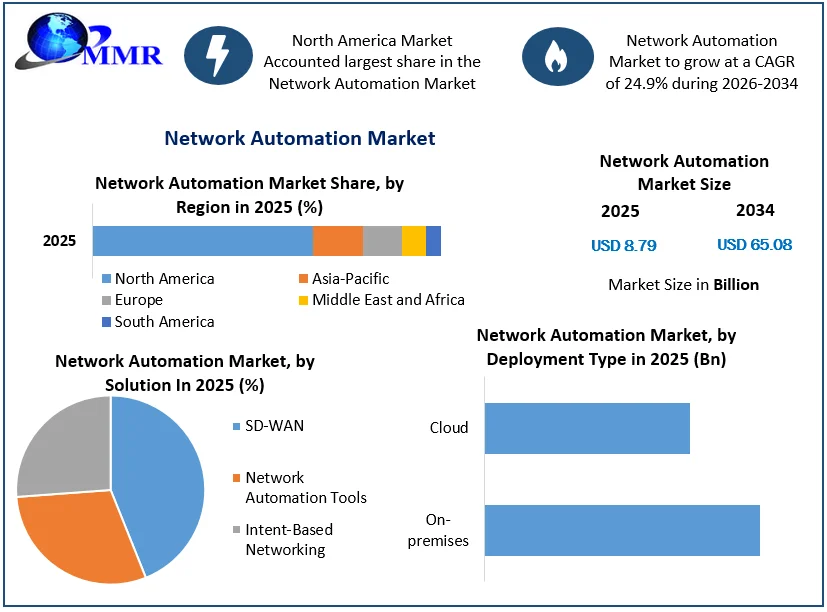
The Global Network Automation Market size was valued at USD 8.79 Bn. in 2025 and the total revenue is expected to grow by 24.9% from 2026 to 2034, reaching 65.08 Bn in 2034
Global Network Automation Market Overview
The planning, deployment, operation, and optimization of networks and associated services are all processes that can be automated. Basic network automation solutions transfer manual processes and activities from each stage of the network lifecycle to software programmes that can repeatably and dependably finish them.
The adoption of cutting-edge technologies that help networks run more efficiently and address network concerns, such as edge computing, 5G and Wi-Fi 6, software-defined wide area networks (SD-WAN), and machine learning (ML), has increased (at times, even before they occur). For businesses to establish a networking solution that becomes smarter, more responsive, constantly adopts the network, and defends it, network automation is a crucial step.
In order to acquire competitive insights, industry participants are concentrating on the creation of cutting-edge network automation solutions. For instance, IBM Corporation unveiled IBM Cloud Pak for Network Automation in June 2022, a new hybrid cloud automation tool powered by AI for providers of telecom and other communication services. The company was able to offer cutting-edge network automation suites for communication service providers thanks to this new technology, facilitating the seamless rollout of 5G networks.
Global Network Automation Market Growth and Share Analysis
To know about the Research Methodology :- Request Free Sample Report
Global Network Automation Market Dynamics:
Growing Need for Data Centers
The network is essential to IT operations more than ever in the new cloud-based environment. As users access the data and computing resources from both remote locations and corporate headquarters, network traffic is rising as key servers and data are hosted in the cloud. The abundance of cloud services that supplement conventional enterprise data centres has made network traffic flow patterns more complex. A lot of businesses are seeking for ways to make their networks more cloud platform compatible. Network automation solutions are becoming more necessary as a result of the growing network traffic since they improve network management and provide full network visibility across all environments.
Increasing investments in Developing to drive the growth of Network Automation Market
With an emphasis on long-term value development, networking companies are substantially investing in the R&D of networking solutions. Leading networking firms haven't cut back on their investment in developing and testing network automation solutions despite short-term volatility in company performance and financial results. Intent-based Networking Solutions, for instance, have been developed by networking firms like Forward Networks. Business policy is the input for intent-based networking, which then transforms the necessity into a network configuration and produces network designs.
Growing Demand for Advanced Healthcare Systems using Networking Automation Technology
To meet the constantly growing customer needs, intent-based networking technology is gaining traction across the healthcare sectors. Examples include enhancing network infrastructure at screening centres, offering efficient wireless infrastructure for the development of smart hospitals, and enhancing IT infrastructure reliability and efficiency in hospitals. Intent-based networking solutions are being used by a number of healthcare sectors to enhance no-contact medical services and promote residents' health in the continuing COVID-19 pandemic era, which is fueling the market growth. In addition, by offering real-time monitoring of the vital medical equipment functions, hospitals can minimise the workload on medical personnel and improve the efficiency of medical services, which is fueling the growth of the network automation market.
Due to the rising demand for proactive monitoring with predictive automation via intent-based networking technology, the intent-based networking segment had around 20% of the network automation market share in Canada in 2023. By using intent-based networking technologies, the business will be able to get rid of network latency, which will hasten problem-solving. An extended variant of SDN called "intent-based networking" enables businesses to automate network programming and lets network administrators construct any number of networks they choose.
Increasing Investments in Emerging Network Automation Solutions
Network Automation solutions are supported by cutting-edge technologies like artificial intelligence (Al) and machine learning (ML), which allow for model-driven network programmability and data analysis. As a result, businesses are better able to deliver predictive analyses, comprehend network behaviours, and offer advice to network operations teams. It contributes to lowering the possibility of human mistakes enhancing operational effectiveness, and boosting network service availability, resulting in a better client experience. IT teams have adopted a network-type of automation as the foundation for a more orchestrated approach to manage and deploy the entire infrastructure as a result of the emergence of real-time telemetry and analytics, single-pane-of-glass management, and Zero Touch Provisioning (ZTP), among other technologies.
Manual configuration of network services is too time- and labour-intensive. Because of this, IT companies have begun investing in automation solutions to increase efficiency, reduce mistakes, and free up additional human resources for other projects. As software may alter every aspect of their company, network, and customer interfaces, CSPs are also investing in network and business automation through digital process reengineering. As a result, more money is being invested in automation technologies to grow the industry.
Growing Security Concerns in Network Automation Market
Business applications, data, and services must always be accessible from wherever in the current, interconnected digital world. To do this, networks must connect various hosting environments, fixed and mobile devices, and other types of IT infrastructure. Networks are an important business enabler, but they may also be a source of added risk. New network attacks are continually being created by hackers and cybercriminals in an effort to infiltrate, steal, or destroy crucial data and disrupt businesses for their own gain. Over the network, malware assaults such as distributed denial of service (DDoS), phishing, ransomware, worms, and others are possible.
Open-source automation solutions that are easily accessible are expected to limit the growth of the network automation market. Many open-source technology developers have developed efficient open-source network monitoring tools, which are regarded to be superior to their more expensive commercial alternatives.
The market for commercial network automation solutions is being constrained by the availability of such accessible and open-source solutions, in large part because SMEs prefer them owing to financial restrictions. Some retailers are trying to make money off of open-source solutions by offering for-profit updates to these products. Commercial upgrades provide paid versions of items with enhanced features including automated software patch downloads, support, and maintenance.
Global Network Automation Market Segment Analysis:
By Deployment Type, the Network Automation Market is segmented into On-premises and Cloud. The Cloud segment held the largest market share in 2025. By utilising the possibilities of cloud computing, cloud network automation enables quick and secure network configuration. Additionally, a solution's capacity to handle massive network application traffic can be scaled thanks to the cloud deployment paradigm. Adopting these solutions enables small businesses to gather and analyse data, enhancing client services. Due to the numerous benefits that the cloud deployment model offers, the demand for network automation solutions that are located in the cloud is now rising relative to their on-premises equivalents.
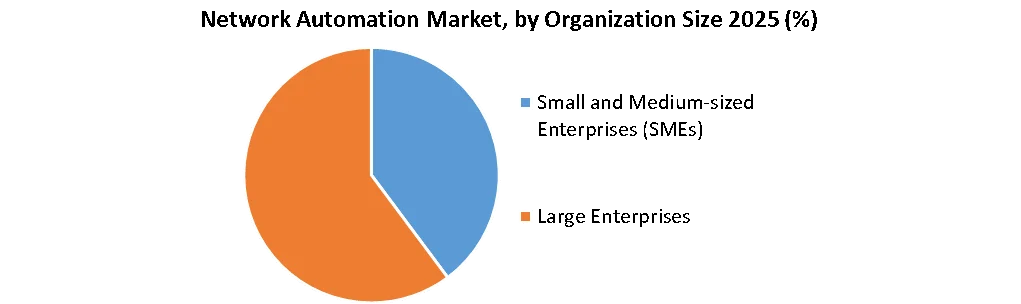
By Organisation Size, the Network Automation Market is segmented into Small and Medium-sized Enterprises (SMEs) and Large Enterprises. The use of SDN technology among SMEs has been prompted by the growing popularity of cloud computing. Budget restrictions cause SMEs to favour the market's cloud-based solutions in general. These organisations have gradually begun implementing cutting-edge technical items that improve their operational capabilities while using minimal resources. Network automation can help SMEs cut costs on network infrastructure and shorten the amount of time spent solving network problems (by determining the state of the network at any point in time).
By Vertical, the Network Automation Market is segmented into Information Technology (IT), Banking, Financial Services, and Insurance (BFSI), Manufacturing, Healthcare, Energy and Utilities, Education, and Others. The Information Technology (IT) segment held the largest market share in 2025. There are a lot of computing, storage, and networking devices in data centres.
As a result, managing and configuring these multi-vendor devices in data centres is complicated. Network scalability has also raised OPEX costs for running IT departments and improving their ability to adapt to shifting business needs. Due to these issues, IT departments have been forced to invest significantly in maintaining their network infrastructure, which has fueled the demand for network automation.
The UK's IT and telecom industry is expected to grow by almost 20% through the forecast period. In order to provide its consumers with better programmability and network efficiency, the telecom industry underwent significant technological changes. Telecom service providers were able to deploy more virtualization in their networks as a result of the growing adoption of NFV technologies. A rise in the IT & telecom business has occurred as a result of several government initiatives for digitalization in order to meet end-user demand. Additionally, the development of 5G technology is expected to bring about improved networking options.
Global Network Automation Market Regional Insights:
In 2025, North America dominated the market with the largest market share accounting for xx%. The growth is attributed to the broad adoption of cutting-edge technologies like DevOps, SD-WAN, and intent-based networking. The market has grown as a result of the rising demand for deep-learning AI algorithms for remotely controlling network equipment. These algorithms assist market participants in providing improved automation technologies to their end consumers, such as image processing and speech recognition.
Europe is expected to grow at significant growth through the forecast period. Software-defined networking (SDN) and network function virtualization (NFV) technologies are being adopted more widely every day in Europe. In order to accommodate these increasing network requirements, these variables quickly alter how large businesses construct their wide area networks. Additionally, as more technologies are implemented in enterprises, the complexity of their IT infrastructure grows, driving up the demand for network automation solutions.
Global Network Automation Market Recent Development
| Month | Company name | Recent development description |
|---|---|---|
| February 2026 | Cisco | Cisco announced new AgenticOps capabilities on February 10 to automate network troubleshooting improve performance and create automated workflows across campus branch and industrial networks. |
| March 2026 | Nokia | Nokia expanded its Network as Code ecosystem on March 3 with advances in API based agentic AI supporting programmable network services and network automation. |
| March 2026 | Arista Networks | Arista Networks announced its XPO high density liquid cooled optical networking initiative on March 12 to support higher capacity connectivity for AI data center networks. |
| May 2026 | Arista Networks | Arista Networks introduced new cognitive campus networking capabilities and was named a Leader in the 2026 Gartner Magic Quadrant for Enterprise Wired and Wireless LAN on May 20. |
| June 2026 | Nokia | Nokia introduced an agentic AI framework for its Network Services Platform on June 11 to support guided troubleshooting and policy controlled automation in IP networks. |
| September 2026 | Nokia | Nokia announced a collaboration with Microsoft on September 17 to combine Nokia Data Suite with Microsoft Fabric and enable AI driven network automation and autonomous telecom operations. |
Global Network Automation Market Scope: Inquire before buying
| Network Automation Market | |||
|---|---|---|---|
| Report Coverage | Details | ||
| Base Year: | 2025 | Forecast Period: | 2026-2034 |
| Historical Data: | 2020 to 2025 | Market Size in 2025: | USD 8.79 Bn. |
| Forecast Period 2026 to 2034 CAGR: | 24.9% | Market Size in 2034: | USD 65.08 Bn. |
| Segments Covered: | by Solution | SD-WAN Network Automation Tools Intent-Based Networking |
|
| by Organization Size | Small and Medium-sized Enterprises (SMEs) Large Enterprises |
||
| by Vertical | Information Technology (IT) Banking, Financial Services, and Insurance (BFSI) Manufacturing Healthcare Energy and Utilities Education Others |
||
| by Deployment Type | On-premises Cloud |
||
Global Network Automation Market, by Region
North America (United States, Canada and Mexico)
Europe (UK, France, Germany, Italy, Spain, Sweden, Austria, Turkey, Russia and Rest of Europe)
Asia Pacific (China, India, Japan, South Korea, Australia, ASEAN and Rest of APAC)
Middle East and Africa (South Africa, GCC, Egypt, Nigeria and Rest of ME&A)
South America (Brazil, Argentina, Columbia and Rest of South America)
Global Network Automation Market Key Players are:
1. Cisco(US)
2. IBM(US)
3. Micro Focus(US)
4. SolarWinds(US)
5. Kentik(US)
6. Versa Networks(US)
7. AppViewX(US)
8. BackBox(US)
9. NetBrain Technologies(US)
10.Riverbed Technology(US)
11.Apstra(US)
12.BMC Software(US)
13.Veriflow(US)
14.Entuity(US)
15.Juniper Networks(US)
16.Forward Networks(US)
17.VMware(US)
18.Entuity(US)
19.Itential(US)
20.Volta Networks(US)
21.Sedona Systems(US)
22.SaltStack (UK)
23.Anuta Networks(India)
24.BlueCat (Canada)
25.NetYCE (Netherlands)
Frequently Asked Questions:
1. What was the global market size Network Automation Market in 2025?
Ans. The Global Network Automation Market was valued at 8.79 Bn in 2025
2. Why is network automation important?
Ans. Automation is increasingly necessary for managing converged IP service fabrics at scale in the age of 5G and the cloud. Network performance degradation and outages are most frequently brought on by human mistake, which is decreased by automation, making automated networks more dependable. Automation can also be used by large corporations and service providers to speed up the time to market, enhance customer satisfaction, and fulfil the expectations for scalability that are becoming more and more stringent. Greater network uptime, stability, and efficiency are the end results.
3. How is AI used in network automation?
Ans. AI is utilised for intelligent root-cause analysis, automatic data collecting and normalisation across network domains and vendors, and alarms regarding probable equipment failure or performance degradation. It's especially helpful for figuring out anomalies that can influence customer services, which frequently enables problems to be fixed before users are impacted.
4. Who are the major suppliers in the network automation market?
Ans. The major suppliers in the network automation market include Cisco, Juniper Networks, IBM, Micro Focus, and NetBrain.
5. What is the Best Network Automation Tool?
Ans. SolarWinds Network Configuration Manager, Kiwi CatTools, ManageEngine Network Configuration Manager, Lan-Secure Configuration Center, and BMC TrueSight Automation for Networks are the best Network Automation Tool.