
Movie Making Market – Industry Structure Evaluation, Demand Drivers Analysis, Regional Growth Analysis and Identification, Competitive Positioning Review & Global Market Size Forecast to 2032
Overview
The Movie Making Market size was valued at USD 93.22 Billion in 2025 and the total Movie Making revenue is expected to grow at a CAGR of 7.92% from 2025 to 2032, reaching nearly USD 158.94Billion.
Movie-Making Market Overview
The Movie-Making Market is the collective activities involved in the creation, production, distribution, and exhibition of films or movies. It encompasses a wide range of activities, from scriptwriting and pre-production to filming, post-production, marketing, and distribution. The movie-making market is experiencing growth due to Technological advancements, including CGI and virtual reality, enhancing cinematic experiences, and captivating audiences. Global demand for diverse and representative content fuels creativity, expanding the Movie Making Market.
Emerging markets in Asia and Latin America, empowered by rising incomes, strengthen demand for entertainment. Collaborative international co-productions leverage resources and attract global viewership. Successful film franchises and cinematic universes cultivate sustained engagement. Film festivals and awards elevate film visibility and prestige. Effective marketing, digital distribution, and streaming platforms broaden access, attracting wider audiences. Moreover, movies serve as cultural mirrors, reflecting societal trends and fostering discussions. This growth trajectory is underpinned by escapism, artistic innovation, and the enduring allure of storytelling, solidifying the Movie-Making Market dynamic expansion.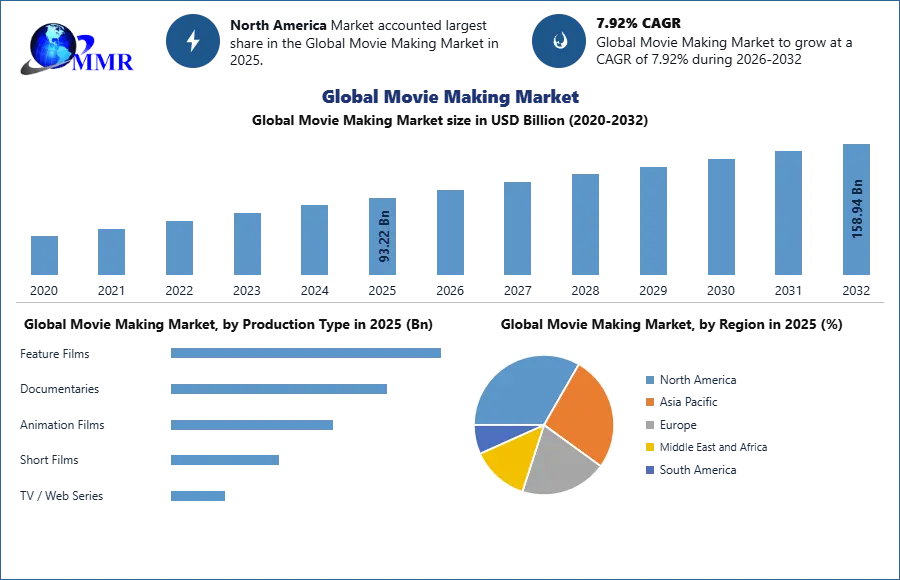 To know about the Research Methodology :- Request Free Sample Report
Making Market Dynamics
Technological Advancements boost the Market growth
Technological advancements reshaped the movie-making industry. The innovations opened up new possibilities for creativity, efficiency, and audience engagement. In pre-production, filmmakers now possess access to advanced pre-visualization tools and software that enable them to visualize scenes, determine camera angles, and plan visual effects before the commencement of filming. This helps in planning complex sequences and helps streamline the production process. During production, digital cinematography has replaced traditional film stock for many filmmakers. Digital cameras offer greater flexibility in capturing scenes, enabling real-time adjustments, immediate playback, and reduced costs associated with film development. High-definition and even 4K or higher resolutions provide stunning image quality, enhancing visual storytelling.
Visual effects and computer-generated imagery have become integral to modern filmmaking. Technology allows for the creation of breathtaking worlds, creatures, and unimaginable effects. VFX also offers practical benefits, allowing filmmakers to safely execute dangerous or logistically challenging sequences. Post-production has been revolutionized by digital editing software, which enables precise and efficient editing, color correction, and sound design.
Filmmakers experiment with different cuts, pacing, and visual effects to achieve the desired artistic vision. Distribution has seen a seismic shift with the rise of streaming platforms. Audiences now access content on-demand, anytime and anywhere, leading to changes in how movies are marketed and released. Additionally, virtual reality (VR) and augmented reality (AR) technologies are being explored for immersive experiences, offering new avenues for Movie Making Market. For instance, due to technological advancement animation is rapidly growing.
Streaming Platforms and Digital Distribution Drives the Market Growth
Streaming platforms and digital distribution fundamentally transformed the way movies are consumed, distributed, and experienced by audiences. The platforms provide a convenient and flexible way for viewers to access a vast array of content, influencing various aspects of the Movie-Making Industry. Streaming platforms offer audiences the ability to watch movies, TV shows, and original content on-demand, eliminating the need for traditional scheduled programming. This helps to a shift in viewer behavior, with audiences increasingly favoring personalized viewing experiences that align with schedules and preferences. For filmmakers and content creators, streaming platforms present new opportunities and challenges.
Original content produced by streaming services has become a significant driver of competition, leading to increased investment in exclusive films and series. This has allowed creators to explore diverse genres, styles, and storytelling formats that may not have found a place in traditional distribution channels. Digital distribution through streaming has also provided a global reach, allowing movies accessible to audiences around the world simultaneously. This has expanded the potential market for filmmakers, making it easier to target international audiences and provide to diverse cultural preferences. For example,
 The Indian film industry grew to over 172 billion Indian rupees in the year. While indicative of a trajectory of recovery, the industry was still reeling from the blow dealt by the coronavirus pandemic, in addition to competing with a swiftly expanding video OTT culture.
Rising Production Costs limit the Market Growth
Rising production costs in the movie-making industry become a significant and complex challenge that impacts various aspects of film creation and distribution. These escalating costs stem from several factors, each contributing to the overall financial strain on studios and production companies. One of the primary factors of rising production costs is the demand for high-quality visuals and intricate special effects. Audiences come to expect visually stunning and immersive cinematic experiences, necessitating the use of advanced technology and skilled visual effects artists. These professionals command higher salaries and require innovative equipment, contributing to the overall budget. Additionally, the involvement of A-list actors and renowned directors substantially elevates production expenses. Star salaries, including heavy upfront payments and profit-sharing agreements, consume a significant portion of the budget. Renowned directors often come with substantial fees and creative control, adding to the financial burden.
Location scouting and set construction also impact costs. Filmmakers often seek unique and visually appealing locations, leading to expenses related to travel, accommodations, and permits. Elaborate set designs and construction further add to the expenditure, particularly for period pieces or films set in fantastical worlds. Marketing and distribution costs are another aspect that boosts expenses. Competing in the global market requires substantial promotional efforts, including advertising campaigns, premieres, and press tours. Securing prime release dates and screens in theaters adds to distribution costs, especially for high-demand periods. Rising material costs affect both physical and digital production. This factor significantly hampers the growth of the making Market.
Increasing trend of Short Films and Web Series creates lucrative growth opportunities for the Market growth.
The rising trend of short films and web series has created lucrative growth opportunities for the movie-making market. These bite-sized formats offer cost-effective production, enabling filmmakers to create high-quality content even with limited budgets. With global accessibility through online platforms, a wider audience is reached, driving increased exposure and recognition. This trend fosters creative experimentation, allowing filmmakers to push boundaries and engage audiences with fresh narratives.
Niche and diverse content have been thriving, catering to specific communities and cultures. Success in short films and web series can lead to larger projects, secured funding, and partnerships with brands. As viewing habits shift towards shorter content, creators can captivate audiences more efficiently. These formats act as stepping stones for emerging talent, fostering industry recognition through festivals and building dedicated fan bases. Ultimately, the trend democratizes filmmaking, fueling innovation, diversity, and creative expression while shaping the future of the Movie-Making Market.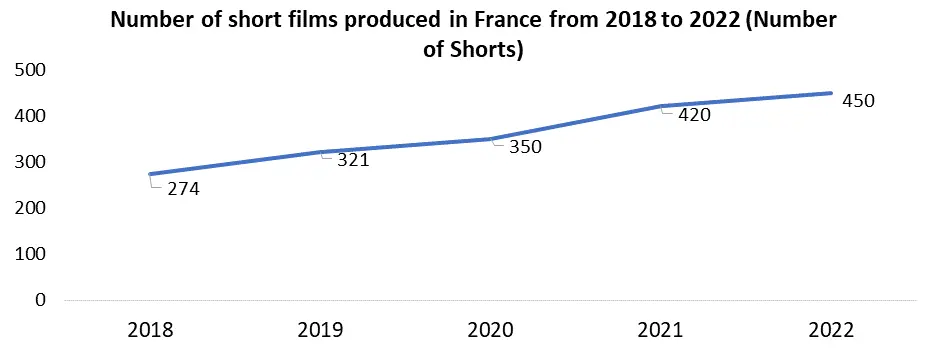
Movie Making Market Segment Analysis:
Based on Genre, the action and adventure segment dominates the Genre segment of the global Movie Making Market in the year 2024. Action and adventure films feature thrilling and dynamic sequences that transcend cultural and language barriers. Explosive stunts, high-speed chases, and intense combat resonate with audiences around the world, making these films accessible to a global market. The audience turns to action and adventure films as a form of escapism.
These movies transport viewers into exciting and high-stakes scenarios, providing a break from everyday life and allowing them to immerse themselves in fantastical worlds. The genre frequently incorporates innovative special effects and visual technologies to create awe-inspiring spectacles. This visual appeal attracts moviegoers seeking a cinematic experience that only be fully appreciated on the big screen. Action-packed scenes, suspenseful moments, and intense battles evoke a sense of excitement and adrenaline. This emotional response a heightened engagement and memorable moviegoing experience.
Regional Insights
The North American region dominate the Global Movie Making Market in the year 2025. Film production, distribution, and box office revenue are powerfully driven by North America, especially the United States. Hollywood plays an important role, in crafting a substantial share of the world's blockbuster movies and establishing industry trends. Major studios, influential directors, and an extensive network of production facilities reside in the U.S. Additionally, Canada within the North American market offers scenic locations and co-production prospects.
Meanwhile, the Making Market is experiencing rapid growth in the Asia Pacific region. Notably, China, Japan, South Korea, and Hong Kong significantly contribute to this market. China, in particular, stands out with remarkable growth in its film industry, emphasizing both local and international co-productions. Japanese and South Korean cinema gained worldwide acclaim for their distinctive narratives and exceptional production quality.
Movie Making Market Recent Development:
| Exact Date | Company | Development | Impact |
|---|---|---|---|
| 15 January 2026 | Netflix / Sony Pictures Entertainment | The companies finalized a landmark global Pay-1 licensing deal valued at approximately $7 billion for exclusive streaming rights. | This agreement secures Netflix as the primary streaming home for Sony's feature films through 2032, significantly consolidating global content distribution. |
| 27 February 2026 | Warner Bros. Discovery (WBD) / Paramount Skydance | Warner Bros. Discovery accepted a $111 billion acquisition bid from Paramount Skydance, following a competitive bidding war. | The merger is expected to close by late 2026, creating a media powerhouse better equipped to compete with Disney and Amazon in the global movie market. |
| 06 March 2026 | The Walt Disney Company | Disney and Pixar officially released "Hoppers", kicking off a major 2026 theatrical slate focused on tentpole franchises. | This launch reinforces the industry's shift toward high-budget IP-driven cinema to drive recovery in global box office figures. |
| 14 March 2025 | Moonvalley AI | The AI research firm launched "Marey", an advanced AI video generator designed for professional cinematic content creation. | The tool accelerates the trend of AI-driven pre-production and automation, reducing VFX costs for independent and studio filmmakers alike. |
| 27 November 2025 | WAVES Film Bazaar | The 2025 event concluded with the signing of four major MoUs between Indian and Australian media entities for bilateral co-production. | The collaboration facilitates over ₹1050 crore in business leads, strengthening Asia-Pacific as a hub for international film collaboration. |
| 04 January 2026 | 20th Century Studios | The film "Avatar: Fire and Ash" surpassed the $1 billion mark at the global box office within weeks of its release. | The success demonstrates the sustained commercial viability of premium formats like 3D and IMAX in the modern movie-making market. |
Global Movie Making Market Scope: Inquire before buying
| Global Movie Making Market | |||
|---|---|---|---|
| Report Coverage | Details | ||
| Base Year: | 2025 | Forecast Period: | 2026-2032 |
| Historical Data: | 2020 to 2025 | Market Size in 2025: | 93.22 USD Billion |
| Forecast Period 2026-2032 CAGR: | 7.92% | Market Size in 2032: | 158.94 USD Billion |
| Segments Covered: | by Production Type | Feature Films Documentaries Animation Films Short Films TV / Web Series |
|
| by Genere | Drama Comedy Horror Science Fiction Others |
||
| by Technology | 3D and 4D Experiences Virtual Reality (VR) Augmented Reality (AR) Others |
||
| by Distribution Channel | Traditional Cinema Releases Streaming Platforms Direct-to-DVD Releases Others |
||
Movie Making Market, by Region
North America (United States, Canada and Mexico)
Europe (UK, France, Germany, Italy, Spain, Sweden, Austria and Rest of Europe)
Asia Pacific (China, South Korea, Japan, India, Australia, Indonesia, Malaysia, Vietnam, Taiwan, Bangladesh, Pakistan and Rest of APAC)
Middle East and Africa (South Africa, GCC, Egypt, Nigeria and Rest of ME&A)
South America (Brazil, Argentina Rest of South America)
Movie Making Key Player
1. ARRI Group
2. RED Digital Cinema
3. Blackmagic Design
4. Sony Corporation
5. Canon Inc.
6. Panavision
7. DJI
8. Cooke Optics
9. Sennheiser
10. Avid Technology
11. Adobe Inc.
12. Autodesk
13. Foundry Visionmongers
14. SideFX
15. Epic Games (Unreal Engine – virtual production)
16. Deluxe Entertainment Services Group
17. Technicolor Creative Studios
18. Framestor
19. Industial Light & Magic (ILM)
20. Weta FX
21. DNEG (Double Negative)
22. Universal Pictures
23. Warner Bros. Studios
24. Paramount Pictures
25. Walt Disney Studios
26. Sony Pictures Entertainment
27. Pinewood Studios Group
28. Legendary Entertainment
29. Lionsgate Films
30. Netflix Studios
Others
Frequently Asked Questions:
1] What is the growth rate of the Global Movie Making Market?
Ans. The Global Movie Making Market is growing at a significant rate of 7.92% during the forecast period.
2] Which region is expected to dominate the Global Movie Making Market?
Ans. North America is expected to dominate the Movie Making Market during the forecast period.
3] What is the expected Global Movie Making Market size by 2032?
Ans. The Movie Making Market size is expected to reach USD 158.94Bn by 2032.
4] What are the factors driving the Global Movie Making Market growth?
Ans. Technological Advancements in Movie Making Boosts the Market Growth.