
Microlens Arrays Market Size by Optical Principle, Lens Geometry, Material, Application and End User Industry
Overview
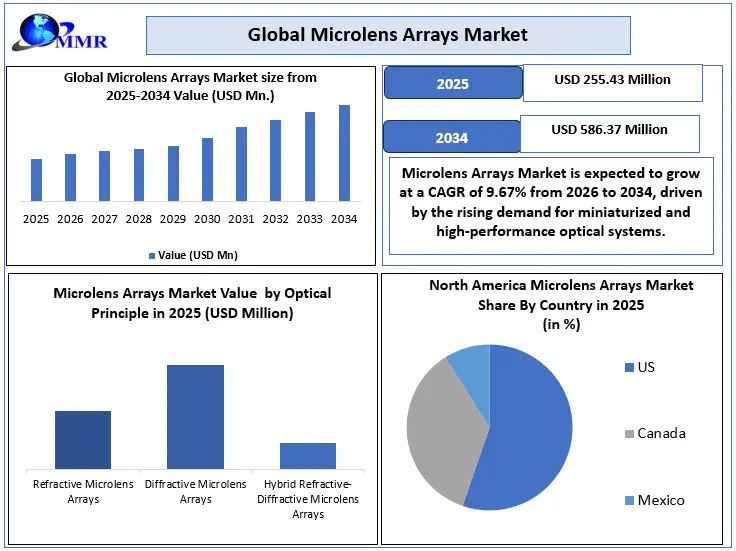
Global Microlens Arrays Market size was valued at USD 255.43 Million in 2025, and the total revenue is expected to grow at a CAGR of 9.67% from 2026 to 2034, reaching nearly 586.37 million by 2034.
Microlens Arrays Market Overview
Miniaturization is transforming the optics industry, and microlens arrays have become one of the most critical enabling components behind compact imaging, sensing, and display technologies. From smartphone camera modules and automotive LiDAR to AR/VR headsets and optical communication systems, manufacturers are increasingly integrating high-precision microlens arrays to improve light efficiency while reducing optical module size. The global Microlens Arrays Market was valued at USD 255.43 Million in 2025 and is projected to reach USD 586.37 Million by 2034, growing at a CAGR of 9.67% during the forecast period (2026–2034). Growth is supported by rising deployment of CMOS image sensors, automotive ADAS, 3D sensing technologies, wafer-level optics, and next-generation photonics infrastructure.
The Microlens Arrays Market is a specialized segment of the global optics and photonics industry, covering the design, manufacturing, and integration of miniature lens arrays used for beam shaping, light focusing, collimation, homogenization, imaging, and optical sensing. Microlens arrays are increasingly combined into CMOS image sensors, AR/VR devices, LiDAR systems, optical communication modules, medical imaging equipment, displays, and semiconductor systems, where compact dimensions and precise light management are essential.
In 2025, optical sensing and imaging applications accounted for around 46% of microlens array demand, while AR/VR and 3D sensing together represented nearly 34%. Consumer electronics integration influenced almost 61% of new product adoption, highlighting the increasing penetration of microlens arrays into compact optical architectures. The market is gaining further momentum from automotive optical sensing and high-speed data communication infrastructure.
Microlens Arrays Market Size and Share Analysis
To know about the Research Methodology :- Request Free Sample Report
Key Highlights in Microlens Arrays Market (2025):
• Asia Pacific Microlens Arrays Market is projected to be the fastest-growing regional market, expanding at a CAGR of 10.12% during the forecast period (2026–2034).
• Aspherical Microlens Arrays accounted for a 55.42% share of the global Microlens Arrays Market in 2025 and are projected to grow at a CAGR of 10.34% during 2026–2034.
• North America Microlens Arrays Market is projected to grow at a CAGR of 8.34% during 2026–2034, supported by high-value photonics, LiDAR, aerospace, and semiconductor applications.
• Consumer Electronics accounted for the largest end-use industry share in Microlens Arrays Market at 31.96% of the global market in 2025.
• Imaging and sensing applications represented nearly 46% of total Microlens Arrays Market demand in 2025, driven by CMOS image sensors, machine vision, automotive sensing, and compact optical imaging systems.
Microlens Arrays Market Dynamics: Growth Drivers, Trends, Opportunities & Challenges
Rapid Adoption of LiDAR and Automotive Optical Sensing Driving Microlens Arrays Market Growth
Automotive LiDAR has become one of the fastest-growing applications for microlens arrays as ADAS and autonomous driving systems require compact, high-precision optical components for beam shaping, collimation, illumination control, and signal routing. Increasing deployment of solid-state and flash LiDAR systems is accelerating demand for wafer-level microlens arrays across passenger vehicles and commercial mobility platforms.
Yole estimated approximately 1.8 million passenger-vehicle LiDAR units were installed globally in 2024, with installations expected to exceed 3 million units in 2025. As OEMs increase sensing resolution, detection range, and miniaturization requirements, demand for precision microlens arrays is expected to expand across LiDAR, driver monitoring, optical sensing, and automotive illumination systems.

Automotive LiDAR is also moving from premium vehicles toward broader passenger-car deployment: Yole reported about 1.8 million passenger-vehicle LiDAR units installed in 2024 and expected installations to exceed 3 million units in 2025. As ADAS systems demand higher sensing resolution, longer detection ranges, smaller modules, and more precise illumination, the requirement for compact precision micro-optics is expected to increase, strengthening microlens-array opportunities across LiDAR, driver monitoring, optical sensing, and advanced automotive illumination systems.
Growth of AR/VR & Advanced Display Technologies Driving Microlens Arrays Market:
The commercialization of AR smart glasses, VR headsets, mixed-reality devices, and micro-LED displays is increasing adoption of microlens arrays in near-eye optical systems. Microlens arrays improve brightness uniformity, optical coupling efficiency, field of view, and compact optical module design, making them a critical component for immersive display architectures.
Growing enterprise adoption across industrial visualization, healthcare, defense, and consumer electronics is expected to create long-term demand for advanced microlens array technologies during the forecast period.
Next-Generation Consumer Electronics Accelerating Microlens Array Adoption
Smartphones, wearable devices, smart glasses, tablets, and digital cameras increasingly integrate microlens arrays to improve light collection efficiency, pixel sensitivity, autofocus performance, and optical miniaturization. Adoption is expanding alongside multi-camera smartphone architectures, ToF sensors, facial recognition systems, 3D sensing modules, and high-resolution CMOS image sensors.
These applications continue to make consumer electronics the largest end-use industry, accounting for 31.96% of global Microlens Arrays Market demand in 2025.

The Microlens Arrays Market presents attractive investment opportunities across wafer-level optics, automotive sensing, optical communications, medical imaging, semiconductor photonics, and industrial machine vision. Investments are increasingly concentrated in scalable microfabrication technologies, including photolithography, nanoimprint lithography, UV molding, and precision glass molding, enabling high-volume production for consumer electronics and automotive applications. The growing use of 3D sensing, multi-camera systems, depth sensing, facial recognition, and time-of-flight (ToF) sensors is further increasing demand. Device manufacturers are also focusing on higher camera resolution, smaller pixels, thinner optical modules, and compact device designs. In addition, the adoption of AR-enabled devices, micro-LED displays, near-eye displays, and wearable electronics is growing the use of microlens arrays for beam shaping and light management. These developments are supporting the growth of the Microlens Arrays Market across next-generation consumer electronics and advanced imaging applications.
Microlens Arrays Market Investment Landscape and High-Growth Opportunity Analysis
The Microlens Arrays Market presents attractive investment opportunities across advanced photonics, high-volume manufacturing, automotive sensing, AR/VR optics, medical imaging, and optical communications. Investment is increasingly shifting toward scalable microfabrication and wafer-level optics, where photolithography, nanoimprinting, UV molding, precision glass molding, and semiconductor-compatible processes support higher-volume production.
Key Investment Opportunity Areas 2025-2026:
| Investment Opportunity | Opportunity Level | Investment Focus | Growth Potential |
| Wafer-Level Optics and Mass Manufacturing | Very High 🔴 | Photolithography, UV molding, nanoimprinting, automated wafer processing | High-volume consumer, automotive & semiconductor demand |
| Medical Imaging & Diagnostics | High 🟡 | Endoscopy, OCT, biosensing, microscopy, | Premium, precision-optics opportunity |
| 3D Sensing & Machine Vision | High🟡 | Depth sensing, structured illumination, industrial imaging | Expanding automation and sensing applications |
| Custom & Application-Specific MLAs | Medium–High 🟢 | Customized pitch, geometry, coatings and focal lengths | Higher-margin specialized applications |
Key Manufacturing Challenges in the Microlens Arrays Market
• High manufacturing complexity due to micron-level control over lens geometry, focal length, pitch, and positioning.
• Wafer-level production yield challenges arising from process variation and surface-quality consistency across high-volume manufacturing.
• Large-area uniformity requirements for thousands of identical microlenses within a single wafer.
• Alignment complexity during integration with CMOS sensors, photodetectors, photonic integrated circuits, and display systems.
Microlens Arrays Market Segmentation Insight 2025
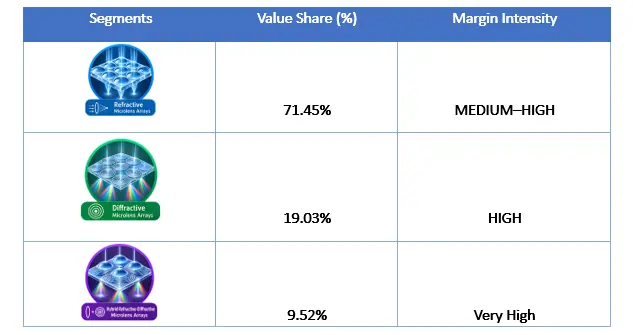
Refractive Microlens Arrays dominated the global market in 2025 with a 71.45% share due to their widespread adoption across CMOS imaging, LiDAR, optical sensing, laser systems, and display technologies. The segment delivers high optical throughput, efficient light collection, and superior beam shaping performance across consumer electronics, automotive, telecommunications, and medical imaging applications.
By Optical Principle – Refractive Microlens Arrays Dominate
• Largest segment in 2025: Refractive Microlens Arrays
• Broad adoption across CMOS imaging, optical sensing, displays, and laser systems
• High suitability for beam shaping, focusing, fiber collimation, and light homogenization
• Provides high optical throughput and efficient light collection
• Strong demand from consumer electronics, automotive, telecommunications, and medical imaging
By Material – Glass Microlens Arrays Dominate
Glass Microlens Arrays accounted for 41.56% of the global Microlens Arrays Market in 2025, making glass the largest material segment due to its high optical transparency, dimensional stability, refractive-index consistency, and thermal resistance across automotive LiDAR, industrial optics, medical imaging, and optical sensing applications.
• Largest material segment in 2025: Glass
• Offers high optical transparency and transmission efficiency
• Provides excellent dimensional and refractive-index stability
• Superior thermal stability supports demanding operating environments

• Widely suitable for automotive LiDAR, medical imaging, industrial optics, and optical sensing
Microlens Arrays Market Regional Analysis and Country Opportunity Assessment
Asia Pacific held the largest share of the global Microlens Arrays Market at 34.21% in 2025, supported by its leadership in semiconductor fabrication, smartphone manufacturing, display production, automotive electronics, and precision optics. China, Japan, South Korea, and Taiwan collectively represent the largest manufacturing and consumption hub for CMOS image sensors, LiDAR modules, AR/VR optics, and semiconductor photonics. North America accounted for 29.97% of the market in 2025, driven by strong demand across aerospace, medical imaging, silicon photonics, LiDAR, and optical communication infrastructure.

North America represents another major Microlens Arrays Market, supported by semiconductor technologies, advanced photonics R&D, LiDAR, medical imaging, AR/VR, aerospace and optical communication systems. Demand is mainly concentrated in the U.S., where high-value applications require customized, high-precision micro-optical components.
Microlens Arrays Market Country Analysis 2025
| Country | Market Position | Key Demand Drivers | Major Growth Opportunities |
| China | Largest Volume Market | Consumer electronics, semiconductors, displays, smartphones, LiDAR | CMOS imaging, AR/VR, automotive sensing, high-volume MLA manufacturing |
| United States | High-Value Innovation Market | Photonics, LiDAR, optical communications, aerospace, medical imaging | Silicon photonics, data centers, advanced sensing, customized MLAs |
| Japan | Precision Optics Leader | Imaging sensors, optical glass, cameras, automotive electronics | Precision glass MLAs, semiconductor optics, automotive sensing |
| South Korea | Advanced Display & Electronics Hub | Semiconductors, smartphones, OLED, micro-LED, AR/VR | Near-eye displays, 3D sensing, advanced display optics |
| Germany | Leading European Market | Automotive engineering, industrial optics, machine vision, medical technology | LiDAR, ADAS optics, industrial imaging, precision micro-optics |
Microlens Arrays Market Competitive Landscape and Strategic Positioning Analysis
The Microlens Arrays Market is characterized by a mix of global optics manufacturers and specialized photonics companies competing through wafer-level optics, precision glass molding, nanoimprint lithography, custom optical design, and high-volume semiconductor-compatible manufacturing.
Leading companies including AGC Inc., Jenoptik AG, Nippon Electric Glass Co., Ltd., SUSS MicroOptics SA, Focuslight Technologies, and NIL Technology are expanding production capacity and investing in LiDAR, AR/VR optics, medical imaging, and optical communication applications.

Microlens Arrays Market Recent Developments
| Year | Development Area | Key Development | Impact |
| 2025 | Automotive LiDAR | Growing MLA integration in LiDAR optical systems | Higher automotive optics demand |
| 2025 | Optical Communications | Adoption in advanced transmission and beam management | Expands photonics applications |
| 2026 | Aerospace & Satellite Imaging | Growing use of precision MLAs in optical sensors | Aerospace and satellite imaging applications are projected to increase adoption of precision microlens arrays in compact optical sensing and imaging systems, creating new high-value opportunities for aerospace-grade optical components. |
Microlens Arrays Market Scope: Inquire before buying
| Microlens Arrays Market | |||
|---|---|---|---|
| Report Coverage | Details | ||
| Base Year: | 2025 | Forecast Period: | 2026-2034 |
| Historical Data: | 2020 to 2025 | Market Size in 2025: | USD 255.43 Mn. |
| Forecast Period 2026 to 2034 CAGR: | 9.67% | Market Size in 2034: | USD 586.37 Mn. |
| Segments Covered: | by Optical Principle | Refractive Microlens Arrays Diffractive Microlens Arrays Hybrid Refractive-Diffractive Microlens Arrays |
|
| by Lens Geometry | Spherical Microlens Arrays Aspherical Microlens Arrays Cylindrical Microlens Arrays Others |
||
| by Material | Glass Fused Silica & Quartz Silicon Polymers Others |
||
| by Manufacturing Technology | Photolithography & Thermal Reflow Direct-Write / Gray-Scale Lithography Nanoimprint / UV Imprinting Precision Molding Laser Processing Etching & Other Microfabrication Processes |
||
| by Application | Beam Shaping & Homogenization Light Collimation & Optical Coupling Imaging & Image Processing Displays & Projection Optical Sensing & Detection LiDAR & 3D Sensing Optical Communications Solar / Light Concentration Others |
||
| by End-Use Industry | Consumer Electronics Automotive Telecommunications & Data Communications Healthcare & Medical Devices Semiconductor & Photonics Industrial & Machine Vision Aerospace & Defense Energy & Solar Others |
||
Global Microlens Arrays Market by Region
North America (United States, Canada and Mexico)
Europe (United Kingdom, France, Germany, Italy, Spain, Sweden, Russia and the Rest of Europe)
Asia Pacific (China, South Korea, Japan, India, Australia, Indonesia, Malaysia, Philippines, Thailand, Vietnam and the Rest of the Asia Pacific)
Middle East and Africa (MEA) (South Africa, GCC, Nigeria and the Rest of MEA)
South America (Brazil, Argentina, Colombia, Chile and the Rest of South America)
Global Microlens Arrays Market Key Players
Tier 1 – Major & Established Players
1. AGC Inc.
2. Jenoptik AG
3. SUSS MicroOptics SA
4. Nippon Electric Glass Co., Ltd.
5. VIAVI Solutions Inc.
6. ams-OSRAM AG
7. Focuslight Technologies Inc.
8. NIL Technology ApS
9. Nalux Co., Ltd.
10. INGENERIC GmbH
11. Axetris AG
12. PowerPhotonic Ltd.
Tier 2 – Specialized Micro-Optics & MLA Players
13. RPC Photonics, Inc.
14. Holographix LLC
15. Syntec Optics
16. Sumita Optical Glass, Inc.
17. Isuzu Glass Ltd.
18. HOLO/OR Ltd.
19. CDA GmbH
20. ORAFOL Fresnel Optics GmbH
21. LIMO GmbH / Focuslight
22. North Ocean Photonics
23. Wuxi OptonTech Ltd.
24. Fuzhou Rising Electro Optics Co., Ltd.
Tier 3 – Optical Components & Photonics Suppliers
25. Edmund Optics Inc.
26. Thorlabs, Inc.
27. MKS Instruments / Newport
28. Shanghai Optics Inc.
29. ZEISS
30. Knight Optical
31. Avantier Inc.
32. Holmarc Opto-Mechatronics Ltd.
33. UQG Optics Ltd.
34. Fresnel Technologies, Inc.
35. LightTrans International GmbH
Others
Frequently Asked Questions:
1] What segments are covered in the Microlens Arrays Market report?
Ans. The segments covered in the Microlens Arrays Market report are based on Optical Principle, Lens Geometry, Material, Manufacturing Technology, Application, End-Use Industry and region.
2] Which region is expected to hold the highest share of the Microlens Arrays Market?
Ans. APAC region is expected to hold the highest share of the Microlens Arrays Market.
3] What is the market size of the Microlens Arrays Market by 2034?
Ans. The global Microlens Arrays Market is projected to reach USD 586.37 Million by 2034.
4] What is the growth rate of the Microlens Arrays Market?
Ans. 4. The Microlens Arrays Market is expected to grow at a CAGR of 9.67% during the forecast period (2026–2034).
5] What was the market size of the Microlens Arrays Market in 2025?
Ans. The market size of the Microlens Arrays Market in 2025 was USD 255.43 Mn.