
Global Men Skin Care Products Market By Product Type, By Skin Concern, By Product Form, By Formulation Positioning, By Price Range, By Consumer Age Group, By Skin Type , By Distribution Channel, by Region and Forecast 2034
Overview
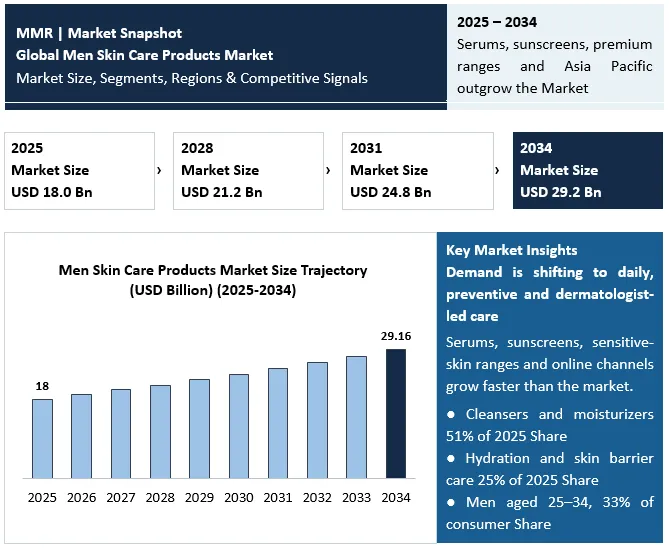
The Global Men Skin Care Products Market was valued at USD 18.0 Bn in 2025 and is expected to reach USD 29.2 Bn by 2034, growing at a CAGR of 5.5% during 2026–2034.
Global Men Skin Care Products Market overview
Men skin care products cover facial cleansers and face wash, moisturizers, sunscreens, serums and targeted treatments, masks and exfoliators, eye and lip care and aftershave skincare, made in cream, lotion, gel, liquid, foam, serum and balm formats and sold through supermarkets, pharmacies, specialty beauty stores, brand-owned stores and online platforms. The global Men Skin Care Market, encompasses men’s facial skincare products, male grooming solutions, and skin health products.
The Men Skin Care Products Market analysis is for personal care and cosmetic brands, dermatological and masstige brand owners, contract and private-label manufacturers, cosmetic ingredient and packaging suppliers, pharmacy, beauty-retail and e-commerce buyers, and investors. It answers practical questions on market entry and market strategies: how cleansers, moisturizers, sunscreens and serums compare on price and repeat purchase, where male consumer behavior is heading, how ingredient costs, regulation and inflation flow through to shelf prices, and which channels, segments and countries deserve capital through 2034.
Facial cleansers and moisturizers accounted for the largest share of men's skincare product sales in 2025, while men aged 25–34 represented about 33% of buyers during the same year. Men Skin Care Products Market growth is moving toward serums and targeted treatments, sunscreens, sensitive-skin and barrier-repair ranges, premium and natural-positioned formulations, brand-owned e-commerce and Asia Pacific, as skin-health awareness, social-media grooming content and preventive care change what men use and where they buy it.
Maximize Market Research delivers a comprehensive Men Skin Care Products Market Research Report covering global value and volume (million units) by product type, primary skin concern, product form, formulation positioning, price range, consumer age group, primary skin type targeting, distribution channel and region, across 5 regions and their countries, together with a competitive landscape, strategic scenarios and growth opportunities.
Men Skin Care Products Market Size and Growth: Industry Outlook to 2034
The Men Skin Care Products Market is sized at the finished-product level: leave-on and rinse-off skincare formulated, positioned or marketed for men, including facial cleansers, moisturizers, sunscreens, serums, masks and exfoliators, eye and lip care and aftershave skincare. According to Eurostat, 77% of EU internet users bought goods or services online in 2024, which supports the shift of men’s skincare discovery and replenishment toward e-commerce.
To know about the Research Methodology :- Request Free Sample Report
Key Findings: Insights Shaping the Global Men Skin Care Products Market
The company filings and consumer behaviour point to the following key market research findings, highlighting Men Skin Care Products Market demand, consumption, supply, revenue generation and market value creation through 2034.
1. Cleansers lead; serums lead growth. Facial cleansers and face wash held about 26% of 2025 value and grow at 4.3%, while serums and targeted treatments grow at 7.8% and sunscreens at XX%. Preventive and problem-specific routines bring daily users into a category once limited to a bar of soap and an aftershave.
2. Hydration leads concerns; sun protection and anti-aging grow fastest. Hydration and skin barrier maintenance held about 25% of value in 2025; sun protection grows at 7.2% and anti-ageing at XX%, against XX% for cleansing and oil control.
3. Premium and natural ranges outgrow mass. Premium products grow at 6.8% against 4.6% for mass-market, and natural-positioned and certified organic formulations grow at 7.5% and XX%. Dermatologist-developed formulas, ingredient transparency and clean labels support higher average selling prices.
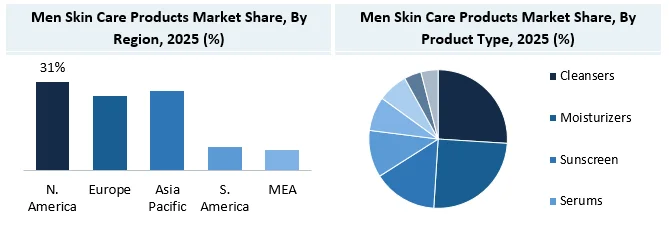
4. North America is the largest region. It held about 31% of 2025 value, supported by deep pharmacy, mass-retail, specialty beauty and e-commerce networks and a US personal care price index up 3.8% in the 12 months to August 2026. Retailer private labels and brand-owned sites set pricing and promotion norms.
5. Asia Pacific is the fastest-growing region. It grows at a 7.2% CAGR, lifting its share from 28% to about 32% by 2034, and is expected to pass North America. China, India, Japan and South Korea lead, powered by K-beauty and J-beauty influence, social commerce and a young male consumer base.
6. Online channels gain share. Online retail rises from 27% of 2025 value to about XX% by 2034, with brand-owned e-commerce the fastest channel at 10.2% CAGR. AI skin analysis, virtual consultations and subscription replenishment shift discovery and loyalty.
7. Price inflation and compliance reshape competition. The EU Cosmetics Regulation add safety-substantiation, labelling and testing costs. Scale, sourcing flexibility and regulatory capacity favour well-capitalised brands.
8. The competitive landscape is layered. Global personal care groups, prestige and dermocosmetic houses, K-beauty and Indian direct-to-consumer brands and private-label suppliers compete on brand equity, efficacy credentials and digital reach.
Men Skin Care Products Industry Structure and Value Chain
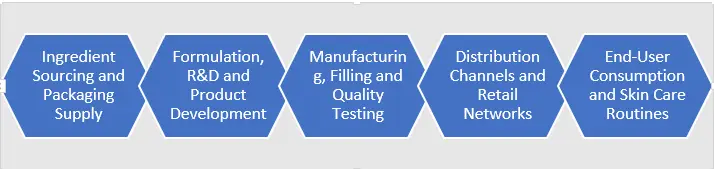
The Men Skin Care Products Industry value chain includes cosmetic ingredient and packaging sourcing, formulation and product development, manufacturing and quality testing, retail and e-commerce distribution and end-user consumption. Formulation science, ingredient innovation, e-commerce penetration, dermatologist endorsement and male consumer awareness influence Men Skin Care Products Market Demand, Supply and Consumption.
Men Skin Care Products Market Trends
1. Rising Men Skin Care Products Consumption: According to the U.S. International Trade Administration (ITA), 2025, skincare products accounted for one-third of total male grooming retail value sales in the Asia Pacific region, while male grooming product sales were projected to increase by XX% in constant value terms. Growing skincare awareness, demand for multifunctional formulations and expanding e-commerce accessibility are supporting Men Skin Care Products Market Demand, consumption and revenue growth.
2. Changing Consumer Purchasing Behaviour: Men are moving from a single bar of soap and aftershave to routines that combine cleansing, moisturizing and daily SPF. Cleansers and moisturizers together held about 51% of 2025 value, and skincare routine frequency, ingredient awareness and repeat purchase now shape Men Skin Care Products consumption patterns.
3. Trending Shift Toward Serums, Sunscreens and Targeted Care: Consumer preferences are shifting toward niacinamide, vitamin C, hyaluronic acid and retinoid serums, mineral and hybrid sunscreens and barrier-repair creams. Serums grow at 7.8% and sunscreens at XX%, influencing Men Skin Care Products Production and product innovation.
4. Price Sensitivity Reshaping Men Skin Care Products Market Demand: Shoppers weigh promotions, multipacks and value ranges. This supports the importance of masstige tiers, subscription pricing and multifunctional products in influencing Men Skin Care Product Demand.
5. Men Skin Care Products Supply and Omnichannel Consumption Trends: Brands are broadening supply across supermarkets, pharmacies, speciality beauty stores and online. Manufacturers are focusing on multifunctional formulas, sustainable packaging, direct-to-consumer subscriptions and seasonal sun-care ranges.
Men Skin Care Products Market Drivers: Grooming Awareness, Preventive Skincare, Premiumisation and Digital Discovery
Male grooming has moved from a shaving routine to a skin-health routine, and rising awareness of acne, dryness, sun damage and early aging keeps replacement demand steady. Men aged 25–34 accounted for about 33% of 2025 value and those aged 18–24 grow fastest at 7.4%, which shows skincare moving from an occasional purchase into the weekly basket of a younger cohort.
Influencer-led content, social commerce, AI skin analysis and subscription programmes let newer labels reach male shoppers without shelf space, although customer acquisition cost and returns remain items to manage.
Rising incomes, urbanisation and male workforce participation add geographic breadth. Premium products account for about 21% of value at 6.8% CAGR, while Asia Pacific, growing at 7.2%, benefits from K-beauty and J-beauty influence, a large young male population and expanding e-commerce reach across China, India, Japan and South Korea.
Men Skin Care Products Market Restraints and Challenges: Price Sensitivity, Ingredient Costs and Regulation
Consumer education remains the most persistent restraint. Many men still follow a minimal routine, and the mass-market tier, which held 41% of value in 2025, is price-sensitive and promotion-driven. Gender-neutral and established general skincare brands, including dermocosmetic ranges, are the main substitute threat, because many men buy from women’s or unisex shelves.
Cost and compliance friction compound the pressure. The personal care price index was up 3.8% in the 12 months to August 2026 (BLS), and active ingredients, packaging and freight add volatility; mass-market margins thin quickly. Rules such as the EU Cosmetics Regulation (EC) No 1223/2009 and the US FDA’s MoCRA add safety-substantiation, listing and labelling costs, and unverifiable natural, vegan or sustainability claims are headaches for premium and clean-label lines.
Asia Pacific is expected to add the most value, growing at 7.2% through 2034; the Middle East and Africa grow at about 6.1% on rising grooming awareness and modern retail, and South America at about 5.3% on Brazil’s beauty retail heritage. Private-label and OEM/ODM programmes, dermatologist-led collaborations, refillable packaging and personalised skincare extend the longer-dated option set.
Men Skin Care Products Market Dynamics Analysis:
Economic Factors, Demand and Supply, Competitive Forces and Regulatory Influences
1. Economic and macroeconomic factors: According to the World Bank, global GDP per capita reached USD 14,405.8 in 2025, while the United States recorded USD 90,026.5 and China USD 13,862.0. Differences in income levels influence consumer purchasing power, premium skincare adoption and price sensitivity. Higher-income markets offer opportunities for premium men's skincare products, while emerging economies support demand for affordable formulations, influencing Men Skin Care Products Market Growth and Revenue.
2. Men Skin Care Products Market Demand and Supply Gap Analysis: Demand comes from daily cleansing, hydration, sun protection, acne and anti-aging routines, while supply is concentrated in manufacturing clusters in the United States, France, Germany, Japan, South Korea, China, India and Brazil, with many brands relying on contract and OEM/ODM manufacturers.
3. Consumer behaviour trends and preference evolution: Shoppers read ingredient lists, ask for dermatologist-tested and fragrance-free formulas, and want fast, one-step routines. Multifunctional moisturisers with SPF and light gel textures suit oily and combination skin.
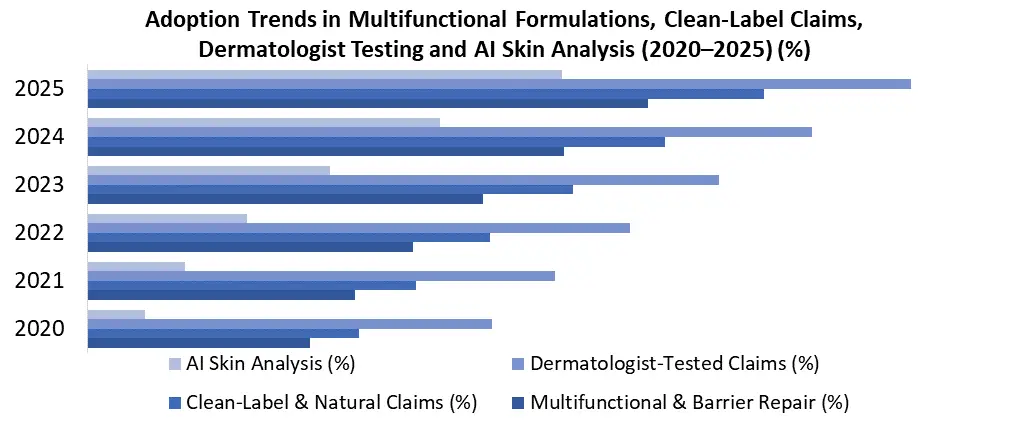
4. Technological advancements and innovation impact: AI skin analysis, encapsulated actives, microbiome-friendly formulas and virtual consultations compress development cycles and cut returns. About 26% of leading brands offer AI skin analysis or digital recommendations.
5. Regulatory influences and regulatory changes: MoCRA in the United States, the EU Cosmetics Regulation and REACH, and national registration rules set safety, labelling and claims standards, raising compliance costs for smaller labels and favouring scale.
Social Media Influence, Online Shopping Penetration and Changing Consumer Preferences
1. Social Media-Driven Demand: The global social media user base reached 5.24 billion in January 2025. Instagram, TikTok and YouTube influence Men Skin Care Products Consumption through male beauty influencers, routine videos and celebrity-backed collections.
2. Growing Online Purchase Penetration: 77% of EU internet users purchased goods or services online in 2024. Increasing e-commerce penetration supports demand in the Digital Men Skin Care Products Market.
3. Digital Consumer Engagement: 83% of EU internet users aged 16–24 shopped online in 2024. AI skin analysis, customer reviews and personalised recommendations strengthen product discovery and online purchasing confidence among younger male consumers.
4. Changing Consumption Patterns: Men’s care brands such as Harry’s, Jack Black and Manscaped have built followings on TikTok Shop, showing how social commerce converts short-form video into skincare purchases and repeat orders.
5. Changing Consumption Patterns: Men's grooming brands such as Harry's, Jack Black and Manscaped are expanding through TikTok Shop, influencer marketing and digital retail. In 2026, Manscaped reported a 38% increase in conversion volume through TikTok advertising, highlighting how social commerce influences men's grooming product purchases, skincare awareness, brand engagement and the Men Skin Care Products Market Penetration.
6. Social Commerce Expansion: Global social media user identities increased 4.1% to 5.24 billion in January 2025. Influencer collaborations, shoppable content and targeted advertisements create opportunities for Men Skin Care Products Market Penetration.
Men Skin Care Products Market Innovations: Dermatologist-Developed Formulas, Multifunctional Care, Clean Labels and AI Skin Analysis
The Men Skin Care Products Market is being reshaped by five trends: dermatologist-led formulation, multifunctional and barrier-repair products, clean-label ingredients, premiumisation and digital-first retail. Dermatologist-tested claims appear in about 46% of new launches, up from about 23% in 2020, as clinical credentials move from pharmacy brands into the mainstream. Multifunctional and barrier-repair formulas make up about 31% of new launches, up from 12%, reflecting the pull of simpler routines.
Computer-aided formulation and predictive modelling compress development cycles, and growing consumer interest in refillable packaging is pushing the industry toward circular business models, supporting Men Skin Care Products Market volume growth through extended product use and sustainable consumption practices.
Men Skin Care Products Landscape: From Facial Cleansers and Moisturizers to Sunscreens, Serums and Aftershave Care
Product type sets the character of the routine. Facial cleansers and face wash, the entry point for most men, held about 26% of 2025 value and grew at 4.3%. Sunscreens, serums and targeted treatments are the fastest-growing groups; aftershave skincare held about 8% and grew at 3.6%, masks and exfoliators about 7%, and eye and lip care and other products the remaining 8%.
Facial Cleansers and Face Wash: Daily Hygiene, Oil Control and Sensitive-Skin Formulation
Facial cleansers and face wash held 26% of the Men Skin Care Products Market in 2025, roughly USD XX Bn, and grew at a 4.3% CAGR. They range from gel and foam face wash for oil control to cream cleansers for dry or sensitive skin and exfoliating scrubs, sold through supermarkets, pharmacies and online.
Differentiation increasingly rests on skin compatibility as much as cleansing power: milder surfactants, salicylic acid for blemish control, charcoal and clay for deep cleansing, and fragrance-free options now sit alongside classic menthol and citrus scents. Prices range from mass-market face wash under USD 5 to premium cleansers above USD 30, and repeat purchase depends on how the product feels after shaving and exercise.
Formats, Price Tiers and Ingredient Supply: Creams, Gels, Serums, Natural Claims and Active Ingredients
Emerging Men Skin Care Products Innovation: Multifunctional Formulas, Clean Labels, Barrier Repair and AI Skin Analysis
Innovation is concentrated in multifunctional and hybrid formulas; skin barrier and microbiome-friendly technologies; encapsulated and controlled-release actives; clean-label, vegan and sustainable ingredients; AI-assisted formulation and virtual testing; and personalised recommendations through digital skin analysis. Large groups such as L’Oréal, Beiersdorf, Unilever and Procter & Gamble use scale and clinical research to move quickly on trends, while independent labels rely on small-batch, dermatologist-collaborated and direct-to-consumer launches.
Under the EU Cosmetics Regulation (EC) No 1223/2009, products need a safety assessment and responsible person before sale, and certain ingredients are restricted or banned. In the United States, the FDA’s MoCRA framework requires facility registration, product listing, adverse-event reporting and safety substantiation, and labelling rules govern ingredient disclosure and marketing claims.
Global Men Skin Care Products Market Segmentation
By product type, facial cleansers and face wash led with about 26% of the 2025 value, followed by moisturizers at XX%, sunscreens at XX%, serums and targeted treatments at 11%, aftershave skincare at XX%, masks and exfoliators at 7%, eye and lip care at 4% and other products at XX%. Cleansers anchor daily routines, whereas serums lead growth at XX% CAGR because targeted actives let one product address acne, tone and aging concerns.
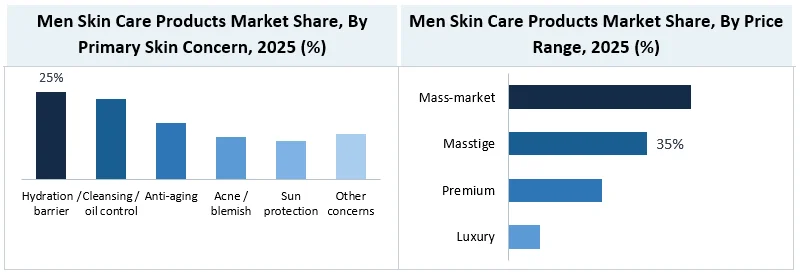
By primary skin concern, hydration and skin barrier maintenance held about 25% of value, cleansing and oil control 23%, anti-aging and wrinkle appearance management XX%, acne and blemish management 12%, sun protection and preventive care XX% and other concerns (pigmentation, sensitive skin and irritation) about 13%. Sun protection grows at 7.2% and pigmentation and sensitive-skin care at about XX%, as preventive care replaces reactive purchasing.
By price range, mass-market products led with about 41%, masstige products held 31%, premium products 21% and luxury products 7%. The move toward premium and dermatologist-led tiers is the defining price trend: premium grows at 6.8% and masstige at 5.4%, against XX% for mass-market products.
Men Skin Care Products Market Segment Analysis:
Target Market, Consumer Demographics, Niche Markets and Segment Attractiveness
1. Product and form segmentation: Cleansers (26%), moisturizers, sunscreens (15%), serums and aftershave skincare define product segmentation, and serums are the most attractive product segment, with growth at 7%. Creams (XX%) lead product forms.
2. Consumer demographics and customer profiling: Men aged 25–34 was about 33% of buyers in 2025, 35–44 about XX%, 18–24 about XX%, 45–54 about XX%, 55 and above about 8% and under 18 about XX%. The core target market is the urban, routine-seeking professional man who owns several products and uses two or three daily.
3. Behavioral segmentation: Ingredient awareness, efficacy, skin type, promotions and brand trust drive purchase decisions, and replenishment cycles, brand switching and price sensitivity shape customer behavior segmentation across mass, masstige and premium tiers.
4. Skin type and concern segmentation: All-skin-type and universal formulations lead, while sensitive-skin and combination-skin targeted products grow fastest, at about 6.9%. Segment-specific trends include oil-free gels for oily skin and ceramide creams for dry skin.
Men Skin Care Products Market Regional Outlook: North America, Europe, Asia Pacific, Middle East & Africa and South America
The North America Men Skin Care Products Market held the largest Men Skin Care Products Market share, about 31% of global value in 2025. The United States anchors demand through a deep pharmacy, mass-retail, specialty beauty and e-commerce base and a strong direct-to-consumer brand scene. Growth is expected at about 4.8% CAGR as premium, sun-care and online channels offset a mature volume base. Europe held about 26% of 2025 value, led by Germany, France, the United Kingdom, Italy and Spain, home to Beiersdorf, L’Oréal and dermocosmetic brands; growth is about 4.4% CAGR.
The Asia Pacific Men Skin Care Products Market is expected to be the fastest-growing region, with a 7.2% CAGR through 2034, rising from 28% of 2025 value to about XX% by 2034 and overtaking North America. China is the largest producer and a fast-growing consumer market, India is scaling men’s grooming brands and e-commerce, and Japan and South Korea add premium and K-beauty innovation. The Middle East and Africa, about 7% of 2025 value, grows at about XX% as grooming awareness and modern retail expand, while South America, about 8%, grows at XX% on Brazil’s beauty retail heritage and rising e-commerce.
Men Skin Care Products Market Country-Level Analysis: The global Men Skin Care Products Market is expanding across the United States, Canada, Germany, France, the United Kingdom, China, India, Japan, South Korea and Brazil. North America benefits from premium men's grooming demand, while Europe emphasizes natural and dermatological skincare formulations. Asia Pacific supports men's skincare market growth through rising disposable incomes, e-commerce penetration and skincare awareness. India and China offer opportunities for facial cleansers, moisturizers, sunscreens and anti-aging products, strengthening Men Skin Care Products Market demand and regional revenue growth.
|
Region |
2025 share |
2025 (USD Bn) |
2034 (USD Bn) |
CAGR |
Notes |
|
North America |
31.0% |
5.6 |
XX |
4.8% |
US pharmacies, mass retail, |
|
Europe |
XX% |
XX |
XX |
XX% |
Germany, UK, France, Italy and |
|
Asia Pacific |
XX% |
XX |
XX |
XX% |
China, India, Japan and South |
|
Middle East & Africa |
XX% |
XX |
XX |
6.1% |
UAE, Saudi Arabia, Turkey and |
|
South America |
XX% |
XX |
XX |
XX% |
Brazil leads; beauty retail |
Leading Men Skin Care Products Manufacturers: Competitive Landscape and Men Skin Care Products Market Key Players
The Men Skin Care Products Market competitive landscape includes several distinct groups rather than a single set of comparable companies. Global personal care groups such as Procter & Gamble, Unilever, Beiersdorf, L’Oréal, Kenvue, Colgate-Palmolive and Edgewell sell men’s cleansers, moisturizers and aftershave care through mass retail, pharmacies and e-commerce. Prestige and dermocosmetic houses including Estée Lauder (Clinique, Kiehl’s), Shiseido, La Roche-Posay, Vichy, Clarins and Pierre Fabre compete on efficacy and heritage. Asian groups such as Amorepacific, LG Household & Health Care, Kao, Mandom, Kosé and Pola Orbis, together with Indian brands including Beardo, Bombay Shaving Company, Ustraa, The Man Company and Minimalist, and direct-to-consumer brands such as Harry’s, Every Man Jack, Tiege Hanley and Brickell, serve mid-range volume, while OEM and ODM manufacturers supply many of them.
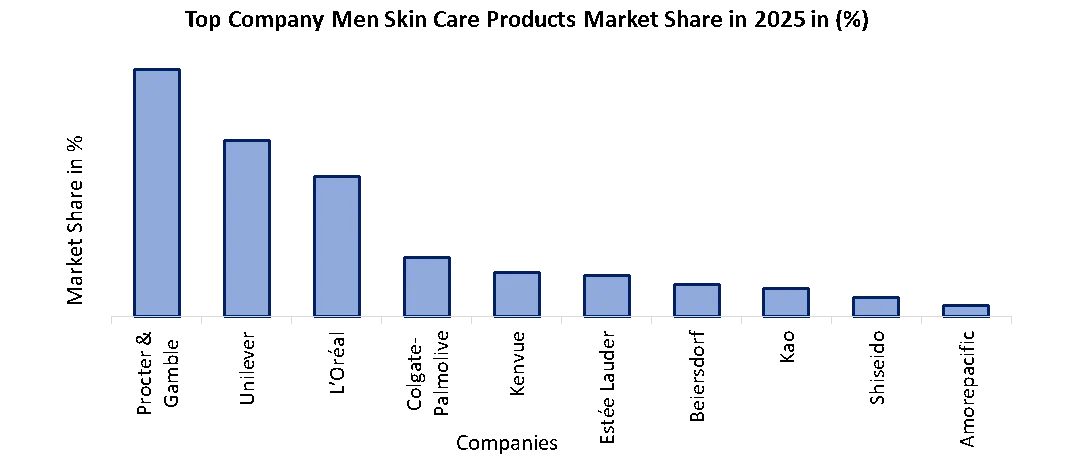
Men Skin Care Products Market competition is increasingly shaped by brand equity, efficacy credentials, ingredient innovation and digital reach. In June 2025, Unilever announced the acquisition of men’s personal care brand Dr. Squatch in a deal reported at about USD 1.5 Bn, citing its social-first marketing and push into premium, digitally native brands. Partnerships, athlete and influencer collaborations and portfolio acquisitions are likely to continue as retailers consolidate suppliers and favour brands that deliver on efficacy, speed and compliance.
Global Men Skin Care Products Market Recent Developments, Product Launches and Industry News | 2025–2026
|
Date |
Company / Source |
Key Development |
Impact on Men Skin Care |
|
Jun 25 |
Unilever / Dr. Squatch |
Unilever announced the acquisition of Dr. |
Strengthens premium men's grooming |
|
Jan 26 |
Every Man Jack |
Announced a brand overhaul and a Premium |
Highlights premiumization, celebrity endorsements |
|
Aug 26 |
U.S. Bureau of Labor Statistics |
The U.S. personal care price index |
Indicates price-driven revenue pressures |
|
Sep 2026 |
NIVEA MEN |
Launched its first Liquid Moisturizer line, |
Supports demand for convenient, lightweight and |
|
Sep 2026 |
Every Man Jack |
Announced its first co-created collection |
Demonstrates athlete-led product |
Men Skin Care Products Competitive Landscape Analysis: Competitor Benchmarking, Rivalry Intensity and Market Strategies
1. Competitor analysis and Men Skin Care Products Market share: The report profiles 86 players, benchmarking company revenue, net sales, men’s-skincare-related revenue, growth rate, profit margin and R&D investment, and groups them by role rather than ranking them as identical producers.
2. Competitive positioning and differentiation: Global groups differentiate on scale and distribution, prestige houses on efficacy and heritage, dermocosmetic brands on clinical credentials, mass-market players on price, and independent labels on natural ingredients, sensitive-skin focus and direct-to-consumer engagement.
3. Rivalry intensity and competitive forces: Men skin Care Products Market Rivalry is shaped by gender-neutral substitutes, private-label pressure, ingredient and packaging cost inflation, price sensitivity and retailers consolidating suppliers.
4. Market player strategies and competitive maneuvers: Men Skin Care Products Leading brands expand premium and dermatological collections, develop multifunctional and barrier-support products, adopt sustainable ingredients, grow direct-to-consumer and online channels, localise supply chains and pursue acquisitions and athlete or influencer partnerships.
Global Men Skin Care Products Market Scope: Inquire before buying
|
Global Men Skin Care Products Market |
|||
|
Report Coverage |
Details |
||
|
Base Year: |
2025 |
Forecast Period: |
2026-2034 |
|
Historical Data: |
2020 to 2025 |
Market Size in 2025: |
USD 18.0 Billion |
|
Forecast Period 2026 to 2034 |
5.5% |
Market Size in 2034: |
USD 29.2 Billion |
|
Men Skin Care Products Market |
By Product Type |
Facial Cleansers and Face Wash Facial Moisturizers and Hydrating Creams Sunscreen and UV Protection Products Facial Serums and Targeted Treatments Facial Masks and Exfoliators Eye Care and Lip Care Products Aftershave Skincare Products Other Skin Care Products |
|
|
By Skin Concern |
Cleansing and Oil Control Hydration and Skin Barrier Maintenance Anti-Aging and Wrinkle Appearance Acne and Blemish Management Sun Protection and Preventive Care Pigmentation and Uneven Skin Tone Sensitive Skin and Irritation Management Other Skin Concerns |
||
|
By Product Form |
Creams Lotions Liquids and Foams Serums and Concentrated Fluids Balms, Sticks and Solids Other Product Forms |
||
|
By Formulation Positioning |
Conventional Formulations Natural-Positioned Formulations Certified Organic Formulations |
||
|
By Price Range |
Mass-Market Products Masstige Products Premium Products Luxury Products |
||
|
By Consumer Age Group |
Below 18 Years 18–24 Years 25–34 Years 35–44 Years 45–54 Years 55 Years and Above |
||
|
By Skin Type |
Dry Skin Oily Skin Combination Skin Normal Skin Sensitive Skin All Skin Types / Universal Formulations |
||
|
By Distribution Channel |
Offline Retail Supermarkets and Hypermarkets Pharmacies and Drugstores Specialty Beauty and Personal Care Stores Brand-Owned Physical Stores Other Offline Retail Channels Online Retail Brand-Owned E-Commerce Websites Third-Party E-Commerce Marketplaces |
||
Global Men Skin Care Products Market, By Region
North America (United States, Canada, Mexico)
Europe (Germany, United Kingdom, France, Italy, Spain, Netherlands, Switzerland, Sweden, Denmark, Belgium, Austria, Poland, Rest of Europe)
Asia Pacific (China, Japan, India, South Korea, Australia, New Zealand, Singapore, Taiwan, Thailand, Malaysia, Indonesia, Vietnam, Philippines, Rest of Asia Pacific)
Middle East and Africa (United Arab Emirates, Saudi Arabia, Israel, Egypt, South Africa, Nigeria, Algeria, Morocco, Angola, Kenya, Ghana and Rest of Middle East and Africa)
South America (Brazil, Argentina, Chile, Colombia, Rest of South America)
Key players/Competitors profiles covered in the Men Skin Care Products Market report from a strategic perspective
North America
1. Procter & Gamble Company (United States)
2. Edgewell Personal Care Company (United States)
3. Colgate-Palmolive Company (United States)
4. Estée Lauder Companies Inc. (United States)
5. Kiehl’s (United States)
6. Clinique (United States)
7. Jack Black LLC (United States)
8. Every Man Jack (United States)
9. Baxter of California (United States)
10. Brickell Men’s Products (United States)
11. Lumin (United States)
12. Tiege Hanley (United States)
13. CeraVe (United States)
14. Cetaphil (United States)
15. Neutrogena (United States)
16. Kenvue Inc. (United States)
17. Beiersdorf North America – NIVEA MEN Operations (United States)
18. Harry’s Inc. (United States)
Europe
19. L’Oréal S.A. (France)
20. Beiersdorf AG (Germany)
21. Unilever PLC (United Kingdom)
22. Bulldog Skincare Holdings Limited (United Kingdom)
23. L’Occitane International S.A. (Luxembourg)
24. Clarins (France)
25. Shiseido EMEA Skincare Operations (France)
26. Biotherm Homme (France)
27. Laboratoires Pierre Fabre (France)
28. NAOS – Bioderma (France)
29. La Roche-Posay (France)
30. Vichy Laboratoires (France)
31. Recipe for Men (Sweden)
32. L:a Bruket (Sweden)
33. MÁDARA Cosmetics (Latvia)
34. The Body Shop (United Kingdom)
35. Horace (France)
Asia Pacific
36. Shiseido Company, Limited (Japan)
37. Kao Corporation (Japan)
38. Mandom Corporation (Japan)
39. Rohto Pharmaceutical Co., Ltd. (Japan)
40. Kosé Corporation (Japan)
41. Pola Orbis Holdings Inc. (Japan)
42. Amorepacific Corporation (South Korea)
43. LG Household & Health Care Ltd. (South Korea)
44. COSRX (South Korea)
45. Innisfree (South Korea)
46. The Face Shop (South Korea)
47. Himalaya Wellness Company (India)
48. Emami Limited (India)
49. Honasa Consumer Limited (India)
50. Beardo (India)
51. Bombay Shaving Company (India)
52. Ustraa (India)
53. The Man Company (India)
54. Marico Limited (India)
55. VLCC Health Care Limited (India)
56. Forest Essentials (India)
57. L’Oréal India Pvt. Ltd. (India)
58. Garnier Men (India)
59. Nivea India Pvt. Ltd. (India)
60. Minimalist (India)
61. Galderma India (India)
62. Shanghai Jahwa United Co., Ltd. (China)
63. Jala Group (China)
64. Proya Cosmetics Co., Ltd. (China)
65. CHANDO Group (China)
Middle East & Africa
66. Unilever Middle East Personal Care Operations (United Arab Emirates)
67. Beiersdorf Middle East – NIVEA MEN (United Arab Emirates)
68. L’Oréal Middle East (United Arab Emirates)
69. The Grooming Lab (United Arab Emirates)
70. The Camel Soap Factory (United Arab Emirates)
71. L’Oréal South Africa (South Africa)
72. Unilever South Africa (South Africa)
73. Beiersdorf South Africa (South Africa)
74. Clicks Group Skincare Retail Operations (South Africa)
75. Sorbet Man (South Africa)
South America
76. Natura &Co (Brazil)
77. Grupo Boticário (Brazil)
78. O Boticário (Brazil)
79. Natura (Brazil)
80. Hinode Group (Brazil)
81. Granado Pharmácias (Brazil)
82. L’Oréal Brazil (Brazil)
83. Beiersdorf Brazil – NIVEA MEN (Brazil)
84. Unilever Brazil (Brazil)
85. Belcorp (Peru)
86. Yanbal (Peru)
Others
Global Men Skin Care Products Market FAQs: Frequently Asked Questions
1. What is the Men Skin Care Products Market Size?
Ans. MMR values the global men skin care products market at USD 18.0 Bn in 2025, USD XX Bn in 2026 and USD 29.2 Bn by 2034, a 5.5% CAGR over 2026–2034. Volume is about XX million units in 2025.
2. What Drives Men Skin Care Products Market Growth?
Ans. Growth comes from rising grooming and skin-health awareness, preventive skincare, social-media influence, premiumisation, dermatologist-developed products and online discovery, with Asia Pacific growing at 7.2% through 2034.
3. Which region and country is the largest Men Skin Care Products Market?
Ans. North America held the largest share in 2025, about 31% of value, led by the United States. Asia Pacific is the fastest-growing region at XX% CAGR, led by China, India, Japan and South Korea, and is expected to overtake North America by 2034.
4. Which Men Skin Care Products segments are growing fastest?
Ans. Facial cleansers are the largest product type at about 26% of 2025 value, but serums and targeted treatments and sunscreens grow fastest, alongside premium products (XX%), certified organic formulations (XX%) and brand-owned e-commerce (10.2%).
5. Who are the leading Men Skin Care Products manufacturers?
Ans. Leading names include Procter & Gamble, Unilever, Beiersdorf (NIVEA MEN), L’Oréal, Kenvue, Colgate-Palmolive, Estée Lauder, Shiseido, Amorepacific, Kao and fast-growing brands such as Every Man Jack, Harry’s, Beardo and Minimalist. The report profiles 86 players.
6. How do cleansers, moisturizers, sunscreens and serums differ?
Ans. A cleanser removes dirt, oil and impurities and anchors the daily routine, a moisturizer restores hydration and supports the skin barrier, a sunscreen protects against UV damage and a serum delivers concentrated actives such as vitamin C, niacinamide or retinoids for targeted concerns. Cleansers hold the largest share, while serums and sunscreens grow fastest.