Marine Fuel Management Market Size by Product, Process, Application, Region, Industry-Wide Analysis, Competitive Landscape Assessment & Long-Term Forecast to 2032

4%
CAGR (2026-2032)
5.53 USD Bn.
Forecast Market Size
300
Report Pages
150
Market Tables

Overview

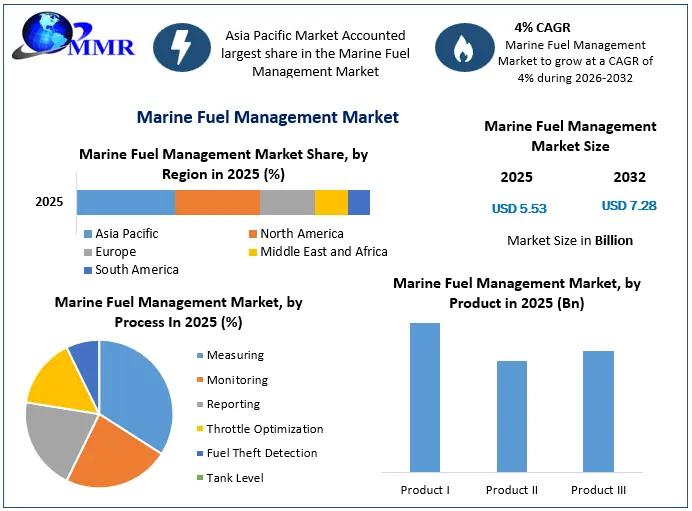
The Marine Fuel Management Market size was valued at USD 5.53 Billion in 2025 and the total Marine Fuel Management revenue is expected to grow at a CAGR of 4% from 2026 to 2032, reaching nearly USD 7.28 Billion.
Global Marine Fuel Management Market Overview:

The global Marine Fuel Management market is witnessing steady growth, driven by the increasing need to optimize fuel consumption, reduce operating costs, and comply with stringent environmental regulations across the maritime industry. Marine fuel management systems enable ship operators to monitor fuel usage in real time, improve vessel efficiency, minimize fuel wastage, and enhance voyage planning through advanced sensors, flow meters, automation, and data analytics. The growing adoption of digital fleet management solutions, rising bunker fuel prices, and the implementation of emission regulations by international maritime authorities are accelerating the deployment of fuel management systems across commercial shipping, offshore vessels, naval fleets, and passenger ships.

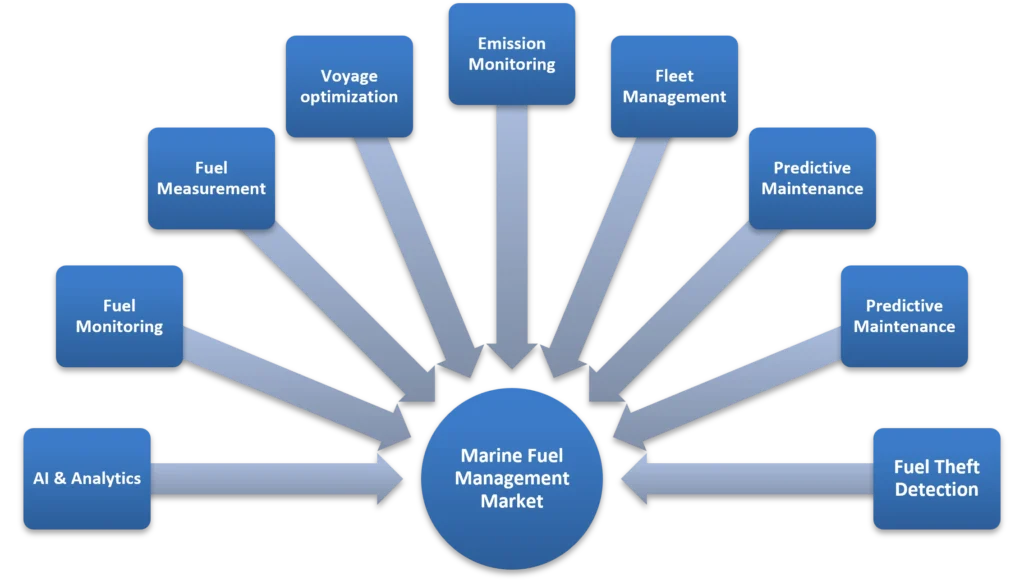
Technological advancements such as IoT-enabled monitoring, artificial intelligence (AI), cloud-based analytics, and predictive maintenance are transforming marine fuel management by providing real-time operational insights and improving fuel efficiency. Increasing investments in smart shipping, autonomous vessels, and decarbonization initiatives are further expanding market opportunities. Additionally, the industry's transition toward alternative marine fuels—including LNG, methanol, biofuels, ammonia, and hydrogen—is driving demand for advanced fuel monitoring and management solutions capable of handling multiple fuel types. However, high implementation costs, integration challenges with legacy vessel systems, and cybersecurity concerns remain key constraints. Despite these challenges, the growing focus on sustainable maritime operations, digital transformation, and fuel efficiency is expected to drive long-term growth in the global Marine Fuel Management market.

Marine Fuel Management Market Snapshot

To know about the Research Methodology:-Request Free Sample Report
Global Marine Fuel Management Market Dynamics:

Stringent maritime emission regulations and fuel efficiency requirements are driving the market

The implementation of stringent environmental regulations by the International Maritime Organization (IMO) and regional authorities is driving the global marine fuel management market. Shipowners and fleet operators are increasingly adopting fuel management systems to optimize fuel consumption, reduce greenhouse gas emissions, and comply with regulations such as IMO 2020 sulfur limits, Carbon Intensity Indicator (CII), and Energy Efficiency Existing Ship Index (EEXI). These solutions provide real-time monitoring of fuel usage, helping operators improve operational efficiency while lowering fuel costs and environmental impact.

Growing digitalization of the maritime industry is creating market opportunities

The rapid adoption of digital technologies across the shipping industry is creating significant growth opportunities for marine fuel management solutions. Integration of IoT sensors, cloud-based fleet management platforms, artificial intelligence (AI), and advanced analytics enables ship operators to monitor fuel performance, optimize voyage planning, detect fuel theft, and improve predictive maintenance. Increasing investments in smart shipping, connected vessels, and autonomous maritime operations are further accelerating demand for intelligent fuel management systems.

High installation costs and integration complexity are restraining market growth

Despite the operational benefits, the adoption of marine fuel management systems is challenged by high installation and maintenance costs, particularly for small and medium-sized fleet operators. Retrofitting existing vessels with advanced sensors, flow meters, automation systems, and software platforms requires significant capital investment and technical expertise. Additionally, integrating fuel management systems with legacy onboard equipment can increase implementation time and operational complexity.

Transition toward alternative marine fuels and cybersecurity concerns remain key market challenges

The maritime industry's shift toward LNG, methanol, biofuels, ammonia, hydrogen, and other low-carbon fuels is creating new technical requirements for fuel monitoring systems. Marine fuel management providers must continuously upgrade their solutions to support multiple fuel types and evolving vessel technologies. At the same time, the increasing digitalization of vessel operations raises concerns regarding cybersecurity, data protection, and system reliability, encouraging vendors to invest in secure and resilient fuel management platforms.

Key Trends in the Global Marine Fuel Management Market

  • Growing adoption of AI and predictive analytics for fuel optimization: Shipping companies are utilizing AI-driven analytics to optimize fuel consumption, improve voyage planning, and reduce operational costs through real-time performance monitoring.
  • Increasing integration of IoT-enabled fuel monitoring systems: Advanced sensors, smart flow meters, and cloud-connected monitoring platforms are enabling continuous tracking of fuel consumption, engine performance, and bunker inventory across fleets.
  • Rising demand for multi-fuel management solutions: As vessels increasingly adopt LNG, methanol, biofuels, ammonia, and hydrogen, fuel management systems are evolving to support multiple fuel types and ensure operational flexibility.
  • Expansion of cloud-based fleet management platforms: Ship operators are integrating marine fuel management systems with cloud-based fleet management software to enable remote monitoring, automated reporting, and data-driven decision-making across global fleets.
  • Growing focus on decarbonization and regulatory compliance: Increasing efforts to achieve carbon reduction targets and comply with IMO decarbonization regulations are driving investments in advanced fuel management technologies that improve energy efficiency and reduce emissions.

Segment Analysis – Global Marine Fuel Management Market

Based on Product, the marine fuel management market is divided into Product I, Product II, and Product III.

The Product II segment dominated the global marine fuel management market in 2025 and is expected to maintain its leading position throughout the forecast period. Product II solutions typically integrate advanced hardware, software, and analytics capabilities, enabling real-time fuel monitoring, consumption analysis, voyage optimization, and regulatory compliance. Their widespread adoption across commercial vessels, offshore support vessels, and naval fleets is driven by the increasing need to reduce fuel costs, improve operational efficiency, and support decarbonization initiatives. The integration of IoT, cloud connectivity, and AI-based analytics further strengthens the demand for these comprehensive fuel management systems.

The Product III segment is expected to witness the fastest growth during the forecast period, supported by rising demand for intelligent, cloud-based, and predictive fuel management platforms that offer advanced analytics, remote monitoring, and multi-vessel fleet management capabilities. Meanwhile, Product I continues to maintain steady demand, particularly among small and medium-sized vessel operators seeking cost-effective fuel monitoring solutions with essential tracking and reporting functionalities.

Based on Process, the marine fuel management market is divided into Measuring, Monitoring, Reporting, Throttle Optimization, Fuel Theft Detection, and Tank Level.

The Monitoring segment accounted for the largest share of the global marine fuel management market in 2025, driven by the increasing adoption of real-time fuel monitoring systems across commercial shipping, offshore vessels, and naval fleets. Continuous monitoring enables operators to optimize fuel consumption, improve engine performance, reduce emissions, and comply with international maritime regulations such as IMO's Carbon Intensity Indicator (CII) and Energy Efficiency Existing Ship Index (EEXI). The growing integration of IoT sensors, cloud-based analytics, and digital fleet management platforms is further supporting segment growth.

The Fuel Theft Detection segment is expected to register the fastest growth during the forecast period due to increasing concerns over fuel pilferage, operational losses, and financial transparency in marine operations. Advanced AI-powered analytics, GPS tracking, and smart sensor technologies are enhancing fuel security and operational visibility. Meanwhile, Measuring remains a fundamental process for accurate fuel consumption tracking, while Reporting supports regulatory compliance and operational decision-making through automated documentation. Throttle Optimization is gaining traction as shipping companies seek to maximize engine efficiency and reduce fuel consumption, whereas Tank Level monitoring continues to witness steady demand by enabling precise bunker inventory management, leak detection, and safe fuel storage across diverse vessel types.

Marine Fuel Management Market - 2025

Global Marine Fuel Management Market Regional Insights:

North America dominated the global Marine Fuel Management market in 2025 and is expected to maintain its leading position throughout the forecast period. The region's leadership is driven by the presence of advanced maritime infrastructure, high adoption of digital vessel management technologies, and stringent environmental regulations aimed at improving fuel efficiency and reducing emissions. The United States and Canada are witnessing increasing investments in smart shipping solutions, fleet modernization, and marine fuel monitoring systems across commercial shipping, offshore operations, and naval fleets. Additionally, the growing deployment of IoT-enabled vessel management platforms and the strong presence of leading marine technology providers continue to support regional market growth.

Asia Pacific is expected to register the fastest growth during the forecast period, fueled by expanding maritime trade, rising shipbuilding activities, and increasing investments in port modernization across China, Japan, South Korea, India, and Singapore. The region's dominance in commercial shipbuilding, coupled with growing adoption of digital fleet management systems and compliance with IMO emission standards, is accelerating demand for marine fuel management solutions. Meanwhile, Europe continues to witness substantial growth owing to stringent decarbonization policies, increasing use of alternative marine fuels, and widespread adoption of smart shipping technologies, particularly in Norway, Germany, the Netherlands, and the United Kingdom. Latin America is experiencing steady market expansion, supported by growing offshore oil & gas activities, expanding port infrastructure, and modernization of commercial fleets in Brazil and Mexico. The Middle East & Africa is also projected to grow steadily, driven by increasing investments in major shipping hubs, offshore energy projects, and maritime logistics across countries such as the UAE, Saudi Arabia, and South Africa, collectively supporting long-term demand for advanced marine fuel management solutions.

Marine Fuel Management Market Recent Industry Developments:

Month & Year Recent Development
June 2025 Wärtsilä Corporation enhanced its digital fleet optimization platform by introducing advanced AI-powered fuel performance analytics to improve fuel efficiency and support compliance with IMO decarbonization regulations.
April 2025 ABB Ltd. expanded its marine digital solutions portfolio with enhanced energy and fuel management capabilities for commercial and offshore vessels, enabling real-time operational optimization.
February 2025 ZeroNorth A/S launched upgraded voyage and fuel optimization software featuring AI-driven recommendations to reduce fuel consumption and greenhouse gas emissions across global shipping fleets.
November 2024 Kongsberg Maritime introduced next-generation vessel performance monitoring solutions integrating fuel management, engine analytics, and route optimization to improve operational efficiency.
September 2024 DNV enhanced its maritime digital platform with advanced fuel consumption benchmarking and emissions reporting tools to help shipowners meet Carbon Intensity Indicator (CII) and EU maritime compliance requirements.
July 2024 Nautilus Labs expanded its AI-powered fleet optimization platform with new predictive fuel consumption models designed to improve voyage efficiency and reduce operating costs for commercial shipping companies.

Competitive Landscape – Global Marine Fuel Management Market

The global Marine Fuel Management market is moderately competitive, with leading companies focusing on developing advanced fuel monitoring systems, digital fleet management platforms, and AI-powered analytics to improve vessel efficiency and support maritime decarbonization. Companies are increasingly investing in IoT-enabled sensors, cloud-based software, predictive analytics, and real-time fuel consumption monitoring to help shipowners reduce fuel costs, comply with IMO emission regulations, and optimize fleet operations. Strategic initiatives such as product innovation, partnerships with shipping companies, acquisitions, and integration of fuel management systems with vessel automation and navigation platforms remain key competitive strategies.

Leading companies including ABB Ltd., Wärtsilä Corporation, Kongsberg Gruppen ASA, Emerson Electric Co., Siemens AG, Honeywell International Inc., Schneider Electric SE, DNV, Nautilus Labs, Interschalt maritime systems AG, Krill Systems Inc., Banlaw Systems Pty Ltd., Bergan Blue, ZeroNorth A/S, and Yokogawa Electric Corporation are strengthening their market position through digital innovation, expansion of smart vessel solutions, and collaborations with shipowners, fleet operators, and maritime technology providers. Their continued investments in fuel optimization technologies, voyage performance software, emissions monitoring, and predictive maintenance solutions are expected to accelerate the adoption of intelligent marine fuel management systems worldwide.

Marine Fuel Management Market Scope: Inquire before buying

Global Marine Fuel Management Market
Report Coverage Details
Base Year: 2025 Forecast Period: 2026-2032
Historical Data: 2020 to 2025 Market Size in 2025: USD 5.53 Bn.
Forecast Period 2026 to 2032 CAGR: 4% Market Size in 2032: USD 7.28 Bn.
Segments Covered: By Product Product I
Product II
Product III
By Process Measuring
Monitoring
Reporting
Throttle Optimization
Fuel Theft Detection
Tank Level
By Application Fuel Consumption
Efficiency Level
Fleet Management
Viscosity Control
Shore Side Reporting
Cross Fleet Standardization
Cargo Delivery Verification

Marine Fuel Management Market, by Region:

North America (United States, Canada and Mexico)
Europe (UK, France, Germany, Italy, Spain, Sweden, Austria and Rest of Europe)
Asia Pacific (China, South Korea, Japan, India, Australia, Indonesia, Malaysia, Vietnam, Taiwan, Bangladesh, Pakistan and Rest of APAC)
Middle East and Africa (South Africa, GCC, Egypt, Nigeria and Rest of ME&A)
South America (Brazil, Argentina Rest of South America)

Marine Fuel Management Market Key Players:

North America

  1. Emerson Electric Co. (St. Louis, Missouri, USA)
  2. Honeywell International Inc. (Charlotte, North Carolina, USA)
  3. Krill Systems, Inc. (Seattle, Washington, USA)
  4. Nautical Control Solutions LP (Houston, Texas, USA)
  5. Drew Marine (Whippany, New Jersey, USA)
  6. Mustang Technologies, Inc. (Houston, Texas, USA)

Europe

  1. ABB Ltd. (Zurich, Switzerland)
  2. Wärtsilä Corporation (Helsinki, Finland)
  3. Kongsberg Maritime (Kongsberg, Norway)
  4. DNV AS (Høvik, Norway)
  5. Siemens AG (Munich, Germany)
  6. Endress+Hauser Group (Reinach, Switzerland)
  7. Interschalt maritime systems AG (Hamburg, Germany)
  8. Banlaw Systems Europe Ltd. (United Kingdom)
  9. Marorka ehf. (Reykjavík, Iceland)
  10. Aquametro Oil & Marine AG (Therwil, Switzerland)
  11. Marine Fluid Technology A/S (Copenhagen, Denmark)
  12. BMT Group Ltd. (London, United Kingdom)
  13. KROHNE Group (Duisburg, Germany)
  14. Alfa Laval AB (Lund, Sweden)
  15. SKF Marine GmbH (Hamburg, Germany)
  16. NAPA Ltd. (Helsinki, Finland)
  17. ZeroNorth A/S (Copenhagen, Denmark)
  18. Rolls-Royce Solutions (MTU) (Friedrichshafen, Germany)

Asia Pacific

  1. Yokogawa Electric Corporation (Tokyo, Japan)
  2. Equatorial Marine Fuel Management Services Pte. Ltd. (Singapore)
  3. Kawasaki Heavy Industries, Ltd. (Kobe, Japan)
  4. Furuno Electric Co., Ltd. (Nishinomiya, Japan)
  5. Mitsui E&S Co., Ltd. (Tokyo, Japan)
  6. Mitsubishi Heavy Industries, Ltd. (Tokyo, Japan)
  7. NYK Group (Tokyo, Japan)
  8. ClassNK – Nippon Kaiji Kyokai (Tokyo, Japan)

Others

Frequently Asked Questions:

1. Which region has the largest share in Global Marine Fuel Management Market?
Ans: Asia Pacific region holds the highest share in 2025.

2. What is the growth rate of Global Marine Fuel Management Market?
Ans: The Global Market is growing at a CAGR of 4% during forecasting period 2026-2032.

3. What is scope of the Global market report?
Ans: Global Market report helps with the PESTEL, PORTER, COVID-19 Impact analysis, Recommendations for Investors & Leaders, and market estimation of the forecast period.

4. Who are the key players in Global market?
Ans: The important key players in the Global Market are – ABB, Aquametro AG, Banlaw Systems Ltd., Bergan Blue, BMT Group, DNV-GL AS, Emerson, Endress+Hauser Management AG, Eniram, Interschalt Marine Systems GmbH, Kaminco, Krill Systems, Inc., Marorka, Mustang Technologies, Nautical Control LP, Siemens AG, INTERSCHALT Maritime Systems, EQUATORIAL MARINE FUEL MANAGEMENT SERVICES PTE LTD, Marine Fluid Technology A/S, Drew Marine Fuel Management, and Marine Kingdom Shipping

5. What was the Global Marine Fuel Management Market size in 2025?
Ans:
The Global Marine Fuel Management Market size was USD 5.53 Billion in 2025.

Table of Contents

1. Global Marine Fuel Management Market: Research Methodology 2. Global Marine Fuel Management Market: Executive Summary 2.1 Market Overview and Definitions 2.1.1. Introduction to Global Marine Fuel Management Market 2.2. Summary 2.2.1. Key Findings 2.2.2. Recommendations for Investors 2.2.3. Recommendations for Market Leaders 2.2.4. Recommendations for New Market Entry 3. Global Marine Fuel Management Market: Competitive Analysis 3.1 MMR Competition Matrix 3.1.1. Market Structure by region 3.1.2. Competitive Benchmarking of Key Players 3.2 Consolidation in the Market 3.2.1 M&A by region 3.3 Key Developments by Companies 3.4 Market Drivers 3.5 Market Restraints 3.6 Market Opportunities 3.7 Market Challenges 3.8 Market Dynamics 3.9 PORTERS Five Forces Analysis 3.10 PESTLE 3.11 Regulatory Landscape by region • North America • Europe • Asia Pacific • The Middle East and Africa • South America 3.12 COVID-19 Impact 4. Global Marine Fuel Management Market Segmentation 4.1 Global Marine Fuel Management Market, by Product (2025-2032) • Product I • Product II • Product III 4.2 Global Marine Fuel Management Market, by Process (2025-2032) • Measuring • Monitoring • Reporting • Throttle Optimization • Fuel Theft Detection • Tank Level 4.3 Global Marine Fuel Management Market, by Application (2025-2032) • Fuel Consumption • Efficiency Level • Fleet Management • Viscosity Control • Shore Side Reporting • Cross Fleet Standardization • Cargo Delivery Verification 5. North America Marine Fuel Management Market(2025-2032) 5.1 North America Marine Fuel Management Market, by Product (2025-2032) • Product I • Product II • Product III 5.2 North America Marine Fuel Management Market, by Process (2025-2032) • Measuring • Monitoring • Reporting • Throttle Optimization • Fuel Theft Detection • Tank Level 5.3 North America Marine Fuel Management Market, by Application (2025-2032) • Fuel Consumption • Efficiency Level • Fleet Management • Viscosity Control • Shore Side Reporting • Cross Fleet Standardization • Cargo Delivery Verification 5.4 North America Marine Fuel Management Market, by Country (2025-2032) • United States • Canada • Mexico 6. Europe Marine Fuel Management Market (2025-2032) 6.1. European Marine Fuel Management Market, by Product (2025-2032) 6.2. European Marine Fuel Management Market, by Process (2025-2032) 6.3. European Marine Fuel Management Market, by Application (2025-2032) 6.4. European Marine Fuel Management Market, by Country (2025-2032) • UK • France • Germany • Italy • Spain • Sweden • Austria • Rest Of Europe 7. Asia Pacific Marine Fuel Management Market (2025-2032) 7.1. Asia Pacific Marine Fuel Management Market, by Product (2025-2032) 7.2. Asia Pacific Marine Fuel Management Market, by Process (2025-2032) 7.3. Asia Pacific Marine Fuel Management Market, by Application (2025-2032) 7.4. Asia Pacific Marine Fuel Management Market, by Country (2025-2032) • China • India • Japan • South Korea • Australia • ASEAN • Rest Of APAC 8. Middle East and Africa Marine Fuel Management Market (2025-2032) 8.1 Middle East and Africa Marine Fuel Management Market, by Product (2025-2032) 8.2. Middle East and Africa Marine Fuel Management Market, by Process (2025-2032) 8.3. Middle East and Africa Marine Fuel Management Market, by Application (2025-2032) 8.4. Middle East and Africa Marine Fuel Management Market, by Country (2025-2032) • South Africa • GCC • Egypt • Nigeria • Rest Of ME&A 9. South America Marine Fuel Management Market (2025-2032) 9.1. South America Marine Fuel Management Market, by Product (2025-2032) 9.2. South America Marine Fuel Management Market, by Process (2025-2032) 9.3. South America Marine Fuel Management Market, by Application (2025-2032) 9.4 South America Marine Fuel Management Market, by Country (2025-2032) • Brazil • Argentina • Rest Of South America 10. Company Profile: Key players 10.1 ABB 10.1.1. Company Overview 10.1.2. Financial Overview 10.1.3. Global Presence 10.1.4. Capacity Portfolio 10.1.5. Business Strategy 10.1.6. Recent Developments 10.2 Aquametro AG 10.3 Banlaw Systems Ltd. 10.4 Bergan Blue 10.5 BMT Group 10.6 DNV-GL AS 10.7 Emerson 10.8 Endress+Hauser Management AG 10.9 Eniram 10.10 Interschalt Marine Systems GmbH 10.11 Kaminco 10.12 Krill Systems, Inc. 10.13 Marorka 10.14 Mustang Technologies 10.15 Nautical Control LP 10.16 Siemens AG 10.17 INTERSCHALT Maritime Systems 10.18 EQUATORIAL MARINE FUEL MANAGEMENT SERVICES PTE LTD 10.19 Marine Fluid Technology A/S 10.20 Drew Marine Fuel Management 10.21 Marine Kingdom Shipping

Custom Market Research Services

We Will Customise The Research For You, In Case The Report Listed Above Does Not Meet With Your Requirements