
Marine Fire-Fighting Equipment Market Size – Industry Structure Evaluation, Demand Drivers Analysis, Regional Growth Analysis and Identification, Competitive Positioning Review & Global Market Size Forecast to 2034
Overview
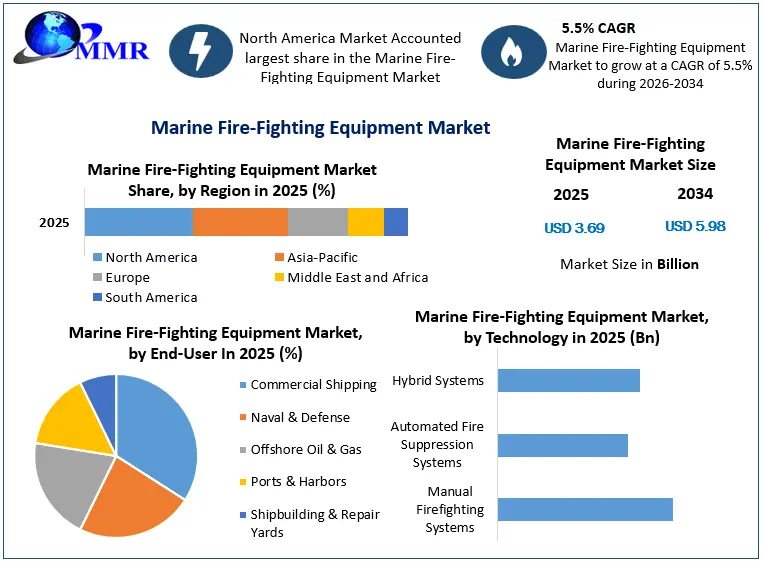
Marine Fire-Fighting Equipment Market was valued at USD 3.69 Bn. in 2025, and total global Marine Fire-Fighting Equipment Market revenue is expected to grow at a CAGR of 5.5% from 2026 to 2034, reaching nearly USD 5.98 Bn. Driven by Increasing marine safety investments and technology adoption.
This is a comprehensive international report targeted on present and future prospects of the Marine Fire-Fighting Equipment Market. This report presents a consolidation of primary and secondary analysis that provides market size, share, dynamics and forecast for numerous segments and sub-segments considering the macro and small environment factors. The report also covers an in-depth analysis of COVID 19 pandemic impact on the sales revenue of Marine Fire-Fighting Equipment Market by year-wise and region and on the key players revenue affected till July 2020 and expected short term and long-term impact on the market.
Marine Fire-Fighting Equipment Market Snapshot
To know about the Research Methodology :- Request Free Sample Report
Marine Fire-Fighting Equipment Market Overview:
A ship is allowed to sail in water, whether in international waters or domestic waters, if it is built in compliance with the code of the fire safety system and carries the necessary fire-fighting equipment approved by the authority concerned. Fire can be caused by the presence of high temperatures, an excess amount of flammable oil, and other fuel in the ship. Because of this, in marine ships, protection devices are mandatory. This has resulted in rise in demand over time for marine firefighting equipment. A ship is equipped with fire retardant and firefighting equipment of a portable or fixed sort. The firefighting devices mounted in the vessel should comply with the specifications of MC SOLAS (Safety of Life at Sea) and ICE (Immigration and Customs Enforcement) approval.
Marine Fire-Fighting Equipment Market Dynamics
Market research is one of the key growth drivers for the marine firefighting equipment market as the growth of the cruise shipping industry. The growth of the cruise shipping industry has been affected by the rising demand from cruise travel agencies and the enthusiasm of cruisers for travelling. This raises investment to meet growing demand, resulting in an increase in the number of cruise ships operating on river and sea. This rise in the number of cruises would have a major effect on the growth of the marine firefighting equipment industry, given the mandatory need to equip ships with safety equipment such as fire extinguishers, smoke detectors, fire warnings, and automatic sprinkler systems.
Increasing concerns regarding the installation of safety devices on ships, compliance with safety standards, crew safety training, firefighting, the current safety legislation, and proper training of crew and marine officials would have an impact on improving the safety of ships. Several safety features such as strengthened structural fire protection, high-pressure water mist systems, and enhanced support for vessels and ships in emergency and regular operations are implemented by key vendors. In order to strengthen their survival at sea, cruise ships have begun conducting emergency response exercises. These features can strengthen the adaptability of the new technology and also increase the performance of techniques for fire suppression. One of the main factors leading to the growth of the market is the rapidly changing passenger ship safety initiatives due to the increasing cruise shipping industry.
Owing to the involvement of many foreign and regional players providing a wide range of marine firefighting equipment, the marine firefighting equipment market is highly fragmented. The market is competitive, and the manufacturers of marine firefighting equipment compete primarily on the basis of product developments, technical advancements, expense and promotional activities. In addition, manufacturers are now concentrating on delivering products that are combined with emerging technology to improve their market share.
Marine Fire-Fighting Equipment Market Segment Analysis
Based on Technology, Automated fire suppression systems Segment dominated the Marine Fire-Fighting Equipment Market in 2025. These systems provide rapid, reliable response with minimal human intervention, making them ideal for use in high-risk environments like engine rooms and cargo holds.
Growing emphasis on crew safety, strict IMO (International Maritime Organization) regulations, and the adoption of advanced sensor technologies are further fueling their demand. Automation reduces the margin of error in emergency situations, increasing operational safety and efficiency across vessel types.
Based on Application, in 2025, Cargo ships held the largest Marine Fire-Fighting Equipment market share. This dominance is attributed to their sheer number in global marine trade, transporting goods across long distances. As these ships carry large volumes of combustible and hazardous materials, stringent fire safety measures are mandatory. Regulatory bodies such as SOLAS (Safety of Life at Sea) enforce fire protection systems on all cargo vessels, boosting demand. Additionally, the cost of fire-related damage on cargo ships is exceptionally high, encouraging investment in robust fire-fighting systems.
Marine Fire-Fighting Equipment Market Regional Analysis
By geography, global marine fire-fighting equipment market is segmented into North America, APAC, Europe, ME & Africa and South America. Among these, North America is expected to retain the major market share during the forecast period. The development of the marine firefighting equipment market is expected to fuel an increase in demand for naval vessels in the Asia Pacific and Middle East & Africa regions. This is due to the use of protection products in naval vessels, such as firefighting equipment. This will give these regions significant growth prospects in the future.
The objective of the report is to present a comprehensive analysis of the Marine Fire-Fighting Equipment Market including all the stakeholders of the industry. The past and current status of the industry with forecasted market size and trends are presented in the report with the analysis of complicated data in simple language. The report covers all the aspects of the industry with a dedicated study of key players that includes market leaders, followers and new entrants. PORTER, SVOR, PESTEL analysis with the potential impact of micro-economic factors of the market have been presented in the report. External as well as internal factors that are supposed to affect the business positively or negatively have been analyzed, which will give a clear futuristic view of the industry to the decision-makers.
The report also helps in understanding Marine Fire-Fighting Equipment Market dynamics, structure by analyzing the market segments and project of the Marine Fire-Fighting Equipment Market size. Clear representation of competitive analysis of key players By Type, Price, Financial position, Product portfolio, Growth strategies, and Regional Presence in the Marine Fire-Fighting Equipment Market make the report investor’s guide.
Marine Fire-Fighting Equipment Market Recent Industry Developments
| Date | Company / Organization | Development | Impact |
|---|---|---|---|
| 19 January 2025 | Nobel Fire Systems | Acquired Marine Fire Safety, a specialist provider of maritime firefighting and lifesaving equipment. | The acquisition enhances national and international coverage while accelerating R&D and technical engineering pool resources. |
| 01 December 2025 | FirePro UK | Successfully renewed its ISO 9001 certification from the British Standards Institution (BSI) for its advanced fire suppression technology operations. | The certification reinforces strict compliance and continuous improvement in manufacturing standards for marine condensed aerosol fire safety products. |
| 01 January 2026 | International Maritime Organization (IMO) | Enforced updated SOLAS fire protection regulations prohibiting foam concentrates with PFOS above 0.001% by weight and mandating broader cargo ship detection coverage. | This major regulatory transition accelerates industry adoption of sustainable, fluorine-free alternative agents and upgraded automated smoke/fire systems on vessels. |
| 31 March 2026 | Sentinel Capital Partners | Signed a definitive agreement to sell its Marioff division, a global leader in marine high-pressure water mist fire protection systems, to Inflexion. | The transaction positions Marioff to focus on lifecycle servicing and capitalize on broader international expansion opportunities across midmarket sectors. |
| 04 May 2026 | FirePro UK | Won the Outstanding Product/Innovation accolade at the Fire Resilience Excellence Awards 2026 for its advanced aerosol fire suppression systems. | The award highlights the system's operational efficiency and versatility in protecting space-constrained marine enclosures and critical machinery spaces. |
| 19 May 2026 | Marine Fire Safety | Announced that its Stat-X Condensed Aerosol Fire-Extinguishing Systems achieved comprehensive EU MED and UK MER Type Approvals. | This landmark certification milestone permits the installation of these compact, non-pressurized suppression setups across all types and sizes of commercial SOLAS-classed vessels globally. |
Marine Fire-Fighting Equipment Market Scope: Inquire before buying
| Marine Fire-Fighting Equipment Market | |||
|---|---|---|---|
| Report Coverage | Details | ||
| Base Year: | 2025 | Forecast Period: | 2026-2034 |
| Historical Data: | 2020 to 2025 | Market Size in 2025: | USD 3.69 Bn. |
| Forecast Period 2026 to 2034 CAGR: | 5.5% | Market Size in 2034: | USD 5.98 Bn. |
| Segments Covered: | by Product Type | Portable Fire Extinguishers Fire Doors Fire Dampers Fire Pumps Fire main piping and valves Fire hose and nozzles Fire Hydrants Fixed Fire Extinguishers Fire Detectors and alarms Inert gas system Emergency escape breathing device(EEBD) Fire fighter outfit Others |
|
| by Technology | Manual Firefighting Systems Automated Fire Suppression Systems Hybrid Systems |
||
| by Application | Cargo Ships Tankers Passenger Ships (Cruise & Ferries) Naval Vessels Others |
||
| by End-User | Commercial Shipping Naval & Defense Offshore Oil & Gas Ports & Harbors Shipbuilding & Repair Yards |
||
Marine Fire-Fighting Equipment Market, By Region
North America (United states, Canada, Mexico)
Europe (Germany, United Kingdom, France, Italy, Spain, Netherlands, Sweden, Switzerland, Belgium, Russia, Poland, Finland, Norway, Austria, Ireland, Greece)
South America (Brazil, Argentina, Chile, Colombia, Peru, Paraguay, Bolivia, Venezuela)
Asia Pacific (China, India, Japan, Australia, South Korea, New Zealand, Singapore, Indonesia, Malaysia, Thailand, Vietnam, Philippines, Bangladesh)
Middle East and Africa (Saudi Arabia, Qatar, Kuwait, Oman, South Africa, Nigeria, Israel, Jordan)
Marine Fire-Fighting Equipment Market Key Players
Marine Fire-Fighting Equipment Market
1. Fire Detection & Alarm Systems
Fire detection and alarm systems provide early identification of smoke, heat, or flames and automatically alert the crew to prevent the spread of fire. These systems are essential for engine rooms, accommodation areas, cargo spaces, and control rooms.
Key Players:
1. Honeywell International Inc. (United States)
2. Siemens AG (Germany)
3. Johnson Controls International plc (Ireland)
4. ABB Ltd. (Switzerland)
5. Consilium AB (Sweden)
6. Autronica Fire and Security AS (Norway)
2. Fixed Fire Suppression Systems
Fixed fire suppression systems are permanently installed onboard and automatically release extinguishing agents such as CO₂, foam, water mist, or clean agents to control fires in enclosed spaces like engine rooms and cargo holds.
Key Players:
1. Marioff Corporation Oy (Finland)
2. Johnson Controls International plc (Ireland)
3. Kidde Fire Systems (United States)
4. Minimax GmbH (Germany)
5. Danfoss Semco A/S (Denmark)
6. Survitec Group Ltd. (United Kingdom)
3. Portable Fire Extinguishers
Portable fire extinguishers are handheld devices used for immediate response to small fires. They are available in different types including dry chemical, CO₂, foam, and water-based extinguishers for various fire classes.
Key Players:
1. Amerex Corporation (United States)
2. Johnson Controls International plc (Ireland)
3. Minimax GmbH (Germany)
4. Britannia Fire Ltd. (United Kingdom)
5. NAFFCO FZCO (United Arab Emirates)
6. Desautel SAS (France)
4. Marine Fire Pumps & Hydrant Systems
Marine fire pumps and hydrant systems deliver high-pressure water through hoses and nozzles to combat onboard fires. They are critical components of ship fire protection systems.
Key Players:
1. Wilo SE (Germany)
2. Xylem Inc. (United States)
3. Grundfos Holding A/S (Denmark)
4. Rosenbauer International AG (Austria)
5. Angus Fire Ltd. (United Kingdom)
6. Shibaura Machine Co., Ltd. (Japan)
5. Water Mist & Foam Fire Suppression Systems
Water mist and foam systems suppress fires by cooling the flame, reducing oxygen concentration, and preventing fuel vapor formation. They are commonly used in engine rooms, machinery spaces, helidecks, and offshore facilities.
Key Players:
1. Marioff Corporation Oy (Finland)
2. Johnson Controls International plc (Ireland)
3. Minimax GmbH (Germany)
4. Angus Fire Ltd. (United Kingdom)
5. Firenor International AS (Norway)
6. Fire Fighting Systems A/S (Denmark)
6. Emergency Escape & Fire Safety Equipment
Emergency fire safety equipment includes firefighter outfits, breathing apparatus, emergency escape devices, fire blankets, and thermal protective aids, ensuring crew safety during fire incidents.
Key Players:
1. Drägerwerk AG & Co. KGaA (Germany)
2. MSA Safety Incorporated (United States)
3. Survitec Group Ltd. (United Kingdom)
4. Viking Life-Saving Equipment A/S (Denmark)
5. Honeywell International Inc. (United States)
6. Scott Safety (United States)
7. Integrated Marine Fire Protection & Monitoring Systems
Integrated fire protection systems combine fire detection, alarm management, suppression control, and remote monitoring into centralized platforms, enhancing vessel safety and operational efficiency.
Key Players:
1. Siemens AG (Germany)
2. Honeywell International Inc. (United States)
3. ABB Ltd. (Switzerland)
4. Consilium AB (Sweden)
5. Wärtsilä Corporation (Finland)
6. Kongsberg Gruppen ASA (Norway)
Frequently Asked Questions
1. What are the key growth drivers for the Marine Fire-Fighting Equipment Market?
Ans. Rising maritime trade, strict safety regulations, increasing vessel numbers, and technological advancements in fire detection and suppression systems drive growth.
2. What is a major opportunity for growth in the Marine Fire-Fighting Equipment Market?
Ans. Retrofitting aging vessels and increasing adoption of smart fire-fighting systems offer significant growth opportunities, especially in developing maritime economies.
3. Which region is projected to witness the fastest growth in the Marine Fire-Fighting Equipment Market?
Ans. North America is expected to grow fastest due to rising shipbuilding, expanding trade routes, and investments in port and marine safety infrastructure.
4. What are the challenges faced by the Marine Fire-Fighting Equipment Market?
Ans. High installation costs, maintenance issues, and lack of skilled operators hinder adoption, especially in small and aging fleets globally.
5. What technology segment is expected to dominate the Marine Fire-Fighting Equipment Market?
Ans. Automated Fire Suppression Systems will dominate due to faster response times, reduced human error, and compliance with stringent maritime safety standards.