
Male Infertility Market Size by Test Type, Treatment and Region – Segment-Level Market Assessment, Growth Opportunity Analysis, Competitive Mapping & Forecast to 2029
Overview
Male Infertility Market is anticipated to reach US$ 4.85 Bn by 2029 from US$ 3.44 Bn. in 2022 at a CAGR of 4.8% during a forecast period.
Male Infertility Market Overview
Male infertility is described as a male counterpart's inability to induce conception in a fertile female. Male infertility is typically caused by a low sperm count, hormonal issues, or a lack of motile sperm. The brain, pituitary gland, and testes must all operate normally for a male to be fertile. Consumption of alcohol and drugs, growing stress levels, obesity, smoking, and environmental pollutants are some of the other major reasons for male infertility. According to WHO estimates, infertility affects 48 million couples and 186 million people globally.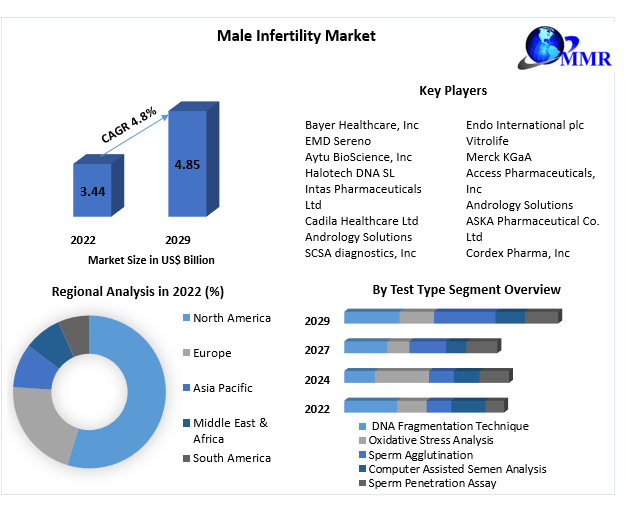
To know about the Research Methodology :- Request Free Sample Report
The report has covered the market trends from 2015 to forecast the market through 2029. 2022 is considered a base year however 2020’s numbers are on the real output of the companies in the market. Special attention is given to 2020 and the effect of lockdown on the demand and supply, and also the impact of lockdown for the next two years on the market. Some companies have done well in lockdown also and specific strategic analysis of those companies is done in the report.
Male Infertility Market Dynamics
Advances in medical diagnostics, as well as rising male infertility, are driving the demand for male infertility. Infertility due to lifestyle-related disorders, rising obesity and an aging population are also expected to fuel market growth throughout the forecast period. However, as people become more conscious of their health problems and are willing to break through cultural barriers by admitting the reality of male infertility and pursuing treatment options, the market for male infertility treatments is growing.
Continuous research and development efforts are being done to evaluate the condition of idiopathic infertility. As a result, companies are investing in the development of root-cause detection and targeted-treatment technologies. Additionally, the manufacturing and commercialization of hormone treatment are likely to boost demand for male infertility throughout the forecast period. Governments throughout the world have taken measures to improve the outlook for infertility-related therapy. Also, better patient data security as a result of law uniformity is likely to boost consumer demand for infertility therapy.
The high cost of therapy is a significant barrier for most who need it. Another limiting element of male infertility treatment is the frequency of recurrent treatment failures, which is leading to the patient opting out of the treatment.
Male Infertility Market Segmentation Analysis
By Test Type, The DNA Fragmentation technique is expected to grow steadily in the future, owing to widespread use and the capacity of the diagnostic technique to provide an accurate examination of sperm DNA integrity. One of the primary reasons affecting male infertility is DNA fragmentation in sperm. This method is used to determine male infertility for diagnostic purposes.
DNA fragmentation accounted for the biggest market share in 2022, since diagnostic procedures may give a reliable evaluation of sperm DNA integrity. DNA fragmentation is a relatively recent technology that has quickly acquired popularity in developing countries and is now extensively utilized.
Male Infertility Market Regional Insights
Europe dominated the market in 2022, with a market share of 31.2 percent, and this dominance is expected to continue during the forecast period. The region's growth is being fueled by an aging population, diseases, and a rising acceptance of less invasive procedures. Furthermore, the existence of a significant number of modern and well-equipped specialist reproductive clinics, as well as manufacturing firms, is expected to fuel market growth in this region.
North America is the second-largest male infertility market because of reasons such as growing occurrences of male infertility due to lifestyle variables such as obesity and diet, and technical developments that are meeting necessity treatment. The male infertility market is also benefiting from an increase in medical tourism and homosexuality in the United States.
Due to the growing population, increased awareness of male infertility conditions, and readily available treatment options, the Male Infertility Market in the Asia Pacific is expected to grow during the forecast period. Although the government supports the adoption of technological advancements, infertility treatments are rarely covered by private or public insurance policies, restricting access to treatment for low-income people in this region.
Competitive Landscape
Major players are adopting long-term strategies to acquire competitive advantages, such as new product launches, product upgrades, mergers and acquisitions, and collaboration partnerships. as an example, in June 2020, Inspiration Healthcare agreed to buy S.L.E., a business that designs and manufactures ventilators for neonatal critical care. The purchase might help the firm become a market leader in neonatal critical care. The purchase would also extend the company's product line and global distribution network.
Inspiration Healthcare acquired Viomedex, a medical device maker, in December 2019. The purchase extended the company's product line and created prospects for expansion into the neonatal critical care market.
Drager cooperated with Florida Hospital in May 2020, after which the latter business deployed Drager's Babyleo TN500 IncuWarmer beds. The beds are in use in three hospitals in Central Florida's health system's Neonatal Intensive Care Units (NICU).
Male Infertility Market Scope: Inquire before buying
| Male Infertility Market | |||
|---|---|---|---|
| Report Coverage | Details | ||
| Base Year: | 2022 | Forecast Period: | 2023-2029 |
| Historical Data: | 2017 to 2022 | Market Size in 2022: | US $ 3.44 Bn. |
| Forecast Period 2023 to 2029 CAGR: | 4.8% | Market Size in 2029: | US $ 4.85 Bn. |
| Segments Covered: | by Test Type | • DNA Fragmentation Technique • Oxidative Stress Analysis • Sperm Agglutination • Computer Assisted Semen Analysis • Sperm Penetration Assay • others |
|
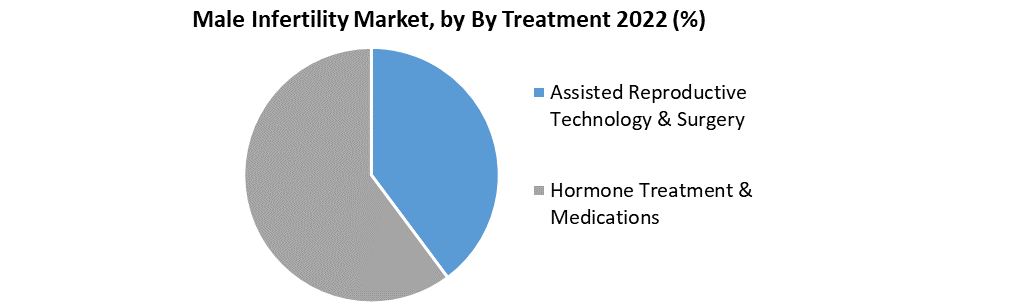
| by Treatment | • Assisted Reproductive Technology & Surgery • Hormone Treatment & Medications |
||
Male Infertility Market, by Region
• North America (United States, Canada and Mexico)
• Europe (UK, France, Germany, Italy, Spain, Sweden, Austria and Rest of Europe)
• Asia Pacific (China, South Korea, Japan, India, Australia, Indonesia, Malaysia, Vietnam, Taiwan, Bangladesh, Pakistan and Rest of APAC)
• Middle East and Africa (South Africa, GCC, Egypt, Nigeria and Rest of ME&A)
• South America (Brazil, Argentina Rest of South America)
Male Infertility Market: Key Players
• Bayer Healthcare, Inc
• EMD Sereno
• Aytu BioScience, Inc
• Halotech DNA SL
• Intas Pharmaceuticals Ltd
• Cadila Healthcare Ltd
• Andrology Solutions
• SCSA diagnostics, Inc
• Endo International plc
• Vitrolife
• Merck KGaA
• Access Pharmaceuticals, Inc
• Andrology Solutions
• ASKA Pharmaceutical Co. Ltd
• Cordex Pharma, Inc
Frequently Asked Questions:
1. Which region has the largest share in Global Male Infertility Market?
Ans: Europe region held the highest share in 2022.
2. What is the growth rate of Global Male Infertility Market?
Ans: The Global Male Infertility Market is growing at a CAGR of 4.8% during forecasting period 2023-2029.
3. What is scope of the Global Male Infertility Market report?
Ans: Global Male Infertility Market report helps with the PESTEL, PORTER, COVID-19 Impact analysis, Recommendations for Investors & Leaders, and market estimation of the forecast period.
4. Who are the key players in Global Male Infertility Market?
Ans: The important key players in the Global Male Infertility Market are –Bayer Healthcare, Inc, EMD Sereno, Aytu BioScience, Inc, Halotech DNA SL, Intas Pharmaceuticals Ltd, Cadila Healthcare Ltd, Andrology Solutions, SCSA diagnostics, Inc, Endo International plc, Vitrolife, Merck KGaA, Access Pharmaceuticals, Inc, Andrology Solutions, ASKA Pharmaceutical Co. Ltd, Cord
5. What is the study period of this Market?
Ans:ex Pharma, and Inc The Global Male Infertility Market is studied from 2022 to 2029.