
Low Methoxyl Pectin Market by Product Type, by Source, by Function Type, by Application and Regional Analysis 2026-2034
Overview
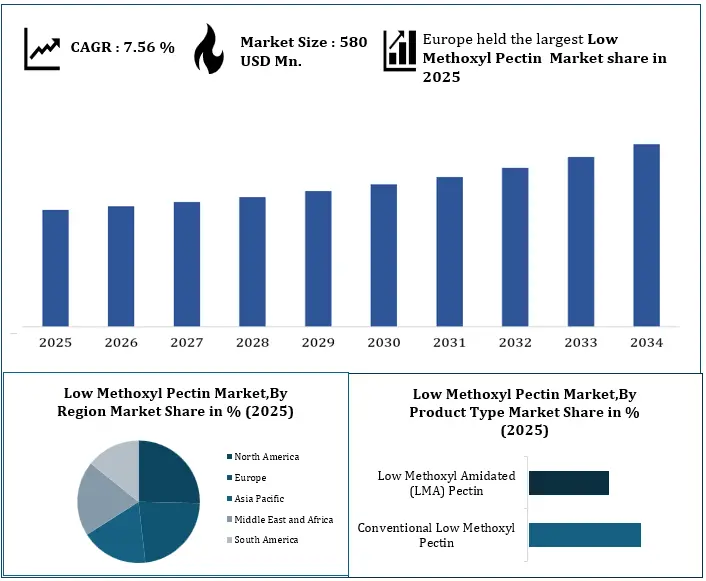
The Low Methoxyl Pectin Market was valued at USD 580 Million in 2025, the low methoxyl pectin market is expected to grow to USD 1,120 Million by 2034, maintaining a CAGR of 7.56% over the 2026-2034 forecast period.
| 7.56 % USD 1,120 Mn. USD 580 Mn. |
| CAGR Forecast Market Market Size |
| (2025-2034) Size (2025-2034) (2025) |
Low Methoxyl Pectin Market Overview
The Low Methoxyl Pectin Market growth is driven by ingredient developers and biotech sectors selecting plant-based, clean-label texturisers to ensure long-term formulation stability. This specialised sector has emerged as a vital texturising asset as consumer patterns favor low-sugar products and pharmaceutical labs seek advanced biomaterial shields for target drug delivery.
A low methoxyl pectin derivative is a highly specialized polysaccharide structural framework containing a degree of esterification below 50%, enabling it to build thermally reversible cross-linked structural matrices independent of high sugar concentrations or extreme acid presence. The low methoxyl pectin industry is expanding rapidly because of intensifying functional food modernization plans, macro confectionery shifts, and the critical need for syneresis control in delicate plant-based dairy setups. These advanced hydrocolloid agents are highly efficient at providing continuous structural stability under heavy mechanical shear, making them the foundational choice for ingredient developers optimizing premium low-sugar formulations.
Low Methoxyl Pectin Market Size, Growth & Share Analysis
To know about the Research Methodology :- Request Free Sample Report
Low Methoxyl Pectin Market Dynamics
The high-ester texturizers, which rely on dense sucrose concentrations and extreme acid formulations to establish network linkages, low-ester variations assemble functional gel structures primarily through divalent cation bridges. Food technology groups are increasingly incorporating these calcium-sensitive polymers into formulations to address the texturizing challenges that occur when sugar content is significantly reduced or eliminated. Operational data across the ingredient value chain shows a consistent rise in contract orders for these clean-label stabilizers, driven by stricter global limitations on artificial additives and a macro shift toward plant-based alternatives.
Low Methoxyl Pectin Market Drivers
• Low-Sugar Food Demand: Growing consumer prioritization of sugar-free, fat-reduced, and diabetic-safe alternatives accelerates the procurement of low-methoxyl grade texturizers. Because these elements construct firm gelling matrices through calcium ionic interactions rather than heavy sucrose concentrations, they serve as the industry standard for functional preserves and fruit preparations.
• Dairy and Confectionery Expansion: Large-scale food manufacturing networks increasingly specify low-ester gelling agents as foundational thickeners, structural stabilizers, and fat replacers. These items provide necessary rheological structure across automated drinking yogurt loops, acidified milk matrices, and modern gelatin-free gummy confection products.
• Clean-Label Plant-Based Preference: Clean-label manufacturing methodologies require plant-based, animal-free stabilizer alternatives over conventional synthetic or bovine-derived options. Incorporating natural extraction pathways satisfies strict ingredient transparency initiatives. Raw texturizer integration has driven a 41% increase in low-sugar food formulation development.
• Waste Stream Valorization: Converting citrus rinds and apple pomace into premium texturizing agents provides processing plants with an exceptionally cost-stable feedstock supply while satisfying corporate environmental goals. To insulate lines against sudden crop fluctuations such as 24% reductions in regional citrus harvests refining operations are heavily balancing their inputs. A verified baseline of infrastructure setups establishes that 42% of modern manufacturing assets are configured to handle direct pomace and rind upcycling.
• Pharmaceutical and Cosmetic Growth: Medical development groups are increasing their intake of low-ester and amidated structural networks to act as functional drug delivery matrices, gastrointestinal barrier coats, and colon-targeted release vectors. Parallel applications leverage these structures to stabilize delicate topical emulsioneights across skin cosmetics.
• Asia-Pacific Manufacturing Expansion: Rapid urban settlement patterns and robust capital expansion throughout major Asian packaging zones create sustained industrial volume requests. Localized infrastructure updates to satisfy high retail consumption are expanding regional manufacturing production lines.
Low Methoxyl Pectin Market Restraints
• Strict Purity Laws: Food safety regulations require a minimum 65% galacturonic acid purity threshold. Meeting these strict chemical limits increases quality testing costs for older refining plants.
• Unstable Raw Materials: Factories rely entirely on citrus and apple processing leftovers, making production vulnerable to crop failures. Environmental shocks can cause sudden 24% drops in harvests, driving up ingredient prices.
• Complex Technical Processing: Low methoxyl pectin requires exact calcium ion balances to form a stable gel. Small changes in factory pH levels cause early clumping or product water separation.
• Cheaper Substitute Options: Lower-cost alternative thickeners like carboxymethyl cellulose (CMC) present constant competition. When fruit peel prices spike, cost-driven food brands quickly switch to these synthetic options.
Low Methoxyl Pectin Market Trends
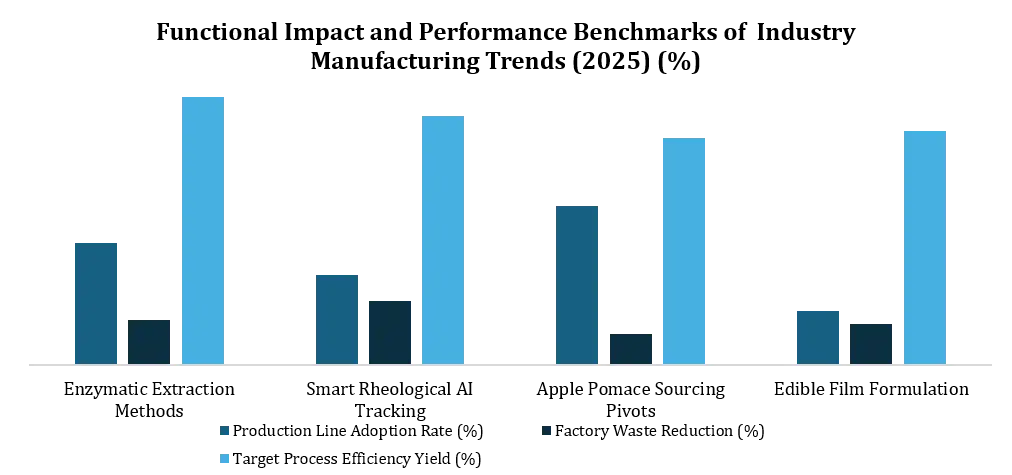
• Enzymatic Extraction Replaces Harsh Acid Washing: Leading ingredient processors are shifting toward immobilized enzyme refining to trim ester bonds precisely without breaking down the pectin backbone. This modern technique lowers chemical waste and boosts target yields past 92%.
• Smart AI Networks Track Gel Strength in Real Time: Modern manufacturing lines employ smart digital control systems to evaluate calcium binding affinity during processing.
• Apple Pomace Feedstock Insulates Sourcing Pipelines: Utilizing apple processing residue is expanding fast as an alternative feedstock to orange and lemon peels. This shift helps hydrocolloid producers insulate their supply chains from regional citrus harvest deficits.
• Low-Ester Pectin Drives Edible Film Packaging Innovation: Innovative packaging teams apply the cross-linking traits of low-methoxyl pectin to craft biodegradable, moisture-blocking protective wraps for fresh foods. This opens up new lucrative green retail avenues.
Low Methoxyl Pectin Market Opportunities
• Enzymatic Retrofits Open High-Efficiency Upgrade Lines for Older Extraction Plants: Converting legacy high-methoxyl processing assets into flexible, de-esterified production blocks unlocks immediate cost savings. Installing specialised immobilised pectin methylesterase (PME) modules allows old facilities to pivot toward low-ester production without replacing entire boiling frameworks.
• Synergistic Plant Gum Blends Create Better Clean-Label Texture Systems: Combining calcium-reactive pectin chains with complementary thickeners like locust bean or guar gum creates a highly resilient gelling network. These hybrid texturizers resolve phase separation in plant-based dairy lines while lowering overall raw ingredient expenses.
• Targeted Matrix Formulations Secure High-Margin Delivery Contracts for Clinical Nutrition: Designing specialized pectin-calcium microcapsules opens up vital commercial pipelines in controlled-release pharmacy lines. These gastro-retentive carrier structures require a strict minimum of 65% galacturonic acid content to protect sensitive live probiotics through the human digestive tract.

Low Methoxyl Pectin Market Challenges
• Citrus Peel Shortages: Harsh weather anomalies and agricultural diseases trigger severe crop deficits. These sudden environmental shocks disrupt raw material availability across primary processing corridors, causing sudden raw material volatility.
• Fluctuating Input Costs: Irregular seasonal fruit harvests and changing juice factory outputs create highly unpredictable spot-market pricing. These constant price swings make long-term fixed supplier contracts exceptionally difficult to maintain.
• Standard Grade Commoditization: Basic lower-tier texturizer grades face severe commoditization across international ingredient trade channels. This structural shift narrows processing profits and reduces product pricing power for extraction facilities.
• Hydrocolloid Substitute Competition: Lower-cost alternative texturizers like xanthan gum, carrageenan, and guar gum compete directly for factory inclusion. These alternatives frequently achieve specific required viscosities or gel strengths at a fraction of the cost.
Low Methoxyl Pectin Market Regional Insights
• Europe Leads by Modernizing Old Processing Facilities: Europe dominated Low Methoxyl Pectin Market in 2025. Local companies prioritise upgrading traditional boiling systems to clean, enzyme-based refining lines. Western Europe acts as the core engineering hub, while the Low-Sugar Spreads Category operates as the primary consumer.
• North America Backs Dairy Alternatives to Drive Volume Sizing: This region captures a stable market share to support fast-growing low-sugar and plant-based foods. The United States Midwest represents the core regional processing zone, where rapid-response ingredient blending setups expand to support massive dairy alternative product lines.
• Asia-Pacific Posts the Quickest Growth via Fast Factory Scaling: This region represents the quickest-expanding ecosystem. Driven by massive food processing investments across China and India, Southeast Asia stands out as the core emerging target sub-region, while the Confectionery Sector acts as the primary consumer.
• South America Focuses on Feedstock Security to Supply Global Brands: This region serves as a crucial sourcing zone for raw peel extraction. Brazil’s industrial citrus processing corridor stands out as the core regional asset center, utilizing automated upcycling to convert fresh orange byproducts into export-ready low-methoxyl base substrates.
Low Methoxyl Pectin Market Segment Analysis
By Product Type
• Conventional Low Methoxyl Pectin Dominated the Low Methoxyl Pectin Market in 2025
Major organic food brands select this non-amidated variant to keep non-GMO labels clean, requiring a strict degree of esterification below 50% to trigger calcium-bridging structures without using synthetic additions.
• Low Methoxyl Amidated (LMA) Pectin: Consumption is expanding quickly across plant-based dairy substitute lines. Adding amide groups into the polymer chain alters the chemical structure, allowing factories to run rapid-response blending loops with lower calcium needs without risking factory pipe clogging.
By Source
• Citrus Fruit Peels Manufacturing Footprint: This remains the dominant material base for mass extraction contracts over the forecast period. Financial project logs show this is anchored by Cargill running its USD 150 Million dedicated pectin refinery in Bebedouro, Brazil in September 2021, which utilises advanced upcycling automation to transform high-volume citrus rinds into export-ready powders.

• Apple Pomace Substrates Manufacturing Footprint: Utilization is accelerating to insulate production networks from citrus price volatility. Sourcing data shows that specialized manufacturers like Herbstreith & Fox run dedicated apple processing lines to serve heat-reversible industrial baking gel markets.
• Alternative Bio-Sources Sourcing Dynamics: This niche sector grows solely within specialized, allergen-free pharmaceutical pipelines, supplying custom organic-certified medical encapsulation contracts.
By Function Type
• Gelling Agent Architectures Growth Acceleration: Sourcing is climbing fast as food factories remove sugars to launch diabetic-friendly retail brands, using the polymer to form crisp, heat-stable "egg-box" molecular links with divalent calcium ions.
• Thickening & Viscosity Control Units Growth Acceleration: Orders are rising across the low-calorie drink sector, where ingredient developers use the powder to restore density and body in juices and plant milks where sugar reduction leaves the texturiser thin.
• Stabilizing & Emulsifying Matrices Growth Acceleration: Procurement expands alongside the explosion of acidified dairy alternatives, where multi-chain negative charges protect plant proteins from clumping during heat pasteurization.
By Application
• Food Application Infrastructure Scaling: This segment leads global volume expansion, backed by CP Kelco executing a 15% manufacturing capacity scaling program at its facility in Denmark to ramp up the shipment of low-ester texturisers to European food lines.
• Pharma Application Infrastructure Scaling: Procurement climbs due to strict encapsulation safety standards, where international pharmacopeia monographs mandate that this premium grade must maintain a strict minimum galacturonic acid purity of 65%.
• Cosmetics Application Infrastructure Scaling: Growth is driven by the clean-beauty retail sector, where specialized exporters like Ceamsa ship non-GMO variations to personal care compounding factories to replace synthetic petroleum-based thickeners.

Low Methoxyl Pectin Market Recent Developments
• In April 2025, dsm-firmenich officially announced that it increased its corporate ownership position in the Yantai DSM Andre Pectin partnership to 90.5%, anchoring high-purity texturiser production lines inside the fast-growing Asia-Pacific market.
• In January 2026, Herbstreith & Fox documented the expanded commercial deployment of immobilized pectin methylesterase (PME) enzymatic cascades across its active processing lines to cleanly remove methyl ester groups without degrading the underlying carbohydrate backbone.
Low Methoxyl Pectin Market Scope: Inquire before buying
| Low Methoxyl Pectin Market | |||
|---|---|---|---|
| Report Coverage | Details | ||
| Base Year: | 2025 | Forecast Period: | 2026-2034 |
| Historical Data: | 2020 to 2025 | Market Size in 2025: | 580 USD Million |
| Forecast Period 2026-2034 CAGR: | 7.56% | Market Size in 2034: | 1120 USD Million |
| Segments Covered: | by Product Type | Conventional Low Methoxyl Pectin Low Methoxyl Amidated (LMA) Pectin |
|
| by Source | Citrus Fruit Peels Apple Pomace Substrates Alternative Bio-Sources (Sugar Beet & Sunflower) |
||
| by Function Type | Gelling Agent Architectures Thickening & Viscosity Control Units Stabilizing & Emulsifying Matrices |
||
| by Application | Food Application Pharma Application Cosmetics Application |
||
Low Methoxyl Pectin Market: By Region
Europe: Germany, United Kingdom, France, Italy, Spain, Netherlands, Switzerland, Belgium, Sweden, Poland, Denmark, Rest of Europe
North America: United States, Canada, Mexico
Asia-Pacific: China, India, Japan, South Korea, Australia, Singapore, Malaysia, Thailand, Indonesia, Vietnam
South America: Brazil, Argentina, Colombia, Chile, Peru, Ecuador, Venezuela
Middle East and Africa: Saudi Arabia, United Arab Emirates, South Africa, Egypt, Israel, Turkey, Qatar, Kuwait, Oman, Rest of Middle East and Africa.
Low Methoxyl Pectin Key Players:
1. Tate & Lyle PLC (CP Kelco)
2. Cargill Incorporated
3. IFF
4. Herbstreith & Fox Corporate Group
5. Ceamsa
6. Yantai Andre Pectin Co Ltd
7. Ingredion Incorporated
8. Silvateam SpA
9. Koninklijke DSM NV
10. Gino Gums & Stabilizers
11. Lucid Colloids Ltd
12. Naturex SA
13. FMC Corporation
14. BV srl
15. Devson Impex Private Limited
16. Sichuan Jinyu Pectin Co Ltd
17. Zhejiang Yixin Pectin Co Ltd
18. Hangzhou Fuyang Tianhe Pectin Co Ltd
19. Qingdao Twell Sansino Import & Export Co Ltd
20. Henan Chemsino Industry Co Ltd
21. Hefei Senotech New Materials Co Ltd
22. Yugen Chemicals Pvt Ltd
23. Krishna Pectins Pvt Ltd
24. Zhejiang Mingland Biotech Co Ltd
25. Qingdao Reborn Materials Co Ltd
26. Hainan YINmore Bio-Tech Co Ltd
27. Shandong Jincheng Bio-Pharma Co Ltd
Others
Frequently Asked Questions:
Q1. How does the market valuation of the low methoxyl pectin market project over the current ten-year forecast window?
Ans. The low methoxyl pectin market is expected to reach USD 1,120 Million by 2034, from a base market size of USD 580 Million in 2025.
Q2. Which product type sub-segment currently controls the larger volume of commercial supply contracts?
Ans. Conventional low methoxyl pectin leads bulk contract distributions, preferred by organic brands over chemically treated amidated varieties to protect their non-GMO labeling status.
Q3. Which geographic region serves as the primary consumption and production hub for this plant-derived texturiser?
Ans. Europe commands the dominant infrastructure position, reliably maintaining a 35% to 40% regional market share range in 2025 due to heavy clustering of enzyme-based refining pipelines across Denmark and Germany.
Q4. What primary operational function drives the vast majority of low methoxyl pectin procurement contracts in manufacturing?
Ans. Factories buy this raw material primarily to serve as a critical gelling agent because its molecular backbone forms immediate, thermo-reversible links with simple calcium ions to build rigid structures in low-sugar matrices.
Q5. Why are tier-1 texturiser operations aggressively expanding their physical factory layouts inside South America?
Ans. Major processing firms choose South America to build automated refining facilities directly next to major orchard networks, which intercepts fresh crop waste streams at the source and lowers cross-border raw material shipping costs.