
Global Live Chat Software Market Size by Component, Deployment Mode, Enterprise Type, Application and End-Use Industry
Overview
The Global Live Chat Software Market is valued at 4.8755 Bn in 2025 and expected to reach at the market size of 23.2515 Bn in 2034 with growing CAGR of 13.24% from 2026 to 2034.
Global Live Chat Software Market Overview:
The Global Live chat software provides a chat box or pop-up window that appears on the screen, allowing customers to engage in conversation with the service representative. It’s a dynamic tool for businesses to adopt, as it allows them to communicate with customers in real time directly through their website or mobile apps. It is found that, 77% of customers expect to interact with someone immediately when they contact a company and 88% of customers say good service makes them more likely to buy again; thus, it forms the crucial base to companies to understand customer touchpoints and provide them with authentic services while building trust.
The Global live chat software market is transforming itself from a basic website messaging tool into an intelligent customer engagement and conversational support platform. Businesses are adopting these platform services provided by live chat software for real-time engagement with website visitors, capturing and qualifying leads, providing instant customer support, and improving retention through personalized interactions. The market includes website live chat, proactive messaging, chatbot integration, AI-powered agent assistance, visitor tracking, conversation analytics, multilingual translation, and omnichannel customer engagement capabilities.
The live chat software market is primarily driven by a massive shift towards digital-first customer service, rising e-commerce activity, demand for 24/7 support and the need to convert website traffic into qualified leads. The live chat software market is growing rapidly through the integration of generative AI and agent-assist technologies, as 85% of customer service leaders planned to explore or pilot customer-facing conversational GenAI, demonstrating the accelerating convergence of live chat, chatbots, and AI-driven customer support. It has also been identified that live chat and self-service as technologies expected to surpass traditional channels such as phone and email by 2027.
Supporting this evolution, the competitive landscape is therefore shifting toward AI-powered, omnichannel, and proactive engagement platforms capable of combining automated chatbots with human agents. Agentic AI is going resolve 80% of common customer service issues autonomously by 2029, potentially reducing operational costs by 30%, highlighting the long-term opportunity for AI-enabled live chat platforms.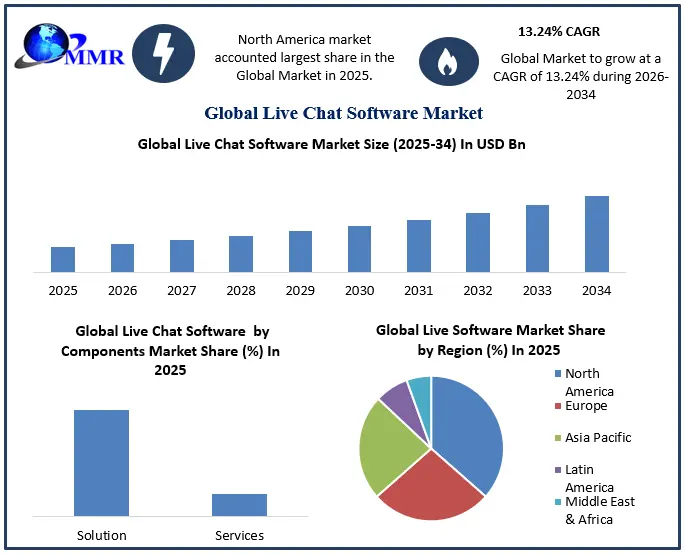
To know about the Research Methodology :- Request Free Sample Report
Live Chat Software Market Dynamics:
Rising Demand for 24/7, Real-Time Customer Engagement to drive the market
Customers expect instant, personalized, and round-the-clock support, which is increasing the demand for live chat software across businesses. Organizations are increasingly using live chat to engage website visitors, respond to customer queries in real time, qualify leads, and provide continuous support across digital channels. The integration of AI-powered chatbots and automated response capabilities is further strengthening this trend by enabling businesses to handle high volumes of customer interactions without relying entirely on human agents. As 85% of customer service leaders planned to explore or pilot customer-facing conversational GenAI in 2025, demonstrating the rapid shift toward AI-enabled conversational engagement. Businesses increasingly prioritize faster response times, personalized interactions, and 24/7 availability; the adoption of live chat platforms is expected to increase, supporting the growth of the global live chat software market.
Data Privacy and Security Concerns to restrain the market
The increasing use of live chat platforms to collect and process customer information creates concerns regarding data privacy, cybersecurity, and regulatory compliance. Live chat interactions may involve personally identifiable information, contact details, purchase information, and other sensitive customer data, requiring businesses to implement robust security and data governance measures. Maintaining data protection while complying with regulations such as GDPR and other regional data protection frameworks increases implementation complexity and operational costs to organizations operating across multiple jurisdictions. These challenges may slow adoption among highly regulated industries, including banking, financial services, healthcare, and government, thereby restraining market expansion.
Integration of Generative AI and Agentic AI to create new opportunities
The integration of generative AI and agentic AI presents a significant opportunities for live chat software providers to expand beyond traditional messaging and automated chatbot functionality. AI-enabled platforms can generate contextual responses, summarize conversations, identify customer intent, translate interactions, recommend responses to agents, and automate routine customer service requests. Agentic AI could autonomously resolve up to 80% of common customer service issues by 2029, potentially reducing customer service operating costs by 30%. This development creates opportunities for vendors to offer intelligent hybrid platforms that combine AI-driven automation with human intervention for complex customer interactions, increasing the value proposition of live chat software.
Augmenting Customer Experience through AI like a Human is a key Challenge for the Market
As businesses increasingly deploy AI-powered chatbots and automated live chat systems, maintaining accurate, contextual, and empathetic customer interactions remains a major challenge. Automated systems may struggle with complex queries, ambiguous language, emotional situations, or highly personalized requests, potentially resulting in customer frustration and increased escalation to human agents. Live chat providers therefore need to continuously improve natural-language understanding, contextual awareness, sentiment analysis, and seamless human handoff capabilities. The growing shift toward autonomous AI-driven customer service also increases the importance of balancing automation with human support to ensure that efficiency gains do not compromise customer satisfaction, trust, or service quality.
Customer Journey Enabled by Live Chat Software
Live chat software increasingly supports the complete customer lifecycle, enabling businesses to convert anonymous website visitors into engaged prospects, qualified leads, paying customers, and long-term customers through proactive engagement, real-time assistance, and personalized support.
Global Live Chat Software Market Trends:
• AI-Powered Live Chat is transforming customer interactions - The integration of artificial intelligence, generative AI, and natural language processing is transforming live chat software from basic messaging tools into intelligent customer engagement platforms. AI-powered features such as automated response generation, smart reply suggestions, conversation summaries, sentiment analysis, and intent detection are helping businesses improve response speed and agent productivity. As AI capabilities mature, live chat platforms are increasingly combining automated assistance with human-agent escalation to deliver faster and more personalized customer experiences.
• Omnichannel Conversational Engagement is gaining momentum - Businesses are increasingly moving beyond website-based live chat toward unified customer engagement across websites, mobile applications, social media, and instant messaging platforms. Customers expect to communicate with businesses through their preferred channels without repeatedly providing the same information. Consequently, live chat software providers are integrating multiple communication channels into centralized platforms that allow businesses to maintain conversation history and customer context across touchpoints. This trend is encouraging vendors to develop omnichannel solutions that combine live chat, chatbots, messaging, and customer support workflows within a single environment.
• Proactive Chat and Behavioral Personalization are expanding - Live chat software is used proactively to identify high-intent visitors and initiate conversations based on browsing behavior, location, time spent on pages, referral sources, and previous interactions. Instead of waiting for customers to initiate contact, businesses are deploying automated chat invitations and personalized messages at critical stages of the buying journey. This approach enables organizations to identify potential leads, provide timely assistance, reduce customer drop-offs, and improve conversion opportunities. The growing integration of visitor analytics and behavioral triggers is therefore shifting live chat from a reactive customer support tool toward a proactive sales, marketing, and lead-generation solution.
• Hybrid Human-AI Customer Service Models are becoming mainstream - The market is increasingly moving toward hybrid models that combine AI-powered automation with human agents. Chatbots and AI assistants handle repetitive and routine inquiries, while complex or sensitive interactions are automatically transferred to human representatives. This model allows businesses to manage high chat volumes while maintaining human intervention where empathy, judgment, or specialized expertise is required. The development of agentic AI is expected to further accelerate this transition because agentic AI could autonomously resolve up to 80% of common customer service issues by 2029, highlighting the potential for increasingly autonomous customer service operations. As a result, live chat vendors are focusing on seamless AI-to-human handoffs, agent-assist tools, and intelligent routing to balance automation, efficiency, and customer experience.
Global Live Chat Software Market Segment Analysis:
By Component, The By Component segment is divided into Solution and Services. Solution held the largest market share of around 82.4% in 2025, supported by the widespread adoption of live chat platforms that integrate real-time messaging, chatbot functionality, visitor tracking, proactive engagement, AI-powered response assistance, analytics, and lead-generation capabilities. The increasing shift toward AI-enabled and cloud-based customer engagement platforms is expected to sustain strong demand for solutions throughout the forecast period. Services represent a smaller share of the market but are expected to witness steady demand as businesses require implementation, integration, customization, training, consulting, and technical support to maximize the effectiveness of live chat software.
By Application, The By Application segment is divided into Customer Support, Sales & Lead Generation, Marketing & Engagement, Customer Retention, and Internal Communication & Collaboration. Customer Support held the largest market share of around 46.8% in 2025, driven by the growing need for real-time assistance, faster query resolution, and 24/7 customer service. The segment is expected to maintain its leading position as businesses increasingly integrate AI chatbots and automated response systems to manage high volumes of customer inquiries.

Sales & Lead Generation is expected to experience strong demand during the forecast period as companies increasingly use proactive chat, visitor behavior tracking, and automated lead qualification to identify high-intent prospects and improve conversion rates. Marketing & Engagement is also anticipated to grow as businesses deploy personalized and behavior-triggered messages to engage website visitors at critical stages of the customer journey. Customer Retention is expected to gain traction through personalized post-purchase assistance, timely support, and proactive customer interactions that strengthen long-term relationships. Alongside, Internal Communication & Collaboration is likely to witness comparatively moderate but steady adoption as organizations use chat platforms for employee assistance, internal help desks, and real-time communication.
Global Live Chat Software Market Regional Insights:
North America is expected to hold a dominant position in the global live chat software market by 2034, supported by the region's advanced digital infrastructure, high enterprise SaaS adoption, and strong concentration of customer experience technology providers. The United States accounted for approximately 16% of global retail e-commerce sales in 2024, reflecting the region's large and mature digital commerce ecosystem where businesses increasingly require real-time customer engagement, lead generation, and online support capabilities. The presence of major technology companies and established live chat and customer experience platforms, combined with the rapid adoption of AI-powered chatbots and omnichannel engagement, is expected to reinforce North America's leading position. The region's mature e-commerce market, high digital customer-service expectations, and early adoption of generative AI are therefore the major factors driving the North American live chat software market.
Europe is expected to witness steady growth in the live chat software market, driven by increasing digitalization of customer service and the growing adoption of omnichannel engagement solutions. The region's strong e-commerce ecosystem and emphasis on personalized customer experiences are encouraging businesses to integrate live chat with CRM, chatbot, and customer support platforms. The GDPR, implemented on 25 May 2018, significantly influences the market by requiring businesses to protect personal data processed through live chat interactions, including customer details and conversation histories. The EU AI Act, which entered into force on 1 August 2024, is also shaping the adoption of AI-powered chatbots and conversational AI by introducing a risk-based regulatory framework. These regulations are increasing demand for secure, transparent, and compliant live chat platforms, supporting vendors with strong data protection and AI governance capabilities.
Asia Pacific is expected to be the fastest-growing regional market during the forecast period, supported by rapid digital transformation, expanding e-commerce activity, increasing smartphone and internet penetration, and the growing adoption of cloud-based business software. Countries such as China, India, Japan, South Korea, and Southeast Asian economies are witnessing increasing demand for real-time digital customer engagement as businesses expand their online presence.
The rapid growth of digitally native businesses and SMEs, combined with increasing investments in AI-powered chatbots and multilingual customer support, is expected to create significant opportunities for live chat software providers in the region. The region is also witnessing the emergence of technology providers offering live chat, conversational AI, and customer engagement solutions. Key emerging and regional players include Haptik, Yellow.ai, Gupshup, SleekFlow, and Engati. These companies are strengthening the regional ecosystem through AI chatbots, automated customer support, omnichannel messaging, and conversational engagement technologies, creating significant opportunities for the live chat software market.
South America is expected to experience gradual market expansion, driven by the increasing adoption of e-commerce, digital banking, and online customer service channels. Businesses are increasingly using live chat to provide faster customer assistance and improve engagement with digitally connected consumers. The expansion of SMEs into online markets and increasing adoption of cloud-based SaaS platforms are expected to support demand. However, variations in digital infrastructure, technology investment, and cybersecurity readiness across countries may influence the pace of adoption.
The Middle East & Africa region is expected to witness increasing adoption of live chat software, supported by digital transformation initiatives, expanding e-commerce ecosystems, and investments in cloud technologies. Gulf countries are particularly positioned for stronger adoption as businesses across retail, banking, tourism, and government services increasingly prioritize digital customer engagement. The growing need for multilingual customer support is also creating opportunities for AI-powered live chat platforms capable of translation and automated assistance. However, differences in digital infrastructure and technology maturity across African markets may limit adoption in some countries.
Global Live Chat Software Market Recent Developments:
| Date | Recent Development |
| 15 June 2026 | Salesforce announced plans to acquire Intercom's Fin autonomous AI agent platform for approximately US$3.6 billion, strengthening its Agentforce capabilities and expanding AI-driven customer service across chat, email, WhatsApp, SMS, phone, and Slack. |
| 10 June 2026 | Zoho SalesIQ launched its Summer '26 release, introducing an Agentic Intelligence focus and enhancing capabilities across AI bots, WhatsApp, video calls, and customer engagement, reflecting the shift of live chat platforms toward AI-driven interactions. |
| 19 May 2026 | Zendesk introduced its Autonomous Service Workforce, expanding AI Agents across messaging, email, voice, and AI platforms such as ChatGPT and Gemini, with shared context designed to provide continuity across customer interactions. |
| 14 April 2026 | HubSpot highlighted its Customer Agent developments, positioning AI agents alongside human representatives to handle routine customer queries around the clock. The company reported that its Customer Agent could help resolve 50% more tickets and deliver 29% faster resolution in its highlighted results. |
| 11 March 2026 | Zendesk announced its agreement to acquire Forethought, an AI customer service platform, as part of its AI-first strategy. The move strengthens capabilities in autonomous resolution, AI-powered agent assistance, and customer service automation. |
Global Live Chat Software Market Competitive Landscape:
The global live chat software market is characterized by strong competition among established technology providers such as Zendesk, Intercom, Salesforce, HubSpot, and Zoho. These players provide cloud-based live chat and customer engagement solutions integrated with AI-powered chatbots, CRM, analytics, proactive messaging, and omnichannel communication. Their offerings are generally available through tiered subscription models ranging from entry-level plans for small businesses to customized enterprise packages, allowing them to serve diverse customer groups. These platforms are offered globally through direct online sales, enterprise sales teams, cloud marketplaces, and partner networks, while their promotional efforts emphasize AI-powered automation, improved customer experience, faster response times, and lead conversion.
The Asia Pacific competitive landscape is increasingly supported by emerging technology providers such as Yellow.ai, Haptik, SleekFlow, and Gupshup. These companies provide conversational AI, chatbot automation, omnichannel messaging, customer engagement, and conversational commerce solutions, with increasing integration of multilingual capabilities suited to diverse Asian markets. Their offerings are delivered through cloud platforms, direct enterprise relationships, technology partnerships, and digital channels, with pricing generally revolves around subscriptions, usage, or customized enterprise contracts. These players are strengthening their regional presence by focusing on localized customer engagement, AI-driven automation, multilingual support, and industry-specific applications across sectors such as retail, BFSI, telecommunications, and e-commerce.
Competition is shifting from traditional live chat toward AI-first conversational customer engagement. Global players are leveraging scale, integrated software ecosystems, and strong brand recognition, while regional players compete through localization, flexibility, and specialized AI capabilities. Vendors are increasingly strengthening their product portfolios with generative AI, intelligent chatbots, proactive engagement, and human-AI collaboration; adopting flexible pricing models; expanding through cloud-based global and regional distribution networks; and promoting solutions around faster customer response, improved lead conversion, automation, and personalized customer experiences.
Global Live Chat Software Market Scope: Inquire before buying
| Live Chat Software Market | |||
|---|---|---|---|
| Report Coverage | Details | ||
| Base Year: | 2025 | Forecast Period: | 2026-2034 |
| Historical Data: | 2020 to 2025 | Market Size in 2025: | 4.87 USD Billion |
| Forecast Period 2026-2034 CAGR: | 13.24% | Market Size in 2034: | 23.25 USD Billion |
| Segments Covered: | by Component | Solution Services |
|
| by Deployment Mode | Cloud-Based On Premises |
||
| by Enterprise Type | Small and Medium-Sized Enterprises (SMEs) Large Enterprises |
||
| by Application | Customer Support Sales & Lead Generation Marketing & Engagement Customer Retention Internal Communication & Collaboration |
||
| by End- Use Industry | BFSI Retail & E-commerce IT & Telecommunications Healthcare; Travel & Hospitality Education; Media & Entertainment Government Manufacturing Other Industries |
||
Live Chat Software Market, by region
North America (United States, Canada, and Mexico)
Europe (UK, France, Germany, Italy, Spain, Sweden, Austria, and the Rest of Europe)
Asia Pacific (China, South Korea, Japan, India, Australia, Indonesia, Malaysia, Vietnam, Taiwan, Bangladesh, Pakistan, and the Rest of APAC)
Middle East and Africa (South Africa, GCC, Egypt, Nigeria, and the Rest of ME&A)
South America (Brazil, Argentina Rest of South America)
Global Live Chat Software Market Key Players:
North America
1. Zendesk, Inc.
2. Salesforce, Inc.
3. Intercom
4. HubSpot, Inc.
5. LiveChat, Inc.
6. Freshworks Inc.
7. LivePerson, Inc.
8. Kustomer
9. Gorgias
10. Olark
11. Re:amaze
12. Help Scout
13. Ada Support Inc.
14. Podium
15. Birdeye
Europe
16. Userlike UG
17. Tidio
18. Crisp
19. LiveAgent (Quality Unit, s.r.o.)
20. tawk.to
21. Smartsupp
22. Comm100
23. Trengo
24. Chatwoot
25. Front
26. Dixa
27. Superchat
28. iAdvize
29. Botmind
Asia Pacific
30. Zoho Corporation
31. Yellow.ai
32. Haptik
33. Gupshup
34. SleekFlow
35. Engati
36. WATI
37. AiSensy
38. Verloop.io
39. Kommunicate
40. Senseforth.ai
41. Uniphore
42. Kore.ai
South America
43. Take Blip
44. Zenvia
45. Aivo
46. Botmaker
47. Yalo
48. Movidesk
49. Octadesk
Middle East & Africa
50. Unifonic
51. Lucidya
52. WideBot
53. Botme
54. Sinch
55. Cequens
56. Wonderful
Frequently Asked Questions:
1. What is the size of the Global Live Chat Software Market?
The global live chat software market was valued at approximately US$4.8755 billion in 2025 and is projected to reach US$23.2515 billion by 2034, expanding at a 13.24% CAGR during 2026–2034.
2. Which segment dominates the Global Live Chat Software Market?
The Solution segment dominates by component, while Customer Support is the leading application segment due to the growing demand for real-time and 24/7 customer assistance.
3. Which region holds the largest share of the Global Live Chat Software Market?
North America is expected to maintain a dominant position, supported by high SaaS adoption, advanced digital infrastructure, strong e-commerce activity, and the presence of major technology providers.
4. Which region is expected to grow fastest in the market?
Asia Pacific is expected to register the fastest growth, driven by rapid digitalization, expanding e-commerce, increasing cloud adoption, and rising demand for AI-powered customer engagement solutions.
5. What are the major trends shaping the Global Live Chat Software Market?
The major trends include AI-powered live chat, generative AI integration, omnichannel conversational engagement, proactive visitor engagement, and hybrid human-AI customer service.