
Leather Goods Market Size by Product, Type, Distribution Channel, Region – Revenue Pool Analysis, Margin Structure Assessment, Capital Flow Trends, Competitive Benchmarking & Forecast to 2032
Overview
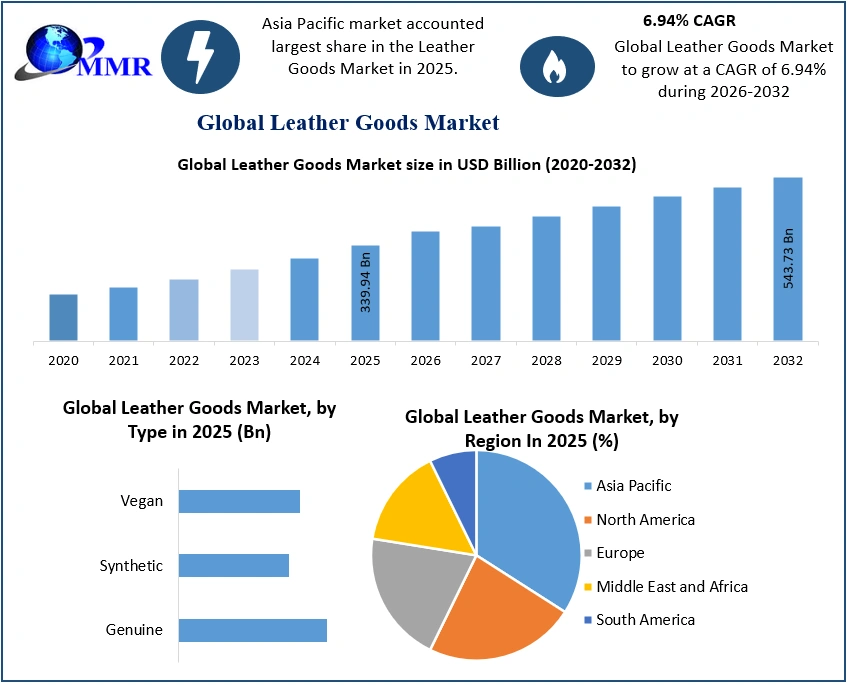
The Leather Goods Market size was valued at USD 339.94 Billion in 2025 and the total Leather Goods revenue is expected to grow at a CAGR of 6.94% from 2025 to 2032, reaching nearly USD 543.73 Billion by 2032.
Leather Goods market Overview:
In the Leather Goods Market, leather emerges as a resilient and pliable material sourced from the hides of various animals including goats, horses, camels, buffalo, sheep, cattle, and hogs. Its versatility finds application in crafting furniture, attire, bags, gloves, footwear, watches, harnesses, and various other items, owing to its inherent flexibility, durability, and strength. Resistant to scratches and fire, leather proves to be a long-lasting product, coveted for its comfort and repairability in the manufacturing process of diverse articles.
 To know about the Research Methodology :- Request Free Sample Report
The incorporation of leather in apparel and sports equipment has witnessed a notable increase in recent times. The growing fashion industry has fuelled consumer demand for high-quality, premium, and luxury leather products. Customers prioritize aesthetics and seek out high-end items to make a fashion statement. Furthermore, the rising number of High-Net-Worth Individuals (HNWIs), alongside the growing popularity of designer and branded clothing in key markets such as the U.S., France, and China, propels the demand for luxury leather goods. Renowned for their exclusivity, Leather Goods often command premium prices in the leather goods market.
Leather Goods Market Dynamics:
Demand Surges for Trendy Leather Apparel, Footwear, and Accessories:
The surge in demand for stylish and comfortable leather apparel, footwear, and accessories has catalysed Leather Goods market growth. Leather goods includes a diverse array of products including gloves, bags, footwear, watches, furniture, and more. The escalating demand for leather in garment production stands as a key driver positively impacting market growth. Furthermore, the unique properties of leather—such as its fireproof, dustproof, crack-proof nature, and inherent durability have positioned it favourably compared to other materials, thereby bolstering Leather Goods market demand and sales.
Cost-effective and Robust Construction of Syntheticc Leather Products
Syntheticc leather, also referred to as Faux leather, presents a more economical alternative to genuine leather. Not only is it environmentally friendly, but it can also be manufactured in a wide array of colors and finishes, including high gloss. Its easy maintenance, resistance to cracking, UV fading, and lack of the distinctive leather smell contribute to its expected demand in the foreseeable future. As a man-made product, Faux Leather boasts exceptional durability, often surpassing that of genuine leather in contemporary applications. Various forms of artificial leather like pleather, Naugahyde, vegan leather, barkcloth, cork, glazed cotton, and recycled PET polyester are available in the Leather Goods market. Pleather, for instance, commonly utilized in clothing, is crafted from plastic, offering a lighter and more affordable option compared to genuine leather. Furthermore, materials like Naugahyde mimic the appearance of animal skin. These attributes and the advantages inherent in Syntheticc leather are poised to propel Leather Goods market growth.
Eco-Friendly Fashion: Introducing Bio-Based Leather
The production of bio-based leather poses no harmful impact on the environment. Manufacturers are increasingly turning their attention to Syntheticc leather made from natural fibers such as flax cotton or cotton, combined with materials like corn, palm, soybean, and others, aiming to capture a larger leather goods market share in the global industry. The emergence of bio-based leather has spurred innovation in manufacturing processes. For instance, pineapple leaves are now being harnessed to create "Pinatex," a unique Syntheticc leather material. These leaves boast elastic and sturdy fibers, ideal for incorporation into the production process.
Leather Goods Market Restraint Factors:
Stringent governmental regulations, particularly in regions like Europe and the U.S., are leading to the closure of various tanneries and leather processing units. These regulations, aimed at environmental conservation and animal welfare, pose constraints on market growth in the foreseeable future. Consequently, governments are promoting the adoption of new Synthetic alternatives, such as plastic leather, to mitigate the impact of these regulations and sustain Leather Goods market demand.
Additionally, the lack of skilled professionals, technological advancements, intermediate inputs, and processing equipment exacerbates challenges within the Leather Goods market. The scarcity of universities offering specialized leather technology degrees has resulted in a significant skill gap within the industry. Addressing this gap should be a primary focus for the development of the leather goods sector. The shortage of professionals and insufficient training facilities to educate technicians and operators required in the sector further compound the prevailing challenges. The absence of technology, skills, and intermediate resources poses a significant hurdle for the Leather Goods market, as these factors are crucial for producing high-quality leather goods. Upholding quality standards is paramount for the industry's growth and sustainability.
Leather Goods Market Segment Analysis:
The MMR report will provide an accurate prediction of the contribution of the various segments to the growth of the leather goods market size.
By Product, the Footwear holds the largest leather goods market share of nearly 40.5% in 2025. In response to the increasing consumer preference for leather athletic footwear, leading athletic footwear manufacturers such as Nike, New Balance, Adidas, Puma, Reebok, Allbirds, and Converse have ventured into the production of leather athletic footwear. For instance, Nike, Inc. pioneered the introduction of sneakers crafted from fly leather in 2017. This innovative material was developed by combining discarded leather scraps from tanneries with a polyester blend.
Based on Type, the Genuine segment held the largest market share in 2025. Premium leather products enjoy high demand in North America and Europe, with consumers willing to pay premium prices for these items. Genuine leather finds extensive use in the fashion industry and is imported by prominent market players operating in North America. With the increase in disposable income among consumers worldwide, the demand for genuine leather is anticipated to witness significant growth during the forecast period. While less expensive options are available in the market, Synthetic leather goods are increasingly appealing, leading to an expected growth in demand for these Synthetic alternatives in the coming years.
Leather Goods Market Regional Analysis:
Geographically, APAC Leather Goods Market accounted for the largest share of 36.20% in 2025. This growth is driven by a multitude of leather product manufacturers operating in the region. Countries such as China and India serve as significant exporters of leather goods, with China accounting for 67% of global shoe production and exporting 36% of its leather goods. Favorable government policies and a focus on bolstering regional manufacturing capabilities are fostering the emergence of small and mid-size enterprises, thereby influencing market growth positively.
In response to industry dynamics, governments are revising regulations and implementing initiatives to support the leather sector amidst the pandemic. For instance, the Indian government has allocated US$ 250 billion towards the Indian Footwear, Leather, and Accessories Development Programme (IFLADP), emphasizing financial assistance for core areas such as capacity augmentation, technological upgrades in production units, improvement of Common Effluent Treatment Plants (CETPs), human resource development, and establishment of institutional facilities. Moreover, the Council for Leather Exports is executing an assertive and strategic marketing approach to leverage potential markets effectively.
Leather Goods Market Country-wise Analysis:
The United States stands as the largest importer of leather and leather products from India. Meanwhile, Mexico boasts a diverse range of leather goods production, spanning footwear, handbags, belts, jackets, and upholstery, among others. With access to high-quality raw materials like cattle hides and a skilled workforce, Mexico holds a competitive edge in the industry. Its well-established tanning sector yields premium leather with distinctive finishes and textures.
In the United Kingdom, raw hides and skins are imported from Italy, Ireland, and Germany, contributing to the production of top-tier leather goods including footwear, bags, and jackets. Renowned British brands such as Mulberry, Burberry, and Clarks dominate the market. Germany, celebrated for its excellence in leather craftsmanship, particularly in footwear and automotive interiors, thrives on innovation and sustainable practices. Esteemed brands like Adidas, Puma, and Hugo Boss hail from Germany. Spain boasts a rich tradition in leather goods manufacturing.
In India, the leather industry benefits from robust infrastructure, including a well-established industrial base, skilled labor force, and modern manufacturing facilities. Cow leather exports from India totalled 3.2 million units, positioning India among the top exporters alongside Vietnam and China. Key production hubs in India, including Tamil Nadu, Andhra Pradesh, West Bengal, Uttar Pradesh, Maharashtra, Punjab, Haryana, and Delhi, contribute significantly to global leather and footwear manufacturing. India accounts for 13% of global hide production and manufactures 10% of the world's footwear.
Global Leather Goods market Competitive Analysis
The Leather Goods market is competitive with global, regional and emerging brands competing for market share. Companies invest in R&D to innovate products and meet consumer demands to stay ahead of competition. The growth of the analyzed Leather Goods market is being positively influenced by new product launches and strategic initiatives by key players. For example, In January 2021, Adidas AG unveiled a new collection of trainers crafted from mushroom leather as a component of its sustainability initiative. Partnering with biotech startup Bolt Threads, Stella McCartney, and lululemon, the company aims to pioneer plant-based vegan leather footwear.
Leather Goods Market Scope: Inquire before buying
| Global Leather Goods Market | |||
|---|---|---|---|
| Report Coverage | Details | ||
| Base Year: | 2025 | Forecast Period: | 2026-2032 |
| Historical Data: | 2020 to 2025 | Market Size in 2025: | USD 339.94 Bn. |
| Forecast Period 2026 to 2032 CAGR: | 6.94% | Market Size in 2032: | USD 543.73 Bn. |
| Segments Covered: | by Product | Footwear Home Décor Apparel |
|
| by Type | Genuine Synthetic Vegan |
||
| by Distribution Channel | Specialty Stores Online Retailer Supermarkets/Hypermarkets Others |
||
Leather Goods Market, by Region
Asia Pacific (China, South Korea, Japan, India, Australia, Indonesia, Malaysia, Vietnam, Taiwan, Bangladesh, Pakistan and Rest of APAC)
Europe (UK, France, Germany, Italy, Spain, Sweden, Austria and Rest of Europe)
North America (United States, Canada and Mexico)
Middle East and Africa (South Africa, GCC, Egypt, Nigeria and Rest of ME&A)
South America (Brazil, Argentina Rest of South America)
Leather Goods Market, Key Players:
North America
1. Nike, Inc. (United States)
2. Samsonite International S.A.,
3. Louis Vuitton,
4. VF Corp. (United States)
5. Lear Corp. (United States)
Europe
6. Hermes International S.A.,
7. Coach, Inc.,
8. Kering SA
9. Christian Dior SE
10. Delsey General Information
11. Puma SE (Germany)
12. Adidas AG (Germany)
Asia Pacific
13. VIP Industries Limited
14. Nappa Dori (India)
15. LUCRIN Geneva (Switzerland)
16. Hidesign
17. Prada Group
Middle East and Africa
18. Tuba Leather Company
19. mrcarterco budapest
20. Aigner
South America
21. SNB Stone
22. Santa Lolla
FAQs:
1] Which region is expected to hold the highest share in the Market?
Ans. The APAC region is expected to hold the highest share in the Market.
2] Who are the top key players in the Leather Goods Market?
Ans. Hermès International S.A., Louis Vuitton Malletier, Woodland Worldwide are the top key players in the Market.
3] Which segment is expected to hold the largest market share in the Leather Goods Market by 2032?
Ans. Genuine segment is expected to hold the largest market share in the Leather Goods Market by 2032.
4] What is the market size of the Leather Goods Market by 2032?
Ans. The market size of the Leather Goods Market is expected to reach USD 543.73 Bn. by 2032.
5] What was the market size of the Leather Goods Market in 2025?
Ans. The market size of the Leather Goods Market was worth USD 339.94 Bn. in 2025.