
Lactic Acid Market by Raw Material, by Application, by Form, by Source and Regional Insights 2034
Overview
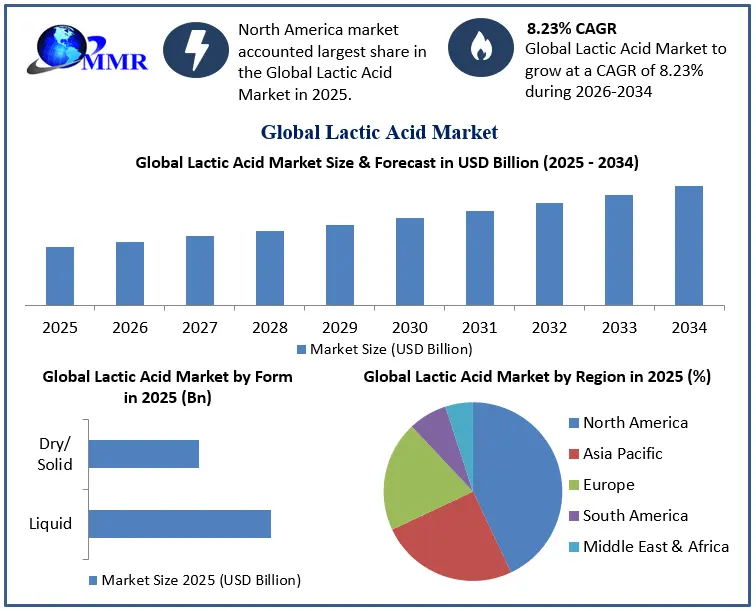
The Lactic Acid Market was valued at USD 3.47 billion in 2025 and is projected to grow at a CAGR of 8.23% from 2026 to 2034, reaching USD 7.07 billion by 2034.
Lactic Acid Market Overview:
Lactic acid is a bio‑based acid that is mainly made by fermenting sugars from crops such as sugarcane, corn and cassava. Lactic acid is used in areas, including food and drinks medicines, skin care and many industrial processes. Lactic acid also is a raw material for polylactic acid or PLA which is a biodegradable plastic used for packaging and other items. Because of these uses the market for acid is growing beyond old food uses. Demand for higher‑purity acid and, for lactic acid used to make biopolymers is rising.
North America continues to be a market for lactic acid. This is because there is established fermentation capacity and strong needs from food, bioplastics, pharmaceuticals and personal care industries. At the time Asia Pacific is becoming more important because of its big manufacturing base, availability of carbohydrate-based feedstocks and more investments in PLA production. Current industry data also shows that PLA is becoming a source of lactic acid demand in North America, China and Southeast Asia. Meanwhile food and beverage uses are still very important in Europe and other markets. In terms of materials, sugarcane, corn and cassava are still important feedstocks. Also the demand for applications is becoming more varied, across food and beverages PLA, pharmaceuticals, personal care and industrial uses.
The global market includes both known producers and regional manufacturers. Companies like Corbion, Cargill, Galactic, Henan Jindan, Jungbunzlauer, Musashino Chemical Laboratory, Futerro and NatureWorks are involved in parts of the value chain. Competition is no longer driven by food-grade demand. Now factors like fermentation efficiency, product purity, feedstock supply, production capacity and access, to PLA markets are shaping the competition. The lactic acid market is evolving into a bio-based materials ecosystem. Food and beverage use still offers a demand base.. New opportunities are also coming from PLA, specialty chemicals, pharmaceuticals and personal care products. These areas are helping the market grow beyond uses.
Lactic Acid Market Growth and Share Analysis
To know about the Research Methodology :- Request Free Sample Report
Lactic Acid Market Dynamics:
Drivers:
The need for plastics is growing: Lactic acid is a key material used to make polylactic acid (PLA) which is driving more interest in eco-friendly packaging and other kinds of plastic that come from natural sources.
More people are eating processed and ready-to-eat food: Food companies use acid to control the acidity keep food fresh and stop bad bacteria from growing which means more lactic acid is needed as more people choose ready-made meals.
More companies are using bio-based ingredients: Manufacturers are starting to use ingredients that come from plants or are made through fermentation in food, beauty products and other mixtures.
More production is happening using fermentation: Improvements, in fermentation methods and better factory setups are making it easier for companies to produce efficiently and have more supplies available.
Restrains:
Higher cost of bio-based alternatives: Lactic-acid-derived PLA can remain more expensive than conventional petroleum-based plastics, limiting adoption in highly price-sensitive applications.
Dependence on agricultural feedstocks: Production relies heavily on crops such as corn and sugarcane, making manufacturers exposed to changes in agricultural commodity prices.
Energy-intensive purification and drying: Producing high-purity or dry lactic acid requires additional processing, which can increase production costs compared with basic liquid products.
Price competition in commodity applications: Large-scale producers and expanding production capacity can put pressure on selling prices, particularly for standard-grade lactic acid.
Opportunities:
Expansion of PLA applications: New uses in packaging 3D printing, textiles, automotive parts and biomedical products can lead to need for lactic acid.
Development of low-carbon production: Companies have chances to make acid better for the environment by using renewable materials, better fermentation methods and combined production systems.
Growth in emerging markets: More food processing, health care, beauty and packaging work in developing countries can bring chances to use lactic acid.
Development of specialty-grade products: lactic acid for medicine health care, beauty and other special uses can offer chances outside the main market, for large volume products.
Challenges:
Maintaining consistent product quality: Food, pharmaceutical, cosmetic, and biomedical applications require controlled purity and consistent product specifications, increasing manufacturing and quality-control requirements.
Managing feedstock price volatility: Changes in corn, sugarcane, and other agricultural input prices can directly affect production economics and product pricing.
Competing with established plastics: PLA and other bio-based materials still need to compete with well-established conventional plastics on price, performance, and processing infrastructure.
Scaling sustainable production: Expanding fermentation capacity while maintaining cost efficiency, reliable feedstock supply, and consistent quality remains an operational challenge for producers.
Raw Materials used in lactic acid fermentation and their lactic acid yield:
| Raw Material | Lactic Acid Yield |
| Corn | 63.5 g/L |
| Wheat | 106 g/L |
| Molasses | 90 g/L |
| Cellulose | 24.1 g/L |
| Rice | 129 g/L |
Lactic Acid Market Segment Analysis:
Based on the Raw Material, the Lactic Acid Market is segmented into Corn, Sugar, Cassava, and Other Crops. In 2025, the sugarcane segment has emerged as the dominant raw material segment with a revenue share of over 39.0%. The abundant availability of sugarcane in nature, low cost, and environmental friendliness, fuel the product demand for this segment. In 2025, the global sugar production was accounted for 179 million metric tons, along with Brazil was the largest sugar-producing country in the world, and produced 42 million metric tons of sugar.
The corn segment is expected to witness rapid growth at a CAGR of 7.96% during the forecast period. Corn has emerged as a prominent raw material, as it has low cost, high sustainability, and abundance in nature, driving the market growth for this segment.
Based on the Application, the Lactic Acid Market is segmented into Industrial, Food and Beverage, Pharmaceuticals, Personal Care, and Others.
The food and beverages application segment held the largest market share, accounting for 40% in 2025. The growing adoption of Lactic acid as a preservative in the food and beverage industry is fueling the lactic acid market growth for this segment. According to the U.S. Food and Drug Administrating (FDA) report, lactic acid is normally recognized as a safe (GRAS) additive for general purpose uses, which boosts the demand for the product across the globe.
The industrial application segment is expected to be the fastest-growing application of lactic acid. It is projected to grow at a CAGR of 8.1% during the forecast period. The Industrial application of lactic acid growth is attributed to the high durability, mechanical strength, and transparency of the product. The continuous growth of the automotive industry and increasing demand from the end-use industries are the major driving factors for the growth of this application segment.
Lactic Acid Market Regional Insights:
North America region held the largest market share accounted for 43% in 2025, and is expected to grow at a CAGR of 8% during the forecast period. The market is driven by the growing poly-lactic acid market and increasing demand from the established end-users is fueling the market growth for this region. Rising demand for poly-lactic acid, as the U.S. government has announced plans towards reducing carbon footprint, growing demand from packaging applications, and the rapid growth of the pharmaceutical and personal care industries are expected to fuel the market growth during the forecast period.
Asia Pacific market is expected to be the fastest-growing market at a CAGR of 8.3% during the forecast period, in terms of revenue. Japan and China were the major contributors to the market growth in 2025. The growth is attributed to an increase in demand for biodegradable packaging in food products.
The objective of the report is to present a comprehensive analysis of the Market to the stakeholders in the industry. The past and current status of the industry with the forecasted market size and trends are presented in the report with the analysis of complicated data in simple language. The report covers all the aspects of the industry with a dedicated study of key players that include market leaders, followers, and new entrants.
PORTER, PESTEL analysis with the potential impact of micro-economic factors of the market have been presented in the report. External as well as internal factors that are supposed to affect the business positively or negatively have been analyzed, which will give a clear futuristic view of the industry to the decision-makers.
The reports also help in understanding the Market dynamic, structure by analyzing the market segments and projecting the Market size. Clear representation of competitive analysis of key players by product, price, financial position, product portfolio, growth strategies, and regional presence in the Market make the report investor’s guide.
Lactic Acid Market Scope: Inquire before buying
| Lactic Acid Market | |||
|---|---|---|---|
| Report Coverage | Details | ||
| Base Year: | 2025 | Forecast Period: | 2026-2034 |
| Historical Data: | 2020 to 2025 | Market Size in 2025: | USD 3.87 Bn. |
| Forecast Period 2026 to 2034 CAGR: | 8.23% | Market Size in 2034: | USD 7.07 Bn. |
| Segments Covered: | by Raw Material | Corn Sugar Cassava Other Crops |
|
| by Application | Industrial Food and Beverage Pharmaceuticals Personal Care Others |
||
| by Form | Liquid Solid |
||
| by Source | Natural Synthetic |
||
Lactic Acid Market, by Region
North America (United States, Canada and Mexico)
Europe (UK, France, Germany, Italy, Spain, Sweden, Austria and Rest of Europe)
Asia Pacific (China, South Korea, Japan, India, Australia, Indonesia, Malaysia, Vietnam, Taiwan, Bangladesh, Pakistan and Rest of APAC)
Middle East and Africa (South Africa, GCC, Egypt, Nigeria and Rest of ME&A)
South America (Brazil, Argentina Rest of South America)
Lactic Acid Market, Key Players:
1. BASF
2. Galactic
3. Nature Works
4. Corbion Purac
5. Pyramid Bioplastics
6. Danimer Scientific
7. Dow Chemical
8. Synbra
9. Henan Jindan Lactic Acid Technology
10.Musashino Chemical
11.Futerro
12.Teijin
13.Wei Mon Industry
14.Thyssenkrupp AG
15.Vaishnavi Bio-Tech Ltd.
16.ADM
17.Cargill
18.Cellulac
19.Corbion
20.NingXia Hypow Bio-Technology
21.PURAC
Frequently Asked Questions – Global Lactic Acid Market
1. What is the global lactic acid market size?
The global lactic acid market was valued at approximately USD 3.47 billion in 2025 based on the market definition used in your analysis. Market estimates vary by source because of differences in scope and methodology.
2. What are the major applications of lactic acid?
Lactic acid is widely used in polylactic acid (PLA) and bioplastics, food & beverages, pharmaceuticals, cosmetics and personal care, and industrial applications. PLA and bioplastics are an important growth area because of demand for sustainable materials.
3. What are the key factors driving the lactic acid market?
Key growth factors include increasing demand for biodegradable plastics, processed and ready-to-eat foods, natural ingredients, and sustainable chemicals. Expanding applications in personal care and pharmaceuticals are also supporting demand.
4. Which region dominates the global lactic acid market?
The leading region varies by research methodology. Recent reports identify North America as a major market, while Asia Pacific is also a significant and rapidly growing market, supported by PLA production and expanding food, pharmaceutical, and personal-care industries.
5. What is the outlook for the global lactic acid market?
The market is expected to continue growing through the forecast period, driven particularly by PLA/bioplastics, sustainable packaging, food preservation, and bio-based products. Different research firms report different market sizes and CAGRs because their market definitions and methodologies differ.