
Japan Beta Glucan Market Size, by Source, Form Powder, Application, Distribution Channel and End User
Overview
The Japan Beta Glucan Market was valued at USD 71.50 Million in 2025 and is projected to reach USD 85.04 Million by 2032, registering a CAGR of 3.9% during the forecast period. The market is witnessing steady growth due to increasing consumer awareness regarding preventive healthcare, rising demand for functional foods, and the growing popularity of immune-supporting ingredients. Beta glucan, a naturally occurring polysaccharide derived from oats, barley, yeast, mushrooms, and algae, is widely recognized for its ability to support immune function, improve heart health, regulate blood sugar levels, and promote overall well-being. These scientifically backed health benefits have significantly increased its adoption across the food, beverage, pharmaceutical, nutraceutical, and personal care industries in Japan.
Japan's rapidly aging population and increasing healthcare expenditure are key factors supporting market expansion, as consumers actively seek nutritional products that help prevent lifestyle-related diseases and enhance long-term wellness. Moreover, manufacturers are investing in research and development to introduce innovative beta glucan formulations with improved bioavailability and enhanced functional properties. The growing trend toward clean-label, plant-based, and natural ingredients has further strengthened demand for beta glucan-enriched products. In addition, favorable government initiatives promoting healthy dietary habits, combined with advancements in ingredient extraction technologies and expanding applications in cosmetics and animal nutrition, are expected to create new growth opportunities. As consumer preference continues shifting toward preventive nutrition and scientifically validated functional ingredients, the Japan Beta Glucan Market is expected to maintain stable and sustainable growth throughout the forecast period.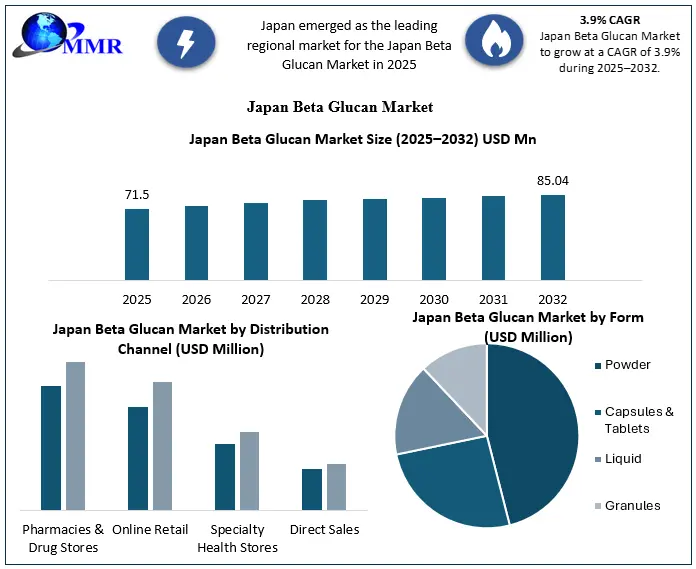
To know about the Research Methodology :- Request Free Sample Report
Japan Beta Glucan Market Dynamics
Rising Demand for Functional Foods and Preventive Healthcare
The increasing demand for functional foods and preventive healthcare is a key driver of the Japan Beta Glucan Market. Japan has one of the world's oldest populations, with approximately 29% of its population aged 65 years and above, significantly increasing demand for ingredients that support immunity, cardiovascular health, and healthy aging. Beta glucan, derived from oats, barley, yeast, and mushrooms, is gaining popularity due to its scientifically validated health benefits, including cholesterol reduction and immune modulation. In addition, Japan's functional food and nutraceutical industry continues to expand steadily, with consumers increasingly opting for clean-label and naturally derived ingredients. The market is expected to grow from USD 71.50 Million in 2025 to USD 85.04 Million by 2032, registering a CAGR of 3.9%, reflecting sustained demand across food, beverage, pharmaceutical, and dietary supplement applications.
High Production Costs and Limited Consumer Awareness
Despite favorable demand, the market faces challenges related to high production and extraction costs. Producing high-purity beta glucan requires advanced extraction and purification technologies, increasing manufacturing expenses by 15–25% compared to conventional food ingredients. These higher costs often translate into premium product pricing, limiting adoption among price-sensitive consumers. Furthermore, although awareness of functional ingredients is increasing, a significant share of consumers remains unfamiliar with the specific health benefits and differences between oat-, yeast-, and mushroom-derived beta glucan, slowing broader market penetration.
Expansion in Nutraceuticals and Functional Beverages
The rapid growth of Japan's nutraceutical and functional beverage industries presents substantial opportunities for beta glucan manufacturers. More than 60% of Japanese consumers actively seek foods and beverages offering additional health benefits, encouraging companies to incorporate beta glucan into dairy products, cereals, bakery products, beverages, and dietary supplements. Continuous investment in biotechnology and ingredient innovation is also expanding its application in cosmetics, pharmaceuticals, and animal nutrition, creating new revenue streams for market participants.
Regulatory Compliance and Product Standardization
Maintaining consistent product quality while complying with Japan's stringent food safety and labeling regulations remains a significant challenge. Differences in extraction methods, raw material sources, and beta glucan purity can affect product efficacy and consumer confidence. Manufacturers must invest in quality assurance, clinical validation, and standardized production processes to meet evolving regulatory requirements. Additionally, increasing competition from other functional ingredients, such as probiotics, prebiotics, collagen, and plant proteins, requires companies to differentiate their offerings through scientific evidence, innovation, and premium product positioning.
Japan Beta Glucan Market Trends
The Japan Beta Glucan Market is experiencing steady transformation, driven by changing consumer preferences, advancements in functional food innovation, and increasing demand for natural health ingredients. One of the most prominent trends is the growing adoption of immune-boosting and preventive healthcare products. Consumers are increasingly seeking food and dietary supplements enriched with beta glucan to support immunity, heart health, digestive wellness, and healthy aging. The market is projected to grow from USD 71.50 Million in 2025 to USD 85.04 Million by 2032, at a CAGR of 3.9%, reflecting sustained demand for functional ingredients.
Another key trend is the rising popularity of clean-label and plant-based products. A growing number of Japanese consumers prefer products made with natural ingredients and minimal additives, encouraging manufacturers to incorporate oat-, barley-, mushroom-, and yeast-derived beta glucan into functional beverages, cereals, bakery products, dairy alternatives, and nutritional supplements. Additionally, the increasing demand for vegan and allergen-friendly formulations is expanding the application of beta glucan across multiple product categories.
Technological advancements in extraction and purification methods are also improving the quality, purity, and bioavailability of beta glucan, enabling manufacturers to develop premium-value products with enhanced health benefits. Furthermore, companies are investing in clinical research and product innovation to validate health claims and strengthen consumer confidence. The expanding use of beta glucan in cosmetics, pharmaceuticals, animal nutrition, and medical nutrition is further broadening market opportunities. As Japan's aging population continues to grow and consumers increasingly prioritize preventive healthcare, these trends are expected to drive sustained innovation and long-term market growth throughout the forecast period.
Japan Beta Glucan Market Regional Insights
The Kanto region dominates the Japan Beta Glucan Market due to its large population, high disposable income, and strong presence of pharmaceutical, nutraceutical, and functional food manufacturers. Major metropolitan areas such as Tokyo and Yokohama serve as innovation hubs where consumers exhibit high awareness of preventive healthcare and functional ingredients. The region also benefits from well-established retail networks, including supermarkets, pharmacies, specialty health stores, and e-commerce platforms, making beta glucan-based products widely accessible.
The Kansai region, including Osaka, Kyoto, and Kobe, represents another significant market driven by increasing demand for dietary supplements, fortified foods, and health-oriented beverages. The presence of leading food processing companies and research institutions supports product innovation and the development of advanced beta glucan formulations. Consumers in this region are increasingly adopting products that promote immune health, cardiovascular wellness, and digestive health.
The Chubu region is witnessing steady growth due to its strong manufacturing base and expanding food and beverage industry. Rising investments in functional food production and growing awareness of clean-label and natural ingredients are encouraging the adoption of beta glucan across multiple applications. Meanwhile, the Kyushu and Tohoku regions are experiencing gradual market expansion, supported by improving healthcare awareness, an aging population, and increasing availability of nutraceutical products through online retail channels.
Overall, urban regions continue to account for the largest share of demand owing to higher consumer purchasing power and greater awareness of functional nutrition. However, market penetration is steadily increasing across other parts of Japan as manufacturers expand their distribution networks and introduce innovative beta glucan-based products. This nationwide expansion is expected to support the market's growth from USD 71.50 Million in 2025 to USD 85.04 Million by 2032, registering a CAGR of 3.9% during the forecast period.
Japan Beta Glucan Market Competitive Insights
The Japan Beta Glucan Market is moderately competitive, with the presence of domestic manufacturers, global ingredient suppliers, and nutraceutical companies focusing on product innovation, research and development, and strategic collaborations to strengthen their market position. Companies are increasingly investing in advanced extraction technologies to produce high-purity beta glucan from oats, barley, yeast, and mushrooms while enhancing product efficacy and bioavailability. The growing demand for functional foods, dietary supplements, and clean-label ingredients has encouraged manufacturers to expand their product portfolios and introduce customized formulations targeting immune health, cardiovascular wellness, digestive health, and healthy aging.
Market participants are also emphasizing clinical research and scientific validation to support health claims and comply with Japan's stringent food safety and labeling regulations. Strategic partnerships with food and beverage manufacturers, pharmaceutical companies, and research institutions are becoming increasingly common to accelerate product development and commercialization. In addition, companies are strengthening their distribution networks through supermarkets, pharmacies, specialty health stores, and rapidly growing e-commerce platforms to improve product accessibility across the country.
The market is further characterized by increasing competition from international ingredient suppliers offering innovative beta glucan solutions for functional foods, nutraceuticals, cosmetics, and pharmaceutical applications. As the market is projected to expand from USD 71.50 Million in 2025 to USD 85.04 Million by 2032, at a CAGR of 3.9%, companies are expected to focus on sustainable sourcing, premium-quality ingredients, and continuous innovation to maintain a competitive advantage and meet the evolving preferences of health-conscious consumers.
Japan Beta Glucan Market Scope: Inquire before buying
| Japan Beta Glucan Market | |||
|---|---|---|---|
| Report Coverage | Details | ||
| Base Year: | 2025 | Forecast Period: | 2026-2032 |
| Historical Data: | 2020 to 2025 | Market Size in 2025: | USD 71.50 Million |
| Forecast Period 2026 to 2032 CAGR: | 3.9% | Market Size in 2032: | USD 85.04 Million |
| Segments Covered: | By Source | Oats Barley Yeast Mushrooms Algae |
|
| By Form Powder | Capsules & Tablets Liquid Granules |
||
| By Application | Functional Foods & Beverages Dietary Supplements & Nutraceuticals Pharmaceuticals Animal Feed & Nutrition Personal Care & CosmeticsHeadphones |
||
| By Distribution Channel | Supermarkets & Hypermarkets Pharmacies & Drug Stores Specialty Health Stores Online Retail Direct Sales |
||
| By End User | Food & Beverage Manufacturers Pharmaceutical Companies Nutraceutical Manufacturers Cosmetic & Personal Care Companies Animal Nutrition Manufacturers Individual Consumers |
||
Japan Beta Glucan Market Key Players
| Sr. No. | Company Name | Region | Core Competencies |
| 1 | Nisshin Seifun Group Inc. | Japan | Functional food ingredients, oat and grain processing |
| 2 | ADEKA Corporation | Japan | Nutraceutical ingredients and food additives |
| 3 | Mitsubishi Corporation Life Sciences Limited | Japan | Functional ingredients and health nutrition |
| 4 | Asahi Group Holdings, Ltd. | Japan | Functional beverages and health supplements |
| 5 | Yakult Honsha Co., Ltd. | Japan | Probiotic and immune health products |
| 6 | Suntory Holdings Limited | Japan | Functional beverages and wellness products |
| 7 | Kowa Company, Ltd. | Japan | Pharmaceuticals and nutraceuticals |
| 8 | Amano Enzyme Inc. | Japan | Biotechnology and enzyme-based ingredient solutions |
| 9 | San-Ei Gen F.F.I., Inc. | Japan | Functional food ingredients and stabilizers |
| 10 | Fuji Oil Holdings Inc. | Japan | Plant-based and functional food ingredients |
| 11 | Kerry Group plc | Ireland | Beta glucan ingredients and food innovation |
| 12 | Tate & Lyle PLC | United Kingdom | Oat beta glucan and specialty food ingredients |
| 13 | DSM-Firmenich | Switzerland | Nutritional and health ingredient solutions |
| 14 | Lesaffre Group | France | Yeast-derived beta glucan production |
| 15 | Lallemand Inc. | Canada | Yeast extracts and immune health ingredients |
| 16 | Kemin Industries | United States | Functional ingredients and animal nutrition |
| 17 | Cargill, Incorporated | United States | Grain processing and food ingredients |
| 18 | Ingredion Incorporated | United States | Specialty starches and dietary fibers |
| 19 | Archer Daniels Midland (ADM) | United States | Plant-based nutrition and ingredient solutions |
| 20 | Ceapro Inc. | Canada | Oat beta glucan technologies and cosmetic ingredients |
| 21 | Garuda International, Inc. | United States | Mushroom-derived beta glucan ingredients |
| 22 | Biorigin | Brazil | Yeast-based functional ingredients |
| 23 | Lantmännen Biorefineries | Sweden | Oat-derived beta glucan and grain innovation |
| 24 | Roquette Frères | France | Plant-based nutritional ingredients |
| 25 | Givaudan SA | Switzerland | Health and wellness ingredient solutions |
| 26 | ABF Ingredients | United Kingdom | Specialty ingredients and functional nutrition |
| 27 | Koyo Mercantile Co., Ltd. | Japan | Distribution of functional food ingredients |
| 28 | Nihon Shokuhin Kako Co., Ltd. | Japan | Food processing and starch-based ingredients |
| 29 | Glico Nutrition Co., Ltd. | Japan | Functional nutrition and dietary supplements |
| 30 | Daicel Corporation | Japan | Biotechnology, healthcare, and functional ingredient development |
Frequently Asked Questions
Q1. What is the market size of the Japan Beta Glucan Market in 2025?
The Japan Beta Glucan Market was valued at USD 71.5 Million in 2025 and is expected to witness steady growth during the forecast period.
Q2. What is the projected value of the Japan Beta Glucan Market by 2032?
The market is projected to reach USD 85.04 Million by 2032, growing at a CAGR of 3.9% from 2026 to 2032.
Q3. What are the key factors driving the growth of the Japan Beta Glucan Market?
The market is primarily driven by increasing demand for functional foods and dietary supplements, growing consumer awareness of immune health, rising adoption of preventive healthcare, and expanding applications of beta glucan in pharmaceuticals, cosmetics, and animal nutrition.
Q4. Which source segment holds a significant share in the Japan Beta Glucan Market?
Beta glucan derived from oats and yeast holds a significant market share due to its proven health benefits, wide availability, and increasing use in functional food, nutraceutical, and pharmaceutical products.
Q5. Which region dominates the Japan Beta Glucan Market?
The Kanto region, including Tokyo and Yokohama, dominates the Japan Beta Glucan Market owing to its large consumer base, strong presence of food and pharmaceutical manufacturers, advanced healthcare infrastructure, and high demand for functional and preventive healthcare products.