
IoT Fleet Management Market Global Market Size Estimation, Industry-Wide Analysis, Competitive Landscape Assessment & Long-Term Forecast to 2032
Overview
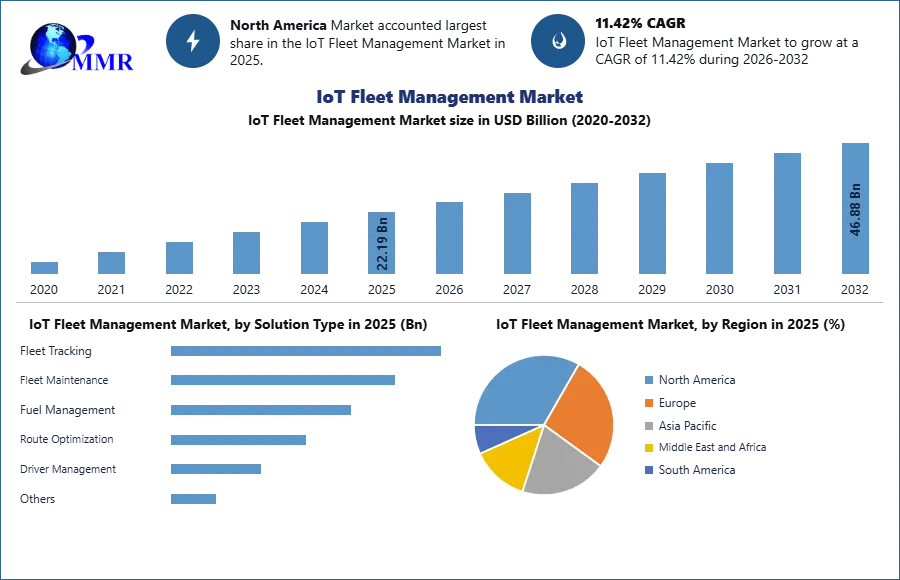
The IoT Fleet Management Market was valued at USD 22.19 Billion in 2025 and is estimated to grow at a CAGR of 11.42% over the forecast period, reaching USD 46.88 Billion by 2032.
IoT Fleet Management Market Overview
The IoT fleet management market refers to the integration of Internet of Things (IoT) technology into fleet management systems, providing real-time monitoring, data analytics, and optimization capabilities for vehicle fleets. These systems are used to track vehicles, manage fuel consumption, optimize routes, monitor driver behavior, and predict maintenance needs, thereby improving operational efficiency and reducing costs. The market has been growing steadily due to the increasing demand for operational efficiency, cost reduction, and safety improvements in fleet management. Additionally, advancements in sensor technologies, cloud computing, and big data analytics have led to the development of more intelligent fleet management systems that are scalable and customizable. The market's growth is also supported by regulatory mandates, such as those related to vehicle emissions and driver safety, which have made the adoption of IoT fleet management systems increasingly necessary for fleet operators worldwide.
To know about the Research Methodology :- Request Free Sample Report
IoT Fleet Management Market Dynamics
Market Drivers
1. Technological Advancements in IoT and Data Analytics
The growth of IoT in fleet management has been driven by advancements in data analytics, sensor technologies, and real-time fleet tracking. Fleet operators are increasingly adopting IoT solutions to monitor vehicle health, optimize fuel consumption, and ensure timely deliveries. IoT-based systems enable real-time data collection and analysis, improving efficiency and reducing operational costs. The integration of advanced data analytics allows fleet managers to proactively manage maintenance schedules, reduce downtime, and enhance the overall fleet performance. With increasing demand for intelligent solutions, IoT technologies are expected to remain the cornerstone of future fleet management systems, offering scalable and automated solutions for businesses of all sizes. As IoT technologies evolve and the availability of more advanced sensors increases, the market is poised to witness further growth, with solutions becoming more cost-effective and efficient.
2. Growing Demand for Cost Reduction and Efficiency
With rising fuel costs and the need to optimize route planning, fleet operators are increasingly turning to IoT solutions for cost reduction. IoT fleet management solutions enable fleet managers to track fuel consumption, monitor driver behavior, and identify inefficiencies. Through telematics, fleet managers can reduce fuel wastage, optimize routes, and improve vehicle maintenance scheduling. These capabilities result in reduced operational costs, better resource utilization, and an overall increase in profit margins. Additionally, real-time fleet tracking and predictive maintenance prevent unexpected breakdowns, improving fleet uptime and ensuring more efficient operations. Companies seeking to reduce costs while improving their environmental footprint will continue driving the demand for IoT fleet management systems.
3. Regulatory Compliance and Safety Requirements
Governments and regulatory bodies worldwide are enforcing stricter regulations regarding vehicle safety, emissions, and driver behavior. These regulations require fleet operators to adopt systems that provide visibility into fleet operations. IoT solutions play a vital role in helping businesses comply with safety standards, monitor driver fatigue, ensure regulatory compliance on working hours, and track vehicle emissions. The increasing focus on sustainability and the growing need for data transparency are encouraging businesses to adopt IoT-enabled fleet management systems. Regulatory pressure is expected to drive the demand for IoT fleet management systems in both developed and developing economies.
Market Restraints
1. High Initial Investment Costs
Although IoT-based fleet management solutions offer long-term operational savings, the initial investment required for implementing these systems can be significant, especially for small and medium-sized enterprises (SMEs). The cost of sensors, communication systems, and software integration can be prohibitive for companies with limited budgets. Moreover, ongoing maintenance, data storage, and network infrastructure also contribute to the total cost of ownership. While larger enterprises can easily justify the return on investment (ROI), the high upfront costs pose a challenge for smaller businesses looking to adopt IoT solutions. This pricing issue is a restraint that may limit the adoption of these technologies among SMEs, despite the long-term benefits.
2. Data Privacy and Security Concerns
The integration of IoT devices in fleet management raises significant concerns around data security and privacy. The continuous transmission of sensitive data such as vehicle location, driver behavior, and operational performance introduces risks of cyberattacks, data breaches, and unauthorized access. Companies may hesitate to adopt IoT solutions without assurances that their data will be adequately protected. Ensuring the security of IoT devices and the data they transmit is a major concern that needs to be addressed for the continued growth of the market. Increased government regulations on data privacy and the rising sophistication of cyberattacks are key factors that could potentially hinder the widespread adoption of IoT fleet management solutions.
3. Limited Connectivity in Remote Areas
One of the major challenges in implementing IoT-based fleet management systems is ensuring reliable connectivity in remote areas. IoT systems rely on continuous data transmission to provide real-time updates, but in areas with poor network coverage, such as rural or isolated regions, connectivity can be intermittent or non-existent. This can limit the effectiveness of fleet management systems in ensuring real-time tracking and data collection, especially in countries with vast geographic areas or underdeveloped network infrastructure. The limited availability of connectivity in remote regions is a significant challenge that needs to be addressed for further expansion of the market.
Market Opportunities
1. Growth in Electric Vehicle (EV) Fleets
The global shift towards electric vehicles (EVs) presents a significant opportunity for the IoT fleet management market. As the adoption of EVs increases, fleet operators will need to integrate IoT solutions to optimize the charging process, monitor battery health, and ensure efficient routing to charging stations. IoT systems will enable fleet managers to track energy consumption, battery status, and charging locations in real-time, which is crucial for maximizing fleet uptime. As governments around the world incentivize EV adoption with regulations, tax breaks, and other benefits, the demand for IoT solutions that support EV fleets will continue to rise. This transition offers a long-term growth opportunity for companies offering fleet management solutions tailored to electric vehicles.
2. Emerging Markets and Untapped Regions
The IoT fleet management market is seeing increasing adoption in emerging markets such as Latin America, Africa, and Southeast Asia. These regions are witnessing rapid urbanization, growing infrastructure development, and increasing investments in transportation. Fleet operators in these regions are beginning to realize the importance of efficiency and cost reduction, prompting the demand for IoT fleet management solutions. As these economies continue to develop, businesses in these regions will be more inclined to invest in IoT technology to modernize their fleet operations. This presents a major opportunity for IoT fleet management vendors to expand their presence in untapped markets and cater to a growing customer base.
3. Technological Advancements in Artificial Intelligence (AI) and Machine Learning (ML)
The integration of AI and ML in fleet management solutions presents an exciting opportunity for market growth. These technologies enable predictive analytics for vehicle maintenance, demand forecasting, route optimization, and real-time decision-making. AI and ML can also be used to analyze driver behavior and suggest personalized improvements, enhancing safety and reducing costs. By incorporating AI and ML into IoT-based fleet management systems, businesses can improve fleet efficiency, reduce risks, and increase profitability. As these technologies continue to advance, IoT fleet management systems will become more intelligent and capable of automating more complex tasks, driving further market growth.
IoT Fleet Management Market Segment Analysis
IoT Fleet Management Market Segmentation, By Solution Type
Based on solution type, the market has been divided into Fleet Tracking, Fleet Maintenance, Fuel Management, Route Optimization, and Driver Management. Among these, the Fleet Tracking sub-segment was projected to generate the maximum revenue. The Fleet Tracking sub-segment witnessed the highest market share in 2025. This segment dominated because fleet tracking solutions provide real-time visibility into vehicle locations, routes, and status, enabling fleet managers to optimize operations, reduce costs, and improve fleet efficiency. As the demand for efficient fleet management systems grows, fleet tracking has become a critical solution for businesses to enhance logistics and supply chain performance.
IoT Fleet Management Market Segmentation, By Application
Based on application, the market has been divided into Logistics and Transportation, Construction and Mining, Retail and E-commerce, Healthcare, and Others. Among these, the Logistics and Transportation sub-segment generated the maximum revenue in 2025. This segment dominated because the logistics and transportation sector heavily relies on fleet management systems for route optimization, real-time tracking, and cost reduction. IoT-enabled fleet management solutions help logistics companies ensure timely deliveries, improve customer service, and reduce fuel consumption. These advantages make fleet management a vital tool for businesses in the transportation industry.
IoT Fleet Management Market Regional Insights
North America dominated the market in the year 2025, and is expected to continue its dominance during the forecast period. The region led due to strong industrial demand, regulatory support for transportation safety, and the widespread adoption of IoT technologies. The U.S. and Canada have been at the forefront of IoT adoption in fleet management, with companies increasingly investing in fleet tracking, maintenance management, and fuel optimization. The region’s strong infrastructure, advanced technological capabilities, and favorable government policies have contributed to its market leadership. Additionally, North America is home to several key players in the IoT fleet management space, further reinforcing its dominance.
Recent Development
January 2025: Geotab launched its new fleet management platform, which integrates AI-driven predictive maintenance and real-time vehicle diagnostics. This innovation is expected to streamline fleet operations and reduce downtime, strengthening Geotab’s position in the IoT fleet management market.
February 2025: Fleet Complete expanded its IoT fleet management offering to include new features for improved fuel management and driver performance tracking. These features aim to further enhance operational efficiency for fleet managers and reduce overall operating costs.
March 2025: Samsara announced a partnership with Amazon Web Services (AWS) to enhance its cloud-based IoT fleet management platform. The collaboration will improve the scalability and performance of Samsara’s fleet management system across multiple industries.
IoT Fleet Management Market Scope: Inquire before buying
| IoT Fleet Management Market | |||
|---|---|---|---|
| Report Coverage | Details | ||
| Base Year: | 2025 | Forecast Period: | 2026-2032 |
| Historical Data: | 2020 to 2025 | Market Size in 2025: | USD 22.19 Billion |
| Forecast Period 2026-2032 CAGR: | 11.42% | Market Size in 2032: | USD 46.88 Billion |
|
Segments Covered IoT Fleet Management Market: |
by Solution Type | Fleet Tracking Fleet Maintenance Fuel Management Route Optimization Driver Management Others |
|
| by Connectivity | Cellular Satellite Wi-Fi Bluetooth Zigbee |
||
| by Application | Logistics and Transportation Construction and Mining Retail and E-commerce Healthcare Others |
||
IoT Fleet Management Market, by Region
North America (United States, Canada and Mexico)
Europe (UK, France, Germany, Italy, Spain, Sweden, Austria, Turkey, Russia and Rest of Europe)
Asia Pacific (China, India, Japan, South Korea, Australia, ASEAN and Rest of APAC)
Middle East and Africa (South Africa, GCC, Egypt, Nigeria and Rest of ME&A)
South America (Brazil, Argentina, Columbia and Rest of South America)
Key Players/Competitors Profiles Covered in the Global IoT Fleet Management Market Report in Strategic Perspective
- Cisco Systems, Inc.
- Verizon Communications, Inc.
- Fleet Complete
- Geotab Inc.
- CalAmp Corp.
- Omnitracs LLC
- Zonar Systems, Inc.
- Trimble Inc.
- MiX Telematics
- Lytx, Inc.
- Wialon
- Orbcomm Inc.
- Geoforce, Inc.
- Fleetmatics Group PLC
- Samsara
- Teletrac Navman
- DynoSense, Inc.
- Steer Technology
- Gurtam
- Smaato
- Cyngn
- Teletrac
- T-Mobile
- Masternaut
- SpeedGauge