Water Treatment System Market– Industry Structure Evaluation, Demand Drivers Analysis, Regional Growth Analysis and Identification, Competitive Positioning Review & Global Market Size Forecast to 2034

9%
CAGR (2026-2034)
45.50 USD Bn.
Forecast Market Size
311
Report Pages
155
Market Tables

Overview

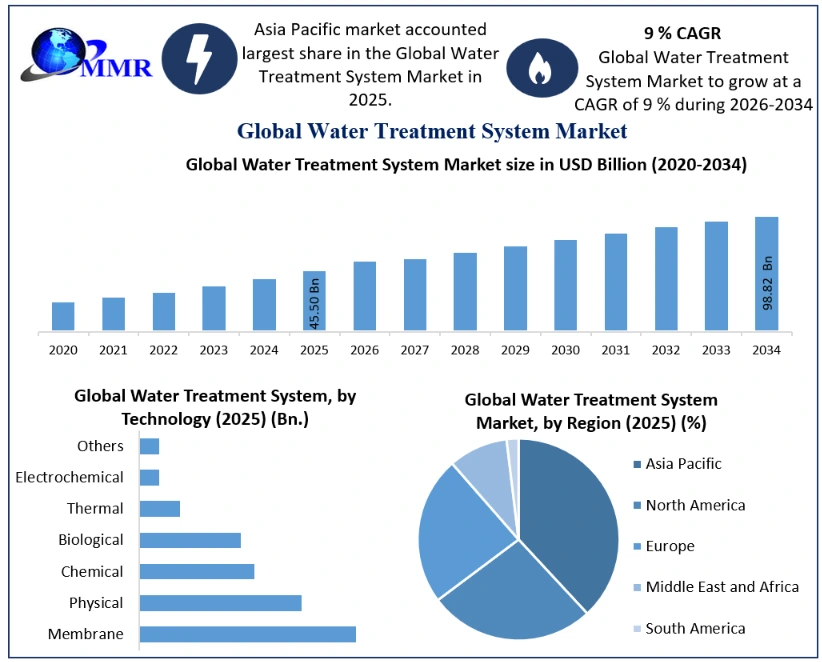
The Water Treatment System Market size was valued at USD 45.50 Billion in 2025 and the total Water Treatment System revenue is expected to grow at a CAGR of 9% from 2026 to 2034, reaching USD 45.50 Billion by 2034.

The report includes the analysis of impact of COVID-19 lock-down on the revenue of market leaders, followers, and disrupters. Since lock down was implemented differently in different regions and countries, impact of same is also different by regions and segments. The report has covered the current short term and long term impact on the market, same will help decision makers to prepare the outline for short term and long term strategies for companies by region.

Water Treatment System Market Key Highlights:

Global market analysis and forecast, in terms of value.

Comprehensive study and analysis of market drivers, restraints and opportunities influencing the growth of the Global market

Global market segmentation on the basis of type, source, end-user, and region (country-wise) has been provided.

Global market strategic analysis with respect to individual growth trends, future prospects along with the contribution of various sub-market stakeholders have been considered under the scope of study.

Global market analysis and forecast for five major regions namely North America, Europe, Asia Pacific, the Middle East & Africa (MEA) and Latin America along with country-wise segmentation.

Profiles of key industry players, their strategic perspective, market positioning and analysis of core competencies are further profiled.
Competitive developments, investments, strategic expansion and competitive landscape of the key players operating in the Global market are also profiled.
Water Treatment System Market Growth Outlook

To know about the Research Methodology:-Request Free Sample Report

Exponential growth in the global population has exerted considerable pressure on the existing water resources available for human consumption, in turn augmenting the dependence on groundwater, owing to its easy availability. However, improper disposal of wastewater generated in agricultural and industrial areas has led to large-scale contamination of groundwater in urban areas, enhancing the global point of entry water treatment systems market by. The growing investments toward development of efficient point of entry water treatment system is expected to boost the water treatment systems market growth in the coming years.

 Water Treatment System Market Segment Analysis:

On the basis of technology, The global water treatment system market is segmented by technology into physical/mechanical, chemical, biological, membrane, thermal, electrochemical, and other treatment technologies. Physical and mechanical processes remove suspended solids through screening, filtration, sedimentation, and clarification. Chemical treatment uses coagulants, flocculants, disinfectants, and pH-adjustment chemicals to eliminate contaminants. Biological treatment relies on microorganisms to break down organic pollutants in wastewater. Membrane technologies, including reverse osmosis, ultrafiltration, and nanofiltration, support high-efficiency purification and water reuse. Thermal and electrochemical processes serve specialized applications such as desalination, brine concentration, and advanced wastewater treatment.

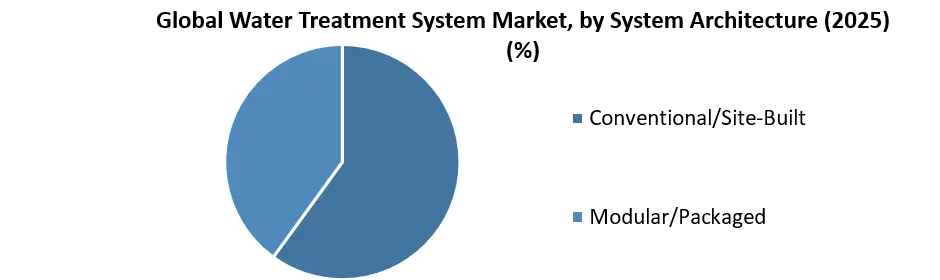
On the basis of  System Architecture, System architecture is categorized into conventional/site-built and modular/packaged water treatment systems. Conventional systems are engineered and constructed at the installation site to meet specific capacity, water-quality, and operational requirements, making them suitable for large municipal and industrial facilities. Modular and packaged systems use pre-engineered treatment units that offer faster installation, flexible capacity expansion, and reduced construction time. These include containerized, skid-mounted, tank-integrated, and trailer-mounted/mobile systems. Their compact design supports decentralized water treatment, remote industrial operations, temporary installations, and emergency water supply.
Water Treatment System Market by System Architecture

Water Treatment System Market Regional Analysis:

Asia Pacific will remain the dominant market through to 2034, with over xx% share in terms of revenues. From US$ xx Bn recorded in, this region is estimated to exceed US$ xx Bn by end. Europe and North America, collectively registering a market share of nearly 43% in , will remain the major markets over the forecast period as well.

The objective of the report is to present comprehensive analysis of Global market including all the stakeholders of the industry. The past and current status of the industry with forecasted market size and trends are presented in the report with the analysis of complicated data in simple language. The report covers all the aspects of industry with dedicated study of key players that includes market leaders, followers and new entrants by region. PORTER, SVOR, PESTEL analysis with the potential impact of micro-economic factors by region on the market have been presented in the report. External as well as internal factors that are supposed to affect the business positively or negatively have been analyzed, which will give clear futuristic view of the industry to the decision makers.

The report also helps in understanding Global market dynamics, structure by analyzing the market segments, and project the Global market size. Clear representation of competitive analysis of key players by Global market Type, price, financial position, product portfolio, growth strategies, and regional presence in the Global market make the report investor’s guide.

 Water Treatment System Market Scope: Inquire before buying

Water Treatment System Market
Report Coverage Details
Base Year: 2025 Forecast Period: 2026-2034
Historical Data: 2020 to 2025 Market Size in 2025: USD 45.50 Bn.
Forecast Period 2026 to 2034 CAGR: 9% Market Size in 2034: USD 98.82 Bn.
Segments Covered: by Technology Physical/Mechanical
Chemical
Biological
Membrane
Thermal
Electrochemical
Others
by System Architecture Conventional/Site-Built
Modular/Packaged
Containerized
Skid-Mounted
Tank-Integrated
Trailer-Mounted/Mobile
Others
by Wastewater Type Produced Water
Oil & Gas Wastewater
Industrial Wastewater
Landfill Leachate
Municipal Wastewater
Contaminated Groundwater & Dewatering Water
Others
by Commercial Model Equipment Purchase/Ownership
Rental & Leasing
Treatment-as-a-Service
Others
by Deployment Type Permanent
Planned Temporary
Emergency/Contingency
by Treatment Capacity ≤100 m³/day
100–500 m³/day
501–1,000 m³/day
1,001–5,000 m³/day
5,000 m³/day
by Application Oil & Gas
Waste Management
Industrial
Mining & Mineral Processing
Construction & Dewatering
Municipal
Environmental Remediation
Others

Water Treatment System Market, by Region:

North America (United States, Canada and Mexico)
Europe (UK, France, Germany, Italy, Spain, Sweden, Austria and Rest of Europe)
Asia Pacific (China, South Korea, Japan, India, Australia, Indonesia, Malaysia, Vietnam, Taiwan, Bangladesh, Pakistan and Rest of APAC)
Middle East and Africa (South Africa, GCC, Egypt, Nigeria and Rest of ME&A)
South America (Brazil, Argentina Rest of South America)

Water Treatment System Market Key Players:

1. Veolia (France)
2. Xylem Inc. (US)
3. Ecolab (US)
4. DuPont de Nemours Inc. (US)
5. Pentair plc (UK)
6. 3M Company (US)
7. A. O. Smith Corporation (US)
8. SUEZ (France)
9. Kurita Water Industries Ltd. (Japan)
10. Danaher Corporation (US)
11. Honeywell International Inc. (US)
12. Aquatech International LLC (US)
13. Thermax Ltd. (India)
14. VA Tech Wabag Ltd. (India)
15. Ion Exchange (India) Ltd. (India)
16. BWT Aktiengesellschaft (Austria)
17. Culligan International (US)
18. Calgon Carbon Corporation (US)
19. LG Electronics (South Korea)
20. Panasonic Holdings Corporation (Japan)
21. Dow Inc. (US)
22. BASF SE (Germany)
23. Kemira (Finland)
24. Solenis (US)
25. Baker Hughes Company (US)
26. SLB (Schlumberger) (US)
27. Siemens Energy (Germany)
28. Acciona (Spain)
29. Doosan Corporation (South Korea)
30. Watts Water Technologies Inc. (US)
31. Grundfos (Denmark)
32. H2O Innovation Inc. (Canada)
33. HUBER SE (Germany)
34. Industrie De Nora S.p.A. (Italy)
35. METAWATER Co. Ltd. (Japan)
36. Organo Corp. (Japan)
37. Ovivo Inc. (Canada)
38. Trojan Technologies (Canada)
39. Eureka Forbes Limited (India)
40. Pure Aqua, Inc. (US)
Others

Frequently Asked Questions:

1. Which region has the largest share in Global Water Treatment System Market?
Ans: Asia Pacific region held the highest share in 2025.

2. What is the growth rate of Global Water Treatment System Market?
Ans: The Global Water Treatment System Market is growing at a CAGR of 9% during forecasting period 2025-2034.

3. What is scope of the Global Water Treatment System market report?
Ans: Global Water Treatment System Market report helps with the PESTEL, PORTER, COVID-19 Impact analysis, Recommendations for Investors & Leaders, and market estimation of the forecast period.

4. Who are the key players in Global Water Treatment System market?
Ans: The important key players in the Global Water Treatment System Market are – Siemens AG, Aker Solutions, FMC Technologies Inc., Alderley plc, Veolia, Frames Group, CETCO Energy Services, Aquatech International, Eco-Tec, Schlumberger Limited, Ovivo, Thermo Energy Corporation, Global Water Engineering, Ecosphere Technologies Inc., Miox Corporation, Pentair plc, Calgon Carbon Corporation, Danaher Corporation, Best Water Technology AG, Veolia Environnement S.A, UEZ S.A, Ecolab Inc., Xylem Inc., Hitachi, Toshiba Corporation, BWT Aktiengesellschaft, Evoqua Water Technologies LLC, Thermax Ltd, IVRCL, Voltas Limited, 3M, VA TECH WABAG LIMITED, Ion Exchange (India) Ltd, METITO Holdings Ltd, Eureka Forbes Ltd, Aquarion AG, and

5. What was the Global Water Treatment System Market size in 2025?
Ans:
The Global Water Treatment System Market size was USD 45.50 Billion in 2025.

Table of Contents

1. Executive Market Landscape and Industry Overview 1.1. Global Water Treatment System Market Size Valuation and Forecast Analysis (Value in USD Million), 2026–2034 1.2. Evolution from centralized plants toward modular treatment architectures 1.3. Role of treatment systems across industrial and municipal water applications 1.4. Demand growth linked to water scarcity and discharge requirements 1.5. Integration of treatment systems with modular large-scale tank infrastructure 2. Global Water Treatment System Market Dynamics & Strategic Predictive Frameworks 2.1. Global Water Treatment System Market Trends and Compact MWT Transformation 2.2. Global Water Treatment System Market DROC Framework Analysis 2.2.1. Drivers 2.2.2. Restraints 2.2.3. Opportunities 2.2.4. Challenges 3. Treatment System Cost Structure, Economics & Pricing Dynamics 3.1. Capital expenditure structure across treatment equipment and supporting infrastructure 3.2. Operating costs covering chemicals, energy, labor, membranes, and maintenance 3.3. Cost differences between modular, skid-mounted, and permanent treatment plants 3.4. Treatment pricing based on capacity, process complexity, and water quality 3.5. Lifecycle costs associated with equipment replacement and process upgrades 3.6. Cost drivers influencing treatment economics across industrial applications 4. Water Treatment Supply Chain & Equipment Ecosystem 4.1. Procurement structure for pumps, membranes, tanks, filters, and dosing equipment 4.2. Availability of stainless steel, polymers, media, membranes, and specialty components 4.3. Sourcing of long-lead equipment for modular treatment system deployments 4.4. Supplier dependencies for instrumentation, controls, pumps, and separation technologies 4.5. Local versus imported equipment strategies across major treatment markets 4.6. Supply-chain bottlenecks affecting fabrication, installation, commissioning, and maintenance 5. Water Treatment Demand & Feedwater Characteristics Analysis 5.1. Raw water treatment requirements across industrial and municipal applications 5.2. Oil and gas produced-water characteristics influencing treatment process selection 5.3. Leachate treatment requirements based on contaminants and loading variability 5.4. Wastewater treatment demand across industrial waste management operations 5.5. Water reuse requirements for process, utility, irrigation, and discharge applications 5.6. Seasonal and operational variability influencing treatment capacity requirements 6. Treatment Capacity & Tank Requirement Mapping 6.1. Treatment capacity requirements based on feedwater flow, peak loading, and operating conditions 6.2. Tank volume requirements across equalization, storage, treatment, and treated-water stages 6.3. Capacity-to-tank sizing relationships for modular treatment deployments 6.4. Buffer storage requirements for variable inflow and intermittent treatment operations 6.5. Tank requirements associated with oil and gas, wastewater, and leachate applications 6.6. Expansion capacity requirements for phased treatment system deployment 7. Modular Treatment Configuration, Layout & Infrastructure Development 7.1. Modular treatment layouts optimized for constrained or temporary sites 7.2. Treatment train integration with storage, pumping, and transfer infrastructure 7.3. Containerized and skid-mounted configurations for rapid deployment requirements 7.4. Process separation between pretreatment, primary, secondary, and polishing stages 7.5. Utility arrangements supporting power, chemicals, compressed air, and drainage 7.6. Expansion provisions enabling phased additions to treatment capacity 8. Treatment Train Configuration & Process Integration 8.1. Pretreatment sequencing for screening, equalization, and contaminant conditioning 8.2. Primary treatment arrangements for solids, oil, and suspended contaminant removal 8.3. Secondary biological and physicochemical treatment configurations 8.4. Tertiary and polishing stages for high-quality treated-water production 8.5. Membrane integration based on feedwater quality and recovery requirements 8.6. Process train selection according to application, contaminant profile, and discharge target 9. A9. Water Treatment Technology & Process Design Evolution 9.1. Screening, clarification, and filtration technologies for suspended solids removal 9.2. Coagulation and flocculation systems for contaminant aggregation and separation 9.3. Membrane technologies including ultrafiltration, nanofiltration, and reverse osmosis 9.4. Biological treatment systems for biodegradable organic contaminant reduction 9.5. Advanced oxidation technologies for persistent and difficult-to-treat contaminants 9.6. Disinfection systems using ultraviolet, ozone, and chemical treatment methods 10. A10. Oil & Gas Water Treatment Technologies 10.1. Oil-water separation systems for produced water treatment applications 10.2. Dissolved air flotation for oils, solids, and suspended contaminants 10.3. Hydrocyclones for compact separation of dispersed oil phases 10.4. Media filtration for polishing treated water before reuse 10.5. Membrane treatment for dissolved contaminants and water recovery 10.6. Polishing systems targeting residual hydrocarbons, metals, and organics 11.Waste & Leachate Treatment System Technologies 11.1. Leachate equalization systems managing variable flow and contaminant loading 11.2. Ammonia removal technologies for landfill leachate treatment applications 11.3. High-strength organic removal through biological and physicochemical processes 11.4. Membrane systems for dissolved solids and refractory contaminant reduction 11.5. Leachate concentrate management and residual stream handling requirements 11.6. Treatment configurations adapted to landfill age and leachate composition 12. Modular Tank Integration & Water Treatment Infrastructure 12.1. Modular treatment integration with equalization and untreated water storage 12.2. Tank-to-treatment transfer systems supporting controlled hydraulic loading requirements 12.3. Sludge and concentrate storage integration within treatment layouts 12.4. Secondary containment requirements for chemical and contaminated water storage 12.5. Level monitoring and automated controls across interconnected treatment tanks 12.6. Tank capacity optimization based on flow variability and treatment residence requirements 13. Pumps, Piping, Valves & Process Handling Systems 13.1. Chemical dosing systems for pH adjustment and coagulation control 13.2. Pump selection based on flow, pressure, viscosity, and chemical compatibility 13.3. Valves and manifolds supporting isolation, routing, and process sequencing 13.4. Flow metering for accurate treatment performance and chemical optimization 13.5. Sludge handling equipment for thickening, dewatering, and disposal 13.6. Pipeline materials selected according to water chemistry and contamination 14. Consumables, Membrane Management & Treatment Media 14.1. Membrane fouling control through pretreatment and operating optimization 14.2. Backwashing systems supporting filtration media and membrane performance 14.3. Chemical cleaning systems for membrane and process equipment restoration 14.4. Antiscalant and conditioning strategies for high-recovery membrane operation 14.5. Media replacement cycles across granular and specialty filtration systems 14.6. Consumables management for chemicals, cartridges, membranes, and treatment media 15. Installed Water Treatment System Base & Capacity Analysis 15.1. Installed treatment capacity by application, technology, and geographic region 15.2. Existing modular treatment assets serving industrial and remote facilities 15.3. Treatment plant age profiles indicating replacement and modernization opportunities 15.4. Installed capacity associated with oil and gas production facilities 15.5. Existing leachate treatment infrastructure across waste management operations 15.6. Brownfield upgrades and capacity expansion within operating treatment sites 16.Treatment Utilization, Throughput & Performance Management 16.1. Treatment capacity utilization across industrial and modular installations 16.2. Hydraulic loading relative to designed treatment throughput capacity 16.3. Water quality variability affecting process efficiency and operating stability 16.4. Recovery rates measuring treated-water output against feedwater volumes 16.5. System uptime and maintenance downtime across treatment installations 16.6. Performance monitoring through contaminant removal and compliance indicators 17. End-Use Application & Treatment Requirement Analysis 17.1. Oil and gas produced-water treatment process configurations 17.2. Treatment requirements for refinery and petrochemical wastewater streams 17.3. Industrial wastewater treatment for manufacturing and processing facilities 17.4. Leachate treatment across landfill and waste management facilities 17.5. Mining and metals wastewater treatment applications with high contaminant loads 17.6. Emergency and temporary treatment applications requiring rapid deployment 18.Water Reuse, Recovery & Resource Management Systems 18.1. Water reuse systems supporting closed-loop industrial water management 18.2. Treated-water recovery for cooling, washing, and process applications 18.3. Zero-liquid-discharge configurations for water-intensive industrial facilities 18.4. Concentrate management strategies for high-recovery membrane treatment systems 18.5. Resource recovery opportunities from sludge and concentrated waste streams 18.6. Reuse economics influenced by freshwater costs and discharge constraints 19. Treatment Automation, Instrumentation & Digital Monitoring 19.1. Automation architecture for centralized treatment process monitoring systems 19.2. Online sensors measuring pH, turbidity, conductivity, flow, and pressure 19.3. SCADA integration across modular treatment skids and storage assets 19.4. Remote monitoring platforms enabling distributed treatment system management 19.5. Predictive maintenance using equipment condition and operating performance data 19.6. Digital dosing optimization based on real-time water quality measurements 20. Environmental Compliance & Regulatory Framework Analysis 20.1. Environmental discharge regulations governing treated-water quality requirements 20.2. Oil and gas wastewater standards affecting produced-water treatment 20.3. Landfill leachate regulations covering discharge and contaminant management 20.4. Permitting requirements for temporary and modular treatment installations 20.5. Chemical handling and occupational safety requirements for treatment facilities 20.6. Monitoring, reporting, and compliance obligations for treatment operators 21. Treatment System Safety, Reliability & Operational Resilience 21.1. Treatment resilience against variable flow and contaminant concentrations 21.2. Redundant process trains supporting uninterrupted treatment availability 21.3. Emergency bypass and containment arrangements for process disruptions 21.4. Corrosion protection for equipment exposed to aggressive water chemistry 21.5. Climate resilience considerations for remote and outdoor treatment installations 21.6. Contingency planning for equipment failures and treatment capacity shortages 22. Energy Efficiency, Sustainability & Circular Water Management 22.1. Energy consumption across pumping, aeration, membranes, and treatment processes 22.2. Energy-efficient equipment strategies for reducing treatment operating costs 22.3. Renewable power integration for remote modular treatment installations 22.4. Chemical consumption reduction through optimized dosing and process control 22.5. Sludge minimization and resource recovery supporting circular treatment models 22.6. Carbon footprint assessment across treatment equipment lifecycle and operations 23. Commercial & Business Models 23.1. Equipment sales models for modular and permanent treatment system deployments 23.2. Leasing and rental structures for temporary and capacity-constrained applications 23.3. Engineering, procurement, and construction contracting models 23.4. Operation and maintenance service agreements for treatment facilities 23.5. Water-as-a-service and performance-based treatment arrangements 23.6. Revenue structures across equipment, installation, commissioning, and lifecycle services 24.Water Treatment Technology Innovation & Future Infrastructure 24.1. Advanced membrane systems improving recovery and contaminant removal performance 24.2. Electrochemical treatment technologies for complex industrial wastewater streams 24.3. Artificial intelligence for treatment optimization and anomaly detection 24.4. Digital twins enabling virtual commissioning and process performance analysis 24.5. Autonomous treatment modules supporting remote and unmanned facilities 24.6. Next-generation sensors enabling continuous contaminant and process monitoring 25. Water Treatment System Market Size and Forecast by Segmentation (by Value USD Million) (2025-2034) 25.1. Water Treatment System Market Size And Forecast, By Technology 25.1.1. Physical/Mechanical 25.1.2. Chemical 25.1.3. Biological 25.1.4. Membrane 25.1.5. Thermal 25.1.6. Electrochemical 25.1.7. Others 25.2. Water Treatment System Market Size And Forecast, By System Architecture 25.2.1. Conventional/Site-Built 25.2.2. Modular/Packaged 25.2.3. Containerized 25.2.4. Skid-Mounted 25.2.5. Tank-Integrated 25.2.6. Trailer-Mounted/Mobile 25.2.7. Others 25.3. Water Treatment System Market Size And Forecast, By Wastewater Type 25.3.1. Produced Water 25.3.2. Oil & Gas Wastewater 25.3.3. Industrial Wastewater 25.3.4. Landfill Leachate 25.3.5. Municipal Wastewater 25.3.6. Contaminated Groundwater & Dewatering Water 25.3.7. Others 25.4. Water Treatment System Market Size And Forecast, By Treatment Capacity 25.4.1. ≤100 m³/day 25.4.2. 100–500 m³/day 25.4.3. 501–1,000 m³/day 25.4.4. 1,001–5,000 m³/day 25.4.5. 5,000 m³/day 25.5. Water Treatment System Market Size And Forecast, By System By Commercial Model 25.5.1. Equipment Purchase/Ownership 25.5.2. Rental & Leasing 25.5.3. Treatment-as-a-Service 25.5.4. Others 25.6. Water Treatment System Market Size And Forecast, By Deployment Type 25.6.1. Permanent 25.6.2. Planned Temporary 25.6.3. Emergency/Contingency 25.7. Water Treatment System Market Size And Forecast, By Application 25.7.1. Oil & Gas 25.7.2. Waste Management 25.7.3. Industrial 25.7.4. Mining & Mineral Processing 25.7.5. Construction & Dewatering 25.7.6. Municipal 25.7.7. Environmental Remediation 25.7.8. Others 25.8. Water Treatment System Market Size and Forecast, By Region & Country 25.8.1. North America 25.8.1.1. United States 25.8.1.2. Canada 25.8.1.3. Mexico 25.8.2. Europe 25.8.2.1. United Kingdom 25.8.2.2. France 25.8.2.3. Germany 25.8.2.4. Italy 25.8.2.5. Spain 25.8.2.6. Sweden 25.8.2.7. Russia 25.8.2.8. Rest of Europe 25.8.3. Asia Pacific 25.8.3.1. China 25.8.3.2. South Korea 25.8.3.3. India 25.8.3.4. Japan 25.8.3.5. Australia 25.8.3.6. Indonesia 25.8.3.7. Philippines 25.8.3.8. Malaysia 25.8.3.9. Vietnam 25.8.3.10. Thailand 25.8.3.11. Rest of Asia Pacific 25.8.4. Middle East & Africa 25.8.4.1. South Africa 25.8.4.2. Saudi Arabia 25.8.4.3. United Arab Emirates 25.8.4.4. Qatar 25.8.4.5. Kuwait 25.8.4.6. Bahrain 25.8.4.7. Oman 25.8.4.8. Egypt 25.8.4.9. Nigeria 25.8.4.10. Rest of Middle East & Africa 25.8.5. South America 25.8.5.1. Brazil 25.8.5.2. Argentina 25.8.5.3. Chile 25.8.5.4. Colombia 25.8.5.5. Rest of South America 26.Water Treatment System Market Competitive Landscape 26.1. Competitive Matrix 26.2. Key Player Benchmarking 26.2.1. Company Name 26.2.2. Headquarters 26.2.3. Water Treatment System Portfolio 26.2.4. Treatment Technology Capabilities 26.2.5. Contaminant Removal Performance 26.2.6. System Integration & Customization 26.2.7. Installation & After-Sales Services 26.2.8. Global Market Presence 26.2.9. Annual System Deployments 26.2.10. Average System Cost 26.2.11. Water Recovery Rate 26.2.12. Revenue 26.2.13. Market Share 26.2.14. R&D Investment 26.2.15. Operating Margin 26.2.16. Year-on-Year Growth 26.2.17. Geographic Presence 27. Company Profiles: Key Players 27.1. Overview 27.2. Business Portfolio 27.3. Financial Overview 27.4. SWOT Analysis 27.5. Strategic Analysis 27.6. Recent Developments 28. Global Water Treatment System Market, Key Players 28.1. Veolia (France) 28.2. Xylem Inc. (US) 28.3. Ecolab (US) 28.4. DuPont de Nemours Inc. (US) 28.5. Pentair plc (UK) 28.6. 3M Company (US) 28.7. A. O. Smith Corporation (US) 28.8. SUEZ (France) 28.9. Kurita Water Industries Ltd. (Japan) 28.10. Danaher Corporation (US) 28.11. Honeywell International Inc. (US) 28.12. Aquatech International LLC (US) 28.13. Thermax Ltd. (India) 28.14. VA Tech Wabag Ltd. (India) 28.15. Ion Exchange (India) Ltd. (India) 28.16. BWT Aktiengesellschaft (Austria) 28.17. Culligan International (US) 28.18. Calgon Carbon Corporation (US) 28.19. LG Electronics (South Korea) 28.20. Panasonic Holdings Corporation (Japan) 28.21. Dow Inc. (US) 28.22. BASF SE (Germany) 28.23. Kemira (Finland) 28.24. Solenis (US) 29. Treatment Capacity, Installed Base & Deployment Benchmarking 29.1. Total treatment capacity comparison among leading system providers 29.2. Installed treatment systems across major end-use industries 29.3. Modular versus permanent treatment system deployment comparison 29.4. Treatment capacity ranges offered by leading suppliers 29.5. Geographic distribution of installed treatment system projects 29.6. Brownfield upgrades and new treatment capacity development pipeline 30. Treatment Technology & System Architecture Benchmarking 30.1. Membrane technology capabilities across leading treatment system suppliers 30.2. Biological treatment technology deployment and process configurations 30.3. Filtration and separation technology portfolio comparison 30.4. Advanced oxidation and electrochemical treatment capabilities 30.5. Modular, containerized, and skid-mounted system architecture comparison 30.6. Integrated treatment train and process automation capabilities 31.  Modular Tank Integration & Infrastructure Benchmarking 31.1. Compatibility with modular large-scale water storage tank systems 31.2. Equalization tank integration and hydraulic management capabilities 31.3. Treated-water and residual-stream storage integration approaches 31.4. Chemical storage and dosing infrastructure compatibility 31.5. Sludge, concentrate, and waste-storage integration capabilities 31.6. Deployment flexibility across temporary, remote, and constrained sites 32. Oil & Gas Treatment Capability Benchmarking 32.1. Produced-water treatment capacity across leading technology providers 32.2. Oil-water separation and hydrocarbon removal capabilities 32.3. Dissolved air flotation and hydrocyclone technology deployment 32.4. Membrane polishing capabilities for produced-water reuse 32.5. Treatment solutions for upstream, midstream, and downstream operations 32.6. Water-reuse and discharge compliance capabilities for oilfield applications 33. Waste, Leachate & Industrial Wastewater Benchmarking 33.1. Landfill leachate treatment technologies offered by leading suppliers 33.2. Ammonia and high-organic-load removal capabilities 33.3. Treatment solutions for complex industrial wastewater streams 33.4. Membrane-based dissolved contaminant removal capabilities 33.5. Concentrate and residual-stream management solutions 33.6. Treatment flexibility for variable waste and leachate compositions 34. Operational Performance & Treatment Efficiency Benchmarking 34.1. Contaminant removal efficiency across major treatment technologies 34.2. Water recovery and treatment throughput performance comparison 34.3. Energy consumption across competing treatment system configurations 34.4. Chemical consumption and dosing optimization performance 34.5. System availability and maintenance requirements across installed systems 34.6. Treatment performance under variable feedwater conditions 35.Supply Chain, Procurement & Service Benchmarking 35.1. Supplier ecosystems for pumps, membranes, filters, tanks, and controls 35.2. Procurement strategies for critical treatment-system components 35.3. Treatment chemical and consumables sourcing capabilities 35.4. Engineering, procurement, and construction partner relationships 35.5. Installation, commissioning, and field-service capabilities 35.6. Spare-parts availability and aftermarket support infrastructure 36.Key Insights 37. Strategic Moves & Industry Outlook 38. Research Methodology

Custom Market Research Services

We Will Customise The Research For You, In Case The Report Listed Above Does Not Meet With Your Requirements