
Global Voltage Level Translators Market by Type, Application, Region – Global Market Size Estimation, Industry-Wide Analysis, Competitive Landscape Assessment & Long-Term Forecast to 2034
Overview
The Global Voltage Level Translators Market is valued at USD 1.62 billion in 2025 and is projected to grow at a CAGR of 6.8% from 2026 to 2034, reaching USD 2.98 billion by 2034.
Global Voltage Level Translators Market Overview
The global voltage level translators market comprises semiconductor devices and integrated circuits that enable reliable communication between electronic components operating at different voltage levels. Voltage level translators convert digital signals between different logic voltages while maintaining signal integrity and compatibility across electronic systems. These devices play an important role in consumer electronics, automotive electronics, telecommunications, industrial automation, computing equipment, and Internet of Things (IoT) applications. Increasing demand for advanced electronic devices, compact circuit designs, and efficient data communication supports market growth. The expanding adoption of microcontrollers, sensors, processors, and mixed-voltage semiconductor architectures increases the need for voltage level shifting solutions. Furthermore, rising investments in electric vehicles, connected devices, 5G infrastructure, and advanced computing systems strengthen demand for high-speed, low-power voltage level translators. Manufacturers focus on improving switching speed, power efficiency, channel density, and signal compatibility to address evolving electronic design requirements. Technological advancements in semiconductor manufacturing and the growing integration of voltage translation functions into compact integrated circuits support innovation across the global voltage level translators market.
Global Voltage Level Translators Market Growth and Share Analysis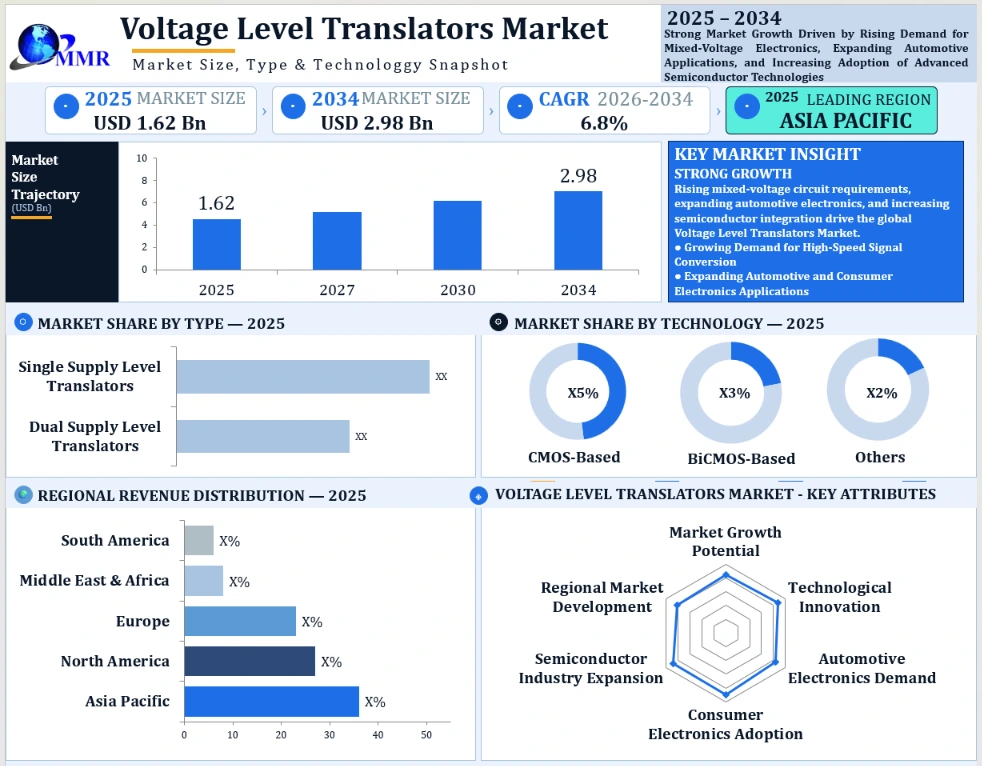
To know about the Research Methodology :- Request Free Sample Report
Key Highlights of the Global Voltage Level Translators Market
- Market Growth: The global voltage level translators’ market is valued at USD 1.62 billion in 2025 and projects growth at a CAGR of 6.8% through 2034, reaching USD 2.98 billion.
- Leading Region: Asia Pacific leads the market due to strong semiconductor manufacturing, electronics production, and expanding automotive electronics demand.
- Dominant Market Driver: Increasing adoption of mixed-voltage electronic systems, microcontrollers, sensors, and processors strengthens demand for voltage level translators.
- Key Growth Opportunity: The expansion of IoT devices, electric vehicles, connected electronics, and advanced computing systems creates opportunities for compact, low-power voltage translation solutions.
- Competitive Focus: Manufacturers prioritize high-speed signal conversion, low power consumption, bidirectional communication, automatic direction sensing, and compact integrated circuit designs to improve product performance.
Global Voltage Level Translators Market Dynamics
Global Voltage Level Translators Market Drivers
Increasing Adoption of Mixed-Voltage Electronic Systems
The growing integration of processors, microcontrollers, sensors, and peripheral devices operating at different voltage levels drives demand for voltage level translators. Modern electronic systems combine low-voltage logic components with interfaces operating at 1.8 V, 3.3 V, and 5 V, creating a need for reliable signal conversion and voltage compatibility. The expansion of consumer electronics, Internet of Things (IoT) devices, automotive electronics, and industrial automation strengthens demand for high-speed, low-power voltage level translator ICs.
Rising Demand for Automotive and Industrial Electronics
The increasing use of electronic control units, advanced driver assistance systems (ADAS), battery management systems, and connected vehicle technologies supports demand for voltage level translators. These components enable communication between processors, sensors, communication modules, and control circuits operating across different voltage domains. Industrial automation systems also require reliable voltage translation for programmable logic controllers, robotics, sensors, and machine-control equipment. The growing deployment of electronic control systems strengthens demand for components that provide signal integrity, low power consumption, and dependable operation.
Global Voltage Level Translators Market Restraints
Increasing Integration of Voltage Translation Functions
The integration of voltage translation capabilities into system-on-chip (SoC) devices, microcontrollers, and field-programmable gate arrays (FPGAs) limits demand for certain standalone voltage level translator ICs. Integrated solutions reduce component counts, simplify circuit layouts, and support compact electronic designs. In applications where integrated voltage conversion meets performance requirements, manufacturers may avoid separate translator components. This trend creates pricing pressure for discrete devices, particularly in high-volume consumer electronics and cost-sensitive applications.
Signal Integrity and Compatibility Requirements
Voltage level translators must maintain reliable signal transmission across different voltage domains while meeting application-specific requirements for propagation delay, switching speed, output drive, and power consumption. Incorrect device selection can create signal distortion, communication errors, or compatibility issues in high-speed electronic systems. Automotive and industrial applications also demand robust performance under varying operating conditions, increasing component qualification and design complexity. These requirements increase the importance of application-specific device selection and circuit validation.
Global Voltage Level Translators Market Opportunities
Expansion of IoT and Connected Electronics
The growing deployment of IoT sensors, smart home equipment, wearable devices, and connected industrial systems creates opportunities for voltage level translator manufacturers. These applications frequently connect low-voltage processors with sensors, communication interfaces, and peripheral components operating at different logic levels. Demand for compact packages, low-power operation, bidirectional translation, and automatic direction sensing supports product development. Manufacturers that provide reliable solutions for mixed-voltage circuit designs can address expanding requirements across connected consumer and industrial electronics.
Growing Adoption of Electric Vehicles and Advanced Computing
The expansion of electric vehicles, battery management systems, advanced computing equipment, and high-performance communication infrastructure creates additional opportunities for voltage level translators. These systems incorporate multiple processors, sensors, memory devices, and control interfaces that operate across different voltage domains. Automotive-qualified translators, power-off protection features, high-speed interfaces, and multi-channel devices support increasingly complex circuit architectures. Continued investment in electronic system integration strengthens opportunities for manufacturers offering high-reliability and energy-efficient voltage translation solutions.
Global Voltage Level Translators Market Trends
Increasing Demand for Low-Power and Compact Translator ICs
Manufacturers increasingly focus on compact voltage level translator ICs that support low power consumption, high channel density, and efficient circuit integration. Smaller packages help reduce printed circuit board space, while improved electrical performance supports modern processors, sensors, and communication interfaces. Automatic direction sensing, partial power-down support, and output-enable functions also improve flexibility across mixed-voltage electronic systems. These design priorities reinforce product innovation in consumer electronics, automotive electronics, and industrial applications.
Growing Preference for Bidirectional Translation
Bidirectional voltage level translators support communication between devices that transmit and receive signals across different voltage domains, making them suitable for interfaces such as I²C and SMBus. Their ability to support two-way communication creates demand across sensors, embedded systems, automotive electronics, and connected devices. Unidirectional translators remain important for fixed-direction signal paths where simple circuit design and cost efficiency are priorities. Manufacturers continue to develop application-specific products that balance signal speed, power consumption, reliability, and design flexibility.
Global Voltage Level Translators Market Challenges
Managing High-Speed Signal Performance
Maintaining signal integrity at high data rates presents a significant challenge for voltage level translator manufacturers. Increasing interface speeds create stricter requirements for propagation delay, rise and fall times, channel capacitance, and signal distortion. Poor matching between translator specifications and connected components can affect communication reliability in computing, telecommunications, and automotive systems. Manufacturers therefore focus on optimizing electrical performance and ensuring compatibility with evolving digital interfaces.
Addressing Diverse Voltage Standards and Interface Requirements
Electronic systems use multiple voltage domains, communication protocols, and logic standards, which complicate the development of universally compatible voltage level translators. A device designed for one interface may not support the switching speed, direction control, or electrical characteristics required by another. Designers must evaluate operating voltage ranges, input thresholds, output drive, and bidirectional functionality before selecting components. This diversity increases design complexity and encourages manufacturers to develop specialized products for different application requirements.
Maintaining Reliability Across Operating Environments
Voltage level translators used in automotive, industrial, and outdoor electronic systems must operate reliably under temperature fluctuations, electrical noise, vibration, and demanding operating conditions. Meeting these requirements calls for rigorous component testing, qualification, and validation. Manufacturers also need to maintain consistent product quality and long-term availability to support equipment reliability. These demands increase development complexity and create challenges in balancing performance, durability, and production costs.
Global Voltage Level Translators Market Segment Analysis
By Type
The global voltage level translators market is segmented into dual-supply level translators and single-supply level translators. Dual-supply level translators enable communication between electronic components operating at different voltage levels using separate power supplies, supporting reliable signal conversion across complex electronic systems. Single-supply level translators simplify circuit designs by supporting voltage translation in systems with a single power supply. Growing demand for compact electronic devices, efficient circuit architectures, and integrated semiconductor solutions supports the adoption of both types across consumer electronics, automotive systems, industrial equipment, and communication devices.
By Application
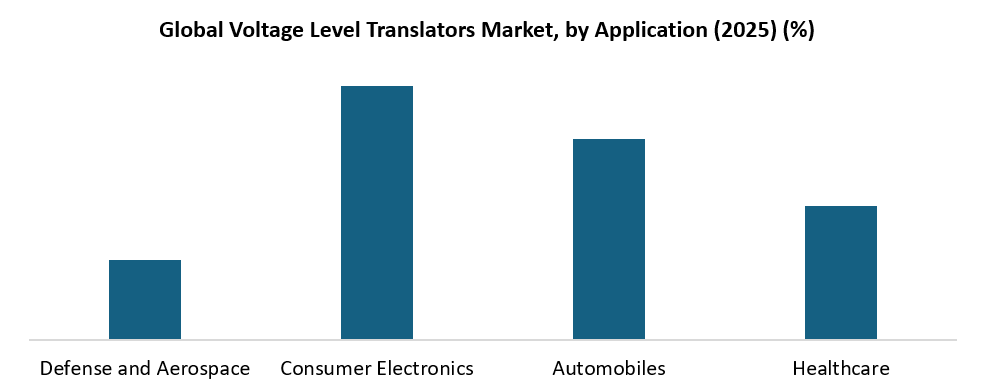
The global voltage level translators market is segmented into defense and aerospace, consumer electronics, automobiles, and healthcare. Defense and aerospace applications require reliable signal interfacing in avionics, navigation, communication, and control systems. Consumer electronics demand voltage level translators to connect processors, sensors, and peripheral components operating at different voltage levels. In automobiles, increasing electronic integration across infotainment systems, vehicle control units, advanced driver-assistance systems, and electric vehicles supports market demand. Healthcare applications include patient monitoring equipment, diagnostic devices, medical imaging systems, and portable medical electronics, where dependable communication between components is essential.
Global Voltage Level Translators Market Regional Analysis
Asia Pacific leads the global voltage level translators market, supported by its strong electronics manufacturing base, semiconductor production capabilities, and expanding automotive industry. China, Japan, South Korea, India, and Taiwan contribute to regional demand through consumer electronics manufacturing, semiconductor integration, and automotive electronics production. The increasing adoption of smartphones, connected devices, industrial automation systems, and electric vehicles strengthens demand for dual-supply and single-supply voltage level translators. Growing investments in semiconductor manufacturing, 5G infrastructure, and advanced electronic components further support regional market growth.
North America represents a significant market for voltage level translators, driven by advanced semiconductor design, automotive electronics, aerospace and defense systems, and industrial automation. The United States contributes substantially through its semiconductor industry, computing infrastructure, and development of advanced electronic devices. Demand for reliable signal conversion across processors, microcontrollers, sensors, and communication interfaces supports the adoption of voltage level translators. The expansion of electric vehicles, connected healthcare devices, and high-performance computing further strengthens regional demand.
Europe maintains a strong position in the global voltage level translators market through its automotive manufacturing industry, industrial automation capabilities, and advanced engineering sector. Germany, France, the United Kingdom, and Italy contribute to demand through automotive electronics, factory automation, telecommunications equipment, and medical devices. The increasing integration of electronic control units, sensors, and microcontrollers in vehicles supports the need for efficient voltage translation. Continued investment in vehicle electrification, smart manufacturing, and energy-efficient electronic systems reinforces regional market development.
South America experiences demand for voltage level translators through the growing adoption of consumer electronics, automotive electronics, telecommunications equipment, and industrial control systems. Brazil and Argentina contribute to regional demand through electronics consumption, automotive manufacturing, and industrial development. The expansion of digital infrastructure, connected devices, and automation technologies supports the integration of electronic components operating at different voltage levels. Increasing modernization of communication networks and industrial equipment provides additional opportunities for market growth.
The Middle East and Africa market develops through investments in telecommunications infrastructure, industrial modernization, healthcare technology, and digital transformation. Countries such as Saudi Arabia, the United Arab Emirates, and South Africa contribute to demand through connected systems, industrial electronics, medical equipment, and communication infrastructure. The growing adoption of automation, smart technologies, and electronic monitoring systems supports the use of voltage level translators in applications requiring reliable signal interfacing. Continued infrastructure development and increasing demand for advanced electronic equipment create further opportunities across the region.
Global Voltage Level Translators Market Competitive Landscape
The global voltage level translators market features established semiconductor manufacturers competing through product portfolio expansion, signal conversion performance, power efficiency, miniaturization, and application-specific solutions. Companies focus on developing voltage translators that support different supply voltages, bidirectional and unidirectional communication, high-speed data transfer, and compact circuit designs. Automotive-grade components, low-power operation, automatic direction sensing, and compatibility with interfaces such as I²C, SPI, and UART represent important competitive differentiators. Manufacturers also strengthen their positions through advanced semiconductor design, broad distribution networks, and solutions tailored to consumer electronics, automotive systems, healthcare equipment, and aerospace and defense applications.
Key competitive differentiators: High-speed signal conversion, low power consumption, automatic direction sensing, automotive qualification, compact packaging, broad voltage compatibility, and support for common communication interfaces shape competition in the global voltage level translators market. Company-specific market shares are not included because reliable, directly comparable market-share data for this specific market is not established by the cited sources.
Global Voltage Level Translators Market Recent Developments:
| Date | Company | Development | Impact |
|---|---|---|---|
| 25 February 2026 | Texas Instruments Incorporated | Texas Instruments introduced the TXG1010 1-bit ground-level and voltage translator, supporting logic-level shifting from 1.71V to 5.5V along with DC ground shifts up to ±10V. | The device resolves signal translation challenges across distinct ground domains, significantly boosting noise immunity and system reliability in industrial automation and robotics. |
| 25 June 2026 | Infineon Technologies AG | Infineon unveiled the EiceDRIVER™ 2EDL900G3 120V Level-Shift Gate Driver IC, featuring integrated current sense amplifiers and programmable deadtime controls. | The compact 3x3mm IC improves power conversion efficiency and thermal management in high-density medium-voltage GaN HEMT and Si MOSFET architectures. |
| 27 August 2026 | Renesas Electronics Corporation | Renesas launched the RH4Z250x line driver and level shifter IC series featuring integrated physical layer protection for industrial IO-Link sensor networks. | The rollout strengthens industrial IoT signal translation by delivering robust fault protection and real-time diagnostic reporting for smart factory automation. |
| 08 September 2026 | Microchip Technology Inc. | Microchip launched the SY757xx portfolio of 1.2V-output LVCMOS clock and level-translating buffers tailored for advanced FinFET SoC and FPGA platforms. | The single-chip solution eliminates discrete voltage-divider circuits, ensuring ultra-low additive jitter and precise timing accuracy across multi-voltage processors. |
| 21 September 2026 | Renesas Electronics Corporation | Renesas released the SLG7IN GreenPAK™ Interface Standard Designs portfolio, featuring pre-configured customizable voltage level translators and protocol converters. | The ultra-low standby power platform enables rapid customization of multi-rail voltage domain translation in space-constrained embedded systems. |
Scope of the Global Voltage Level Translators Market: Inquire before buying
| Global Voltage Level Translators Market | |||
|---|---|---|---|
| Report Coverage | Details | ||
| Base Year: | 2025 | Forecast Period: | 2026-2034 |
| Historical Data: | 2020 to 2025 | Market Size in 2025: | USD 1.62 Bn. |
| Forecast Period 2026 to 2034 CAGR: | 6.8% | Market Size in 2034: | USD 2.98 Bn. |
| Segments Covered: | by Type | Dual supply level translators Single supply level translators |
|
| by Technology | CMOS-Based Translators BiCMOS-Based Translators Other Semiconductor Technologies |
||
| by Application | Defence and aerospace Consumer electronics Automobiles Healthcare |
||
Global Voltage Level Translators Market, by Region:
- North America (United States, Canada and Mexico)
- Europe (UK, France, Germany, Italy, Spain, Sweden, Austria and Rest of Europe)
- Asia Pacific (China, South Korea, Japan, India, Australia, Indonesia, Malaysia, Vietnam, Taiwan, Bangladesh, Pakistan and Rest of APAC)
- Middle East and Africa (South Africa, GCC, Egypt, Nigeria and Rest of ME&A)
- South America (Brazil, Argentina Rest of South America)
Global Voltage Level Translators Market, Major Players:
- Texas Instruments
- NXP Semiconductors
- Analog Devices
- STMicroelectronics
- Microchip Technology Inc.
- onsemi
- Infineon Technologies AG
- Renesas Electronics Corporation
- Toshiba Electronic Devices & Storage Corporation
- Diodes Incorporated
- Nexperia
- Teledyne e2v
- Nuvoton Technology Corporation
- Advanced Linear Devices, Inc.
- ABB Ltd.
- Maxim Integrated
- ROHM Semiconductor
- Littelfuse, Inc.
- Monolithic Power Systems, Inc.
- Silicon Laboratories Inc.
- Skyworks Solutions, Inc.
- Qorvo, Inc.
- Qualcomm Incorporated
- Broadcom Inc.
- Marvell Technology, Inc.
- MediaTek Inc.
- Renesas Electronics America Inc.
- Vishay Intertechnology, Inc.
- Semtech Corporation
- Allegro MicroSystems, Inc.
- Diotec Semiconductor AG
- GigaDevice Semiconductor Inc.
- Holtek Semiconductor Inc.
- Princeton Technology Corporation
- Shenzhen Goodix Technology Co., Ltd.
- Shanghai Belling Corp., Ltd.
- Unisonic Technologies Co., Ltd.
- Niko Semiconductor Co., Ltd.
- Richtek Technology Corporation
- Zetex Semiconductors
- Fairchild Semiconductor
- Pericom Semiconductor Corporation
- Integrated Device Technology, Inc. (IDT)
- Texas Instruments Incorporated
- NXP USA, Inc.
Frequently Asked Questions (FAQs)
1.What is the global voltage level translators market size in 2025?
Ans. The global voltage level translators market is valued at USD 1.62 billion in 2025.
2.What is the projected CAGR of the global voltage level translators’ market?
Ans. The market is projected to grow at a CAGR of 6.8% from 2026 to 2034.
3.What is the projected market size by 2034?
Ans. The global voltage level translators’ market is projected to reach USD 2.98 billion by 2034.
4.Which region leads the global voltage level translator’s market?
Ans. Asia Pacific leads the market due to its strong semiconductor manufacturing base, electronics production, and automotive industry.
5.What are the major factors driving the global voltage level translators’ market?
Ans. Increasing adoption of mixed-voltage electronic systems, automotive electronics, IoT devices, and advanced computing equipment drives market growth.