
Variable Valve Timing Market by Technology, Fuel Type, Phaser Type, Vehicle Type, Region – Global Market Size Estimation, Industry-Wide Analysis, Competitive Landscape Assessment & Long-Term Forecast to 2032
Overview
Variable Valve Timing Market (VVT) was valued at USD 41.93 Bn in 2025, and the global Variable Valve Timing Market is expected to reach nearly USD 59.79 Bn by 2032 with a CAGR of 5.2% during the forecast period.
Variable Valve Timing Market (VVT) Overview:
Variable Valve Timing (VVT) technology is used in internal combustion engines to attain optimum timing of valve opening and closing. It assures enhanced engine performance and fuel efficiency while diminishing emissions with consideration of driving conditions. The VVT market gets its impetus from the increasing emphasis on fuel efficiency and advanced vehicle technologies. On the contrary, expensive production and integration limit its acceptance in cost-sensitive regions. The power, torque, and fuel economy balance offered by the internal combustion engines develops a strong demand for Variable Valve Timing (VVT) systems. The combined package offers good performance with restrictions placed on fuel economy, which drives the market.
Asia Pacific region led the Variable Valve Timing (VVT) market in 2025 because of high vehicle production and rising demand for fuel-efficient technologies. China, Japan, and India contribute substantially to this market growth. Big players such as Eaton Corporation PLC and Robert Bosch enhanced their market share in the region, which further helped in developing the regional market. Another significant trend in the VVT market is the increasing integration of VVT in hybrid and plug-in hybrid vehicles to improve ICE performance and fuel efficiency, and emission control.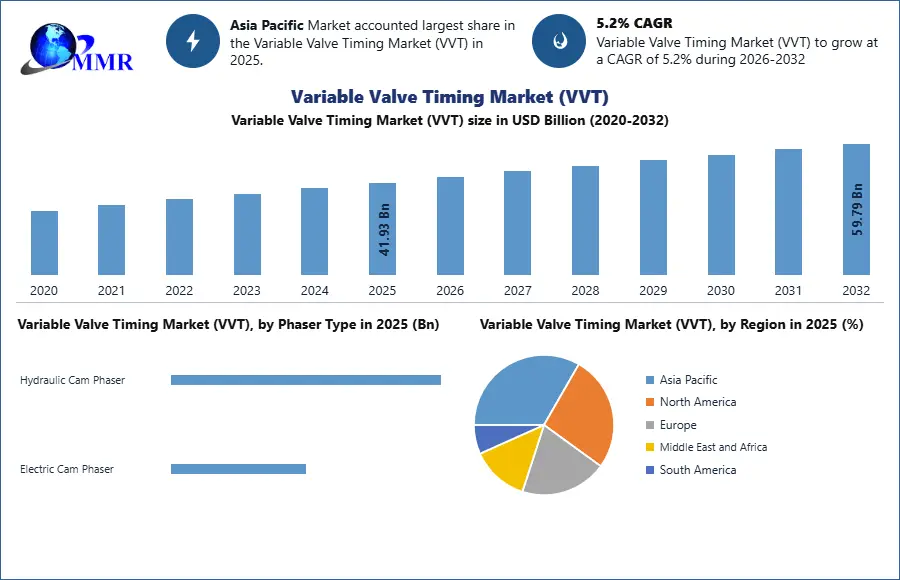 To know about the Research Methodology:-Request Free Sample Report
Variable Valve Timing Market (VVT) Dynamics :
Increasing Vehicle Production and Demand for Fuel-Efficient Engines Accelerate Global Variable Valve Timing (VVT) Market Growth
The increasing production of passenger vehicles, commercial vehicles, and hybrid automobiles is a major driver fueling the growth of the Global Variable Valve Timing (VVT) Market. Variable valve timing technology improves engine efficiency, fuel economy, torque output, and emission control by optimizing valve opening and closing timing based on engine operating conditions. Rising consumer demand for fuel-efficient and high-performance vehicles is significantly increasing the adoption of VVT systems across gasoline and hybrid engines. In addition, stringent government regulations regarding vehicle emissions and fuel economy standards are encouraging automotive manufacturers to integrate advanced engine management technologies such as VVT and variable valve lift systems. The rapid growth of the automotive industry in emerging economies, increasing adoption of turbocharged engines, and advancements in automotive powertrain technologies are further supporting market expansion. Furthermore, rising investments in lightweight engine technologies and smart engine control systems are strengthening the growth of the Global Variable Valve Timing Market.
High System Complexity and Rising Electric Vehicle Adoption Restrict Variable Valve Timing Market Expansion
High engineering complexity and the growing transition toward electric vehicles remain major restraints limiting the growth of the Global Variable Valve Timing (VVT) Market. Advanced VVT systems require sophisticated sensors, actuators, electronic control units, and precision engine calibration, increasing manufacturing and maintenance costs for automotive companies. In addition, system failures related to oil pressure, actuator wear, and electronic control components may increase repair complexity and operational costs. The rapid adoption of battery electric vehicles (BEVs), which do not require traditional internal combustion engine valve systems, is also reducing long-term demand potential for VVT technologies in several developed markets. Furthermore, fluctuations in automotive production, semiconductor shortages, and supply chain disruptions may affect engine component manufacturing and market stability. These technological and market challenges continue to restrain the growth of the Global Variable Valve Timing Market.
Growth of Hybrid Vehicles and Advanced Engine Technologies Creates New Opportunities in the Global Variable Valve Timing Market
The rapid expansion of hybrid vehicles, low-emission engine technologies, and intelligent automotive powertrain systems is creating substantial growth opportunities in the Global Variable Valve Timing (VVT) Market. Hybrid electric vehicles increasingly utilize advanced VVT systems to improve fuel efficiency, engine responsiveness, and emission performance in internal combustion engines integrated with electric drivetrains. Automotive manufacturers are also investing heavily in next-generation turbocharged engines, cylinder deactivation systems, and smart engine management technologies that require advanced valve timing solutions. Emerging markets across Asia-Pacific, Latin America, and the Middle East are witnessing rising vehicle ownership, increasing automotive production, and growing demand for fuel-efficient vehicles, creating strong market growth potential. Furthermore, technological advancements in continuously variable valve timing, cam phasing systems, and electronically controlled valve actuation are expected to improve engine performance and generate new revenue opportunities in the Global Variable Valve Timing Market.
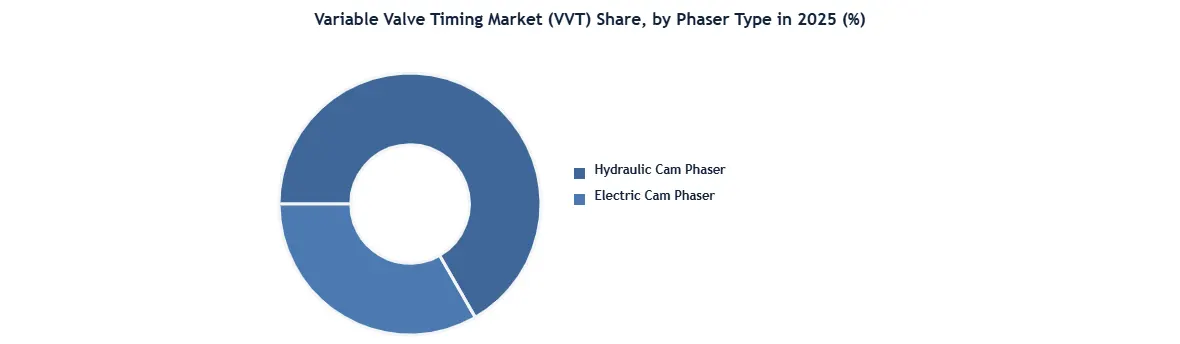
Variable Valve Timing Market Segment Analysis
Variable Valve Timing Market Regional Analysis
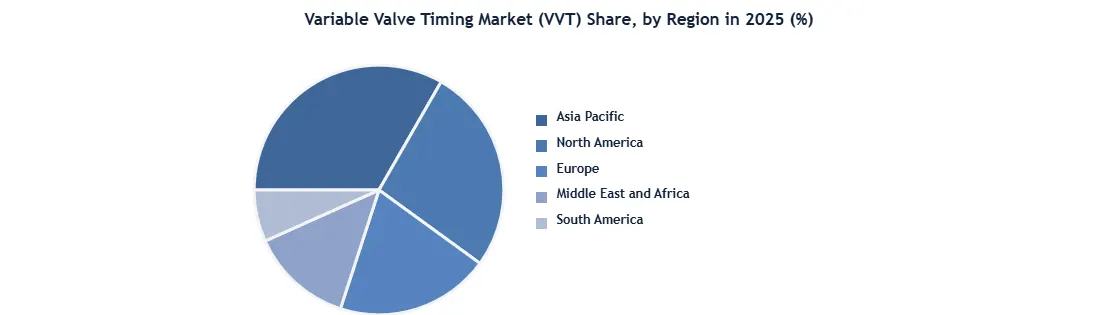
Asia Pacific region dominated the Variable Valve Timing Market in 2025 due to significant demand for VVT systems
Asia Pacific region dominated the market and is expected to be the fastest-growing market in the coming years. This is due to the presence of emerging markets such as India, Japan, South Korea, and China. Moreover, significant demand for VVT systems from the developing countries in South Asia and ASEAN. An increase in per capita income of consumers, availability of customised financial schemes, and a drop in car loan interest rates are some significant factors driving the production of passenger cars, which in turn is anticipated to drive the global market in the region over the forecast period.
Variable Valve Timing Market Competitive Analysis
Top companies like Eaton Corporation PLC, Robert Bosch, Johnson Electric, Atlantis Diesel Engines and Mirgor hold the largest share in the Variable Valve Timing Market, whereas companies like Eaton Corporation PLC and Robert Bosch stand out as this two leading companies offering important products that help engines run better and use less fuel. The Eaton company makes parts like valve systems and hydraulic components that control the engine valves opening, which helps improve power and lower emissions, especially in trucks and commercial vehicles, whereas the Bosch company focuses more on smart and electronic VVT systems, like cam phasers and sensors, which help engines adjust valve timing more precisely. Bosch’s systems are widely used in cars, including hybrids, and are known for combining software and hardware for better engine control. Both companies help automakers meet fuel efficiency and emission standards.
The objective of the report is to present comprehensive analysis of Global Variable Valve Timing Market (VVT) including all the stakeholders of the industry. The past and current status of the industry with forecasted market size and trends are presented in the report with the analysis of complicated data in simple language.The report covers all the aspects of industry with dedicated study of key players that includes market leaders, followers and new entrants by region. PORTER, SVOR, PESTEL analysis with the potential impact of micro-economic factors by region on the market have been presented in the report. External as well as internal factors that are supposed to affect the business positively or negatively have been analyzed, which will give a clear futuristic view of the industry to the decision makers.
The report also helps in understanding Global Variable Valve Timing Market (VVT) dynamics, structure by analysing the market segments, and projects the Global Variable Valve Timing Market (VVT) size. Clear representation of competitive analysis of key players by Global Variable Valve Timing Market (VVT) Type, price, financial position, product portfolio, growth strategies, and regional presence in the Global Variable Valve Timing Market (VVT) make the report investor’s guide.
Variable Valve Timing Market Key Trends
• Hybrid & Electrification Integration- Increasing integration of VVT systems in hybrid and plug-in hybrids to optimise internal combustion engine (ICE) performance, improving fuel efficiency and reducing emissions
• Advanced Cam-Phasing & Valve-Lift Tech- R&D emphasis on camless designs, electric phasers, and continuously variable systems (e.g., Fiat’s MultiAir and Ford’s Ti-VCT), offering finer valve control under varying loads
• Segment Shift- Double Overhead Camshaft dominance, growing in commercial/hybrid vehicle sectors
Variable Valve Timing Market Key Developments
- In February 2025, BorgWarner announced the supply of advanced Variable Cam Timing (VCT) technology for a major East Asian automotive OEM’s latest hybrid and gasoline engines. The technology improves fuel economy, engine performance, and emission reduction for next-generation vehicles.
- In 2025, Denso Corporation patented a new AI-driven VVT control algorithm designed to optimize valve timing based on real-time driving conditions, improving fuel efficiency and engine responsiveness.
- In July 2025, Standard Motor Products expanded its Variable Valve Timing product portfolio by adding 207 new VVT part numbers for import and domestic vehicle applications, strengthening its aftermarket presence.
- In March 2025, Eaton Corporation expanded its valvetrain solutions portfolio for diesel off-highway vehicles, focusing on fuel economy improvement and emission reduction technologies through advanced valve actuation systems.
- In 2024, Valeo unveiled an electromagnetic Variable Valve Timing system designed to improve response time, engine efficiency, and energy savings compared to traditional hydraulic systems.
- In July 2024, Hyundai Motor Company launched its Continuously Variable Valve Duration (CVVD) technology aimed at improving vehicle performance, fuel efficiency, and emission reduction in future Hyundai and Kia vehicles.
- In February 2025, Robert Bosch GmbH secured a multi-year contract with Ford Motor Company to supply advanced VVT actuators and integrated start-stop control modules for 48V mild-hybrid vehicle platforms.
- In early 2024, Continental AG launched a modular start-stop system integrated with Variable Valve Timing control technologies for compact and mid-size vehicles to improve fuel efficiency and reduce emissions.
Variable Valve Timing Market (VVT) Scope: Inquire before buying
| Variable Valve Timing Market (VVT) | |||
|---|---|---|---|
| Report Coverage
|
Details | ||
| Base Year: | 2025 | Forecast Period: | 2026-2032 |
| Historical Data: | 2020 to 2025 | Market Size in 2025: | 41.93 USD Billion |
| Forecast Period 2026-2032 CAGR: | 5.2% | Market Size in 2032: | 59.79 USD Billion |
| Segments Covered: | by Phaser Type | Hydraulic Cam Phaser Electric Cam Phaser |
|
| by Technology | Cam Phasing Cam Switching Dual Independent Variable Timing (DIVT) Continuous Variable Valve Timing Discrete Variable Valve Timing |
||
| by Valvetrain Type | Double Over Head Cam (DOHC) Single Over Head Cam (SOHC) |
||
| by Component Type | VVT Controllers VVT Actuators Sensors Valves Others |
||
| by Fuel Type | Gasoline Diesel Electric & Hybrid |
||
| by Valve Type | Intake Valve Timing Exhaust Valve Timing Combined Intake Exhaust Valve Timing |
||
| by Application | Passenger Cars Light Commercial Vehicles (LCVs) Heavy Commercial Vehicles (HCVs) Others |
||
| by End Use | OEM Aftermarket |
||
Variable Valve Timing Market by Region
North America (United States, Canada, and Mexico)
Europe (UK, France, Germany, Italy, Spain, Sweden, Austria, and the Rest of Europe)
Asia Pacific (China, South Korea, Japan, India, Australia, Taiwan, Indonesia, Philippines, Malaysia, Vietnam, Thailand, Rest of Asia Pacific region)
Middle East & Africa (South Africa, GCC, Nigeria, Rest of ME&A)
South America (Brazil, Argentina Rest of South America)
Variable Valve Timing Market Manufacturers are:
BorgWarner Inc
Aisin Corporation
Schaeffler AG
Eaton Corporation
Hitachi Astemo Ltd.
Mitsubishi Electric Mobility Corporation
Hilite International
Mikuni Corporation
Toyota Motor Corporation
Husco International
Standard Motor Products, Inc.
Sumitomo Electric Industries Ltd.
Cloyes
Höganäs AB
Fulin Precision Co. Ltd.
ETO GRUPPE
Gates Corporation Others
Others