
Global Travel Bag Market Size Consumer Demand, Growth Trends, Key Players Analysis and Market Share and Forecast 2034
Overview
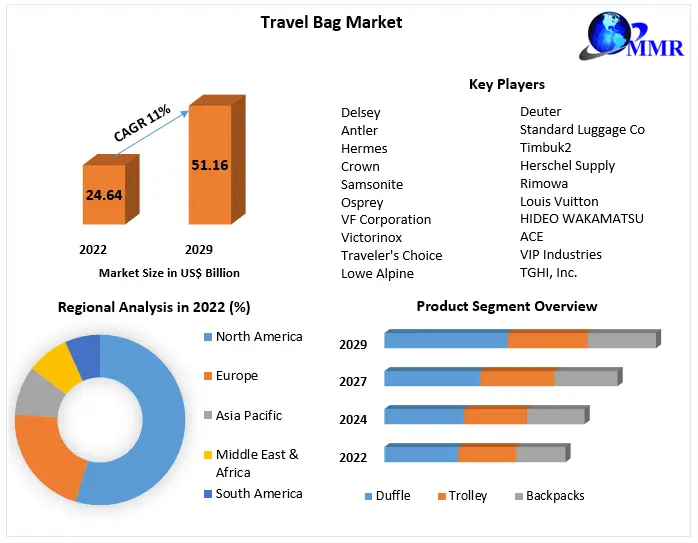
The Travel Bag Market size was valued at USD 33.68 Billion in 2025 and the total Travel Bag revenue is expected to grow at a CAGR of 11% from 2026 to 2034, reaching USD 86.15 Billion.
Travel Bag Market Overview:
Travel bags are portable storage products designed to carry clothing, personal belongings, electronic devices, documents, and other essentials during domestic and international travel. The product category includes duffel bags, backpacks, trolley bags, carry-on bags, rolling bags, weekenders, garment bags, travel totes, cabin bags, and soft-sided luggage. Modern travel bags increasingly combine lightweight construction, durable fabrics, multiple compartments, water resistance, ergonomic designs, laptop sleeves, trolley compatibility, and smart-travel features. Demand is also shifting toward multifunctional, sustainable, premium, and fashion-oriented travel bags, supported by changing consumer preferences and the growth of short-distance and frequent travel.
The Travel Bag Market is expanding as international tourism, domestic travel, air passenger traffic, leisure trips, business travel, and e-commerce-based luggage purchases continue to increase. According to UN Tourism, international tourist arrivals reached an estimated 1.52 billion in 2025, approximately 4% higher than 2024, demonstrating continued global travel demand. In India, the Government's Ministry of Statistics and Programme Implementation reported that pilgrimage and religious activities accounted for around 48 out of every 100 domestic overnight trips recorded for the relevant 365-day period, highlighting the substantial scale of domestic mobility. Asia-Pacific represents a particularly important growth region because of expanding middle-class travel, rising disposable income, tourism development, and increasing domestic and outbound travel. Major companies such as Samsonite International S.A. are strengthening their position through product innovation, omnichannel distribution, premium luggage, lightweight materials, and sustainability-focused designs. Samsonite reported that travel products represented 65.7% of its 2024 net sales, illustrating the importance of travel-related products within the company's portfolio.
The MMR Travel Bag Market Report will provide clients with a comprehensive assessment of the industry's market size, growth rate, CAGR, market trends, growth drivers, restraints, opportunities, challenges, competitive landscape, regional analysis, and segment-wise performance. The report will examine the market by product type, material, bag type, price range, distribution channel, end user, and region, while evaluating consumer movement toward lightweight travel bags, sustainable materials, smart luggage, premium travel accessories, direct-to-consumer brands, online retail, and multifunctional designs. It will also provide detailed profiles of leading players, their product strategies, investments, geographic expansion, partnerships, product launches, and competitive positioning, helping clients identify high-growth segments, emerging opportunities, regional demand patterns, and potential areas for market entry and expansion.
Travel Bag Market Growth and Share Analysis
To know about the Research Methodology :- Request Free Sample Report
Travel Bag Market Dynamics:
Rising Air Passenger Traffic and Global Travel Activity Are Increasing Demand for Travel Bags
The continued expansion of international and domestic travel is directly supporting demand for travel bags, backpacks, trolley bags, duffel bags, and other travel accessories. According to the International Air Transport Association (IATA), global passenger traffic increased 10.4% in 2024, while international passenger traffic rose 13.6% and domestic traffic increased 5.7% year-on-year. Asia-Pacific recorded particularly strong passenger-demand growth of 16.9% in 2024. The increase in leisure travel, business travel, domestic tourism, and international tourism is encouraging consumers to replace older luggage and purchase lightweight, durable, multifunctional, and airline-compliant travel bags. Growing passenger mobility therefore remains a major demand generator for the travel bag industry.
Counterfeit Products and Price Competition Are Limiting Premium Travel Bag Sales
The availability of counterfeit and low-cost travel bags creates pricing pressure for established brands and can limit the expansion of premium and mid-range products, particularly in price-sensitive markets. The OECD estimated that counterfeit and pirated goods represented approximately USD 467 billion, or 2.3% of global imports, in 2021, demonstrating the substantial scale of illicit trade. Clothing, footwear, and leather goods collectively accounted for 62% of seized counterfeit goods, highlighting the vulnerability of adjacent fashion and travel-product categories. In addition, the growth of e-commerce and small-parcel shipments makes counterfeit distribution more difficult to control. This environment can weaken brand differentiation, reduce consumer trust, and pressure manufacturers to compete on price rather than product quality, durability, design, and innovation.
Sustainable Materials and Circular Product Design Are Creating New Growth Opportunities
The increasing emphasis on sustainability is creating opportunities for manufacturers to develop eco-friendly travel bags, recycled-material luggage, durable products, repairable designs, and sustainable travel accessories. The European Union's Regulation (EU) 2024/1781 establishes a framework for improving product circularity and environmental sustainability, while the EU's sustainable and circular textiles strategy promotes longer-lasting, recyclable products and greater use of recycled fibres. These developments provide opportunities for travel bag manufacturers to introduce products using recycled polyester, regenerated nylon, recycled plastics, and other lower-impact materials. Brands that combine sustainability with lightweight construction, water resistance, multifunctional compartments, ergonomic designs, and premium aesthetics can strengthen differentiation and appeal to environmentally conscious consumers.
Integrating Smart Features While Meeting Airline Baggage and Battery Requirements Remains Difficult
The adoption of smart luggage, GPS tracking, connected travel bags, USB charging, digital locks, and other innovative features is creating new possibilities for premium travel products, but manufacturers must balance technology integration with safety, weight, durability, cost, and airline requirements. IATA notes that electronic devices and spare lithium batteries are subject to specific baggage-safety requirements, which can influence the design of technology-enabled travel bags. At the same time, baggage tracking expectations are increasing: IATA reports that 88% of passengers want real-time baggage tracking, while airlines mishandled about 6.3 bags per 1,000 passengers in 2024. Therefore, travel bag companies face the challenge of developing smart and connected products that provide convenience and security without increasing product complexity, regulatory risk, weight, and retail prices.
Travel Bag Market Trend:
| Trend | Market Impact |
| Shift Toward Lightweight and Multifunctional Travel Bags | Consumers are increasingly seeking lightweight travel bags that provide high durability without adding unnecessary weight. Multifunctional compartments, laptop sleeves, expandable storage, ergonomic handles, and trolley compatibility are becoming important product features for frequent travelers. |
| Rapid Adoption of Sustainable and Recycled Materials | Sustainability is becoming a major product-development theme, with manufacturers incorporating recycled polyester, regenerated nylon, recycled plastics, organic fabrics, and other eco-friendly materials. Durable and repairable designs are also gaining attention as consumers place greater emphasis on long-term product value. |
| Smart Luggage Is Moving Into the Premium Segment | Smart luggage and technology-enabled travel bags are gaining traction through features such as GPS tracking, digital locks, USB charging, integrated weighing systems, and compatibility with luggage-tracking devices. These innovations are particularly relevant to business travelers and technology-oriented consumers. |
| Premiumization Is Reshaping Travel Bag Purchasing Patterns | Rising demand for premium and luxury travel bags is encouraging brands to compete through advanced materials, distinctive designs, personalization, durability, and enhanced functionality rather than price alone. Travel bags are increasingly being viewed as both functional products and fashion accessories. |
| E-Commerce Is Expanding Access to Global Travel Bag Brands | Online retail and e-commerce platforms are becoming important distribution channels, allowing consumers to compare product specifications, materials, prices, reviews, and designs before purchasing. Direct-to-consumer websites are also helping brands expand geographically without relying entirely on physical retail networks. |
| Fashion and Travel Are Converging in Product Design | Changing lifestyles are encouraging consumers to select travel bags based on both functionality and style. Trend-driven colors, contemporary silhouettes, premium finishes, and personalized designs are helping travel bags evolve into lifestyle and fashion accessories. |
| Demand for Durable and Weather-Resistant Travel Gear Is Increasing | Frequent travel is driving interest in water-resistant materials, reinforced stitching, abrasion-resistant fabrics, protective compartments, and robust construction. Consumers increasingly prioritize products capable of handling repeated use and different travel environments. |
| Asia-Pacific Is Becoming a Key Innovation and Demand Center | Expanding tourism, urbanization, rising disposable income, growing middle-class consumption, and increasing domestic and international travel are strengthening demand across Asia-Pacific. Manufacturers are responding with localized designs, different price tiers, and products suited to varied travel preferences. |
| Travel Bags Are Becoming More Specialized by Travel Purpose | Product innovation is increasingly addressing specific requirements of leisure travel, business travel, adventure travel, and short-haul trips. This is supporting demand for specialized backpacks, duffel bags, trolley bags, garment bags, and compact travel solutions. |
| Brand Differentiation Is Shifting Toward Product Innovation | Established travel bag manufacturers are increasingly competing through new product launches, sustainable collections, smart features, ergonomic designs, strategic partnerships, and geographic expansion. This is intensifying competition while creating more choices across economy, mid-range, premium, and luxury categories. |
Travel Bag Market Segment Analysis:
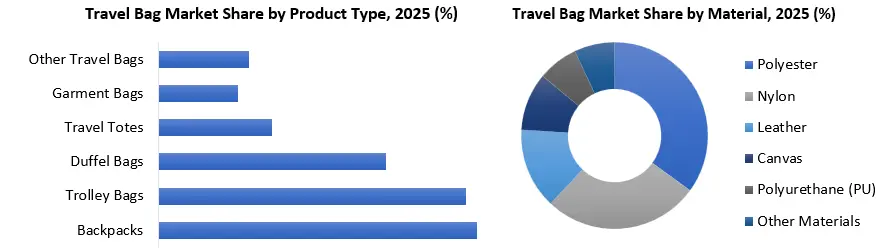
By Product Type, The Backpacks segment is expected to hold a significant share of the Travel Bag Market, supported by rising demand for lightweight, multifunctional travel bags among leisure travelers, students, business travelers, and younger consumers. Backpacks offer portability, ergonomic designs, laptop compartments, expandable storage, and easy mobility, making them suitable for both short-haul and long-distance travel. Trolley Bags are also witnessing strong demand because of their convenience, durability, wheeled mobility, and suitability for air travel. Duffel Bags remain popular for weekend trips, sports travel, and short journeys, while Travel Totes and Garment Bags serve more specialized travel requirements. Other Travel Bags include compact and purpose-specific carrying solutions.
By Material, The Polyester segment is expected to account for a major share of the Travel Bag Market due to its affordability, lightweight construction, durability, and resistance to everyday wear. Polyester is widely used in backpacks, duffel bags, travel totes, and other travel gear, particularly in the economy and mid-range price categories. Nylon is also gaining demand because of its strength, abrasion resistance, lightweight properties, and suitability for premium and multifunctional travel bags. Leather continues to have a strong presence in premium and luxury travel bags, while Canvas is preferred for its durability and casual appearance. Polyurethane (PU) and other materials are increasingly used to provide water resistance, improved aesthetics, and alternative material options.
By Distribution Channel, the Offline segment dominated the market with a 66.49 % share in 2025. High preference among consumers due to extensive depth in the product portfolio by price range, material, luggage type, and design. Also, high service quality and expert guidance enhance the shopping experience of consumers. These factors are expected to drive the growth of the segment through the forecast period.
The online segment is expected to grow at a CAGR of 9 % through the forecast period. The growing popularity of e-commerce websites among consumers and increasing consumer preference to purchase travel bags online due to ease of payment, eye-catching discounts, and home delivery. These factors are expected to drive the growth of the segment in the travel bag market through the forecast period.
By Price Range, the Premium segment dominated the market with a 40.47 % share in 2025. This segment gives a high-quality product, exclusive designs, and advanced features such as intelligent luggage with GPS trackers. These factors are driving the growth of the segment in the market.
The medium segment is expected to grow at a CAGR of 6.5 % through the forecast period. Availability of high-quality products, wide range with designs, colors, etc. at the cost-efficient range is attracting consumers towards the medium range. These factors are expected to drive the market growth of the segment through the forecast period.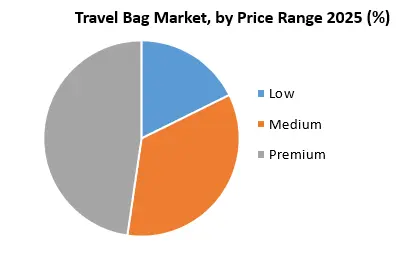
Travel Bag Market Regional Insights:
Asia-Pacific is a leading region in the Travel Bag Market, driven by rising domestic travel, international travel, urbanization, disposable income, and e-commerce penetration. China, India, Japan, South Korea, and Southeast Asia are generating strong demand for backpacks, trolley bags, duffel bags, lightweight travel bags, multifunctional travel bags, and travel accessories. Growing middle-class consumption and expanding tourism are further supporting market growth.
North America is a mature and high-value market supported by leisure travel, business travel, frequent air travel, premiumization, and high consumer purchasing power. Demand is strong for premium travel bags, durable luggage, smart luggage, ergonomic backpacks, airline-compliant designs, and multifunctional travel gear, supported by specialty stores, brand-owned websites, and e-commerce platforms.
Europe benefits from strong tourism, business mobility, international travel, and premium travel accessory demand. Consumers increasingly prefer lightweight, durable, fashionable, sustainable, and multifunctional travel bags, creating opportunities for products using recycled materials, eco-friendly materials, innovative designs, and advanced features.
Middle East & Africa is emerging as a high-potential market due to expanding tourism infrastructure, international aviation, business travel, religious tourism, and tourism investments. Growing demand for premium luggage, trolley bags, backpacks, durable travel bags, and specialized travel gear is supporting regional market growth.
South America is witnessing gradual growth through increasing domestic tourism, international travel, e-commerce, and retail expansion. Brazil, Argentina, Colombia, Chile, and Peru are key markets, with rising demand for affordable, durable, fashionable, and multifunctional travel bags.
Travel Bag Market Recent Developments:
| Company | 2026 Development | Market Impact |
| Samsonite | Samsonite launched its Nexis premium luggage collection in Europe in Q1 2026, using its advanced ROXKIN material to combine lightweight construction, strength, and durability. The collection is planned for wider global rollout in Q2 2026. | Strengthens demand for lightweight travel bags, durable luggage, premium travel products, and innovative materials, supporting premiumization in the Travel Bag Market. |
| Samsonite | Samsonite continued its 2026 focus on sustainable materials, recycled components, repair solutions, and circular product development, including plans to pilot its take-back program in selected U.S. stores during 2026. | Accelerates adoption of eco-friendly travel bags, recycled materials, circular economy practices, repairable luggage, and sustainable travel products. |
| Samsonite | Samsonite expanded its lightweight UpLIFT luggage collection, combining hardside and softside travel bags with reduced weight, organized packing features, and durable construction. | Supports the trend toward lightweight travel bags, multifunctional travel bags, ergonomic features, and airline-friendly luggage. |
| TUMI | TUMI's 2026 new-arrivals portfolio includes new Path to Peak and TUMI Axis collections, alongside travel products such as backpacks, carry-on luggage, checked luggage, and duffel bags. | Expands premium travel bags, business travel bags, multifunctional backpacks, and specialized travel gear, strengthening product differentiation. |
| TUMI | TUMI continues to emphasize lightweight and durable travel solutions through collections such as 19 Degree Lite, while incorporating more sustainable components into selected products. | Reinforces demand for lightweight luggage, durable travel bags, sustainable materials, and premium travel accessories. |
| RIMOWA | RIMOWA introduced new Umber and Ultramarine colorways across its Groove and Essential luggage collections in 2026, extending the use of fashion-oriented colors across luggage and travel accessories. | Highlights the convergence of travel bags and fashion, increasing emphasis on design, personalization, premium aesthetics, and lifestyle-oriented travel products. |
| Samsonite Group | In August 2026, Samsonite announced the planned acquisition of BÉIS, followed by completion of the acquisition in October 2026, expanding its lifestyle portfolio and digital capabilities. | Supports portfolio expansion, digital sales, lifestyle travel bags, direct-to-consumer channels, and broader access to younger and fashion-conscious consumers. |
Travel Bag Market Scope: Inquire before buying
| Travel Bag Market | |||
|---|---|---|---|
| Report Coverage | Details | ||
| Base Year: | 2025 | Forecast Period: | 2026-2034 |
| Historical Data: | 2020 to 2025 | Market Size in 2025: | 33.68 USD Billion |
| Forecast Period 2026-2034 CAGR: | 11% | Market Size in 2034: | 86.15 USD Billion |
| Segments Covered: | by Product Type | Duffel Bags Backpacks Trolley Bags Travel Totes Garment Bags Other Travel Bags |
|
| by Material | Polyester Nylon Leather Canvas Polyurethane (PU) Other Materials |
||
| by Capacity | Below 20 Liters 20–40 Liters 41–60 Liters Above 60 Liters |
||
| by Price Range | Economy Mid-Range Premium Luxury |
||
| by Distribution Channel | Offline Specialty Stores Department Stores Hypermarkets & Supermarkets Other Retail Stores Online Brand-Owned Websites E-Commerce Marketplaces |
||
| by End User | Men Women Children Unisex |
||
| by Application | Leisure Travel Business Travel Adventure Travel Sports Travel Other Travel Purposes |
||
Travel Bag Market, by Region
North America (United States, Canada and Mexico)
Europe (UK, France, Germany, Italy, Spain, Sweden, Austria and Rest of Europe)
Asia Pacific (China, South Korea, Japan, India, Australia, Indonesia, Malaysia, Vietnam, Taiwan, Bangladesh, Pakistan and Rest of APAC)
Middle East and Africa (South Africa, GCC, Egypt, Nigeria and Rest of ME&A)
South America (Brazil, Argentina Rest of South America)
Travel Bag Market, Key Players
1. Samsonite International S.A.
2. Tumi Holdings, Inc.
3. American Tourister
4. VIP Industries Limited
5. Delsey Paris
6. Rimowa GmbH
7. Travelpro Products Inc.
8. Briggs & Riley Travelware
9. Victorinox AG
10. VF Corporation
11. Herschel Supply Company
12. Eagle Creek
13. Thule Group AB
14. Osprey
15. IT Luggage Limited
16. Safari Industries (India) Ltd.
17. Antler Ltd.
18. SwissGear
19. Ricardo Beverly Hills
20. Calpak
21. Away (JRSK Inc.)
22. Monos Travel Ltd.
23. July
24. Paravel
25. Solgaard
26. Horizn Studios GmbH
27. Heys International Ltd.
28. Bric's Industria Valigeria Fine S.p.A.
29. Globe-Trotter Group Limited
30. Piquadro S.p.A.
31. Valigeria Roncato S.p.A.
32. Carl Friedrik
33. Ace Co., Ltd.
34. Mokobara
35. Safari
36. High Sierra
37. Kipling
38. Eastpak
39. JanSport
40. Decathlon
41. Nike, Inc.
42. Adidas AG
43. Puma SE
44. Patagonia, Inc.
45. The North Face
46. Columbia Sportswear Company
47. LVMH Moët Hennessy Louis Vuitton SE
48. Enchante Brands Private Limited
49. California Pak International, Inc.
50. Softline Brand Partners
Frequently Asked Questions:
1. Which region has the largest share in Global Travel Bag Market?
Ans: North America region held the highest share in 2025.
2. What is the growth rate of Global Travel Bag Market?
Ans: The Global Travel Bag Market is growing at a CAGR of 11% during forecasting period 2026-2034.
3. What is scope of the Global Travel Bag Market report?
Ans: Global Travel Bag Market report helps with the PESTEL, PORTER, COVID-19 Impact analysis, Recommendations for Investors & Leaders, and market estimation of the forecast period.
4. Who are the key players in Global Travel Bag Market?
Ans: The important key players in the Global Travel Bag Market are – Louis Vuitton, HIDEO WAKAMATSU, ACE, VIP Industries, TGHI, Inc., Samsonite, Luggage Company, LVMH Group, Travelpro Products, Inc., Rimowa GmbH, and Kering SA.
5. What was the Global Travel Bag Market size in 2025?
Ans: The Global Travel Bag Market size was USD 33.68 Billion in 2025.