
Global Total Shoulder Replacement Market - Industry Structure Evaluation, Demand Drivers Analysis, Regional Growth Analysis and Identification, Competitive Positioning Review & Global Market Size Forecast to 2034
Overview
The Global Total Shoulder Replacement Market was valued at USD 1.97 Billion in 2025 and is projected to reach USD 3.70 Billion by 2034, growing at a CAGR of 7.6% during the forecast period 2026–2034.
Total Shoulder Replacement Market Overview:
It has a high success rate in effectively treating painful symptoms induced by terminal arthritis. Shoulder rheumatism is a disease in which the thin cartilage covering the joints of the shoulder degenerates or disintegrates. These cartilage surfaces allow the bones to move easily against each other in a normal shoulder. When these cartilage coverings are lost, the tibia comes into direct touch with one other, generating tension and causing them to roughen and injure each other. Skeletal movement may be very painful and challenging. Prosthetic replacement parts that are surgically placed provide pain-free mobility, stability, and functionality.
A reverse shoulder replacement is a model in which the ball and socket locations are shifted, a metal ball implant is put where the participant's own natural socket was, and a plastic socket transplant is placed on the humeral head. This reverse design is more stable since it does not rely on muscles to keep it in place. The deltoid, not the rotator cuff tendon, controls its mobility. This makes it an excellent solution when the arm injury requires new surfaces but lacks adequate functional soft tissues to enable stability and mobility. It is frequently used on individuals with shoulder arthritis and a significant rotator cuff injury.
In this report, the Total Shoulder Replacement market's growth reasons, as well as the market's many segments (Type, Procedure, End-User, and Region), are discussed. Data has been given by market players, regions, and specific requirements. This market report includes a comprehensive overview of all the significant improvements that are presently prevailing in all market segments. Key data analysis is presented in the form of statistics, infographics, and presentations. The study discusses the Total Shoulder Replacement market's Drivers, Restraints, Opportunities, and Challenges. The report helps to assess the market growth drivers and determines how to use these drivers as a tool. The report also helps to rectify and resolve issues related to the global Total Shoulder Replacement market situation.
Total Shoulder Replacement Market Analysis from 2025 to 2034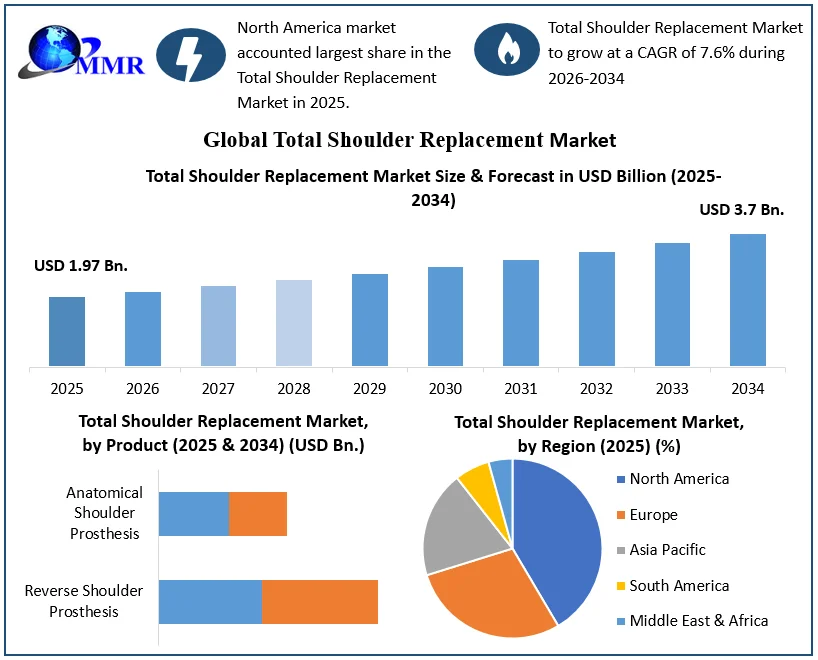
To Know About The Research Methodology :- Request Free Sample Report
Global Total Shoulder Replacement Market Dynamics:
Rising Cases of Shoulder Arthritis and Age-Related Joint Damage Propelling Demand for Shoulder Replacement Procedures
The rising prevalence of elderly population suffering from shoulder arthritis, joint stiffness, and chronic shoulder pain among the aging population is one of the key factors fueling the Total Shoulder Replacement Market growth. With advancing age, the cartilage tissue present in the shoulder joints starts to degenerate, restricting routine activities of daily living. Severe joint damage causes patients to opt for shoulder replacement surgery as a treatment alternative when conservative treatment options like drugs, physiotherapy, and injection therapy begin to fail. This is expected to propel the demand for anatomical and reverse shoulder replacement implants in orthopedic hospitals and specialized surgical centers. According to a clinical study conducted across the U.S., shoulder osteoarthritis accounted for 70.8% of the total number of shoulder replacements analyzed, establishing the correlation between arthritis treatment and shoulder replacement surgeries. Increasing awareness about surgical treatment for shoulder disorders, rising diagnostic facilities, and the availability of expert orthopedic surgeons are factors encouraging patients to take up shoulder replacement procedures. Moreover, a surge in healthcare spending on orthopedic treatments in the form of joint replacement treatment centers and advanced surgical facilities is further complementing the Total Shoulder Replacement Market growth and size. This is poised to augment the patient base and create positive outlooks for the Total Shoulder Replacement Market report.
High Surgical Treatment Cost and Limitation of Insurance Coverage Constraining Shoulder Replacement Market Growth
The soaring cost of shoulder replacement procedures is a significant restraining factor for the Total Shoulder Replacement Market, especially in countries where citizens bear a significant proportion of the healthcare expenditure. The overall cost of surgery incorporates the cost of artificial implants, surgeon fees, anesthetic agents, diagnostic tests, hospitalization, medicines, and post-surgical physiotherapy. According to an US-based insurance-based historical analysis, the average cost of the complete shoulder replacement procedure was around USD 37,027. However, the variation in the final amount depends on the type of hospital, insurance coverage, implant chosen, and patient population. Affordability issues are expected to deter a considerable number of patients from opting for shoulder replacement surgery, especially those with low savings and no insurance coverage. Additionally, in some developing healthcare markets, patients may defer the treatment due to the availability of treatment in public hospitals with long waiting lists and the unavailability of sophisticated implants. Moreover, the reimbursement landscape and authorization criteria of insurance companies for shoulder replacement procedures also impact the decision-making of the patient. Hospitals and medical facilities bear the burden of minimizing the procurement costs of implants due to the higher cost of reverse shoulder implants as compared to anatomical implants. Thus, the Total Shoulder Replacement Market size is limited by the high cost of treatment and the financial accessibility in specific patient populations which might restrain the market growth in price-sensitive regions.
Emerging Healthcare Markets Creating Surgical Infrastructure and Revenue Streams for Shoulder Implants Vendors
The Total Shoulder Replacement Market is set to benefit from an increasing number of orthopedic treatment facilities catering to the growing demand for joint replacement procedures. Multispecialty hospitals, private healthcare organizations, and surgical centers in countries such as India, China, Brazil, Indonesia, and Mexico are contributing to the development of orthopedic surgical treatment infrastructure. However, these facilities are concentrated in Tier-1 cities, leaving a large untapped patient base in other regions. Implant manufacturers can capitalize on the growing need for affordable shoulder replacement procedures and the establishment of healthcare facilities in smaller towns and rural areas. Local production of implants and medical devices can reduce import duties and expenses, thus shortlisting the final cost for hospitals and patients in these regions. Medical device manufacturers can tie up with hospitals to provide customized products, guidance on implant selection, surgeon training, and post-surgical rehabilitation to encourage the adoption of shoulder replacement procedures in these regions. Additionally, value-added services such as digital pre-surgical planning, patient-specific surgical guides, and diagnostic imaging services can generate additional revenue for manufacturers and distributors. Increasing private healthcare expenditure and the growing middle-class population in these regions are also contributing factors to Total Shoulder Replacement Market growth. Implant manufacturers eyeing long-term revenue streams and market share can enter these markets with cost-effective products and distribution channels outside the metro regions to gain a competitive edge.
Post Surgical Complications Hampering Shoulder Procedure Outcomes and Requiring Specialized Orthopedic Facilities
Maintaining treatment quality and minimizing post-surgical morbidity is critical for the Total Shoulder Replacement Market. Shoulder arthroplasty is a reasonably safe procedure with a high likelihood of successful treatment outcomes. However, the complexity of the surgery requires surgeons to have extensive experience to achieve optimal functionality and range of motion following the procedure. Furthermore, the occurrence of surgical site infections, implant loosening, instability, fractures, and restricted shoulder mobility can lead to unfavorable treatment outcomes and subsequent intervention. Revision procedures are required in various post-surgical complication cases, further delaying the patient’s return to regular activities. Moreover, reverse total shoulder arthroplasty involves careful consideration of factors such as implant placement and patient-specific bone density to maximize the functional recovery of the upper limb. Clinicians have to account for the variance in patient characteristics, particularly those with decreased bone density, to ensure post-surgical stability. Patients often require extensive post-surgical physiotherapy before regaining full use of the affected shoulder, and the failure to comply with the rehabilitation protocols may result in poorer treatment outcomes. Additionally, the need for revision surgeries can overwhelm hospital resources, increasing the overall expenditure on treatment and the need for specialized orthopedic care. Smaller medical facilities may find it challenging to hire qualified orthopedic surgeons and provide post-surgical rehabilitation services. Consequently, there is an increased need for orthopedic hospitals to invest in research and clinical studies on implant technologies, evaluate the long-term performance of implants, and provide adequate post-surgical treatment to patients. These factors will play a critical role in the development of the Total Shoulder Replacement Market report.
Global Total Shoulder Replacement Market Trends
Reverse Shoulder Replacements, Stemless Technologies, and Outpatient Surgeries Driving the Shoulder Arthroplasty Market
The Total Shoulder Replacement Market is witnessing a paradigm shift in the treatment approach to shoulder disorders with the rising adoption of reverse shoulder replacement, stemless shoulder implants, digital surgical planning, and outpatient shoulder surgeries. Reverse shoulder replacement is emerging as an effective treatment modality for patients with rotator cuff deterioration and other debilitating shoulder disorders. According to the 2026 American Academy of Orthopedic Surgeons Shoulder and Elbow Registry report, reverse total shoulder arthroplasty accounted for 52.7% of all shoulder replacements, whereas anatomical total shoulder arthroplasty comprised 35.1% of the overall procedures. Such a trend is anticipated to drive manufacturers to develop a comprehensive portfolio of reverse shoulder implants and introduce innovative glenoid components and fixation systems. Additionally, stemless shoulder implants are gaining momentum owing to their ability to preserve proximal humerus bone volume in eligible patients and facilitate future revision surgeries if needed. Another essential development in the Total Shoulder Replacement Market is the utilization of 3D imaging and computer-assisted surgical planning and guidance to facilitate implant placement accuracy and optimal surgical outcomes. Also, a significant number of hospitals and surgical centers are adopting outpatient facilities for a spectrum of shoulder procedures. According to a U.S.-based clinical study, the number of outpatient shoulder replacement procedures recorded in 2020 was 885, whereas in 2022, this number escalated to 4,861. These procedures enable patients to receive treatment without inpatient hospitalization. The overall shift toward minimally invasive procedures, shorter hospital stays, and individualized treatment plans is anticipated to augment the Total Shoulder Replacement Market size and forecast.
Total Shoulder Replacement Market Segment Analysis:
Global Total Shoulder Replacement Market, by Type
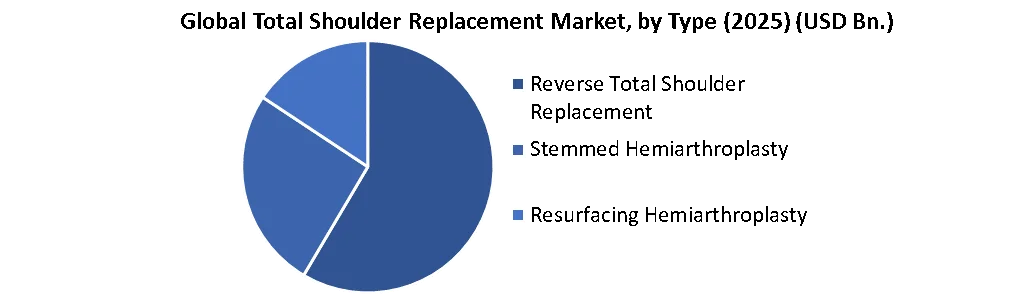
The Anatomical shoulder prosthesis segment is expected to witness a CAGR of 5.2% in the previously mentioned forecast period. Arthroplasty has shown to be one of the most dependable treatment options for shoulder degenerative joint conditions. Over the years, there have been numerous breakthroughs in transplant layouts to tackle the initial difficulties experienced in arthroplasty, e.g. function resumption and prosthesis loosening. Although backward shoulder arthroplasty has become the most widely practiced form of shoulder replacement in significant countries e.g. the US and the UK, overall anatomical shoulder arthroplasty has stayed a very well remedy for osteoarthritis in clients with a capable rotator cuff.
Patients with osteoarthritis who are treated with anatomical shoulder arthroplasty can now anticipate long-term, considerable pain and mobility improvement. Because of the effectiveness of anatomical shoulder arthroplasty, it is projected to garner more attention especially, leading to the growth of this segment.
Global Total Shoulder Replacement Market, by Application
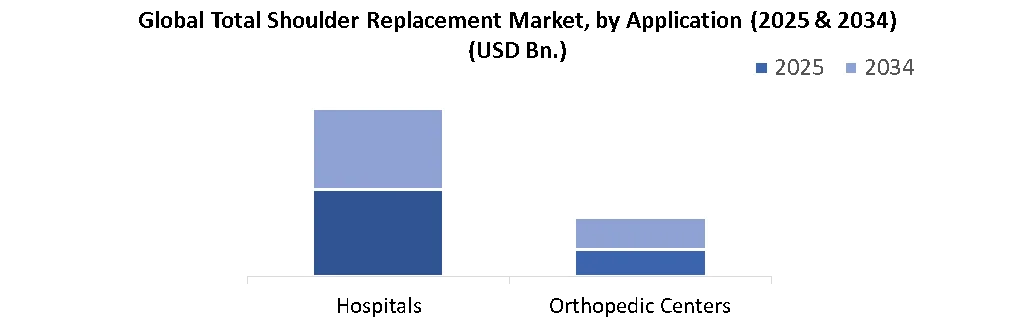
The Total Shoulder Replacement Market can be bifurcated into Hospitals, Orthopedic Centers, and Others. Hospitals own the maximum revenue share due to the availability of advanced surgical equipment, expert orthopedic surgeons, and comprehensive patient care services. Moreover, a high number of shoulder replacement procedures are carried out in hospitals as they offer diagnosis and rehabilitation services along with treatment. With the rising prevalence of arthritis, joint damage, and severe shoulder injuries, hospitals are witnessing an upsurge in demand for total shoulder replacement. The Orthopedic Centers segment is growing exponentially as patients are now preferring specialized treatment facilities to avail shoulder replacement surgery. These centers are focusing on shortening treatment duration, customized treatment plans, and advanced shoulder replacement procedures to reduce overall expenditure. The Other segment comprises ambulatory surgical centers and other small healthcare setups offering selected shoulder replacement procedures and treatment services. The overall market is gaining traction due to increasing investment in orthopedic treatment facilities, advanced implants and surgical procedures, and the availability of specialized orthopedic facilities. Ambulatory surgeries are creating new revenues for hospitals while reducing the overall cost of treatment and length of hospitalization, thus supporting market growth during the forecast period.
Global Total Shoulder Replacement Market Regional Insights:
North America is the largest market share in the Global Total Shoulder Replacement Market, thanks to the region’s developed healthcare infrastructure, a high number of total shoulder replacements, and an aging population. The U.S., in particular, is a major contributor to the regional market due to the increased adoption of reverse shoulder replacement implants, advanced surgical procedures, and the rising acceptance of outpatient orthopedic treatments. Moreover, the increasing healthcare expenditure and favorable insurance coverage for eligible patients contribute to the regional market size.
Europe holds the second-largest share in the Total Shoulder Replacement Market, fueled by the rising prevalence of shoulder arthritis, the growing need for total shoulder replacements, and a strong public healthcare system. Moreover, Germany, the U.K., France, and Italy are major contributors to the demand for total shoulder replacement in Europe. The adoption of improved shoulder implants, and digital surgical planning software in hospitals to improve treatment outcomes and enhanced investment in orthopedic care has led to the increased growth forecast for the region.
The Asia Pacific Total Shoulder Replacement Market has significant growth potential owing to the improving healthcare infrastructure and increasing awareness about orthopedic treatments offered across the region. In addition, the rising need for specialized treatments and enhanced accessibility to shoulder replacement procedures will drive the market growth in China, India, Japan, South Korea, and the rest of the Asia Pacific. Moreover, increasing healthcare expenditures and the proliferation of private hospitals offer lucrative opportunities to manufacturers and distributors in the Asia Pacific shoulder replacement market.
Middle East & Africa is a developing market for total shoulder replacement, mainly attributable to the increased investment in building healthcare infrastructure, enhanced access to orthopedic treatment services, and sophisticated medical technologies. In addition, the Middle East and Africa are witnessing a rise in private hospitals and medical tourism, supporting the need for advanced shoulder replacement procedures. However, extreme treatment expenditures and a lack of specialized surgeons impede the growth of the Middle East & Africa Total Shoulder Replacement Market.
South America is a developing market for total shoulder replacement procedures owing to the rising investment in orthopedic healthcare services and the increased need for total shoulder replacement treatments. Beziel and Argentina are the major economies in the South American region that contribute significantly to the demand for total shoulder replacement in the APAC region. Moreover, the increasing prevalence of shoulder injuries and degenerative joint diseases and the rising need for joint replacement procedures will provide a significant growth opportunity for providers and manufacturers of orthopedic treatments.
Global Total Shoulder Replacement Market Recent Industry Development
| Date | Company | Development | Impact |
|---|---|---|---|
| 25 February 2026 | Catalyst OrthoScience | Catalyst OrthoScience secured U.S. FDA 510(k) clearance for its Archer Patient-Specific Instrumentation (PSI) designed for both anatomic and reverse shoulder arthroplasty procedures. | The system improves 3D preoperative planning translation into the operating room, reducing surgical steps and increasing glenoid and humeral implant positioning precision. |
| 10 March 2026 | Shoulder Innovations | Shoulder Innovations initiated a strategic partnership with Interventional Systems to develop and integrate an advanced robotic platform for shoulder arthroplasty. | The alliance accelerates surgical execution accuracy and procedural efficiency across primary, revision, and complex shoulder replacement surgeries. |
| 15 April 2026 | Zimmer Biomet | Zimmer Biomet received U.S. FDA 510(k) clearance for line extensions to its Identity Shoulder System and Comprehensive Reverse Shoulder Systems, adding smaller implant sizes and matching instrumentation. | The clearance expands treatment access for patients with smaller anatomical statures while simplifying supply chain management via a shared Alliance Humeral Bearing. |
| 22 May 2026 | Zimmer Biomet | Zimmer Biomet received U.S. FDA 510(k) clearance for an upgraded version of its ROSA Shoulder System featuring enhanced robotically assisted glenoid reaming and humeral resection capabilities. | The approval advances data-driven intraoperative precision for anatomic and reverse total shoulder replacements connected through the ZBEdge orthopedic intelligence ecosystem. |
Global Total Shoulder Replacement Market Competitive Landscape
The Total Shoulder Replacement Market is intensely competitive, as key companies are implementing strategies, such as developing advanced shoulder implants, product innovation and enhancement, partnerships, and expanding their distribution networks to gain a significant position in the market. Players, including Zimmer Biomet, Stryker Corporation, DePuy Synthes (Johnson & Johnson MedTech), Smith Nephew, Enovis Corporation, Arthrex, Exactech, and Medacta International, are engaged in developing anatomical shoulder replacement systems, reverse shoulder replacement implants, and products to offer innovative surgical solutions. Companies are concentrating on R&D to improve implants’ performance and design and enhance joint functionality, accuracy during surgery, and post-surgery recovery.
Moreover, the adoption of 3D surgical planning, patient-specific instrumentation, and bone conservation implants is rising significantly, impacting the product competition in the industry. Players are targeting untapped markets, such as India, China, and Brazil, as the healthcare industry in these countries is growing rapidly. Additionally, major companies have an advantage over small and medium-sized companies as they have a wide distribution network, portfolio of products, and well-established relationships with hospitals and surgeons. On the other hand, small companies are focusing on developing specific shoulder implants and cost-effective products to gain a considerable share in the market. The growing healthcare expenditure and need for advanced procedures are enabling manufacturers to invest in product innovation, cutting-edge technologies, and competitive pricing strategies. However, introducing new products, mergers and acquisitions, distribution agreements, and partnerships with hospitals are some of the crucial competitive strategies impacting the market growth. Moreover, these competitive strategies will increase the market size and offer more growth opportunities to manufacturers, impacting the Global Total Shoulder Replacement Market forecast.
Global Total Shoulder Replacement Market Scope: Inquire before buying
| Total Shoulder Replacement Market | |||
|---|---|---|---|
| Report Coverage | Details | ||
| Base Year: | 2025 | Forecast Period: | 2026-2034 |
| Historical Data: | 2020 to 2025 | Market Size in 2025: | USD 1.97 Bn. |
| Forecast Period 2026 to 2034 CAGR: | 7.6% | Market Size in 2034: | USD 3.70 Bn. |
| Segments Covered: | by Product | Anatomical Shoulder Prosthesis Reverse Shoulder Prosthesis |
|
| by Type | Resurfacing Hemiarthroplasty Reverse Total Shoulder Replacement Stemmed Hemiarthroplasty |
||
| by Application | Hospitals Orthopedic Centers Others |
||
Total Shoulder Replacement Market, by Region
North America (United States, Canada and Mexico)
Europe (UK, France, Germany, Italy, Spain, Sweden, Austria and Rest of Europe)
Asia Pacific (China, South Korea, Japan, India, Australia, Indonesia, Malaysia, Vietnam, Taiwan, Bangladesh, Pakistan and Rest of APAC)
Middle East and Africa (South Africa, GCC, Egypt, Nigeria and Rest of ME&A)
South America (Brazil, Argentina Rest of South America
Total Shoulder Replacement Market, Key Players
1. Zimmer Biomet Holdings, Inc. – USA
2. Stryker Corporation – USA
3. Johnson & Johnson MedTech (DePuy Synthes) – USA
4. Smith+Nephew plc – United Kingdom
5. Enovis Corporation – USA
6. Arthrex, Inc. – USA
7. Exactech, Inc. – USA
8. Medacta International SA – Switzerland
9. Shoulder Innovations, Inc. – USA
10. Catalyst OrthoScience, Inc. – USA
11. MicroPort Scientific Corporation – China
12. Corin Group – United Kingdom
13. Waldemar LINK GmbH & Co. KG – Germany
14. implantcast GmbH – Germany
15. Permedica S.p.A. – Italy
16. Aston Medical – France
17. Gruppo Bioimpianti S.r.l. – Italy
18. Evolutis – France
19. Beznoska s.r.o. – Czech Republic
20. FX Solutions – France
21. FH Orthopedics – France
22. Aevumed, Inc. – USA
23. Kinamed Incorporated – USA
24. Baumer S.A. – Brazil
25. JRI Orthopaedics Ltd. – United Kingdom
26. Biotech Medical – France
27. EUROS – France
28. 3S ORTHO – France
29. Elite Surgical – South Africa
30. Corentec Co., Ltd. – South Korea
31. Beijing Chunli Technology Development Co., Ltd. – China
32. Shandong Weigao Orthopaedic Device Co., Ltd. – China
33. Medicalex – France
34. Biotechni – France
35. Groupe Lépine – France
36. Integra LifeSciences Holdings Corporation – USA
37. B. Braun Melsungen AG – Germany
38. CONMED Corporation – USA
39. Acumed LLC – USA
40. Globus Medical, Inc. – USA
41. Surgival Co., S.A.U. – Spain
42. Mathys AG Bettlach – Switzerland
43. Ceraver – France
44. Biotechpromed – Argentina
45. Orthofix Medical Inc. – USA
46. Medtronic plc – Ireland
47. Medartis Holding AG – Switzerland
48. OrthoPediatrics Corp. – USA
49. restor3d, Inc. – USA
50. Materialise NV – Belgium
Frequently Asked Questions:
1. Which is the potential market for the Total Shoulder Replacement in terms of the region?
Ans. Emerging markets (e.g. China, Brazil, and Mexico) are likely to provide considerable growth prospects in the industry.
2. What are the opportunities for new market entrants?
Ans. The market is growing due to an increase in the frequency of arthritis
3. What is expected to drive the growth of the Total Shoulder Replacement market in the forecast period?
Ans. The primary driver of the market is the patients’ preference for minimally invasive surgical procedures.
4. What is the projected market size & growth rate of the Total Shoulder Replacement Market?
Ans. Total Shoulder Replacement Market size was valued at USD 1.97 Bn. in 2025 and the total Total Shoulder Replacement revenue is expected to grow at 7.6% through 2026 to 2034, reaching USD 3.70 Bn.
5. What segments are covered in the Total Shoulder Replacement Market report?
Ans. The segments covered are Type, Procedure, End-User, and Region.