
Synthetic siRNA Market Size by Tools, Application, Indication, Delivery Mode, Region – Revenue Pool Analysis, Margin Structure Assessment, Capital Flow Trends, Competitive Benchmarking & Forecast to 2034
Overview
Global Synthetic siRNA Market size was valued at USD 3.85 Bn. in 2025 and the total Synthetic siRNA Market revenue is expected to grow by 10.1% from 2026 to 2034, reaching nearly USD 9.16 Bn, growth is driven by rising prevalence of chronic diseases and increasing R&D investments in gene-silencing therapies.
Synthetic siRNA Market Overview
Synthetic siRNA are also known as short interfering RNA, which is a type of non-coding double stranded RNA of 20-23 nucleotide base pairs in length. It is a powerful tool used for modulating gene expression by RNA interference (RNAi).siRNAs consist of two RNA strands, an antisense (or guide) strand and a sense (or passenger) strand, which form a duplex 19 to 25 bp in length with 3' dinucleotide overhangs. siRNA are transfected into cells by using delivery methods like polymer-based transfection reagents, electroporation or by adding chemical modifications.
Synthetic siRNA Market Size, Growth and Share Analysis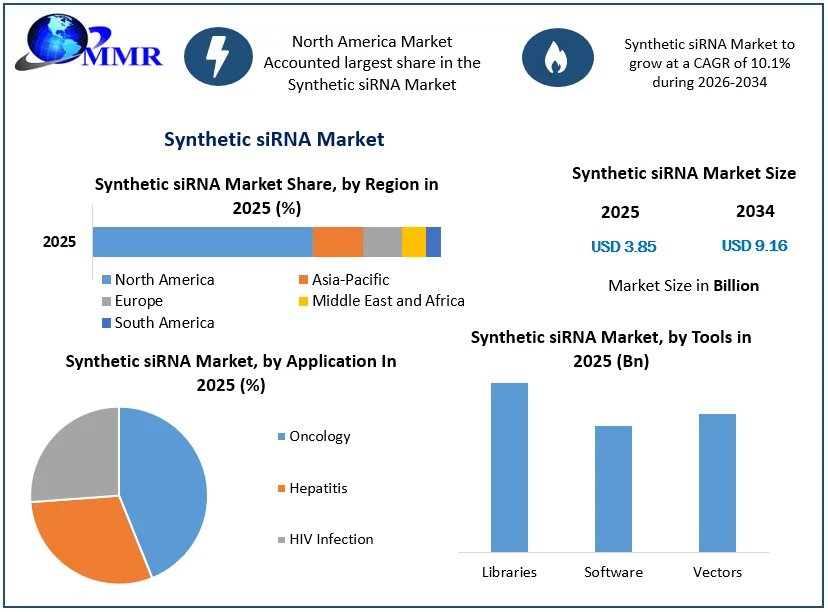
To Know About The Research Methodology :- Request Free Sample Report
Synthetic siRNA Market Dynamics
Increasing applications in gene therapy is the major factor driving the market.
Gene therapy offers a promising therapeutic platform as it targets disease-causing genes in a sequence-specific manner, which enables more precise and personalized treatment of diverse life-threatening diseases. Global prevalence of chronic diseases like cancer is noticing increasing number of applications in molecular diagnostics and incorporation of RNAi techniques in personalized medicines. Other advantages of siRNA include the high efficiency of the gene knockdown, the ability to easily target the gene of interest, as well as stable and long-term silencing by expressing shRNAs are accelerating the market growth.
However, many challenges related to siRNA may limit the market growth. One of the biggest challenge to siRNA based therapeutics is its intracellular delivery, as it has weak stability and pharmacokinetic behavior. It also faces problem of off-targeting during delivery since genes are read in both directions, there exists a possibility that even if the intended antisense siRNA strand is read and knocks out the target mRNA, the sense siRNA strand may target another protein involved in another function. In recent years, there has been a decline in FDA drug approval rates. Getting FDA approval for a new drug has become extremely challenging. It approved less than half the number of new drugs in 2016 (19 so far) when compared to 2015 (45 total).Along with this, high cost of synthesis of required siRNA may hamper the market growth.
The report has profiled key players in the market from different regions. However, the report has considered all market leaders, followers, and new entrants with investors while analyzing the market and estimation the size of the same. Increasing R&D activities in each region are different and focus is given on the regional impact on the cost, availability of advanced technology are analyzed.
Synthetic siRNA Market Segment Analysis:
Based on applications, the oncology segment is expected to hold larger market share of XX% by 2034. According to the WHO, cancer is the second leading cause of death globally. Approximately 70% of deaths from cancer occur in low- and middle-income countries. Cancer-causing infections, such as hepatitis and human papillomavirus (HPV), are responsible for approximately 30% of cancer cases in low- and lower-middle-income countries. High-risk human papillomaviruses infect skin and mucosa, causing approximately 5% of cancers worldwide. The selected siRNA prevents the tumor from growing via RNAi to decrease expression of the M2 subunit of R2 (ribonucleotide reductase).
Based on Delivery Mode, the Global Synthetic SiRNA Market is segmented into Lipid Based siRNA, Nanoparticle-Based siRNA and Others. Among these Lipid-Based siRNA delivery segment has dominated the Synthetic siRNA market in 2025 and is expected to hold largest market share forecast period, because they can effectively protect and deliver siRNA molecules, providing different levels of encapsulation and cellular uptake efficiencies for gene silencing. The lipid-based delivery systems that we have studied have been well characterized, relatively easy to manufacture in large quantities, and shown good to excellent safety and efficacy profiles in preclinical and clinical studies. Additionally, with the recent regulatory approvals and success stories related to lipid nanoparticle-based RNA therapeutics (e.g. mRNA vaccine development), there have been increased investments and innovations related to lipid-based siRNA delivery systems, further strengthening their competitive advantages in the siRNA market.
Synthetic siRNA Market Regional Insights:
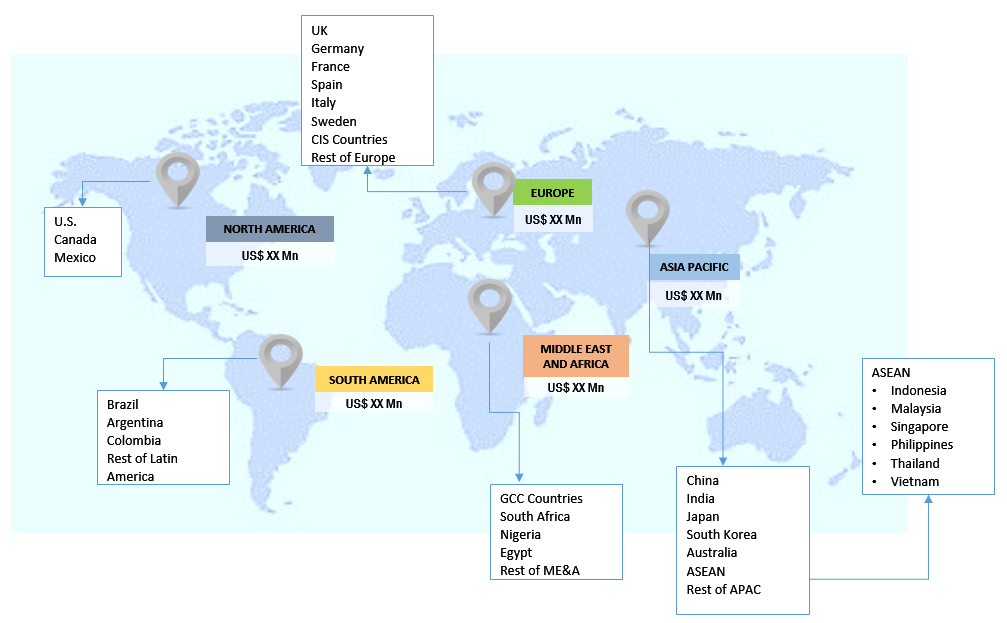
North America dominates the global market and is expected to continue the dominance throughout the forecast period.
The US leads the global market owing to huge number of RNAi therapeutics in the development stage. High investments from biotechnology companies for the development of novel therapeutics is contributing to the market growth in the region. Rising prevalence of personalized medicines for life threatening diseases like cancer, HIV drives the demand for Synthetic siRNA market. For instance, AstraZeneca's agreement with Ionis pharmaceuticals is one of the big deals that are investing heavily into RNA-interference technology. According to the news released on 10th August 2018, the US Food and Drug Administration approved Onpattro (patisiran) infusion for the treatment of polyneuropathy. Recently, the FDA-approved GIVLAARI (givosiran, ALN-AS1) for the treatment of adults with acute hepatic porphyria (AHP).
The report also helps in understanding Global Synthetic siRNA Market dynamics, structure by analyzing the market segments and project the Global Synthetic siRNA Market size. Clear representation of competitive analysis of key players by product, price, financial position, product portfolio, growth strategies, and regional presence in the Global Synthetic siRNA Market make the report investor’s guide.
Synthetic siRNA Market Recent Development
| Date | Company | Development | Impact |
|---|---|---|---|
| 18 November 2025 | Arrowhead Pharmaceuticals | The U.S. FDA granted approval for REDEMPLO (plozasiran), an innovative small interfering RNA (siRNA) therapeutic designed to lower triglycerides in adults with familial chylomicronemia syndrome. | This milestone validates the commercial scalability of the TRiM™ RNAi platform and introduces a novel quarterly subcutaneous gene-silencing treatment option. |
| 07 January 2026 | Bayer | Bayer established a strategic research collaboration with Soufflé Therapeutics to co-develop cell-specific, heart-targeted siRNA therapies for cardiovascular indications. | The partnership accelerates the expansion of synthetic siRNA therapies beyond hepatic targets into extrahepatic tissues such as cardiac muscle. |
| 02 February 2026 | Genentech | Genentech signed an exclusive global licensing agreement valued at up to $1.5 billion with SanegeneBio to discover and develop novel synthetic siRNA therapeutic candidates. | The alliance leverages advanced chemical modification platforms to improve dosing frequency, stability, and tissue specificity across broad disease portfolios. |
| 03 June 2026 | Alnylam Pharmaceuticals | Alnylam entered a strategic AI collaboration valued at up to $2 billion with Inceptive Nucleics to accelerate siRNA molecule design and sequence discovery. | By applying AI foundation models to 20 years of oligonucleotide data, the deal aims to drastically shorten preclinical drug discovery timelines and optimize gene-silencing potency. |
| 16 June 2026 | AviadoBio | AviadoBio expanded its technology license agreement with King's College London to apply its proprietary vMiX™ RNAi gene silencing platform across all human therapeutic fields. | The expanded rights allow for non-vectorized and vectorized synthetic RNAi platforms to address complex neurodegenerative and systemic genetic disorders. |
Synthetic siRNA Market Scope: Inquire before buying
| Synthetic siRNA Market | |||
|---|---|---|---|
| Report Coverage | Details | ||
| Base Year: | 2025 | Forecast Period: | 2026-2034 |
| Historical Data: | 2020 to 2025 | Market Size in 2025: | USD 3.85 Bn. |
| Forecast Period 2026 to 2034 CAGR: | 10.1% | Market Size in 2034: | USD 9.16 Bn. |
| Segments Covered: | by Tools | Libraries Software Vectors |
|
| by Application | Oncology Hepatitis HIV Infection |
||
| by Indication | Hereditary Transthyretin-mediated Amyloidosis Acute Hepatic Porphyria Primary Hyperoxaluria Type 1 Primary Hypercholesterolemia Others |
||
| by Delivery Mode | Lipid Based siRNA Nanoparticle-Based siRNA Others |
||
Synthetic siRNA Market, by Region:
North America (United States, Canada, and Mexico)
Europe (UK, France, Germany, Italy, Spain, Sweden, Austria, and the Rest of Europe)
Asia Pacific (China, South Korea, Japan, India, Australia, ASEAN, Indonesia, Philippines, Malaysia, Vietnam, Thailand, ASEAN, Rest of Asia Pacific)
Middle East & Africa (South Africa, GCC, Nigeria, Rest of ME&A)
South America (Brazil, Argentina, Rest of South America)
Synthetic siRNA Market Key players
1. Thermo Fisher Scientific Inc.
2. Bioneer
3. Dharmacon (ThermoFisher)
4. Invitrogen
5. Integrated DNA Technologies
6. MWG Biotech
7. OligoEngine
8. Proligo (Sigma)
9. Qiagen
10.AstraZeneca
11.Ionis pharmaceuticals
12.Alnylam Pharmaceuticals
13.Arcturus Therapeutics
14.Dicerna Pharmaceuticals
15.Merck & Co. Inc. (Sigma Aldrich)
Frequently Asked Questions:
1. Which region has the largest share in the Global Synthetic siRNA Market?
Ans: The North America region held the highest share in 2025.
2. What is the growth rate of the Global Synthetic siRNA Market?
Ans: The Global Market is expected to grow at a CAGR of 10.1% during the forecast period 2026-2034.
3. What is the scope of the Global Synthetic siRNA Market report?
Ans: The Global Synthetic siRNA Market report helps with the PESTEL, PORTER, Recommendations for Investors and leaders, and market estimation for the forecast period.
4. Who are the key players in the Synthetic siRNA Market?
Ans: The important key players in the Global Synthetic siRNA Market are – Thermo Fisher Scientific Inc., Bioneer, Dharmacon (ThermoFisher), Invitrogen, Integrated DNA Technologies, MWG Biotech, OligoEngine, etc.
5. What is the study period of Synthetic siRNA market?
Ans: The Global Synthetic siRNA Market is studied from 2020 to 2034.