
Stem Cell Umbilical Cord Blood Market Size by Storage Services, Therapeutics, Application, Region, Industry-Wide Analysis, Competitive Landscape Assessment & Long-Term Forecast to 2034
Overview
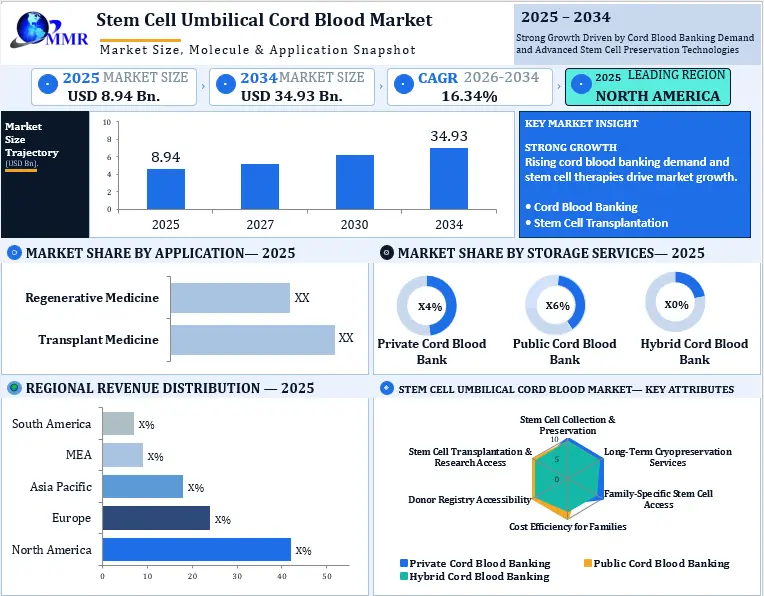
The Global Stem Cell Umbilical Cord Blood Market was valued at USD 8.94 Billion in 2025 and is projected to reach USD 34.93 Billion by 2034, growing at a CAGR of 16.34% during the forecast period 2026–2034.
Global Stem Cell Umbilical Cord Blood Market Overview
The Global Stem Cell Umbilical Cord Blood Market focuses on the collection, processing, cryopreservation, and long-term storage of hematopoietic stem cells obtained from newborn umbilical cord blood. These stem cells support the treatment of certain blood cancers, immune deficiencies, and inherited blood disorders through stem cell transplantation. Growing demand for cord blood banking services, stem cell preservation, regenerative medicine research, and cellular therapies supports market expansion. Hospitals and biotechnology companies use cord blood stem cells for established transplantation procedures and clinical research.
The Stem Cell Umbilical Cord Blood Market is evolving through advanced cryopreservation technologies, automated stem cell processing, digital biobanking, and improved cell viability testing. Public cord blood banks, private stem cell banking providers, hospitals, transplant centers, and research institutions represent major market participants and customers. Increasing investment in regenerative medicine, cord blood transplantation, and biotechnology infrastructure creates growth opportunities for stem cell banking companies, particularly across emerging healthcare markets.
North America leads the global Stem Cell Umbilical Cord Blood Market, supported by established stem cell banking infrastructure, advanced transplantation facilities, and biotechnology investment. Leading companies include Cord Blood Registry (CBR), ViaCord, Cryo-Cell International, StemCyte, Cordlife Group, and FamiCord. Asia Pacific presents expanding opportunities across China, India, Japan, and South Korea. Maximize Market Research (MMR) analyzes market size, cord blood banking models, therapeutic applications, regional demand, competitive positioning, and growth opportunities, providing industry insights into the Stem Cell Umbilical Cord Blood Market outlook through 2034.
Stem Cell Umbilical Cord Blood Market Size, Growth & Share Analysis
To know about the Research Methodology :- Request Free Sample Report
Global Stem Cell Umbilical Cord Blood Market Key Highlights
Global Stem Cell Umbilical Cord Blood Market Dynamics
Drivers: Increasing Demand for Umbilical Cord Blood Banking, Stem Cell Transplantation and Regenerative Medicine
The Global Stem Cell Umbilical Cord Blood Market is driven by rising demand for umbilical cord blood banking, hematopoietic stem cell transplantation, cord blood preservation services, and regenerative medicine. Increasing prevalence of leukemia, lymphoma, inherited blood disorders, and immune deficiencies supports demand for cord blood stem cell therapies. Cord blood stem cells have established applications in transplantation for more than 80 diseases and conditions, although eligibility varies by indication. Growing parental awareness, expanding maternity hospital partnerships, and increasing adoption of private and public cord blood banking strengthen market growth. Stem cell collection and processing services typically cost approximately USD 1,000–3,000 in selected private banking markets.
Restraints: High Stem Cell Banking Costs, Limited Reimbursement and Restricted Clinical Applications
High cord blood banking costs, stem cell cryopreservation expenses, and limited insurance reimbursement restrain the Global Stem Cell Umbilical Cord Blood Market. Private cord blood banking providers commonly charge approximately USD 100–300 annually for long-term stem cell storage, depending on service packages and geographic markets. Limited clinical use of privately preserved cord blood, uncertainty surrounding experimental stem cell therapies, and consumer concerns about treatment accessibility influence purchasing decisions. High initial enrollment fees, recurring storage costs, and limited affordability restrict cord blood preservation market penetration in developing economies.
Opportunities: Growing Investment in Stem Cell Research, Public Cord Blood Banks and Advanced Biobanking Infrastructure
The Stem Cell Umbilical Cord Blood Market presents significant opportunities through expanding public cord blood banking networks, regenerative medicine research, cellular therapies, and advanced stem cell storage infrastructure. Increasing investment in umbilical cord tissue banking, mesenchymal stromal cell research, and hematopoietic stem cell transplantation supports service diversification. Biotechnology companies and healthcare institutions adopt automated cell processing, cryogenic preservation systems, and advanced biological sample management technologies. Liquid nitrogen-based systems operate near −196°C, supporting validated long-term cell preservation. China, India, Japan, and South Korea present opportunities for expanding cord blood collection networks and regional stem cell banking services.
Challenges: Maintaining Cord Blood Stem Cell Viability, HLA Compatibility and Regulatory Compliance
The Global Cord Blood Stem Cell Banking Market faces operational challenges related to stem cell viability, donor screening, HLA tissue matching, sample contamination, and cord blood quality control. Cord blood transplantation requires suitable stem cell doses and donor-recipient compatibility, making total nucleated cell counts, CD34+ cell measurements, and cell viability testing important quality indicators. Stem cell banking companies maintain cryogenic preservation systems near −196°C, continuous temperature monitoring, and biological sample traceability. Compliance with AABB accreditation requirements, FACT-NetCord standards, and country-specific tissue banking regulations increases operational complexity and infrastructure costs.
Trends: AI-Powered Cord Blood Banking, Automated Cryopreservation and Digital Stem Cell Preservation Services
The Stem Cell Umbilical Cord Blood Market is experiencing increasing adoption of automated stem cell processing, AI-assisted biobanking, digital sample tracking, advanced cryopreservation technology, and integrated cord blood and cord tissue banking services. Leading stem cell banking companies offer family preservation packages with storage durations of 20–25 years or longer, depending on provider contracts. Closed-system cell processing, automated inventory management, real-time cryogenic monitoring, and advanced stem cell viability testing support operational efficiency and quality assurance. Growing interest in hybrid public-private cord blood banking, personalized stem cell storage, and regenerative medicine research shapes industry trends and competitive strategies through 2034.
Global Stem Cell Umbilical Cord Blood Market Segment Analysis
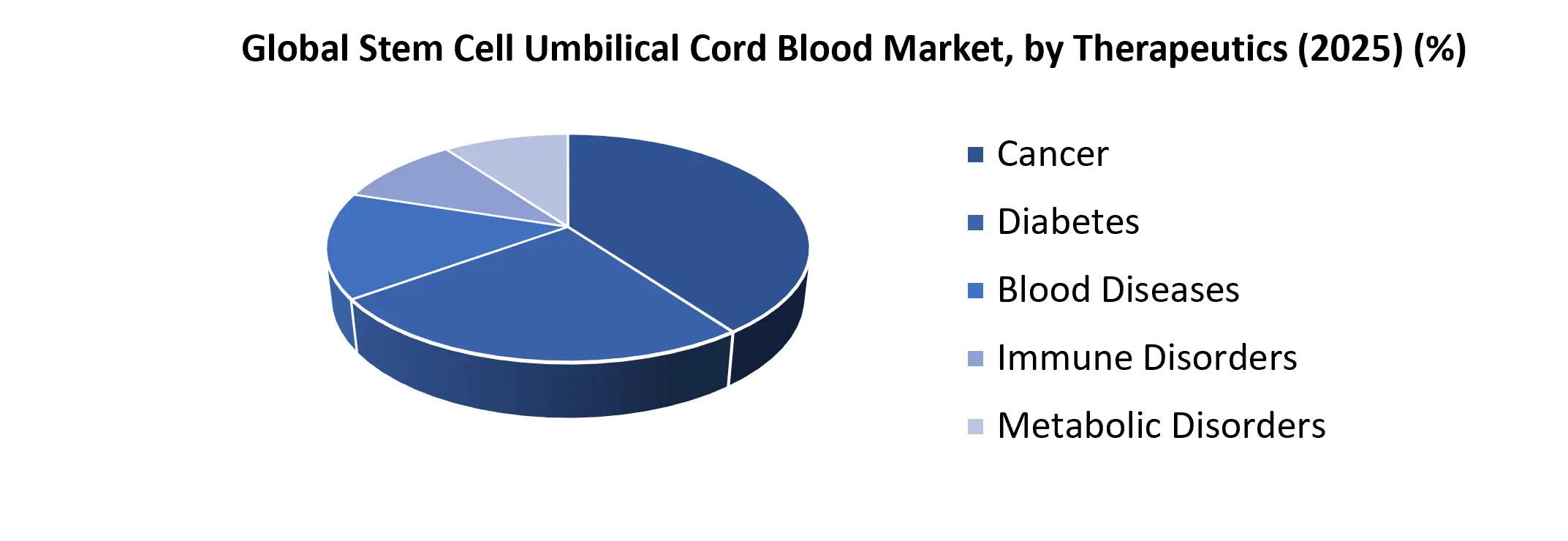
Based on Therapeutics, the Global Stem Cell Umbilical Cord Blood Market is segmented into Cancer, Diabetes, Blood Diseases, Immune Disorders, Metabolic Disorders, and Others. Cancer represents a major therapeutic application, supported by the established use of umbilical cord blood hematopoietic stem cell transplantation in treating leukemia, lymphoma, and other hematological malignancies. Blood Diseases include non-malignant conditions such as sickle cell disease, thalassemia, and aplastic anemia, supporting demand for cord blood stem cell transplantation and donor matching services. Immune Disorders include selected inherited immunodeficiency conditions, while Metabolic Disorders cover inherited metabolic diseases eligible for hematopoietic stem cell transplantation. Diabetes remains an investigational application, with ongoing stem cell therapy research exploring potential treatment approaches rather than established routine clinical use. The Others segment includes additional clinical indications and emerging research applications. Increasing demand for cord blood stem cell therapies, hematopoietic stem cell transplantation, regenerative medicine research, HLA matching, and advanced cellular therapies supports market development through 2034.
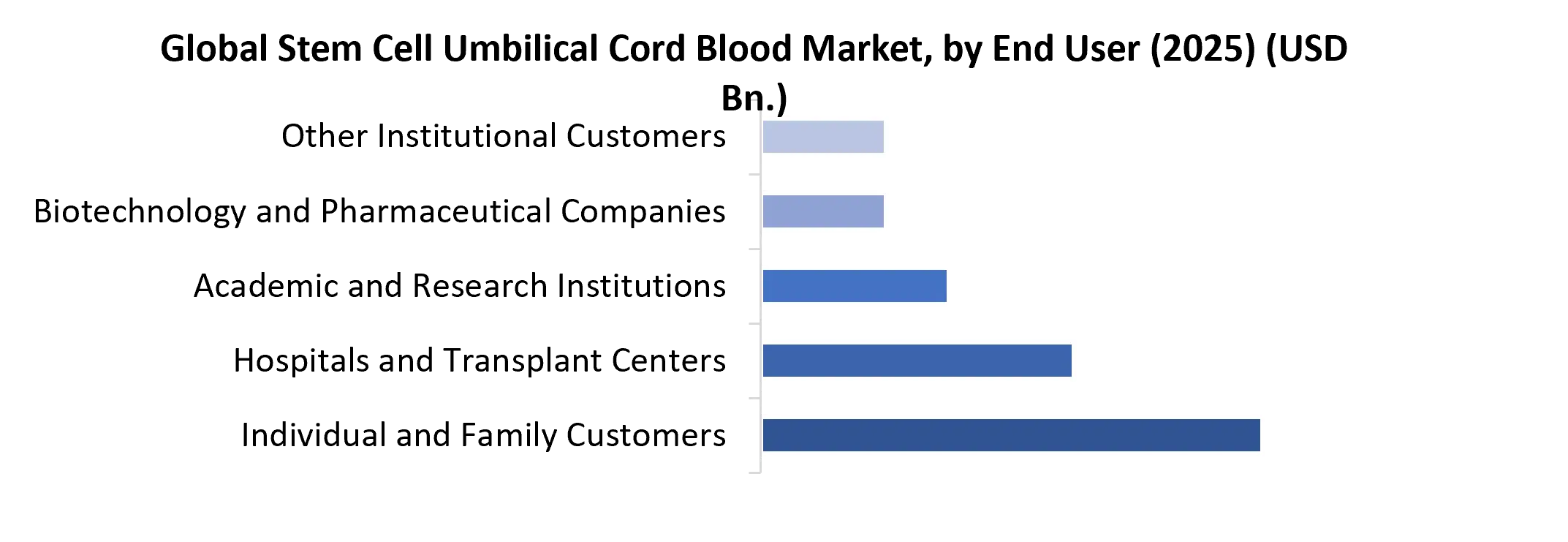
 Based on End User, the Global Stem Cell Umbilical Cord Blood Market is segmented into Individual and Family Customers, Hospitals and Transplant Centers, Academic and Research Institutions, Biotechnology and Pharmaceutical Companies, and Other Institutional Customers. Individual and Family Customers represent a key commercial segment, supported by increasing demand for private cord blood banking, newborn stem cell preservation, umbilical cord blood collection, and long-term cryogenic storage services. Hospitals and Transplant Centers contribute significantly to market demand through hematopoietic stem cell transplantation, cord blood stem cell therapies, and treatment of leukemia, lymphoma, and inherited blood disorders. Academic and Research Institutions support stem cell research, regenerative medicine, and clinical trials, while Biotechnology and Pharmaceutical Companies utilize cord blood-derived stem cells for cellular therapy development, drug discovery, and advanced therapeutic research. Other Institutional Customers, including specialized biobanks and healthcare organizations, support cord blood processing, quality testing, and biological sample management. Expanding stem cell banking infrastructure, automated cryopreservation technologies, and increasing investment in regenerative medicine create growth opportunities across all end-user segments through 2034.
 Global Stem Cell Umbilical Cord Blood Market Regional Insights
North America dominates the Global Stem Cell Umbilical Cord Blood Market, supported by advanced healthcare infrastructure, established cord blood banking facilities, and increasing demand for hematopoietic stem cell transplantation. The United States leads regional market activity through private and public cord blood banking, advanced cryopreservation technology, and regenerative medicine research. Leading companies, including Cord Blood Registry (CBR), ViaCord, Cryo-Cell International, and StemCyte, strengthen the regional competitive landscape through stem cell preservation services, hospital partnerships, and technological innovation.
Europe represents a significant Stem Cell Umbilical Cord Blood Market, driven by established public cord blood banks, advanced cellular therapy research, and regulated stem cell preservation services. Germany, the United Kingdom, France, Italy, and Spain support regional demand through umbilical cord blood collection, stem cell processing, and clinical transplantation programs. Key companies, including FamiCord Group, Cells4Life, Future Health Biobank, and Smart Cells International, focus on private cord blood banking, cryogenic storage solutions, and expanding stem cell banking networks.
Asia Pacific presents strong Stem Cell Umbilical Cord Blood Market growth opportunities, supported by expanding maternity healthcare infrastructure, biotechnology investments, and increasing awareness of newborn stem cell preservation. China, India, Japan, South Korea, and Singapore contribute to regional development through cord blood banking services, hematopoietic stem cell transplantation, and regenerative medicine research. Companies such as Cordlife Group, LifeCell International, and MEDIPOST strengthen regional competition through stem cell storage services, clinical research, and advanced biobanking technologies.
The Middle East & Africa Stem Cell Umbilical Cord Blood Market benefits from healthcare modernization, investment in biotechnology infrastructure, and growing interest in cord blood preservation and stem cell transplantation. Saudi Arabia, the UAE, and South Africa support market development through specialized hospitals, biobanking facilities, and cellular therapy research. Expanding public healthcare initiatives, cryogenic storage infrastructure, and international healthcare partnerships create opportunities for cord blood banking service providers.
South America presents emerging opportunities in the Stem Cell Umbilical Cord Blood Market, supported by expanding healthcare access, increasing awareness of private cord blood banking, and growing biotechnology research. Brazil, Argentina, and Colombia contribute to regional demand through umbilical cord blood collection, stem cell preservation services, and hematopoietic stem cell transplantation programs. Expanding hospital partnerships, biological sample storage infrastructure, and regenerative medicine research strengthen the regional market outlook.
Global Stem Cell Umbilical Cord Blood Market Recent Developments
| Published Date | Company | Recent Developments |
| 30-Aug-26 | Sidra Medicine (Qatar) | Sidra Medicine signs an agreement with The Pearl International Hospital to expand umbilical cord blood banking services, providing expectant families access to stem cell collection, processing, and long-term cryogenic storage. |
| 23-Jun-26 | FamiCord AG (Germany) | FamiCord signs a framework agreement with ArThec S.A. through its subsidiary PBKM to develop regenerative medicine technologies, with approximately EUR 0.7 million in expected revenue over 12 months, subject to project progress. |
| 4-Mar-26 | LifeCellsNI (United Kingdom) | LifeCellsNI secures GBP 590,000 in pre-seed funding to establish Northern Ireland's first dedicated HTA-licensed stem cell storage and contingency biobank facility, expanding cryopreservation infrastructure. |
| 26-Jan-26 | StemCyte, Inc. (USA) | StemCyte announces FDA clearance of an Expanded Access program for REGENECYTE, its cord blood-derived hematopoietic progenitor cell therapy, allowing eligible Long COVID patients investigational access outside clinical trials. |
| 8-Jan-26 | Cordlife Group Limited (Singapore/Indonesia) | Cordlife Indonesia announces its fourth AABB reaccreditation for cord blood banking and first accreditation for somatic cell processing, strengthening stem cell preservation quality standards and processing capabilities. |
Global Stem Cell Umbilical Cord Blood Market Competitive Landscape
The Global Stem Cell Umbilical Cord Blood Market is highly competitive, with leading cord blood banking companies, stem cell preservation service providers, biotechnology firms, and public and private stem cell banks focusing on advanced cryopreservation technology, hematopoietic stem cell transplantation, and long-term umbilical cord blood storage. Major Stem Cell Umbilical Cord Blood Market key players, including Cord Blood Registry (CBR), ViaCord, Cryo-Cell International, StemCyte, Cordlife Group, FamiCord Group, LifeCell International, and MEDIPOST, strengthen their competitive positions through technological innovation, hospital partnerships, quality accreditation, and expanding stem cell banking infrastructure. Cord Blood Registry and ViaCord provide private cord blood and cord tissue preservation services, while StemCyte focuses on cord blood banking and transplantation-related applications. Cryo-Cell International offers stem cell collection, processing, and cryogenic storage services, while LifeCell International supports family and community stem cell banking in India.
Increasing demand for umbilical cord blood banking, regenerative medicine, stem cell therapy, cord blood transplantation, automated stem cell processing, and digital biobanking solutions strengthens global market competition. Leading companies focus on cell viability testing, HLA matching, cryogenic storage reliability, regulatory compliance, and integrated cord blood and cord tissue banking services to improve product quality and customer confidence. Strategic mergers and acquisitions, biotechnology collaborations, public-private partnerships, and regional facility expansions influence the Stem Cell Umbilical Cord Blood Market competitive landscape. North America maintains a strong market position, while Asia Pacific presents expanding opportunities for stem cell banking companies. Maximize Market Research (MMR) examines company market positioning, service portfolios, technological advancements, geographic presence, strategic partnerships, and emerging Stem Cell Umbilical Cord Blood Market growth opportunities through 2034.
Stem Cell Umbilical Cord Blood Market Scope: Inquire before buying
| Stem Cell Umbilical Cord Blood Market | |||
|---|---|---|---|
| Report Coverage | Details | ||
| Base Year: | 2025 | Forecast Period: | 2026-2034 |
| Historical Data: | 2020 to 2025 | Market Size in 2025: | 8.94 USD Billion |
| Forecast Period 2026-2034 CAGR: | 16.34% | Market Size in 2034: | 34.93 USD Billion |
| Segments Covered: | by Storage Services | Public Cord Blood Banks Private Cord Blood Banks Hybrid Cord Blood Banks |
|
| by Therapeutics | Cancer Diabetes Blood Diseases Immune Disorders Metabolic Disorders Others |
||
| by Application | Transplant Medicine Regenerative Medicine |
||
| by End User | Individual and Family Customers Hospitals and Transplant Centers Academic and Research Institutions Biotechnology and Pharmaceutical Companies Other Institutional Customers |
||
Stem Cell Umbilical Cord Blood Market, by Region
North America (United States, Canada and Mexico)
Europe (UK, France, Germany, Italy, Spain, Sweden, Austria and Rest of Europe)
Asia Pacific (China, South Korea, Japan, India, Australia, Indonesia, Malaysia, Vietnam, Taiwan, Bangladesh, Pakistan and Rest of APAC)
Middle East and Africa (South Africa, GCC, Egypt, Nigeria and Rest of ME&A)
South America (Brazil, Argentina Rest of South America)
Stem Cell Umbilical Cord Blood Market, Key Players are:
1. Cord Blood Registry (CBR) – United States
2. ViaCord – United States
3. Cryo-Cell International, Inc. – United States
4. StemCyte, Inc. – United States
5. FamiCord Group – Germany
6. Cordlife Group Limited – Singapore
7. Cells4Life Group LLP – United Kingdom
8. Future Health Biobank Ltd. – United Kingdom
9. Smart Cells International Ltd. – United Kingdom
10. Global Cord Blood Corporation – China / Hong Kong
11. LifeCell International Pvt. Ltd. – India
12. Americord Registry, LLC – United States
13. CryoCord Sdn. Bhd. – Malaysia
14. MEDIPOST Co., Ltd. – South Korea
15. Banque de Sang de Cordon, Cliniques Universitaires Saint-Luc – Belgium
16. Ana Rukavina Cord Blood Bank, UHC Zagreb – Croatia
17. InScientiaFides S.p.A. – San Marino
18. Biohellenika S.A. – Greece
19. Shandong Qilu Stem Cell Engineering Co., Ltd. – China
20. Public Cord Blood Bank Thessaloniki – Greece
21. Bloodworks Northwest Cord Blood Program – United States
22. Cord Blood Bank Geneva – Switzerland
23. Cord Blood Bank University Hospital Basel – Switzerland
24. Banco de Sangre de Cordón Umbilical Andalucía – Spain
25. Hellenic Cord Blood Bank – Greece
26. UNICATT Cord Blood Bank – Italy
27. Canadian Blood Services Cord Blood Bank – Canada
28. MD Anderson Cord Blood Bank – United States
29. Cleveland Cord Blood Center – United States
30. Carolinas Cord Blood Bank at Duke – United States
31. LifeSouth Cord Blood Bank – United States
32. Anthony Nolan Cord Blood Bank – United Kingdom
33. NHS Cord Blood Bank – United Kingdom
34. Cord Blood Bank of Ankara – Turkey
35. Swiss Stem Cells Biotech SA – Switzerland
36. Swedish National Cord Blood Bank – Sweden
37. Programa Concordia, Banc de Sang i Teixits – Spain
38. StemCord Pte Ltd – Singapore
39. Singapore Cord Blood Bank – Singapore
40. King Abdullah International Medical Research Center Cord Blood Bank – Saudi Arabia
41. Bebé Vida – Portugal
42. Sanquin Cord Blood Bank – Netherlands
43. Treviso Cord Blood Bank – Italy
44. Milano Cord Blood Bank – Italy
45. Emilia Romagna Cord Blood Bank – Italy
46. José Carreras Cord Blood Bank Düsseldorf – Germany
47. DKMS Stem Cell Bank – Germany
48. Héma-Québec – Canada
49. Liège Cord Blood Bank – Belgium
50. Leuven Cord Blood Bank – Belgium
Frequently Asked questions
1. What is the global Stem Cell Umbilical Cord Blood Market size in 2025?
The Global Stem Cell Umbilical Cord Blood Market is valued at USD 8.94 billion in 2025, driven by growing demand for umbilical cord blood banking, stem cell preservation, cryopreservation services, and hematopoietic stem cell transplantation.
2. What is the projected Stem Cell Umbilical Cord Blood Market size and CAGR by 2034?
The Stem Cell Umbilical Cord Blood Market is projected to reach USD 34.93 billion by 2034, growing at a CAGR of 16.34% during 2026–2034,
3. What are the major growth drivers of the Stem Cell Umbilical Cord Blood Market?
Major market growth drivers include increasing demand for cord blood stem cell transplantation, rising awareness of newborn stem cell banking, advancements in cryogenic storage technology, and expanding regenerative medicine research.
4. Which cord blood banking model leads the Stem Cell Umbilical Cord Blood Market?
Private Cord Blood Banking represents an important commercial segment, supported by family stem cell preservation, long-term umbilical cord blood storage, and personalized banking services. Public and hybrid cord blood banks support donor access and transplantation. The largest segment by market share requires confirmation.
5. What are the major therapeutic applications of umbilical cord blood stem cells?
Umbilical cord blood stem cells support hematopoietic stem cell transplantation for leukemia, lymphoma, selected blood diseases, inherited immune deficiencies, and metabolic disorders. Diabetes-related stem cell therapies remain investigational.
6. Which region dominates the global Stem Cell Umbilical Cord Blood Market?
North America leads the global Stem Cell Umbilical Cord Blood Market, supported by established public and private cord blood banks, advanced transplantation infrastructure, and stem cell research. Asia Pacific presents growth opportunities across China, India, Japan, and South Korea.
7. Who are the leading companies in the global Stem Cell Umbilical Cord Blood Market?
Major Stem Cell Umbilical Cord Blood Market players include Cord Blood Registry (CBR), ViaCord, Cryo-Cell International, StemCyte, Cordlife Group, FamiCord Group, LifeCell International, and MEDIPOST, specializing in stem cell banking, cord blood preservation, and cryogenic storage services.