
Starch Derivatives Market Size by Type, Function, Raw Material, Application, Region – Segment-Level Market Assessment, Growth Opportunity Analysis, Competitive Mapping & Forecast to 2030
Overview
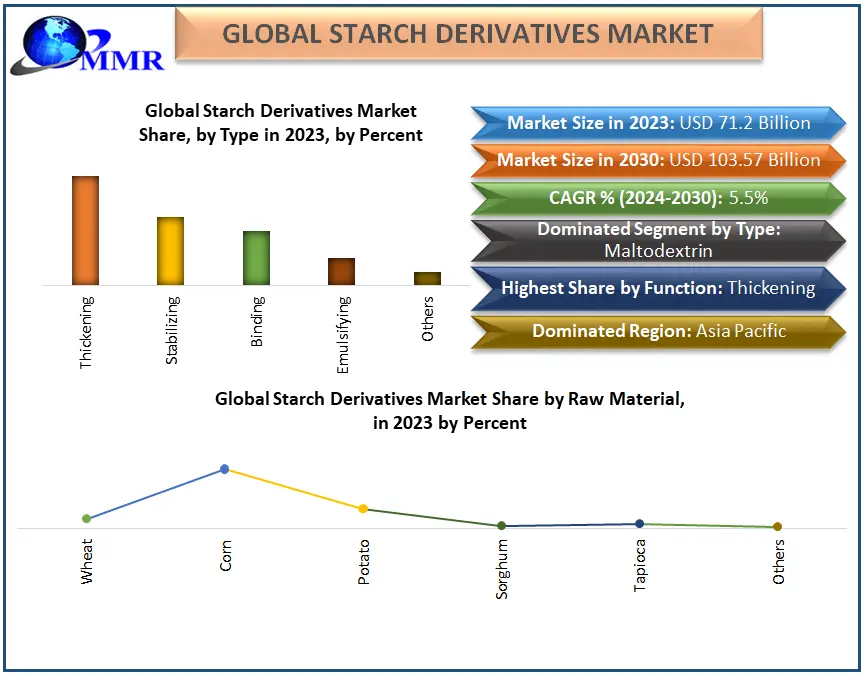
The Starch Derivatives Market size was valued at USD 71.2 Billion in 2023 and the total Starch Derivatives revenue is expected to grow at a CAGR of 5.5% from 2024 to 2030, reaching nearly USD 103.57 Billion by 2030
Starch Derivatives Market Overview:
Starch, being the most abundant carbohydrate reservoir in plants, serves as a critical energy source and structural component. Starch derivatives are created through various chemical modifications such as oxidation, esterification, or etherification, altering the chemical structure of D-glucopyranosyl units within the starch molecule. These modifications serve several purposes, including altering gelatinization and cooking characteristics, reducing retrogradation and gelling tendencies, increasing water-holding capacity, enhancing hydrophilic or hydrophobic properties, and introducing ionic substituents. Such modifications are crucial for tailoring starch derivatives to specific industrial and consumer applications, providing functionalities such as thickening, gelling, binding, adhesive, and film-forming properties.
 To know about the Research Methodology:- Request Free Sample Report
Starch derivatives find widespread applications across various industries. In the food industry, they are utilized as thickening agents in sauces, gravies, soups, and desserts, as well as binding agents in processed foods and snacks like potato chips and jerkies. Moreover, they are integral components of dietary products, including baby foods and low-calorie formulations, where they contribute texture and mouthfeel without adding excessive calories or fat content. Outside the food industry, starch derivatives play significant roles in diverse sectors such as pharmaceuticals, textiles, paper, adhesives, and construction materials. In pharmaceuticals, they serve as excipients in drug formulations, providing controlled release and stability. In textiles, starch derivatives are used in sizing and finishing processes to enhance fabric quality and performance. In paper manufacturing, they improve paper strength and surface properties. Additionally, they act as binders and thickeners in adhesives and construction materials, contributing to product stability and performance.
One notable starch derivative is maltodextrin, widely used in brewing, food processing, and as a supplement in the sports nutrition industry. In brewing, maltodextrin increases the specific gravity of the final product without impacting flavor or fermentability, making it ideal for adjusting beer body and mouthfeel. In food processing, it serves as a bulking agent, flavor enhancer, and texture modifier in various products. As a supplement, maltodextrin provides rapidly digestible carbohydrates for post-workout energy replenishment and muscle recovery in athletes and bodybuilders.
Starch Derivatives Market Dynamics:
Innovative Starch Derivatives as Dietary auxiliaries which drive the Starch Derivatives Market Growth
The population expansion, changing dietary patterns, technological advancements in starch modification techniques, and the growing awareness of functional ingredients in food and non-food applications. Additionally, the versatility and cost-effectiveness of starch derivatives compared to synthetic alternatives further bolster market growth. Growing demand for convenience food and beverages in developing countries across the globe, rising population, and increasing per-capita income are expected to drive the global starch derivatives market. Many key players are investing huge investment in research and development activities for the penetration of the starch derivative. These developments are enhancing the scenes of starch derivative products in the global starch derivatives market. Furthermore, the enactment of biofuel policies and growing raw material prices are some of the factors limiting the growth of the global starch derivatives market. The European Starch Industry, represented by Starch Europe members, operates 73 facilities across 20 EU Member States, yielding 10.5 million tonnes of starch and derivatives annually, alongside 5 million tonnes of proteins and fibers. Utilizing primarily wheat, maize, and potatoes, with contributions from barley, rice, and peas, production has surged from 8.7 million tonnes in 2004 to 10.5 million tonnes in 2022. EU consumption stands at 8.3 million tonnes, with 53% in food, 2% in feed, and 45% in non-food sectors like papermaking. 32% of consumed starch is native, 19% modified, and 49% starch sweeteners.
The Starch Derivatives Market is being increasingly driven by non-food, industrial applications, presenting starch producers with opportunities for revenue expansion. Native starch, while suitable for food applications, finds limited utility in industrial settings. Conversely, modified starch, with its enhanced functionalities, commands a market value approximately 2.7 times greater than native starch. This valuation discrepancy underscores the importance of modification techniques in enhancing starch's industrial applicability. Recent advancements in chemical, enzymatic, and physical modification methods have widened the scope of potential industrial applications for starch derivatives.
| Starch | Antimicrobial agent | Concentration | Micro-organism | Observation |
| Potato | PHGH | 1% | E. coli | 100% |
| 12% | S. aureus | |||
| E. coli | Excellent antimicrobial activities | |||
| Cassava | Chitosan-oregano | 0.1, 0.5, 1.0% | E. coli, S. aereus | Increased biocidal activity against gram-positive than gram-negative bacteria |
| Sweet potato | Potassium sorbate | 5, 10, 15% | E. coli | Inhibition at 5% only |
| S. aureus | No inhibition zones | |||
| Chitosan | 5, 10, 15% | E. coli | Excellent antimicrobial activities | |
| Wheat | Chitosan | Bacillus subtilis, E. coli | Low inhibition | |
| Chitosan-lauric acid | 8% | B. subtilis, E. coli | Efficient inhibitory effect | |
| Potato | Guanidine hydrochloride | 4, 8, 12, 16 mol | E. coli, S. aereus | Excellent antimicrobial properties |
The growing demand for pharmaceutical excipients Boost the Starch Derivatives Market
The growing demand for pharmaceutical excipients plays a crucial role in converting pharmacologically active compounds into suitable dosage forms for patient administration. Excipients are vital for ensuring the production of acceptable solid dosage forms like tablets and powders. They contribute to the formulation's stability, drug release kinetics, manufacturing efficiency, patient acceptance, and product identification. Modified starches, tailored through various modification techniques, offer desirable properties as excipients, meeting stringent quality and performance requirements in drug delivery systems. The versatility of modified starches makes them attractive options for pharmaceutical formulations, driving their demand in the Starch Derivatives Market. The increasing adoption of starch-based materials in various industrial sectors. Beyond pharmaceuticals, modified starches find applications in sectors such as textiles, papermaking, adhesives, and biofuels. In textiles, modified starches are used as sizing agents, imparting strength and stiffness to fibers. Papermaking industries utilize starch derivatives as additives for enhancing paper strength, surface properties, and printability. Adhesives formulated with modified starches offer environmentally friendly alternatives with excellent bonding properties. Additionally, starch-derived biofuels contribute to the renewable energy sector, aligning with sustainability initiatives.
Research and development efforts focused on expanding the functionality of starch derivatives further drive market growth. Ongoing innovations in modification techniques aim to tailor starch properties to meet specific industrial requirements. These advancements include genetic engineering approaches for precise control over starch structure and properties. Enhanced understanding of enzymatic processes facilitates the development of novel modification methods, allowing for the production of starch derivatives with customized functionalities. Moreover, collaborations between academia, industry, and research institutions contribute to knowledge exchange and technological advancements in starch modification.
Starch Derivatives Market Segment Analysis:
Based on Type, the market is divided into Maltodextrin, Cyclodextrin, and Other. Maltodextrin in the Starch Derivatives Market Maltodextrin witnessed highest market share segment in 2023 within the broader starch derivatives market, characterized by its multifaceted applications spanning various industries. Its versatility makes it a crucial ingredient in food and beverage formulations, pharmaceuticals, personal care products, and industrial applications. In the food and beverage sector, maltodextrin serves as a functional additive, offering attributes such as viscosity, texture enhancement, and bulking properties. It is widely used in confectionery, dairy products, sports drinks, and processed foods. Moreover, its neutral taste and ability to mimic fat texture without adding substantial calories have made it indispensable in low-fat or reduced-calorie food formulations, catering to health-conscious consumers.
In pharmaceuticals, maltodextrin serves as a carrier for drugs, ensuring proper dispersion, stability, and controlled release. Its role extends to oral medications, where it enhances solubility and bioavailability, contributing to improved drug delivery systems. Additionally, its inert nature and compatibility with active pharmaceutical ingredients make it a preferred excipient in various medicinal formulations. The personal care industry harnesses maltodextrin's properties for its applications in skincare, hair care, and cosmetics. As a humectant, it helps retain moisture, offering hydration benefits in lotions, creams, and masks. Its film-forming abilities also find utility in hair styling products, providing hold and texture without stiffness.
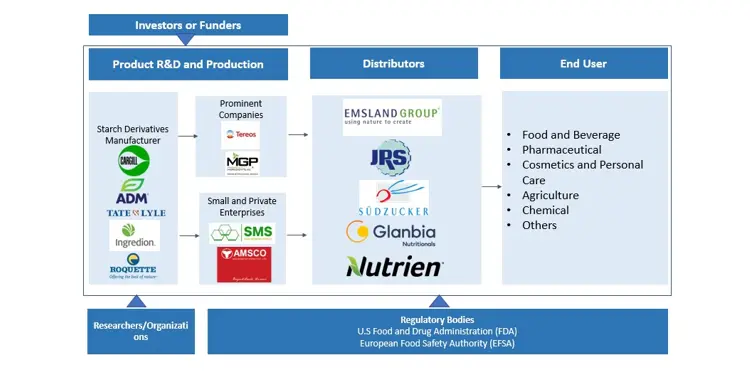
Starch Derivatives Industry Ecosystem:
Starch Derivatives Market Regional Insights:
The Asia Pacific is expected to lead the global starch derivatives market. The leading position in the global market is attributed to the emerging economies of the two most populous countries in the world, namely, China and India. In this region, emerging economies like China & India are expected to witness an increase in modified starch ingestion owing to rapid industrialization and an upsurge in per-capita middle-class spending capacity. It is projected to witness an upsurge in utilization in areas of strange business applications including functional foods, nutrition, and healthcare. Many key players in the global starch derivatives market including Avebe and Ingredion were invested severely in product capacity expansions and setting up new plants, which resulted in the expansion of the end-user industries like the food and beverages industry, the pharmaceutical industry.
Starch Derivatives Market Scope: Inquire before buying
| Starch Derivatives Market | |||
|---|---|---|---|
| Report Coverage | Details | ||
| Base Year: | 2023 | Forecast Period: | 2024-2030 |
| Historical Data: | 2018 to 2023 | Market Size in 2023: | US $ 71.2 Bn. |
| Forecast Period 2024 to 2030 CAGR: | 5.5% | Market Size in 2030: | US $ 103.57 Bn. |
| Segments Covered: | by Type | Maltodextrin Liquid Maltodextrin Powder Maltodextrin Cyclodextrin Other |
|
| by Function | Thickening Stabilizing Binding Emulsifying Others |
||
| by Raw Material | Wheat Corn Potato Sorghum Tapioca Others |
||
| by Application | Food & Beverages Paper Cosmetics Pharmaceuticals Others |
||
Starch Derivatives Market, by Region
North America (United States, Canada and Mexico)
Europe (UK, France, Germany, Italy, Spain, Sweden, Austria and Rest of Europe)
Asia Pacific (China, South Korea, Japan, India, Australia, Indonesia, Malaysia, Vietnam, Taiwan, Bangladesh, Pakistan and Rest of APAC)
Middle East and Africa (South Africa, GCC, Egypt, Nigeria and Rest of ME&A)
South America (Brazil, Argentina Rest of South America)
Starch Derivatives Market Key Players:
Major Contributors in the Starch Derivatives Market in North America:
1. Cargill, Incorporated (United States)
2. Archer Daniels Midland Company (United States)
3. Ingredion Incorporated (United States)
4. Grain Processing Corporation (United States)
5. Penford Corporation (United States))
Major Contributors in the Starch Derivatives Market in Europe:
6. Tate & Lyle PLC (United Kingdom)
7. Roquette Frères (France)
8. Avebe (Netherlands)
9. Tereos S.A. (France)
10. AGRANA Beteiligungs-AG (Austria)
11. Emsland Group (Germany)
12. Südzucker AG (Germany)
13. ALOJA-STARKELSEN LTD. (Latvia)
Major Leading Players in the Starch Derivatives Market in Asia Pacific:
14. Global Bio-chem Technology Group Company Limited (China)
15. SPAC Starch Products (India) Limited (India)
16. Thai Flour Industry Co., Ltd. (Thailand)
17. Universal Starch Chem Allied Ltd (India)
18. Zhucheng Xingmao Corn Developing Co., Ltd. (China)
19. Everbright Starch Co., Ltd. (China)
20. Manildra Group (Australia)
FAQs:
1. What are the growth drivers for the Starch Derivatives Market?
Ans. Starch derivatives are widely used in food processing for their functional properties like thickening, stabilizing, and binding, thus, the growing demand for processed foods globally is a significant driver. Starch derivatives find applications in non-food sectors such as pharmaceuticals, papermaking, textiles, and adhesives. The expansion of these industries, particularly in emerging economies, contributes to the Starch Derivatives market's growth.
2. What are the major restraints for the Starch Derivatives Market growth?
Ans. Price sensitivity among consumers may limit the market penetration of Starch Derivatives due to their higher cost.
3. Which region is expected to lead the global Starch Derivatives Market during the forecast period?
Ans. Asia Pacific is expected to lead the global Starch Derivatives Market during the forecast period.
4. What is the projected market size and growth rate of the Starch Derivatives Market?
Ans. The Starch Derivatives Market size was valued at USD 71.2 Billion in 2023 and the total revenue is expected to grow at a CAGR of 5.5% from 2024 to 2030, reaching nearly USD 103.57 Billion by 2030.
5. What segments are covered in the Starch Derivatives Market report?
Ans. The Starch Derivatives report covers Type, Function, Raw Material, Application, and Region.