
Sports Drink Market - Industry Structure Evaluation, Demand Drivers Analysis, Regional Growth Analysis and Identification, Competitive Positioning / Landscape Review & Global Market Size Forecast to 2032
Overview
Global Sport Drink Market size was valued at USD 28.11 Bn in 2025, and the total Sport Drink revenue is expected to grow at a CAGR of 6.15% from 2026 to 2032, reaching nearly USD 42.70 Bn. The sports drink category is experiencing a dynamic transformation, driven by a rising focus on holistic health and wellness. The demand for functional beverages is now increasing to a wider audience interesting to individuals who aim to fuel both their body and mind throughout the day.
Report Overview
An introduction of functional ingredients like protein-infused sports drinks, immune-boosting beverages, and anti-inflammatory compounds are expected to drive demand for sport drink. The global sports drink consumption topped 1.9 billion liters in 2025. The isotonic sport drink variants held the dominant position with a share of approximately 61% of the total sport drink volume. The Asia-Pacific region has witnessed a significant uptick, with over 550 million liters sport drink consumption in 2025. The prominent sport drink brands are concentrating to deploy sport drink eco-friendly packaging and sourcing ingredients from sustainable practices as sustainability is a top priority for sport drink.
Key highlights:
• By soft drink type, isotonic products held 53% in the global sports drinks market share in 2025 and hypertonic beverages are expected to grow at a 6.55% rate of CAGR during the forecast Period.
• By geography, North America accounted the largest revenue in 2025, and Asia-Pacific is expected to grow at a 6.8% rate of CAGR during the forecast Period.
• Europe sports drinks market was valued at a USD 3.17 billion and expected to grow at a 6.1% rate Of CAGR during the forecast period.
• By soft-drink type, isotonic variants held the dominant position in India sports drinks market share, with a 58 % in 2025.
• PET bottles dominated with a 94% share in 2025 in the Asia Pacific Sport Drink market in 2025.
Sport Drink Market: Demand Drivers and Growth Catalysts
An Increase in Sport Population Drive the demand for Sport Drink
The global sports drink market growth is driven by factors like fitness trends, present of younger generation across developing economies like China & India, growth in disposable incomes, and awareness of health benefits. According to the International Health, Racquet & Sports Club Association, 74% of young people has reported exercising at least once a week in October 2025, which has contributed to a demand for healthy hydration solutions like sport drink. An increase in fitness activity has delicate the requirement for products that replenish electrolytes lost during exercise. The consumption of sports drinks is assisting to fill this gap by delivering hydration and enhancing performance. The presence of approximately 8,000 sports across the globe, and 200 internationally recognized sports are booting the demand for high sport drink. High emphasis on fitness and hydration is expected to drive the demand for sports drinks.
Low-Sugar, Organic, and Plant-Based Options are becoming prominent key trend in the Sport Drink Market.
Currently, many consumers are preferring sports drinks with lower sugar content or entirely sugar-free, as they become more health-conscious and aware of the effects of excessive sugar consumption. Prominent sport drink Brands are focusing to respond to low-sugar content sport drink preference shift by presenting drinks made with natural sweeteners, organic ingredients, and plant-based components. An increase in interest in clean-label and eco-friendly sport drink products are expected to drive the demand for lower sugar content or entirely sugar-free sport drink. As health concerns around sugar intake increasing, many consumers are preferring to sports drinks that offer healthier, low-sugar alternatives. Brands like Gatorade Zero, Powerade Zero, and other low-calorie options are focusing to respond to low-sugar demand, with sales of sugar-free sports drinks.
Sport Drink Market: Price Analysis
 To know about the Research Methodology :- Request Free Sample Report
The price analysis of the USA sport drink sales volume shows a consistent growth line in both unit sales and revenue during the period 2024-2025. Despite the positive growth in unit sales in (2024-2025), sport drink unit sales growth is comparatively slower at 5.5% for the same period. The graph shows that as the volume of sport drink units sold is increasing significantly, the average price per unit is experiencing pressure, potentially because of competitive pricing strategies, discounting, or product mix formulation. The quarterly growth rates have further revealed that while unit sales are growing at 13.75% from 2024 to 2025. Despite U.S. sports drink market is experiencing robust volume growth, pricing strategies and product positioning are expected to need to be recalibrated to sustain or enhance profitability during the forecast period.
Sports drink consumption Analysis:
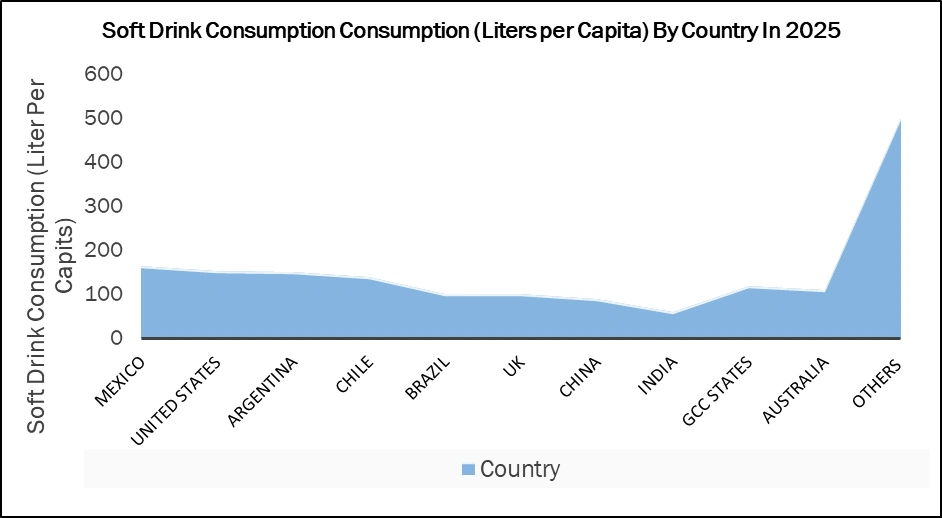
In 2025, sports drink consumption has reached 1.8 billion liters. High demand for energy and electrolyte beverages, increasing participation in fitness activities and awareness of the importance of proper hydration among sport population are some of the prominent factors behind the Sport drink Consumption. High sport drink consumption highlights a broader trend towards functional beverages and hydration drinks as consumers are seeking healthier, more active ways to support their athletic performance. Fitness drinks are becoming integral to many people's daily routines, predominantly as gym memberships, home workout programs. The global fitness industry now valued at over USD 87 billion in 2025, according to the Global Health and Fitness Association, which is expected to drive the demand for Sport Drink, as the number of people engaging in fitness activities has risen exponentially growth rate. The sports protein RTD in consumer health and powder concentrates in soft drinks are expected to grow at CAGR of 12.2% and 4.8%, respectively In the Asia Pacific Region during the forecast period.
Sport Drink Market: Segment Analysis
By end-users, athletes segment held a highest market share with a 40% in 2025. Need for hydration, energy, and electrolyte replenishment energy during powerful physical activities are contributing to the high adoption rate of sport drink. High rate of per-capita consumption and need of sport drink for performance with hydration formulations are expected to boost the demand for sport drink.

Sport Drink Market: Regional Analysis
North America held the dominant Position in the Global Sport Drink Market in 2024 with a share of. The high level of fitness consciousness, coupled with a large number of sports and fitness enthusiasts are some of the prominent factors behind the market dominance. The North America Sport Drink market growth is driven by the high levels of fitness consciousness and sports participation in countries like the United States and Canada. USA is expected to hold more than 80% share in the Sport drink market during the forecast period because of presence of number of active consumers and a growing preference for functional beverages. Established brand players are focusing on premium positioning, clean-label formulations, and direct-to-consumer strategies to increase their profit in the sport drink business. Some of the prominent brands are forming authentic connections with health-conscious consumers who are willing to pay a premium price for perceived quality and functional benefits of the sport drink across the North America.
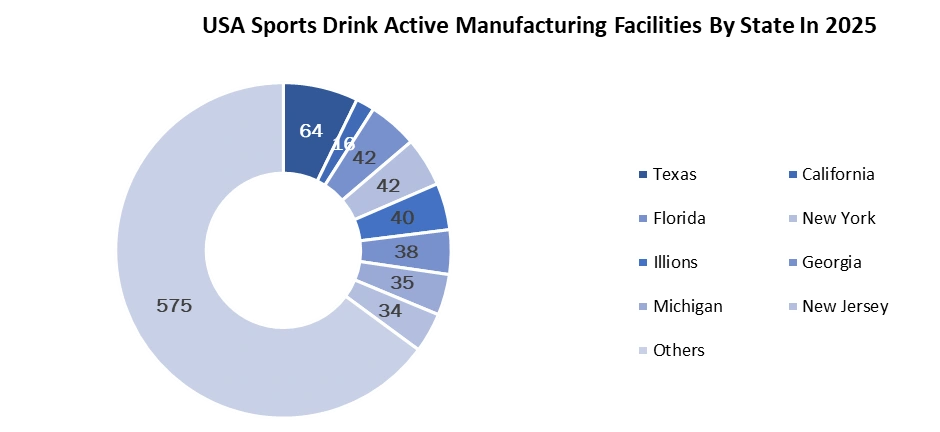 The Texas leads with the highest number of facilities at 64, followed by California and Florida, both with 42 facilities each. Other key states such as Illinois, Michigan, New York, Georgia, and New Jersey each have significant manufacturing presence, with facility counts ranging from 34 to 40. The rest of the country accounts for 575 additional facilities in the total USA sport drink active manufacturing facilities. The graph highlights the concentration of sports drink manufacturing in states with strong consumer markets, robust logistics infrastructure, and growing demand for hydration and performance-enhancing beverages in 2025. The United States sports drinks market was valued at USD 12 billion in 2025 and it is expected to grow at a 4.55% rate of CAGR during the forecast period. the premiumization of sport drink products, and innovation in functional sport drink ingredient are some of the prominent drivers behind the sport Drink demand in USA.
Europe Sports Drinks Market Insights
• By sports-drinks type, isotonic sport variant held a dominant share with a 55% in Europe sports drinks market share in 2025 and hypertonic drinks are expected to grow at a 6% rate of CAGR during the forecast period.
• By packaging, PET bottles held a maximum share with a 94 % in 2025 and metal cans are expected to grow at a high rate of CAGR in the near future.
• The supermarkets/hypermarkets accounted for more than 58% share in the Europe Soft drink market.
• By Country, Germany held the dominant position in the Europe Sports Drinks Market with a share of 28%.
Competitive Landscape Analysis
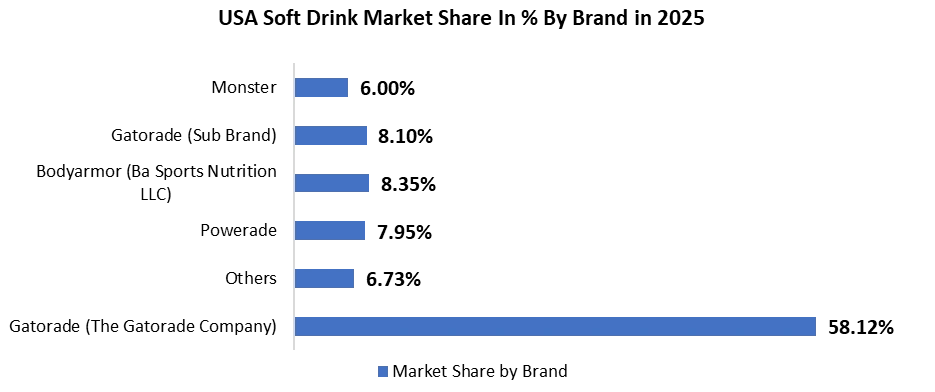 North America: The US Sport Drink Market is dominated by three brands- Gatorade, Powerade and Bodyarmor. Big Three players are making up more than 87% of the USA Sport drink Category. Gatorade held the largest share as 61.6% in the USA sport drink market. The Gatorade is projected to hold maximum share with a range from 58.10% to 63% by 2026, that highlights its strong market leadership in the USA Sport drink market. The competitive landscape is witnessing a steady growth rate among key players, that strengthening the dominance of Gatorade in the USA sports drink Consumption.
Sport Drink Product Launched In 2025
| Product Name | Company | Launch Date | Key Features | Target Market |
| Powerade UltraBoost | The Coca-Cola Company | March 2025 | Enriched with B-vitamins, rapid-absorption electrolytes, and natural energy blends | High-performance beverage seekers |
| Gatorade PRO Electro+ | PepsiCo | February 2025 | Enhanced electrolytes, cleaner ingredients, sustained-energy carbohydrates | Athletes and fitness enthusiasts needing recovery |
| Monster Hydrate Max | Monster Beverage | January 2025 | Zero-sugar, infused with electrolytes, amino acids, and natural flavors | Fitness-focused consumers, moving beyond energy drinks |
Sport Drink Market Scope: Inquire before buying
| Global Sport Drink Market | |||
|---|---|---|---|
| Report Coverage | Details | ||
| Base Year: | 2025 | Forecast Period: | 2026-2032 |
| Historical Data: | 2020 to 2025 | Market Size in 2025: | USD 28.11 Bn. |
| Forecast Period 2026 to 2032 CAGR: | 6.15% | Market Size in 2032: | USD 42.70 Bn. |
| Segments Covered: | by Type | Isotonic Hypertonic Hypotonic |
|
| by Liquid | Liquid / Ready‑to‑Drink (RTD) Powdered Formulations |
||
| by Packaging | Pet Bottles Cans Pouches Others |
||
| by Distribution Channel | Supermarkets / Hypermarkets Convenience Stores / Retail Stores Online Retail / E‑commerce Platforms Specialty Sports / Fitness Outlets Others |
||
| by End User | Athletes & Professional Sportspersons Fitness Enthusiasts / Gym‑Goers Casual / Everyday Consumers |
||
| by Flavor | Lemon Fruit Punch Orange Grape Mixed Fruit / Others |
||
Sport Drink Market, by Region
North America (United States, Canada and Mexico)
Europe (UK, France, Germany, Italy, Spain, Sweden, Austria and Rest of Europe)
Asia Pacific (China, South Korea, Japan, India, Australia, Indonesia, Malaysia, Vietnam, Taiwan, Bangladesh, Pakistan and Rest of APAC)
Middle East and Africa (South Africa, GCC, Egypt, Nigeria and Rest of ME&A)
South America (Brazil, Argentina Rest of South America)
Sport Drink Key Players
1. PepsiCo
2. Abbott Nutrition
3. The Coca-Cola Company
4. Monster Beverage Corporation
5. Red Bull GmbH
6. BodyArmor
7. Suntory Holdings
8. Otsuka Pharmaceutical Co., Ltd.
9. AJE Group
10. Danone S.A.
11. Nuun Hydration
12. Electrolit
13. Britvic plc
14. GU Energy Labs
15. Sqwincher
16. Drink Hoist
17. BioSteel Sports Nutrition
18. Isostar
19. A-Bomb Energy
20. Amway Corp
21. Gusto Organic Ltd
22. Hype Energy Drinks
23. Keurig Dr Pepper, Inc.
24. National Beverage Corp.
25. Carlsberg A/S
26. FDC ltd
27. Cipla Health Ltd
28. Tata Consumer Products Limited
29. Ocean Bevaerages
30. Dabur India Limited
31. Hoist
32. Nooma
33. Goodonya
34. Others
FAQ:
Q1: What key factors are driving growth in the Global Sport Drink Market from 2025 to 2032?
Ans: The market growth is primarily fueled by Higher awareness of functional hydration (electrolytes, performance, recovery, presence of fitness, sports participation, and “active lifestyle” consumers and Shift toward low/zero-sugar and clean-label formulations.
Q2: How fast is the ready-to-drink Sport Drink segment expected to grow?
Ans: The RTD sports drink is expected to grow at a more than 6.5% rate of CAGR during the forecast Period.
Q3: Which region held the largest market share in Sport Drink in 2025?
Ans: North America leads with about xx% market share, driven by high health and fitness awareness and strong consumer demand for hydration and performance beverages.
Q4: Which company has accounted for the highest market share in the Sport Drink Market in 2025?
Ans: The company that has accounted for the highest market share in the global Sports Drink market is PepsiCo, Inc., primarily due to its Gatorade brand, which leads globally with the largest individual market share.
Q5: Who are the leading players in the Sport Drink Market?
Ans: Key players include PepsiCo, Abbott Nutrition, The Coca-Cola Company, Monster Beverage Corporation, Red Bull GmbH, BodyArmor, Suntory Holdings, Otsuka Pharmaceutical Co., Ltd., AJE Group, Danone S.A., Nuun Hydration, Electrolit, Britvic plc and GU Energy Labs.