
Spirulina Market by Type, Drug Formulation, Application, and Region - Global Market Size Estimation, Industry-Wide Analysis, Competitive Landscape Assessment & Long-Term Forecast to 2032
Overview
The Spirulina Market size was valued at USD 651.35 Million in 2024 and the total Spirulina revenue is expected to grow at a CAGR of 10.6% from 2025 to 2032, reaching nearly USD 1458.34 Million.
Spirulina is a cyanobacteria (blue-green algae) biomass that people and animals may ingest. Arthrospira platensis, A. fusiformis, and A. maxima are the three species. Arthrospira is a plant that is grown all over the world and is used as a nutritional supplement or entire food. It is also utilised in the aquaculture, aquarium, and poultry sectors as a feed additive. Spirulina is being studied for its potential to solve food security and malnutrition, as well as as a nutritional supplement in long-term space flight or Mars expeditions. Its benefit for food security is that it requires less space and water to generate protein and energy than cattle. Spirulina powder comprises 5% water, 24% carbs, 8% fat, and about 60% (51-71% protein). Several research have been conducted on spirulina as an alternative feed for animals and aquaculture. Spirulina can be fed up to 10% for poultry and less than 4% for quail.
Spirulina has been proven to be a safe alternative feedstock and immune booster for bigmouth buffalo, milk fish, cultured striped jack, carp, red sea bream, tilapia, catfish, yellow tail, zebrafish, shrimp, and abalone, with up to 2% spirulina per day in aquaculture feed. According to the National Institutes of Health, there is inadequate scientific evidence to advocate spirulina supplementation for any human condition, and additional study is needed to determine whether intake is beneficial. Spirulina has been studied as a technique to regulate glucose in diabetics, however the European Food Safety Authority dismissed the claims in 2013. Spirulina has been researched as a possible dietary supplement for HIV-infected adults and children, but no significant effect on risk of mortality, body weight, or immunological response was found.
Research Methodology
The research report highly depends on both primary and secondary data sources. The research process involves the investigation of various factors affecting the industry, such as government policy, market environment, competitive landscape, historical data, current market trends, technological innovation, upcoming technologies, and technical progress in related industries, as well as market risks, opportunities, market barriers, and challenges. All conceivable elements influencing the markets included in this research have been considered, examined in depth, validated through primary research, and evaluated to provide the final quantitative and qualitative data. The market size for top-level markets and sub-segments is normalised, and the impact of inflation, economic downturns, regulatory & policy changes, and other variables is factored into the market forecast.
This data is combined and added with detailed inputs and analysis, and presented in the report. Extensive primary research was conducted to acquire information and verify and confirm the crucial numbers arrived at after comprehensive market engineering and calculations for market statistics; market size estimations; market forecasts; market breakdown; and data triangulation. Bottom-up technique is widely employed in the whole market engineering process, along with multiple data triangulation methodologies, to perform market estimation and forecasting for the overall market segments and sub-segments covered in this research. To know about the Research Methodology :- Request Free Sample Report
Spirulina Market Dynamics
Health Benefits of Spirulina Superfood: The spirulina market is likely to expand over the forecast period, thanks to rising consumer awareness of the health advantages of spirulina superfood and a diverse range of natural colours created by spirulina. Increased demand for cyanobacteria due to their assistance to weight loss, as well as a rising number of health clubs and fitness centres, are likely to fuel spirulina market share growth in the future years. Cyanobacteria's health advantages have led to its use in sweets, smoothies, juices, salads, and breakfast dishes.
Natural Food Colors Produced from Spirulina: Factors such as the introduction of new variations of natural food colours derived from spirulina, the natural health benefits of spirulina superfood, and different government efforts connected to spirulina production are expected to drive the spirulina market over the forecast period.
Spirulina in Pharmaceutical Products: Spirulina powder is in high demand in the skin and hair care industry as an ingredient in a variety of treatments, including anti-aging, wrinkles, grey hair, hair loss, and allergies. Spirulina powder is utilised in a variety of therapies, as well as a number of pharmaceutical goods, in the medical business. Furthermore, governments in countries such as India and South Africa are encouraging the production of spirulina due to its health advantages, which aids in the expansion of the spirulina market.
Governments Promoting Production of Spirulina: Various governments have begun to promote spirulina production in order to enhance the market and provide a viable source of income for the rural people. Many governments, like India, Angola, and Ghana, are actively supporting the local spirulina market and creating a strong gateway for the growth of this superfood, which has the potential to transform the direction of food for the whole race.
Spirulina-Based Products to Prevent Hunger: The rising demand for spirulina-based products to combat hunger during humanitarian disaster relief and military fighting circumstances is driving market expansion. Furthermore, the increasing usage of spirulina as a feed additive for intense animal growth and advancement is driving the global market forward. The business is also being fuelled by a trend in the animal husbandry and aquaculture industries away from chemical-based feed additives and toward organic alternatives.
Synthetic Colors Usage Banned in EU Countries: The European Food Safety Authority (EFSA), the EU's food safety regulatory body, has outlawed the use of synthetic colours in items consumed in EU nations, supporting the growth of the natural colour sector. Blue Spirulina has become the most appealing hue in the world because to its characteristics and texture, and it is mostly used in the food and beverage industries. Because of its anti-oxidant, hypolipidemic, and anti-inflammatory properties, spirulina is in high demand in the food and beverage and cosmetics industries. Antioxidants protect the body from damage produced by dangerous molecules (free radicals), hence improving a person's health.
Companies Focusing on Spirulina Products: Spirulina has high levels of Vitamins A, C, and E, as well as beta-carotene, with just a trace of Lutein Zeaxanthin - all of which are antioxidants that aid in the treatment of many illnesses and medical problems. The current trend for which firms are releasing novel items to meet the demands of modern society is changing customer tastes toward nutritious and healthful products.
For example, Naked Juice introduced their 100% juice line, which includes spirulina as a key component. Key trends observed in the spirulina market include growing manufacturing of ready-to-drink spirulina smoothies and surging demand for spirulina in the bio-fuel sector, which is projected to drive spirulina demand over the forecast period.
Lower Stability & Poor Sustainability: Natural colours created from spirulina have lower stability and sustainability when compared to synthetic colours, and tight government regulations are expected to hamper market growth during the forecast period. Untapped markets in emerging nations are also expected to create attractive prospects for market players.
Spirulina Market Segment Analysis
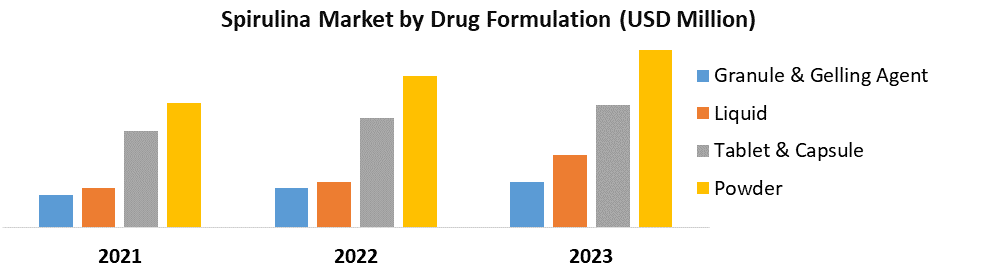
Based on Drug Formulation, the global Spirulina market is segmented into Powder, Tablet & Capsule, Liquid, and Granule & Gelling Agent. The Powder category accounted for 78% of the spirulina market in 2024 and is expected to expand at the fastest CAGR of 10.7% during the forecast period. This is mostly owing to increased demand from nutraceutical manufacturers as a consequence of expanding consumer health awareness, as well as its increasing use as an ingredient in a variety of food and beverage items.
Based on Application, the global Spirulina market is segmented into Food & beverages, Nutraceutical, Animal and Aquaculture Feed, Pharmaceutical, Veterinary, Cosmetic, and Others. In the Nutraceutical category had the biggest market share of xx% and is likely to dominate the total spirulina market over the forecast period. This is due to increased concern about nutrition and health, as well as a preference for natural alternatives to standard pharmaceutical goods. Spirulina is also widely utilised in the food and beverage industries since it contains a high concentration of natural pigments that impart blue colour and may be blended with other colours to create new bespoke colours such as lavender, violet, and green. It is also widely used in the cosmetic and personal care industries. Furthermore, it is mostly utilised in cosmetic and personal care goods, particularly anti-aging cream.
Spirulina Market Regional Insights
North America held the greatest market share of 51% in 2024, followed by Europe and Asia Pacific, and is likely to maintain its lead in the Spirulina market during the forecast period. Because of the growing need in this region for organically derived food colouring ants. Due to the region's robust expansion in the food processing sector, Asia-Pacific is expected to expand at the fastest CAGR during the forecast period, providing profitable potential for market participants. Furthermore, increased demand for spirulina powder among vegetarian customers is another factor driving market expansion, since spirulina is a 100% vegetarian dietary supplement.
Due to extensive spirulina production in countries such as Korea, Indonesia, and China, Asia Pacific is seeing substantial market expansion. The widespread use of spirulina in nutraceuticals for the production of protein-rich dietary supplements has boosted market growth. The region's spirulina market is also being driven by rising demand from the cosmetic and pharmaceutical industries. Europe is a major market due to manufacturers' increasing need for natural food colours in processed goods. Because of rising demand in the food and beverage sectors, such as bread and confectionery, France and the United Kingdom are prospective markets for spirulina. Consumer tastes are evolving toward minimally processed meals with greater visual appeal, which has benefited the market performance of clean-label ingredients such as spirulina.
Report Scope:
The Spirulina Market research report includes product categorization, product application, development trend, product technology, competitive landscape, industrial chain structure, industry overview, national policy and planning analysis of the industry, and the most recent dynamic analysis, among other things. The study discusses the global market's drivers, opportunities, and limitations. It discusses the influence of various drivers, trends, and constraints on market demand during the forecast period. The research also outlines market potential on a global scale.
The research includes the production time, base distribution, technical characteristics, research and development trends, technology sources, and raw material sources of significant Spirulina Market firms in terms of production bases and technologies. The more precise research also contains the key application areas of market and consumption, significant regions and consumption, major producers, distributors, raw material suppliers, equipment providers, and their contact information, as well as an analysis of the industry chain relationship. This report's study also contains product specifications, manufacturing processes, cost structure, and data information organised by area, technology, and application.
Spirulina Market Scope: Inquire before buying
| Spirulina Market | |||
|---|---|---|---|
| Report Coverage | Details | ||
| Base Year: | 2024 | Forecast Period: | 2025-2032 |
| Historical Data: | 2019 to 2024 | Market Size in 2024: | USD 651.35 Mn. |
| Forecast Period 2025 to 2032 CAGR: | 10.6% | Market Size in 2032: | USD 1458.34 Mn. |
| Segments Covered: | by Type | ArthrospiraPlatensis Arthrospira Maxima |
|
| by Drug Formulation | Powder Tablet & Capsule Liquid Granule & Gelling Agent |
||
| by Application | Food & beverages Nutraceutical Animal and Aquaculture Feed Pharmaceutical Veterinary Cosmetic Others |
||
Spirulina Market, by Region
North America (United States, Canada and Mexico)
Europe (UK, France, Germany, Italy, Spain, Sweden, Austria and Rest of Europe)
Asia Pacific (China, South Korea, Japan, India, Australia, Indonesia, Malaysia, Vietnam, Taiwan, Bangladesh, Pakistan and Rest of APAC)
Middle East and Africa (South Africa, GCC, Egypt, Nigeria and Rest of ME&A)
South America (Brazil, Argentina Rest of South America)
Spirulina Market Key Players
1. Sensient Technologies Corp.
2. Parry Nutraceuticals Limited
3. GNC Holdings, Inc.
4. Now Health Group Inc.
5. Naturex S.A.
6. Naturalin Bio-Resources Co., Ltd
7. GNT Holding B.V.
8. Fuqing King DnarmsaSpirulina Co., Ltd.
9. FrakenBiochem Co., Ltd.
10. Far East Bio-Tec Co., Ltd.
11. Dongtai City Spirulina Bio-Engineering Co., Ltd.
12. Dhler GmbH
13. DIC Corporation
14. DDW Inc.
15. Cyanotech Corp
16. Chr. Hansen Holding A/S
17. Cabassi & Giuriati SpA
18. Echlorial
19. Givaudan international SA
20. Yunnan Green A Biological Project Co., Ltd
21. Earthrise Nutritionals, Llc
22. Zhejiang Comp Spirulina Co., Ltd.
Frequently Asked Questions:
1] What segments are covered in Spirulina Market report?
Ans. The segments covered in Spirulina Market report are based on Type, Drug Formulation and Application.
2] Which region is expected to hold the highest share in the global Spirulina Market?
Ans. North America is expected to hold the highest share in the global Spirulina Market.
3] What is the market size of global Spirulina Market by 2032?
Ans. The market size of global Spirulina Market by 2032 is USD 1458.34 Mn.
4] Who are the top key players in the global Spirulina Market?
Ans. Sensient Technologies Corp., Parry Nutraceuticals Limited, Now Health Group Inc., Naturex S.A., Naturalin Bio-Resources Co., Ltd and GNT Holding B.V. are the top key players in the global Spirulina Market.
5] What was the Global Spirulina Market size in 2024?
Ans: The Global Spirulina Market size was USD 651.35 Million in 2024.
6] By Application, What segments are covered in global Spirulina Market report?
Ans. The segments covered in global Spirulina Market report by application are Food & beverages, Nutraceutical, Animal and Aquaculture Feed, Pharmaceutical, Veterinary, Cosmetic and Others.