
Global Spine Surgery Robots Market– Industry Structure Evaluation, Demand Drivers Analysis, Regional Growth Analysis and Identification, Competitive Positioning / Landscape Review & Global Market Size Forecast to 2032
Overview
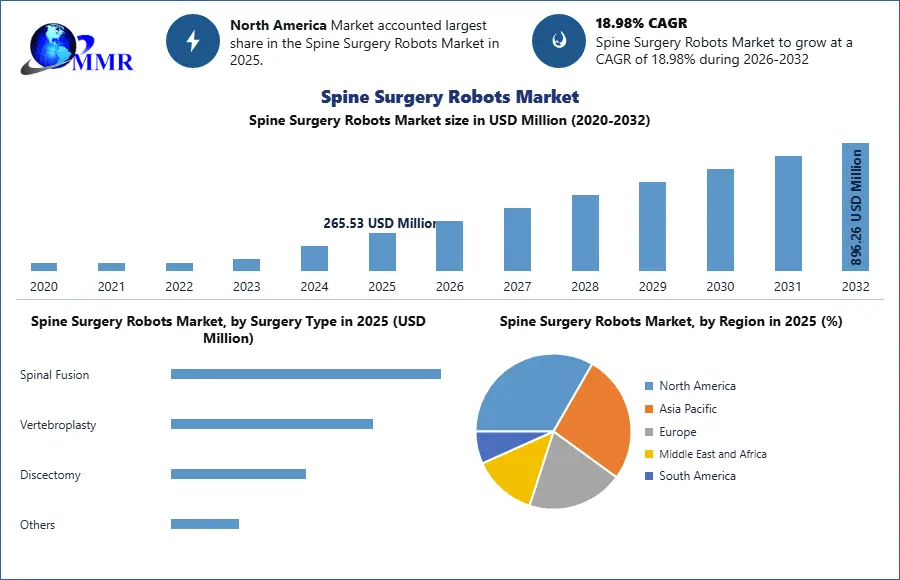
Spine Surgery Robots Market size was valued at US$ 265.53 USD Mn. in 2025 and the total revenue is expected to grow at a CAGR of 18.98% from 2026 to 2032, reaching nearly US$ 896.26 Mn.
Spine Surgery Robots Market Overview
Spine surgery robots enhance surgical precision, improve implant positioning accuracy, and reduce complications during complex spinal procedures such as spinal fusion, vertebroplasty, and discectomy. The Spine Surgery Robots Market is experiencing strong growth due to increasing demand for minimally invasive spinal procedures, rising prevalence of spinal disorders, and advancements in robotic-assisted surgical technologies. Hospitals and specialty surgical centers are increasingly adopting robotic-assisted systems to improve patient outcomes, reduce recovery time, and minimize surgical errors.
Technological advancements including AI-based navigation systems, 3D imaging, real-time surgical planning, and robotic guidance platforms are accelerating market adoption globally. North America dominates the market owing to advanced healthcare infrastructure and high adoption of robotic-assisted surgeries, while Asia-Pacific is emerging rapidly due to increasing healthcare investments and growing orthopedic patient populations. Rising demand for precision-based surgical procedures and continuous innovation in robotic spinal navigation systems are expected to further drive market expansion during the forecast period.
To know about the Research Methodology :- Request Free Sample Report
Spin Surgery Robots Market Dynamics
Increasing Demand for Minimally Invasive Spine Surgeries
The growing preference for minimally invasive spine surgeries is a major driver for the Spine Surgery Robots Market. Robotic-assisted systems improve surgical precision, reduce blood loss, minimize tissue damage, and shorten patient recovery time compared to conventional open surgeries. Rising incidence of spinal disorders such as degenerative disc disease, scoliosis, spinal stenosis, and herniated discs is increasing the demand for advanced robotic surgical systems globally. Hospitals are increasingly adopting robotic platforms integrated with navigation and imaging technologies to enhance procedural accuracy and reduce revision surgeries. Additionally, growing elderly populations and increasing healthcare expenditure are supporting wider adoption of robotic-assisted spinal surgeries across developed and emerging healthcare markets.
Trend: Integration of AI and Real-Time Navigation Systems
A key trend in the Spine Surgery Robots Market is the integration of artificial intelligence, machine learning, and real-time navigation technologies into robotic surgical platforms. Advanced robotic systems now offer 3D imaging, intraoperative navigation, predictive analytics, and automated surgical planning to improve procedural outcomes and surgical workflow efficiency. AI-enabled robotic systems assist surgeons in accurate implant placement and trajectory planning during complex spinal surgeries. Companies are increasingly focusing on cloud-based surgical data management and augmented reality-assisted navigation technologies. The rising adoption of smart operating rooms and digitally connected surgical ecosystems is further transforming robotic spine surgery procedures and improving patient safety across healthcare institutions globally.
Opportunity: Expansion of Robotic Surgery Adoption in Emerging Markets
Emerging economies such as China, India, Brazil, and Southeast Asian countries present significant growth opportunities for the Spine Surgery Robots Market due to improving healthcare infrastructure and rising investments in advanced medical technologies. Increasing awareness regarding robotic-assisted surgeries and growing demand for precision surgical procedures are encouraging hospitals to adopt robotic spine surgery systems. Government healthcare modernization initiatives and expansion of private multi-specialty hospitals are further accelerating market opportunities. Additionally, increasing medical tourism in Asia-Pacific and the Middle East is supporting demand for advanced robotic surgical technologies. Growing partnerships between healthcare providers and robotic system manufacturers are expected to create long-term expansion opportunities globally.
Restraint: High Cost of Robotic Surgical Systems
The high acquisition and maintenance cost of robotic spine surgery systems remains a major restraint for market growth. Advanced robotic platforms require substantial investments in hardware, software integration, imaging systems, and surgeon training programs, limiting adoption among small and mid-sized healthcare facilities. Additionally, recurring maintenance expenses, software upgrade costs, and lengthy implementation timelines increase operational burdens for hospitals. Limited reimbursement policies for robotic-assisted procedures in several developing countries also restrict widespread adoption. Furthermore, concerns regarding technical complexities, cybersecurity risks, and the requirement for highly skilled surgeons continue to challenge the expansion of robotic spine surgery systems in cost-sensitive healthcare markets.
Spine Surgery Robots Market Segment Analysis
By Component
The Instruments segment dominates the Spine Surgery Robots Market due to increasing demand for robotic surgical tools, navigation instruments, robotic arms, and precision-guided implant placement systems during spinal procedures. Robotic instruments play a critical role in enhancing surgical accuracy, minimizing human error, and improving overall procedural efficiency in spinal fusion, vertebroplasty, and discectomy surgeries. Hospitals and surgical centers are increasingly investing in advanced robotic instrument systems integrated with real-time navigation and imaging technologies to improve patient outcomes. Continuous technological advancements in robotic-assisted instrumentation and AI-enabled surgical guidance systems are further supporting segment growth.
By Surgery Type
The Spinal Fusion segment holds the largest market share due to the rising number of spinal deformity and degenerative disc disease cases globally. Robotic-assisted spinal fusion surgeries provide higher implant accuracy, reduced complications, and faster patient recovery compared to traditional surgical approaches. Increasing adoption of minimally invasive spinal fusion procedures and growing demand for precision-guided implant placement are driving segment expansion worldwide.
Spine Surgery Robots Market Regional Analysis
North America dominated the Spine Surgery Robots Market in 2025, due to the strong presence of advanced healthcare infrastructure, high adoption of robotic-assisted surgeries, and increasing prevalence of spinal disorders across the region. The United States accounts for the largest market share owing to rising demand for minimally invasive spine procedures, growing geriatric population, and substantial investments in healthcare technology innovation. Major medical robotics companies and continuous technological advancements in AI-based navigation systems, 3D imaging, and robotic surgical platforms are strengthening regional market growth.
Favorable reimbursement frameworks, increasing surgeon awareness, and the growing number of specialized orthopedic and neurosurgical centers are accelerating robotic system adoption. Additionally, rising incidences of degenerative spinal diseases, obesity-related spinal complications, and sports injuries are increasing surgical procedure volumes. Canada is also witnessing steady growth due to increasing healthcare modernization and expanding adoption of precision-based robotic surgical technologies across hospitals and specialty surgical centers.
Recent Developments
15 April 2026 – Medtronic plc (Ireland)
Medtronic expanded the capabilities of its Mazor robotic-assisted spine surgery platform by integrating advanced AI-driven surgical planning and intraoperative navigation technologies. The company focused on improving precision in minimally invasive spine procedures, reducing surgical complications, and enhancing real-time imaging integration for complex spinal surgeries. Medtronic also strengthened partnerships with major hospitals and surgical centers across North America and Europe to increase adoption of robotic spine systems. The development supports growing demand for robotic-assisted spinal procedures, improved patient outcomes, shorter recovery periods, and enhanced surgical workflow efficiency in the global Spine Surgery Robots Market.
28 March 2026 – Stryker Corporation (United States)
Stryker announced expansion of its robotic spine surgery portfolio through enhanced integration of navigation software, imaging systems, and robotic-assisted surgical technologies. The company upgraded its spinal robotics platform to improve implant positioning accuracy and procedural efficiency during minimally invasive spine surgeries. Stryker also increased investments in AI-powered surgical analytics and digital operating room technologies to support advanced orthopedic and spine procedures. Rising demand for precision-based robotic surgery, reduced hospitalization time, and improved surgical outcomes is accelerating adoption of Stryker’s robotic spine solutions across hospitals and specialty surgical centers globally, strengthening its position in the Spine Surgery Robots Market.
Spine Surgery Robots Market Scope : Inquire before buying
| Spine Surgery Robots Market | |||
|---|---|---|---|
| Report Coverage | Details | ||
| Base Year: | 2025 | Forecast Period: | 2026-2032 |
| Historical Data: | 2020 to 2025 | Market Size in 2025: | 265.53 USD Million |
| Forecast Period 2026-2032 CAGR: | 18.98% | Market Size in 2032: | 896.26 USD Million |
| Segments Covered: | by Component | Instruments Software Others |
|
| by Surgery Type | Spinal Fusion Vertebroplasty Discectomy Vertebroplasty Others |
||
| by Indication | Herniated Discs Scoliosis Spinal Stenosis Spondylolisthesis Degenerative Disc Disease Others |
||
| by End-User | Hospitals & ASCs Specialty Clinics Others |
||
Spine Surgery Robots Market, by Region
North America (United States, Canada and Mexico)
Europe (UK, France, Germany, Italy, Spain, Sweden, Austria and Rest of Europe)
Asia Pacific (China, South Korea, Japan, India, Australia, Indonesia, Malaysia, Vietnam, Taiwan, Bangladesh, Pakistan and Rest of APAC)
Middle East and Africa (South Africa, GCC, Egypt, Nigeria and Rest of ME&A)
South America (Brazil, Argentina Rest of South America)
Key players/Competitors profiles covered in the Spine Surgery Robots Market report in strategic perspective
- Medtronic plc (Ireland)
- Stryker Corporation (United States)
- Globus Medical, Inc. (United States)
- Zimmer Biomet Holdings, Inc. (United States)
- Johnson & Johnson (United States)
- Intuitive Surgical, Inc. (United States)
- Smith & Nephew plc (United Kingdom)
- Brainlab AG (Germany)
- CMR Surgical Ltd. (United Kingdom)
- Renishaw plc (United Kingdom)
- Asensus Surgical, Inc. (United States)
- Think Surgical, Inc. (United States)
- Corindus Vascular Robotics (United States)
- Medrobotics Corporation (United States)
- eCential Robotics (France)
- Curexo, Inc. (South Korea)
- Point Robotics MedTech Inc. (China)
- OMNIlife Science, Inc. (United States)
- Auris Health, Inc. (United States)
- Verb Surgical Inc. (United States)
- NuVasive, Inc. (United States)
- Mazor Robotics Ltd. (Israel)
- Accuray Incorporated (United States)
- OrthAlign, Inc. (United States)
- Tinavi Medical Technologies Co., Ltd. (China)
- Shanghai MicroPort MedBot Group Co., Ltd. (China)
- Meril Life Sciences Pvt. Ltd. (India)
- Siemens Healthineers AG (Germany)
- Fiagon AG Medical Technologies (Germany