
Global Sparkling Red Wine Market Size by Type, Product, Distribution Channel, Region and Forecast 2034
Overview
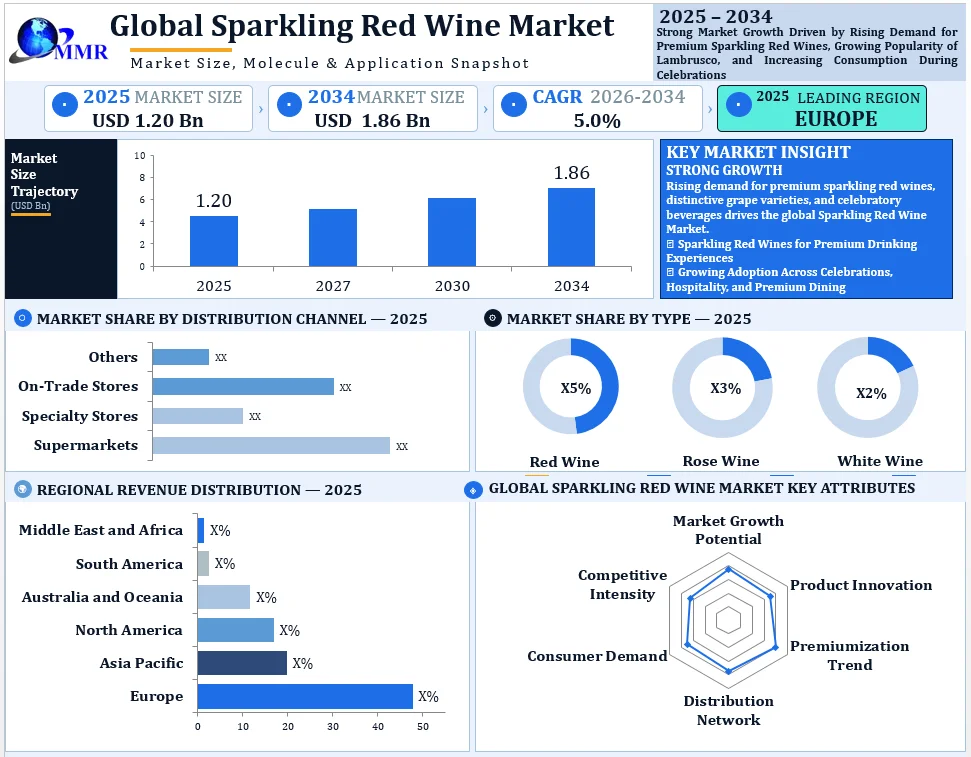
The Global Sparkling Red Wine Market is valued at USD 1.20 billion in 2025 and is projected to reach USD 1.86 billion by 2034, growing at a CAGR of 5.0% during 2025–2034.
Global Sparkling Red Wine Market Overview:
The Global Sparkling Red Wine Market includes the production, distribution, and consumption of red wines containing dissolved carbon dioxide, which creates their characteristic bubbles and effervescence. Popular varieties include Lambrusco and Brachetto d'Acqui, known for their distinctive flavors, aromas, and sweetness levels. These wines are popular at celebrations, social gatherings, and premium dining occasions.
The sparkling red wine market is driven by rising disposable incomes, changing lifestyles, growing demand for premium alcoholic beverages, and increasing consumer interest in unique wine varieties. Expanding hospitality, wine tourism, and online retail channels improve product accessibility. Growing interest in organic wines, sustainable production, innovative packaging, and premium wine experiences creates further opportunities. However, alcohol regulations, taxation, price sensitivity, and competition from other sparkling beverages can influence market growth.
Sparkling Red Wine Market Growth and Share Analysis
To know about the Research Methodology :- Request Free Sample Report
Global Sparkling Red Wine Market: Key Highlights
• Market Size and Growth: The Global Sparkling Red Wine Market reaches USD 1.20 billion in 2025 and is projected to reach USD 1.86 billion by 2034, registering a CAGR of 5.0% during 2026–2034.
• Regional Leadership: Europe leads the market with a 47.71% share in 2025, supported by established winemaking traditions and the popularity of Lambrusco and Brachetto.
• Product Innovation: Producers differentiate their offerings through sweet and dry sparkling red wines, organic varieties, distinctive grape blends, and specialized winemaking methods.
• Distribution Expansion: Supermarkets, specialty wine stores, restaurants, and online retail channels improve product accessibility and support market expansion.
• Competitive Landscape: Regional wineries and established wine producers compete through product quality, premium positioning, regional identity, and international distribution networks.
Global Sparkling Red Wine Market Dynamics
Global Sparkling Red Wine Market Drivers
Growing Demand for Premium Sparkling Wines: Consumer interest in premium alcoholic beverages, distinctive flavors, and new drinking occasions supports demand for sparkling red wine. In 2025, the global sparkling wine market reaches an estimated USD 54.7 billion, reflecting the category's significant presence in the wine industry. Premium varieties, including Lambrusco, benefit from consumer interest in distinctive regional wine styles.
Increasing Popularity Among Younger Adult Consumers: Sparkling wine attracts younger legal-drinking-age consumers who enjoy it at informal gatherings and social occasions. In 2025, 27% of the U.S. legal-drinking-age population consumes sparkling wine. This broader consumer engagement creates opportunities for sparkling red wine producers to expand awareness and consumption occasions.
Global Sparkling Red Wine Market Restraints
Declining Global Wine Consumption: Changing lifestyles, economic pressures, and moderation in alcohol consumption constrain demand across the wine industry. Global wine consumption declines by 2.7% to 208 million hectolitres in 2025, creating a challenging environment for sparkling red wine producers seeking to expand sales.
Price Sensitivity and Premium Product Costs: Higher production, packaging, and distribution costs can make premium sparkling red wines less affordable. In 2025, the average export price of sparkling wine decreases by 3.5% to EUR 7.54 per litre, while export value falls by 6.1%. These market pressures highlight the importance of competitive pricing and effective product positioning.
Global Sparkling Red Wine Market Opportunities
Expansion in Emerging Wine Markets: Emerging markets offer opportunities through expanding hospitality sectors, changing consumer preferences, and increased access to international wine brands. In 2025, Brazil's wine consumption increases by 41.9% to 4.4 million hectolitres, creating a potential opportunity for producers to explore the market through targeted distribution and regionally appropriate product offerings. This figure relates to total wine consumption, not sparkling red wine specifically.
Innovation in Alcohol-Free and Alternative Products: Growing interest in alcohol moderation encourages wine producers to develop alcohol-free and lower-alcohol alternatives. In 2025, alcohol-free sparkling wine sales in Germany exceed 22 million bottles, demonstrating consumer interest in alternative sparkling beverages. This trend creates opportunities for producers to explore new product formats and reach consumers seeking alternatives to conventional alcoholic wine.
Global Sparkling Red Wine Market Challenges
Climate Variability and Grape Supply: Unpredictable weather, extreme temperatures, and irregular rainfall affect grape yields, quality, and production costs. Global wine production stands at approximately 227 million hectolitres in 2025, while global consumption reaches 208 million hectolitres. These conditions create supply uncertainty and complicate production planning for sparkling red wine manufacturers.
Intense Competition and Changing Consumer Preferences: Sparkling red wine competes with sparkling white wine, rosé, Prosecco, Champagne, and ready-to-drink beverages. In 2025, sparkling wine accounts for 11.2% of global wine export volume and 24.3% of export value, demonstrating its importance in international wine trade. Producers need distinctive grape varieties, sweetness profiles, branding, and packaging to stand out in this competitive category. These figures cover sparkling wine overall, rather than sparkling red wine alone.
Global Sparkling Red Wine Market Segment Analysis:
Based on Type, the market is segmented as Red, Rose, and White. The Red wine segment held the largest market share of 55.80% in 2025. Increase in awareness of health benefits the demand for red wine is driving the market. Superior choice of wine products, modernization in flavors, is the major factor for driving the red wine market segments. There are high preferences of advanced distribution networks for a red wine that is conventional to encourage the growth of the sparkling red wine market.
However, the rose wine segment held a share of 23.5% in 2025. This segment has also various health benefits like it reduces the risk of heart attack, containing potassium, less amount alcohol present, and low cholesterol level. As a result preference for red wine is also creates a lucrative growth in the forecast period. Apart from this white wine market held a market share of 20.7% in 2025. The white wine boosts the brain function, also balanced for blood sugar and higher amount of antecedent capacity present which is expected to drive the market in the forecast period.
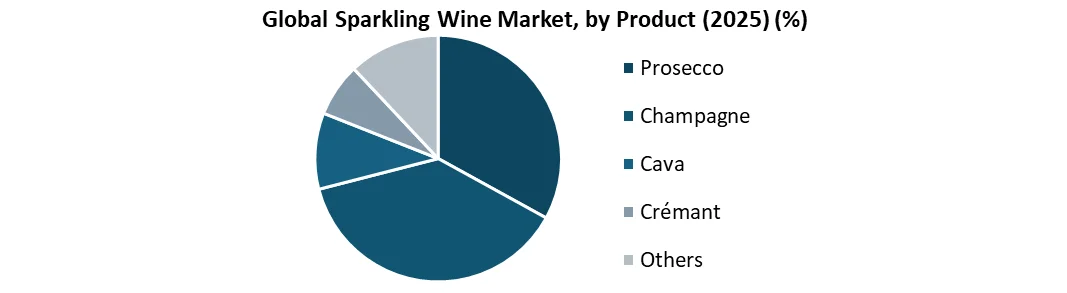
Based on Product, the market is segmented as Champagne, Cava, Cremant, Prosecco, and others. The Prosecco Segment is expected to grow at a CAGR of 7.5% during the forecast period. This segment can help to contravene memory loss of the human body. Prosecco wine contains ashes of zinc and potassium which can also be beneficial for lung tissues. However, the champagne segment also consists of a low amount of alcohol and is expected to grow at a CAGR of xx% during the forecast period. The demand of this segment is as high, it may improve heart health and lower the risk of diabetes.
The Cava segment is rich in nutrients, reduces soreness, and also protects against the fatness of humankind. This kind of factor leads to the market growth of the cava segment during the forecast period. People also prefer cava in alcoholic beverage as it reduces the risk of heart attack and also give nutrients for alcoholic beverages as well. However cremant segment is expected to grow in European countries such as the U.K, Italy, and France. Cremant is usually made outside the champagne wine region. It forms in the rich texture of the fermentation process and gives the best out of the alcoholic beverage.
Based on Distribution Channel, the market is segmented as supermarkets, Specialty stores, On Trade, and others. The supermarket segment is expected to grow at a CAGR of 8.2% during the forecast period. The availability of sparkling red wine is huge in the supermarket and also comes at affordable prices. Due to this consumption of red wine is easier for the consumer as people get a variety of choices at these end. However, Specialty stores carry a deep mixture of brand or style categories of wines which gives huge variety in flavors of wine. The competitive market is as high in this segment as there is a different retail store, distribution channel, and variety of stores available. Apart from this On-Trade segment consists of bars, restaurants, pubs, coffee shops, etc. Due to the effect of COVID-19, the market of this segment is declined. As people, preference is trending toward less connectivity manufacturer faces a lot of problems, and the sale of wine reduces in this segment.
Global Sparkling Red Wine Market Regional Insights:
Europe is the leading region of the Global Sparkling Red Wine Market, accounting for a 47.71% market share in 2025. The region benefits from established winemaking traditions, strong wine consumption, and growing demand for premium alcoholic beverages. Italy contributes significantly through popular sparkling red wine varieties such as Lambrusco and Brachetto. Established wine distribution networks, wine tourism, premium dining, and hospitality activities further support market growth.
Asia Pacific represents 19.76% of the Global Sparkling Red Wine Market, with a market value of USD 119.97 million in 2025. Rising disposable incomes, urbanization, changing consumer preferences, and increasing interest in premium wines support regional demand. China, Japan, India, and Australia contribute to market development through expanding retail networks, e-commerce platforms, and hospitality sectors. Growing interest in imported wines and distinctive alcoholic beverages creates additional opportunities for sparkling red wine producers.
North America accounts for a 16.86% market share, reaching USD 102.36 million in 2025. The region benefits from established wine retail infrastructure, premium beverage consumption, and demand for innovative wine varieties. The United States and Canada support market expansion through restaurants, bars, specialty wine stores, and online distribution channels. Increasing interest in wine tasting, food pairing, social celebrations, and premium beverage experiences strengthens sparkling red wine demand.
The Middle East and Africa market benefits from premium hospitality, international tourism, and established wine-import and distribution networks in eligible markets. South Africa contributes through its developed wine production industry, while the United Arab Emirates supports premium beverage distribution through hotels, restaurants, and tourism-oriented establishments. Demand for imported wines and premium dining experiences creates growth opportunities, although alcohol regulations, import duties, and differences in consumer purchasing power influence regional market development.
South America presents growth opportunities for the Global Sparkling Red Wine Market, supported by established wine-producing countries such as Argentina and Chile, alongside expanding wine consumption in Brazil. Regional wineries, wine tourism, hospitality businesses, and retail distribution networks support product accessibility. Increasing consumer interest in premium wines, social celebrations, and diverse wine varieties contributes to market development. Economic conditions, taxation, and price sensitivity continue to influence purchasing patterns across regional markets.
Global Sparkling Red Wine Market Competitive Landscape
The Global Sparkling Red Wine Market features established wineries and regional producers competing through product differentiation, premium positioning, regional wine varieties, and distribution expansion. Italian producers leverage the popularity of Lambrusco, while Australian wineries differentiate through Sparkling Shiraz. Product quality, brand recognition, export networks, and diverse flavor profiles remain important competitive factors.
Key Market Players
| Company | Country | Competitive Strategy |
|---|---|---|
| Cantine Riunite & CIV | Italy | Focuses on Lambrusco and international distribution. |
| Caviro | Italy | Leverages a broad wine portfolio and cooperative production network. |
| Cleto Chiarli | Italy | Emphasizes regional heritage and premium Lambrusco wines. |
| Medici Ermete | Italy | Focuses on quality-driven Lambrusco production. |
| Lini 910 | Italy | Differentiates through distinctive sparkling wine styles. |
| Venturini Baldini | Italy | Emphasizes regional wine expertise and premium offerings. |
| F.lli Ceci | Italy | Focuses on Lambrusco varieties and distinctive presentation. |
| Paltrinieri | Italy | Specializes in Lambrusco and regional grape varieties. |
| Rockford Wines | Australia | Contributes to Australia's distinctive red wine segment. |
| Charles Melton Wines | Australia | Focuses on premium Australian red wine production. |
Key Competitive Strategies
- Regional specialization: Producers leverage varieties such as Lambrusco and Sparkling Shiraz to establish distinctive market identities
- Premiumization: Quality-focused products and specialized winemaking support premium positioning.
- Distribution expansion: Export partnerships, retailers, restaurants, and online channels improve market reach.
- Product differentiation: Different sweetness levels, grape varieties, and flavor profiles attract diverse consumer groups.
- Brand engagement: Wine tourism, tasting events, and food-pairing promotions encourage consumer interest.
Competitive Outlook
Competition centers on regional identity, product quality, pricing, and distribution reach. Producers that combine distinctive wine styles with effective branding and wider market access strengthen their competitive position in the Global Sparkling Red Wine Market.
Global Sparkling Red Wine Market: Recent Developments
| Date | Company | Development | Impact |
|---|---|---|---|
| January 9, 2026 | St. Julian Winery & Distillery | Introduces Sweet Revenge Bubbly, a sparkling version of its established sweet red wine. |
Expands its sweet red wine portfolio and targets consumers seeking fruit-forward sparkling beverages. |
| February 4, 2026 | Saint Enzo | Receives a Double Gold Medal and a score of 98 points for its debut L'Originale Lambrusco at the 2026 San Francisco International Wine Competition. |
Strengthens brand credibility and increases visibility for premium Lambrusco. |
| February 11, 2026 | Lucci | Launches a dry Lambrusco sparkling red wine across the United States through retail, online, and hospitality channels. |
Broadens access to dry, fruit-forward sparkling red wine and targets younger adult consumers. |
| February 17, 2026 | McBride Sisters Wine Company | Introduces Sweet Red Frizzante under its Black Girl Magic Wines brand, expanding its lightly sparkling red wine portfolio. |
Strengthens product differentiation through approachable sweetness, fruit-forward flavors, and broader retail availability. |
| August 27, 2026 | Ventiventi | Presents La Vie, an organic Lambrusco made using the Charmat method, emphasizing regional identity and sustainable viticulture. |
Supports demand for organic sparkling red wine and strengthens the premium positioning of Italian Lambrusco. |
| September 21, 2026 | Ventiventi | Introduces Rouge de Noirs, an organic Brut sparkling red wine made from Lambrusco Salamino di Santa Croce DOC using the traditional method, with 40 months of lees aging. |
Elevates Lambrusco's premium image through traditional production, extended aging, and organic certification. |
| October 19, 2026 | Primo Estate | Releases the 2026 disgorgement of JOSEPH Sparkling Red, crafted from a blend of aged red wines. |
Reinforces premium differentiation through aged wine blending, limited production, and established product heritage. |
Global Sparkling Red Wine Market Scope: Inquiry Before Buying
| Sparkling Red Wine Market | |||
|---|---|---|---|
| Report Coverage | Details | ||
| Base Year: | 2025 | Forecast Period: | 2026-2034 |
| Historical Data: | 2020 to 2025 | Market Size in 2025: | USD 1.20 Bn. |
| Forecast Period 2026 to 2034 CAGR: | 5.0% | Market Size in 2034: | USD 1.86 Bn. |
| Segments Covered: | by Type | Red Wine Rose Wine White Wine |
|
| by Product | Prosecco Champagne Cava Cremant Others |
||
| by Distribution Channel | Supermarket Specialty stores On-Trade Stores Others |
||
Global Sparkling Red Wine Market by Region
North America (United States, Canada and Mexico)
Europe (UK, France, Germany, Italy, Spain, Sweden, Austria, Turkey, Russia and Rest of Europe)
Asia Pacific (China, India, Japan, South Korea, Australia, ASEAN and Rest of APAC)
Middle East and Africa (South Africa, GCC, Egypt, Nigeria and Rest of ME&A)
South America (Brazil, Argentina, Columbia and Rest of South America)
Global Sparkling Red Wine Market, Key Players are
1. Viña Concha y Toro S.A.
2. Treasury Wine Estates
3. Pernod Ricard
4. E. & J. Gallo Winery
5. Constellation Brands, Inc.
6. Caviro S.p.A.
7. Casella Family Brands
8. Bronco Wine Company
9. Accolade Wines Australia Ltd.
10. Sula Vineyards Pvt. Ltd.
11. LVMH Moët Hennessy Louis Vuitton
12. Cantine Riunite & CIV
13. Cleto Chiarli
14. Medici Ermete
15. Paltrinieri
16. Cavicchioli
17. Lini 910
18. Ventiventi
19. Casali Viticultori
20. Emilia Wine
21. Francesco Bellei
22. Lombardini
23. Cantina Settecani
24. Cantina di Carpi e Sorbara
25. Cantina Sociale di Gualtieri
26. Cantine Due Torri
27. Azienda Vinicola Bertolani
28. Tenuta di Aljano
29. Seppelt Wines
30. Best's Wines
31. Rockford Wines
32. Charles Melton Wines
33. Peter Lehmann Wines
34. De Bortoli Wines
35. Taltarni Vineyards
36. Balgownie Estate
37. Bleasdale Vineyards
38. Grampians Estate
39. Rumball Sparkling Wines
40. Majella Wines
41. d'Arenberg
42. Blue Pyrenees Estate
43. Campbells Wines
44. Pfeiffer Wines
45. Tahbilk Winery
46. Mitchelton Wines
47. Andrew Buller Wines
Global Sparkling Red Wine Market: Frequently Asked Questions:
1. What is the size of the Global Sparkling Red Wine Market in 2025?
Ans. The Global Sparkling Red Wine Market reaches USD 1.20 billion in 2025.
2. What is the projected market size by 2034?
Ans. The market is projected to reach USD 1.86 billion by 2034.
3. What is the CAGR of the Global Sparkling Red Wine Market during 2026–2034?
Ans. The market is projected to grow at a CAGR of 5.0% during the forecast period.
4. Which region leads the Global Sparkling Red Wine Market?
Ans. Europe leads the market with a 47.71% share in 2025, supported by its established wine industry and demand for regional sparkling red wine varieties.
5. What are the major factors driving the Global Sparkling Red Wine Market?
Ans. The market is driven by increasing demand for premium alcoholic beverages, interest in distinctive wine varieties, product innovation, expanding distribution channels, and growing demand for unique wine experiences.