
Solar Powered Electric Vehicle Market – Industry Structure Evaluation, Demand Drivers Analysis, Regional Growth Analysis and Identification, Competitive Positioning Review & Global Market Size Forecast to 2034
Overview
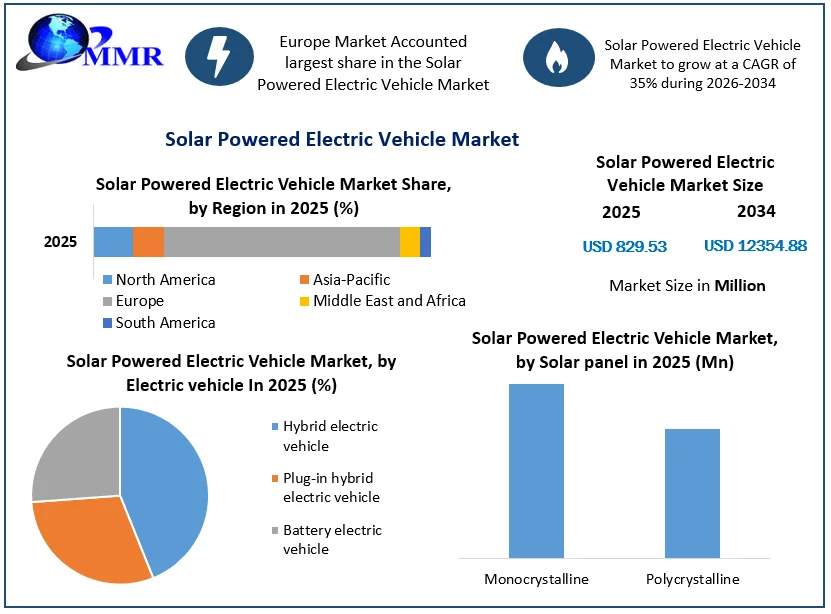
Global Solar Powered Electric Vehicle Market size was valued at USD 829.53 Mn. in 2025, and the total Global Solar Powered Electric Vehicle Market revenue is expected to grow by 35% from 2026 to 2034, reaching nearly USD 12354.88 Mn.
Solar Powered Electric Vehicle Market Overview:
Solar vehicles are electric vehicles that use solar energy as a sort of fuel to propel themselves. Photovoltaic cells are put in the solar panels of solar vehicles and are responsible for converting solar energy to electrical energy, which is stored directly in the vehicle's battery. Silicon is used to make these solar panels, which absorb heat converter it to electricity. The demand for solar vehicles has increased as a result of the growing use of cutting-edge vehicle technology, resulting in the global growth of the solar vehicle market.
Solar-Powered vehicles rely on the sun's emitted solar energy to operate. Due to increased government measures to encourage sustainable and environmentally friendly transportation ideas and rising demand for automobiles that embrace a green philosophy, the global market for solar-Powered vehicles has seen extraordinary growth. According to the US Environmental Protection Agency (EPA), a typical passenger vehicle emits roughly 4.6 metric tonnes of carbon dioxide per year, degrading environmental quality. The demand for environmentally friendly automobiles has risen in response to the growing environmental problem.
Solar Powered Electric Vehicle Market Size, Growth and Share Analysis
To know about the Research Methodology :- Request Free Sample Report
Solar Powered Electric Vehicle Market Dynamics:
A major driver that is expected to drive the solar-Powered electric vehicle market during the forecast period is growing concerned about carbon emissions by the global regulatory organizations. The answer to environmental degradation and energy problems is a solar-Powered electric car. When compared to fuel cars, it makes the vehicle more efficient and cost-effective. All types of conventional fuels are nearing exhaustion, which is expected to contribute to an increase in demand for solar-Powered electric vehicles over the forecast period. Lightyear, a company best known for producing a costly solar automobile, has announced the launch of its second vehicle, a $34,000 solar electric car.
It also helps car owners in complying with state requirements governing fuel system emissions. Solar-Powered electric vehicles have a number of advantages, including minimal pollution, low maintenance, and convenience of charging noise-free operation, and better vehicle economy, all of which are projected to benefit the market during the projection period. The greatest alternative is a solar-Powered electric car, which provides the most comprehensive solution to the current issue of urban pollution in a simple, cost-effective, and non-offensive manner. Because solar energy is directly dependent on the Sun's beams, which provide energy to the entire vehicle, changes in weather are likely to limit solar energy's Powered. This is expected to limit the market for solar-Powered electric vehicles.
The growing popularity of self-charging automobiles has resulted in the development of the solar car market, which has aided the expansion of the solar vehicle business. Solar vehicle producers have been able to offer solar cars and solar commercial vehicles due to rising consumer income and demand for emission-free vehicles. The solar car market relies on photovoltaic cells to charge the battery. These photovoltaic cells convert sunlight into electricity, which is used in the solar vehicle market for propulsion. Additionally, as the number of electric vehicle sales rises, solar cars will serve as range extenders, driving up demand for solar cars and solar commercial vehicles.
Rapid industrialization and the installation of solar-based electric car charging stations are two potentials in the worldwide solar-Powered vehicle market arena. Such chances must be taken advantage of by market participants in order for the notion of solar-Powered automobiles to gain more recognition and acceptance around the world. There's also the possibility of integrating new technologies to improve existing battery and hybrid electric car technology. The lack of industry standardization, the high cost of developing solar-Powered vehicles, and the substantial energy loss during transmission are some of the problems in the global market setting. These difficulties add to the complexity of the current solar-Powered car business. Such obstacles may limit market growth during the forecasted period.
Solar Powered Electric Vehicle Market Segment Analysis:
Based on Battery type, the market is sub-segmented into Lithium-ion battery, Lead ion battery, and Lead carbon. In comparison to lead-based and other battery types, lithium-ion batteries are widely utilized due to their high charging-discharging efficiency, high charge density, and lightweight. By 2034, the segment is expected to hold, with a market share of over 90%. Lithium-ion batteries are needed because they give a greater performance, less maintenance, and are environmentally benign, which is why they are most commonly used in Solar-Powered cars and are likely to see large sales in the forecast period.
Based on Solar panels, the market is sub-segmented into Monocrystalline and Polycrystalline. Monocrystalline solar cells are the most popular type. it is expected to hold 85% of the market share by 2034. Because the cell is made up of a single crystal, the electrons that generate an electric current have more room to travel about. Monocrystalline solar cells are therefore more efficient than other forms of solar cells, and their market is expected to grow in the forecast period.
Solar Powered Electric Vehicle Market Regional Insights:
According to MMR, Europe will continue to be one of the most appealing markets during the forecast period. According to the report, the Netherlands expected to hold more than 35% of the European market in 2034. Also, the Netherlands continues to be one of the world's major markets for renewable energy transportation and e-mobility, making it a lucrative market for solar vehicle makers. Moreover, rising worries about carbon impact, an increasing global population, and increased traffic in Europe will propel the market forward.
Over the forecast period, demand in the Americas is expected to grow at a CAGR of 13%. The e-mobility business in the Americas is supported by a well-developed infrastructure and is heavily subsidized by governments. It's unsurprising that the United States has the highest level of spending in the Americas. According to the survey, the United States is a key market for solar cars and is expected to remain so in the future. Moreover, rising research efforts, the presence of numerous significant firms, and expanding pipelines are offering appealing chances for solar-Powered vehicle producers in the country.
South Korea is one of the fastest-growing markets for solar-Powered vehicles. It held market share of over 28% in the Asia Pacific by 2022. To maximize the potential of its manufacturing process, South Korea has been rapidly integrating modern digital technology in manufacturing. Furthermore, increased investment R&D efforts and growing growth in solar cell technology, such as increases in solar cell and battery technology efficiency, are expected to have a good impact on the country. South Korea is expected to become a lucrative market for solar-Powered car suppliers in the coming years, thanks to rising infrastructure and population, as well as altering economic policies in terms of pollution limits.
The objective of the report is to present a comprehensive analysis of the Solar Powered Electric Vehicle Market to the stakeholders in the industry. The past and current status of the industry with the forecasted market size and trends are presented in the report with the analysis of complicated data in simple language. The report covers all the aspects of the industry with a dedicated study of key players that include market leaders, followers, and new entrants.
PORTER, PESTEL analysis with the potential impact of micro-economic factors of the market have been presented in the report. External as well as internal factors that are supposed to affect the business positively or negatively have been analyzed, which will give a clear futuristic view of the industry to the decision-makers.
The reports also help understand the Market dynamic and structure by analyzing the market segments and projecting the Solar Powered Electric Vehicle Market size. Clear representation of competitive analysis of key players by product, price, financial position, product portfolio, growth strategies, and regional presence in the Market make the report investor’s guide.
Solar Powered Electric Vehicle Market Recent Development
| Date | Company | Development | Impact |
|---|---|---|---|
| 15 January 2025 | Aptera Motors | Aptera Motors announced the successful assembly of its first production-intent solar electric vehicle body structure, moving closer to high-volume commercial manufacturing of its ultra-efficient solar EV. | This milestone validates integrated vehicle solar efficiency for daily commuting and significantly accelerates timeline readiness for customer deliveries. |
| 28 April 2025 | Sono Motors | Sono Motors executed a strategic partnership agreement with a major European transit operator to integrate its proprietary Solar Bus Kit across a fleet of 100 municipal buses. | The deployment expands solar mobility solutions into commercial public transit, directly reducing diesel fuel usage and grid reliance. |
| 12 August 2025 | Hyundai Motor Group | Hyundai Motor Group unveiled an upgraded roof-integrated solar charging system capable of adding over 1,500 kilometers of driving range per year to production EVs. | Higher-efficiency photovoltaic integration strengthens battery sustainability and provides supplemental power directly from ambient sunlight. |
| 19 November 2025 | Squad Mobility | Squad Mobility commenced initial market commercialization and customer deliveries of its solar-powered compact city car across key European urban hubs. | The launch establishes a scalable footprint in affordable urban micro-mobility with vehicles charging directly from rooftop solar cells. |
| 10 February 2026 | Toyota Motor Corporation | Toyota Motor Corporation finalized a technology development agreement for flexible perovskite-silicon tandem solar roofs engineered specifically for electric passenger cars. | Advancements in flexible solar cell architecture boost energy conversion efficiency while seamlessly integrating into lightweight auto body panels. |
Solar Powered Electric Vehicle Market Scope: Inquiry Before Buying
| Solar Powered Electric Vehicle Market | |||
|---|---|---|---|
| Report Coverage | Details | ||
| Base Year: | 2025 | Forecast Period: | 2026-2034 |
| Historical Data: | 2020 to 2025 | Market Size in 2025: | USD 829.53 Mn. |
| Forecast Period 2026 to 2034 CAGR: | 35% | Market Size in 2034: | USD 12354.88 Mn. |
| Segments Covered: | by Battery type | Lithium-ion battery Lead-ion battery Lead carbon |
|
| by Electric vehicle | Hybrid electric vehicle Plug-in hybrid electric vehicle Battery electric vehicle |
||
| by Solar panel | Monocrystalline Polycrystalline |
||
| by End-User | Personal Use Commercial Fleet Vehicles Neighborhood Vehicles |
||
Solar Powered Electric Vehicle Market, by Region
North America (United States, Canada and Mexico)
Europe (UK, France, Germany, Italy, Spain, Sweden, Austria and Rest of Europe)
Asia Pacific (China, South Korea, Japan, India, Australia, Indonesia, Malaysia, Vietnam, Taiwan, Bangladesh, Pakistan and Rest of APAC)
Middle East and Africa (South Africa, GCC, Egypt, Nigeria and Rest of ME&A)
South America (Brazil, Argentina Rest of South America)
Solar Powered Electric Vehicle Market Key Players
The Global Solar Powered Electric Vehicle Market is referred to as an industry concerned with vehicles fitted with PV solar panels which collect and transform the collected energy from the sun into electricity. This energy then helps to increase the efficiency of the batteries used to power the vehicles.
| Company Name | Headquarters | Core Competencies |
| Aptera Motors Corp. | San Diego, California, U.S. | Solar-powered electric vehicles, ultra-efficient lightweight EVs |
| Lightyear B.V. | Helmond, Netherlands | Solar-integrated passenger electric vehicles, vehicle-integrated photovoltaics (VIPV) |
| Sono Group N.V. (Sono Motors) | Munich, Germany | Solar-assisted electric vehicles, integrated solar body panels |
| Squad Mobility B.V. | Amsterdam, Netherlands | Solar-powered compact urban electric vehicles |
| Venturi Automobiles | Monaco | Solar mobility research, high-performance electric vehicles |
| EVX Ventures Pty Ltd. | Perth, Western Australia, Australia | Solar-assisted commercial electric vehicles |
| EdisonFuture | San Jose, California, U.S. | Solar-assisted passenger and commercial electric vehicles |
| Toyota Motor Corporation | Toyota City, Aichi, Japan | Solar roof technology, hybrid and electric vehicles |
| Hyundai Motor Company | Seoul, South Korea | Solar roof systems, battery electric vehicles |
| Kia Corporation | Seoul, South Korea | Solar charging roof technology, electric vehicles |
| Nissan Motor Co., Ltd. | Yokohama, Kanagawa, Japan | Electric vehicles, solar charging integration |
| Volkswagen AG | Wolfsburg, Germany | Electric mobility, vehicle-integrated solar research |
| Ford Motor Company | Dearborn, Michigan, U.S. | Electric vehicles, renewable energy integration |
| Mahindra & Mahindra Limited | Mumbai, Maharashtra, India | Electric mobility, solar-assisted EV initiatives |
| Tesla, Inc. | Austin, Texas, U.S. | Electric vehicles, solar energy ecosystem, energy storage |
| Mercedes-Benz Group AG | Stuttgart, Germany | Solar paint research, premium electric vehicles |
| BMW AG | Munich, Germany | Solar charging technologies, premium electric mobility |
| Honda Motor Co., Ltd. | Tokyo, Japan | Solar charging integration, electric mobility |
| Stellantis N.V. | Hoofddorp, Netherlands | Electric vehicles, renewable energy integration |
| General Motors Company | Detroit, Michigan, U.S. | Electric vehicles, solar charging and renewable energy research |
| BYD Company Limited | Shenzhen, Guangdong, China | Electric vehicles, renewable energy integration |
| Fisker Inc. | Manhattan Beach, California, U.S. | Solar roof-equipped electric vehicles |
| Rivian Automotive, Inc. | Irvine, California, U.S. | Electric vehicles, renewable energy integration research |
| Lucid Group, Inc. | Newark, California, U.S. | Premium electric vehicles, high-efficiency EV technologies |
| VinFast Auto Ltd. | Hai Phong, Vietnam | Electric vehicles, next-generation mobility solutions |
Frequently Asked Questions:
1] What segments are covered in the Solar Powered Electric Vehicle Market report?
Ans. The segments covered in the Solar Powered Electric Vehicle Market report are based on Battery type, Electric vehicle, by End-User and Solar panel.
2] Which region is expected to hold the highest share in the Solar Powered Electric Vehicle Market?
Ans. The Europe region is expected to hold the highest share in the Solar Powered Electric Vehicle Market.
3] What is the market size of the Solar Powered Electric Vehicle Market by 2034?
Ans. The market size of the Solar Powered Electric Vehicle Market by 2034 is the USD 12354.88 Mn.
4] What is the forecast period for the Solar Powered Electric Vehicle Market?
Ans. The Forecast period for the Solar Powered Electric Vehicle Market is 2026-2034.
5] What was the market size of the Solar Powered Electric Vehicle Market in 2025?
Ans. The market size of the Solar Powered Electric Vehicle Market 2025 was USD 829.53 Mn.