
Smart Speaker Market Size – Industry Structure Evaluation, Demand Drivers Analysis, Regional Growth Analysis and Identification, Competitive Positioning Review & Global Market Size Forecast to 2032
Overview
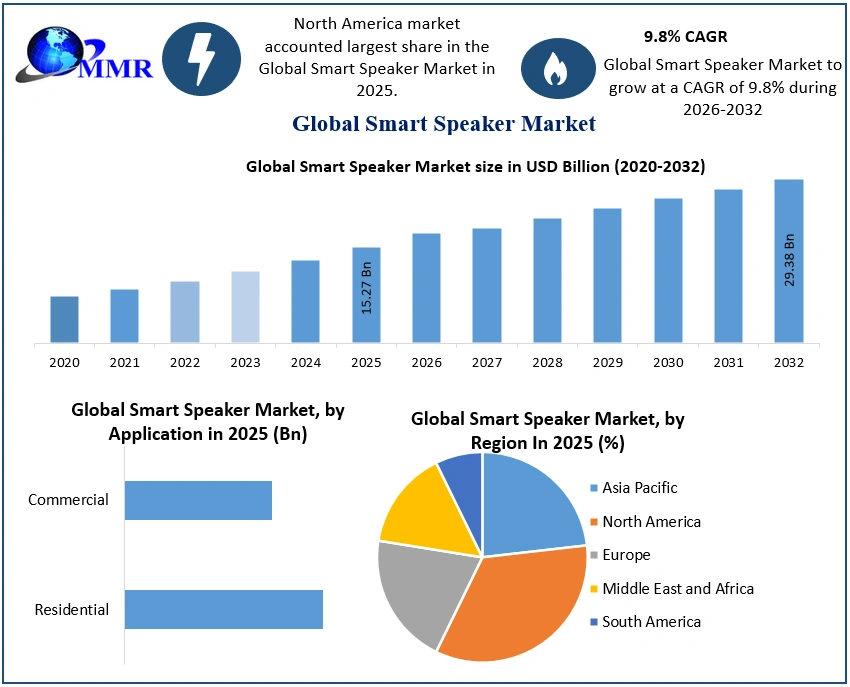
The Smart Speaker Market size was valued at USD 15.27 Billion in 2025 and the total Smart Speaker revenue is expected to grow at a CAGR of 9.8% from 2025 to 2032, reaching nearly USD 29.38 Billion by 2032.
Smart Speaker Market Overview
The global smart speaker market is witnessing rapid growth, driven by rising adoption of AI-powered voice assistants, display-based smart speakers, and IoT-enabled smart home devices. United States leads the market with extensive use of Amazon Echo, Google Nest, and Apple HomePod, supported by high disposable incomes and advanced smart home infrastructure. Canada shows growing adoption of multi-lingual AI assistants and integrated smart home systems.
In China, Baidu’s Xiaodu smart speakers and Alibaba’s Tmall Genie dominate, offering localized content and Mandarin voice recognition, while India is expanding through affordable devices from Xiaomi, JBL, and boAt, combined with increasing smartphone penetration. Japan and South Korea focus on high-quality audio, privacy-conscious AI assistants, and seamless smart home connectivity. Germany and the UK see strong demand for privacy-focused speakers and multi-lingual AI capabilities. For Instance, Google launched Gemini for Home for context-aware AI conversations, and Amazon introduced Echo Dot Max and Echo Studio with Alexa+ generative AI, advanced chipsets, and Matter/Thread/Zigbee support. These trends drive adoption and growth in the global smart speaker market.
To know about the Research Methodology :- Request Free Sample Report
Rising Demand for Display-Based and Smart Home-Integrated Speakers Driving Global Smart Speaker Market Growth
A major driver of the smart speaker market is the surging demand for display based smart speaker devices. As consumers increasingly use smart displays for social networking, video streaming, and video calling, leading brands are expanding their portfolios with screen-equipped speakers including the Amazon Echo Show 5, Google Nest Hub (2nd Gen), Facebook Portal, Lenovo Smart Display 7, Redmi Touch Screen Speaker 8, Baidu Xiaodu Zai Jia 10, Alibaba Tmall Genie CC8, and JBL Link View. These smart display devices are regularly updated based on user feedback, improving voice assistant accuracy and UI.
The rising popularity of smart home products, where smart speakers function as a unified control hub. With widespread adoption of smart locks, lights, security cameras, and TVs, consumers increasingly rely on voice- and display based smart speakers to manage their IoT ecosystems. For instance, Xiaomi’s AIoT platform connects its smart speaker to over 300 million devices. Furthermore, companies like Baidu, Apple, and Siemens are integrating voice-assistant platforms to strengthen smart home interoperability. In recently Google launched Gemini for Home, replacing Google Assistant with a more natural, contextual AI for smart displays and speakers.
Privacy and Data Security Concerns limit the growth of Smart Speaker Market Growth
Privacy and data security concerns are a significant restraining factor in the smart speaker market. Smart speakers and AI voice assistants, such as Amazon Echo, Google Nest, and Apple HomePod, are often “always listening” for their wake word, raising fears of accidental activations and unauthorized recording of private conversations. Many interactions are transmitted to the cloud for processing and storage, sometimes reviewed by third parties, creating vulnerabilities regarding who can access sensitive audio data. Over time, this information combined with other sources to track user behavior, preferences, or lifestyle patterns.
For Instance, in March 2025, Amazon removed the “Do Not Send Voice Recordings” option on select Echo devices, increasing cloud data processing. Simultaneously, the company faces a U.S. class-action lawsuit for allegedly recording conversations for commercial purposes. Regulators are acting, with the UK ICO urging smart speaker manufacturers to reduce data collection, enhance transparency, and give users greater control.
Such privacy and security challenges are slowing adoption of display-based smart speakers and smart home IoT devices, restraining smart speaker market growth globally.
AI and Voice Assistant Advancements create lucrative growth opportunities to the Smart Speaker Market Growth
Advancements in artificial intelligence (AI) and voice assistant technology are driving significant growth opportunities in the smart speaker market. Modern AI-powered chipsets designed for smart speakers enhance battery life, improve music quality, and enable faster, more accurate voice control. Meanwhile, improvements in natural language processing (NLP) and speech recognition technology allow smart speakers to understand and respond to conversational commands more naturally and efficiently.
Companies such as Baidu leverage deep AI expertise to develop voice assistants capable of complex, context-aware interactions, enabling speakers to perform tasks ranging from answering questions to controlling smart home devices. Google has also introduced advanced language models, such as LaMDA, which enhance the ability of smart speakers to engage in natural, human-like dialogue.
These innovations in AI technology research and development are transforming smart speakers from simple voice-controlled devices into intelligent hubs capable of managing smart homes, streaming content, and providing personalized services. As a result, the growing integration of AI and advanced voice assistants is creating lucrative opportunities and accelerating adoption across the global smart speaker market.
Smart Speaker Market: Segment Analysis
Based On Technology the Smart Speaker Market is segmented into Bluetooth/Wi-Fi,Near Field Communication (NFC), Others. The Bluetooth/Wi-Fi segment dominated the technology segment in year 2025. The primary reason for their dominance is their ability to provide high-quality audio streaming, reliable connectivity, and compatibility with a wide range of devices, including smartphones, tablets, and smart home systems. Bluetooth and Wi-Fi connectivity allow users to seamlessly play music, control smart home appliances, and access cloud-based voice assistants like Alexa, Google Assistant, and Siri.
The Wi-Fi-enabled smart speakers support multi-room audio setups, higher data transfer rates, and integration with AI-powered voice assistants, enhancing user experience. Manufacturers such as Amazon, Google, and Apple continue to focus on Wi-Fi and Bluetooth technology due to its global adoption and ease of use, making it the preferred choice for consumers. The NFC segment, though convenient for instant pairing, remains limited in range and functionality, keeping Bluetooth/Wi-Fi speakers at the forefront of the Smart Speaker Market.

Based on OS Type, the Smart Speaker Market is segmented into Android-based, iOS-based, and webOS-based. The Anroid based smart speakers dominated the market in 2025 The widespread adoption of the Android ecosystem globally, which provides manufacturers with flexibility, customization options, and compatibility with a broad range of devices. Android-based speakers integrate seamlessly with Google Assistant, smart home products, and various IoT platforms, enabling users to control lighting, thermostats, security cameras, and entertainment systems efficiently.
Also, Android’s open-source nature allows manufacturers like JBL, Xiaomi, Lenovo, and Sony to develop cost-effective smart speakers for diverse price segments, increasing market penetration. While iOS-based smart speakers, such as Apple HomePod, cater to premium users, their adoption is limited to Apple device owners. WebOS-based devices remain niche, keeping Android-based smart speakers as the dominant segment driving global market growth.

Smart Speaker Market: Regional Analysis
North America dominated the Smart Speaker Market in 2025. with the United States and Canada leading in adoption. High consumer technology awareness, strong smart home device penetration, and high disposable incomes have driven demand for AI-powered smart speakers. The U.S. market, in particular, shows extensive use of Amazon Echo, Google Nest, and Apple HomePod, making it the most mature region globally.
The region benefits from an advanced smart home ecosystem, with households integrating lighting, thermostats, security cameras, and connected TVs. This positions smart speakers as a central hub for voice-controlled home automation.
Amazon launched Alexa Plus, a generative AI-powered upgrade enhancing voice assistant capabilities, while newer Echo smart speakers feature advanced AI chipsets, multi-room audio, and compatibility with Matter, Thread, and Zigbee protocols. Google Nest and Apple HomePod also continue to innovate with AI and IoT connectivity features. These factors early adoption, technological innovation, and mature smart home infrastructure solidify North America’s leading position in the global smart speaker market.
Smart Speaker Market: competitive Landscape
The Smart Speaker Market is highly competitive, with key players including Amazon, Google, Apple, Baidu, Alibaba, Sonos, and other regional brands. Amazon leads globally with its Echo series, recently launching Echo Studio and Echo Dot Max featuring advanced AI chipsets and improved spatial audio. Its Alexa+ generative AI assistant enhances natural conversation, proactive routines, and smart home control. Google is strengthening its position with Gemini for Home, a next-generation AI assistant that offers more context-aware and conversational interactions. Apple HomePod continues to focus on privacy-first features, edge AI processing, and seamless integration with iOS and HomeKit.
In Asia-Pacific, Baidu and Alibaba dominate with localized voice assistants and e-commerce integration, while Sonos targets high-fidelity audio experiences. Key trends shaping competition include AI-driven voice assistants, on-device AI processing, Matter/Thread/Zigbee smart home integration, and subscription models. These innovations are driving differentiation, adoption, and growth in the global smart speaker market.
Smart Speaker Market: Recent Developments
| Date | Company | Product / Update | Key Highlights |
| Jul-24 | Amazon | Remarkable Alexa | Launching a premium Alexa tier with advanced generative AI, improved smart home control, and high-resolution audio. Aimed at monetizing Alexa and Echo devices. |
| Jul-24 | Apple | HomePod mini | Expanded color lineup with yellow, orange, and blue, in addition to white and space gray, allowing users to match personal style and home décor. |
| Apl-24 | Nest Hub Max & Nest Audio (upcoming versions) | Developing updated smart home devices with improved hardware and functionality for better integration with Google ecosystem. | |
| Jan-24 | Sono | 8” In-Ceiling Speaker (with Sonance) | Features powerful, balanced sound, enhanced bass, improved high-frequency dispersion, and compatibility with Sonos Amp for optimal audio performance. |
| Jan-23 | Apple | New HomePod | Introduced advanced sound and intelligent features, including room sensing and Spatial Audio, for immersive sound and seamless smart home integration via Siri. |
Smart Speaker Market Scope: Inquire before buying
| Global Smart Speaker Market | |||
|---|---|---|---|
| Report Coverage | Details | ||
| Base Year: | 2025 | Forecast Period: | 2026-2032 |
| Historical Data: | 2020 to 2025 | Market Size in 2025: | USD 15.27 Bn. |
| Forecast Period 2026 to 2032 CAGR: | 9.8% | Market Size in 2032: | USD 29.38 Bn. |
| Segments Covered: | by OS Type | Android-based iOS-based webOS-based |
|
| by Intelligent Virtual Assistant | Amazon Alexa Google Assistant Siri Cortana Other |
||
| by Technology | Bluetooth/Wi-Fi Near Field Communication (NFC) Others |
||
| by Power Source | Wireless Wired |
||
| by Application | Residential Commercial |
||
| by Distribution Channel | Offline Online |
||
Smart Speaker Market, by Region
North America (United States, Canada and Mexico)
Europe (UK, France, Germany, Italy, Spain, Sweden, Austria and Rest of Europe)
Asia Pacific (China, South Korea, Japan, India, Australia, Indonesia, Malaysia, Vietnam, Taiwan, Bangladesh, Pakistan and Rest of APAC)
Middle East and Africa (South Africa, GCC, Egypt, Nigeria and Rest of ME&A)
South America (Brazil, Argentina Rest of South America)
Smart Speaker Key Players
1. Amazon
2. Google / Alphabet
3. Apple
4. Alibaba
5. Baidu
6. Xiaomi
7. Samsung Electronics
8. Sonos
9. Bose Corporation
10. Harman International (JBL, others)
11. Lenovo
12. Sony
13. LG Electronics
14. Panasonic
15. Pioneer Corporation
16. SK Telecom
17. Invoxia
18. Tencent
19. Philips
20. Orange S.A.
21. Huawei
22. LingLong (DingDong)
23. Goertek
Frequently Asked Questions:
1. What are the growth drivers for the Smart Speaker Market?
Ans. Increasing awareness and consciousness about health and wellness is expected to the major driver for the market.
2. What is the major restraint for the Smart Speaker Market growth?
Ans. Some Smart Speaker lack robust scientific evidence to support their claimed health benefits is expected to be the major restraining factor for the Dietary Supplements Market growth.
3. Which region is expected to lead the global Smart Speaker Market during the forecast period?
Ans. North America is expected to lead the global market during the forecast period.
4. What was the Global Smart Speaker Market size in 2025?
Ans: The Global Smart Speaker Market size was USD 15.27 Billion in 2025.