
Smart Food Logistics Market Size by Component, Technology, Region – Segment-Level Market Assessment, Growth Opportunity Analysis, Competitive Mapping & Forecast to 2029
Overview
Smart Food Logistics Market is expected to reach US$ 23.46 Bn. by 2029, at a CAGR of 12% throughout the forecast period.
Global Smart Food Logistics Definition:
Smart Logistics in the food industry has emerged from the benefits of facilitating the ease of procuring to tracking packages in transit. The ability to receive fresh items with real-time access to the movement of food is the smart logistics powered by the Internet of Things.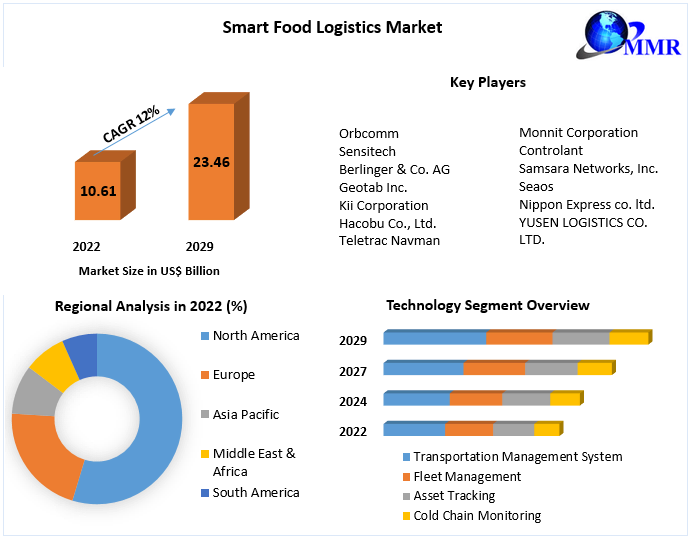 To know about the Research Methodology :- Request Free Sample Report
Global Smart Food Logistics Market Dynamics:
The populations of today’s cities have increased, causing an imbalance between the resources available, those generated in the field, and the resources necessary for the adequate functioning of a city. A Food Supply Chain (FSC) aims to minimize logistics and production costs by integrating and managing capital and information flows, which acts as the main driving factor for the growth of the Global Smart Food Logistics Market.
One of the main logistic challenges for the agri-food industry is to deal with high dynamics and uncertainty in supply and demand. There is great uncertainty regarding fresh product quality as well as available volumes in time on a specific place. The sector is characterized by last-minute changes and rush orders.
As a consequence, the required prediction and planning concept and accompanying logistics system needs to be very flexible, enabling last minutes changes and reallocations, but also provide robust planning, which has increased the demand for smart food logistics.
Increasing food laws and regulations across all the regions, the Food and Drug Safety Act has been putting significant pressure on supply chains to record more information and increase transparency, which is also propelling the growth of the Globalmarket.
Convergence of logistics and technology, along with cloud-based solutions that extend through the entire supply chain has enabled constricted integration of warehouse, transport, and end consumer information and transparency through the supply chain, which acts as a driver towards the growth of the Global Smart Food Logistics Market.
Global Smart Food Logistics Market Segment Analysis:
The report groups the Global Smart Food Logistics Market in different segments by component, technology, and region to forecast the revenues and analyze the market share of each segment over the forecast period.
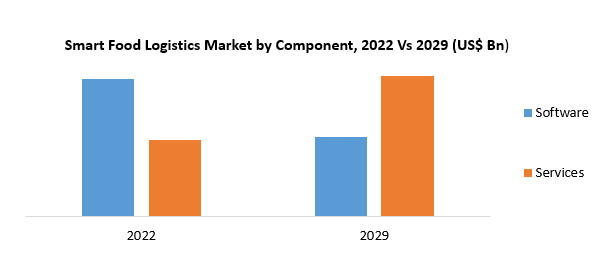 Based on Component, the Software segment was dominant in 2022 and is expected to command a market share of xx% by 2029. By the adoption of software, organizations can operate with increased flexibility and mass-customize their products and services. With the increasing number of specialists in data management and analytics, the supply chain could evolve as a service. Supply chain service providers can add value by capturing and analyzing information for supply chain management and business decisions.
Based on Technology, the cold chain monitoring segment was dominant in 2022 and is expected to command a market share of xx% by 2029. Cold chain monitoring helps the food manufacturers efficiently manage the storage, shipment, and distribution of products requiring a temperature-controlled environment. The adoption of cold chain monitoring ensures stable temperatures for the transport and storage of goods. Tracking a good’s location and tracing temperature throughout the supply chain can be done through the availability of various advanced technologies.
Regional Insights:
GLOBAL SMART FOOD LOGISTICS MARKET REGIONAL MAP
North America is expected to command the largest market share of xx% by 2029
In North America, because of the presence of developed economies like the US and Canada, which are focusing on enhancing the existing solutions in the supply chain space, high adoption of advanced technologies and also the existence of major players are some of the factors driving the growth of the Artificial Intelligence in Supply Chain Market in the region. In September 2021, third-party food logistics company FreezPak Logistics has announced its plans to build a 140000 square foot facility in the US equipped with automated storage and retrieval system.
Europe is also expected to command a market share of xx% by 2029 because agri-food is an important sector in European logistics. Agri-food logistics covers 19% of the transports within the EU and 25% of the international EU transports.
The objective of the report is to present a comprehensive analysis of the Global Smart Food Logistics Market to the stakeholders in the industry. The past and current status of the industry with forecasted market size and trends are presented in the report with the analysis of complicated data in simple language.
The report covers all the aspects of the industry with a dedicated study of key players that include market leaders, followers, and new entrants. PORTER, SVOR, PESTEL analysis with the potential impact of micro-economic factors of the market have been presented in the report. External as well as internal factors that are supposed to affect the business positively or negatively have been analyzed, which will give a clear futuristic view of the industry to the decision-makers.
The report also helps in understanding the Global Smart Food Logistics Market dynamics, structure by analyzing the market segments and projects the Global market size. Clear representation of competitive analysis of key players by product, price, financial position, product portfolio, growth strategies, and regional presence in the Global Smart Food Logistics Market make the report investor’s guide.
Global Smart Food Logistics Market Scope: Inquire before buying
| Global Smart Food Logistics Market | |||
|---|---|---|---|
| Report Coverage | Details | ||
| Base Year: | 2022 | Forecast Period: | 2023-2029 |
| Historical Data: | 2018 to 2022 | Market Size in 2022: | US $ 10.61 Bn. |
| Forecast Period 2023 to 2029 CAGR: | 12% | Market Size in 2029: | US $ 23.46 Bn. |
| Segments Covered: | by Component | Software Services |
|
| by Technology | Transportation Management System Fleet Management Asset Tracking Cold Chain Monitoring |
||
By Region
North America (United States, Canada and Mexico)
Europe (UK, France, Germany, Italy, Spain, Sweden, Austria and Rest of Europe)
Asia Pacific (China, South Korea, Japan, India, Australia, Indonesia, Malaysia, Vietnam, Taiwan, Bangladesh, Pakistan and Rest of APAC)
Middle East and Africa (South Africa, GCC, Egypt, Nigeria and Rest of ME&A)
South America (Brazil, Argentina Rest of South America)
Global Smart Food Logistics Market, Key Players:
1. Orbcomm
2. Sensitech
3. Berlinger & Co. AG
4. Geotab Inc.
5. Kii Corporation
6. Hacobu Co., Ltd.
7. Teletrac Navman
8. Monnit Corporation
9. Controlant
10.Samsara Networks, Inc.
11.Seaos
12.Nippon Express co. ltd.
13.YUSEN LOGISTICS CO. LTD.
Frequently Asked Questions:
1. Which region has the largest share in Global Smart Food Logistics Market?
Ans: North America region holds the highest share in 2022.
2. What is the growth rate of Global Smart Food Logistics Market?
Ans: The Global Smart Food Logistics Market is growing at a CAGR of 12% during forecasting period 2023-2029.
3. What is scope of the Global Smart Food Logistics market report?
Ans: Global market report helps with the PESTEL, PORTER, COVID-19 Impact analysis, Recommendations for Investors & Leaders, and market estimation of the forecast period.
4. Who are the key players in Global Smart Food Logistics market?
Ans: The important key players in the Global market are – Orbcomm, Sensitech, Berlinger & Co. AG, Geotab Inc., Kii Corporation, Hacobu Co., Ltd., Teletrac Navman, Monnit Corporation, Controlant, Samsara Networks, Inc., Seaos, Nippon Express co. ltd., and YUSEN LOGISTICS CO. LTD.
5. What is the study period of this market?
Ans: The Global Smart Food Logistics Market is studied from 2022 to 2029.