
Service Robotics Market Size – Industry Structure Evaluation, Demand Drivers Analysis, Regional Growth Analysis and Identification, Competitive Positioning Review & Global Market Size Forecast to 2032
Overview
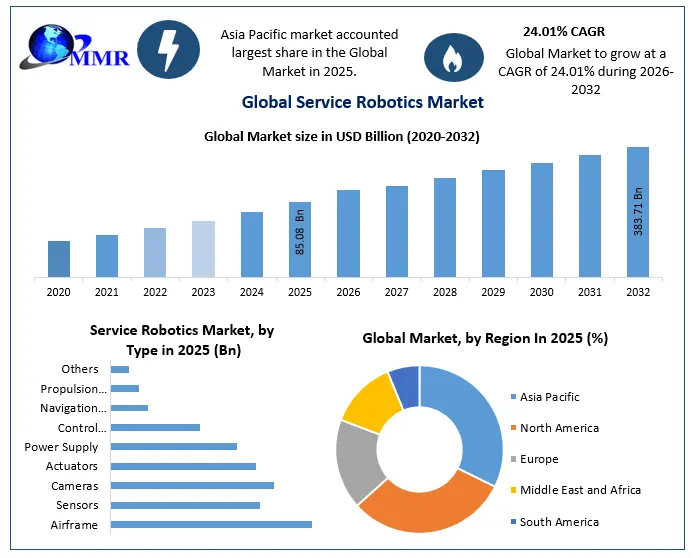
Service Robotics Market size is expected to reach nearly US$ 383.71 Bn by 2032 with the CAGR of 24.01% during the forecast period.
Service Robotics Market Overview:
Service robots are intelligent machines designed to assist humans in performing repetitive, hazardous, or labor-intensive tasks through advanced technologies such as artificial intelligence, machine learning, computer vision, natural language processing, and sensor-based navigation systems. The Service Robotics Market is experiencing substantial growth due to increasing automation across healthcare, logistics, hospitality, retail, defense, domestic assistance, and industrial service applications. The market is expanding rapidly as businesses focus on improving operational efficiency, reducing labor dependency, and enhancing service quality. In healthcare, service robots are widely used for surgical assistance, rehabilitation, patient monitoring, and hospital logistics. Logistics and warehouse sectors are increasingly deploying autonomous mobile robots for inventory handling, sorting, and material transportation. Rising adoption of robotic cleaning systems, delivery robots, and smart personal assistance robots is also supporting market growth. Governments and enterprises are investing heavily in intelligent automation, smart manufacturing, and digital transformation initiatives. Integration of cloud computing, edge AI, and IoT-enabled robotic platforms is further improving robot efficiency and real-time decision-making capabilities.
 To know about the Research Methodology:- Request Free Sample Report
Service Robotics Market Dynamics:
Trend
A major trend in the Service Robotics Market is the growing integration of artificial intelligence and autonomous navigation technologies into robotic service platforms. Service robots are increasingly becoming more intelligent, adaptive, and capable of operating independently in dynamic environments. AI-powered service robots are improving real-time decision-making, voice recognition, predictive maintenance, and human interaction capabilities across multiple industries. Another important trend is the rising adoption of collaborative service robots that can safely operate alongside humans in hospitals, warehouses, retail stores, airports, and hospitality environments. Autonomous mobile robots are gaining strong traction in logistics and e-commerce sectors due to rising demand for warehouse automation and fast delivery services. The market is also witnessing increasing development of cloud-connected robots capable of remote monitoring, data sharing, and fleet management. Smart cleaning robots, robotic assistants, autonomous delivery robots, and healthcare support robots are becoming more common in commercial and residential applications.
Driver
One of the major drivers accelerating the Service Robotics Market is the increasing demand for automation and labor efficiency across commercial and industrial sectors. Businesses are adopting service robots to reduce operational costs, improve productivity, minimize human errors, and address labor shortages in repetitive or hazardous tasks. In healthcare, the growing aging population and rising demand for patient care services are significantly increasing the adoption of robotic assistance systems for rehabilitation, surgery support, and hospital logistics management. The rapid expansion of e-commerce and warehouse automation is also driving strong demand for autonomous mobile robots and robotic sorting systems in logistics operations. Service robots help organizations improve workflow efficiency, reduce downtime, and enhance service quality in environments requiring continuous operations. Governments are actively supporting digital transformation, smart manufacturing, and intelligent automation initiatives, further accelerating market growth.
Market Restraint
High initial investment and maintenance cost associated with advanced robotic systems. Service robots require sophisticated technologies including AI processors, sensors, cameras, robotic arms, navigation software, and autonomous mobility platforms, significantly increasing deployment expenses for businesses and institutions. Small and medium-sized enterprises often face financial limitations in adopting robotic automation solutions due to high capital expenditure and integration costs. In addition, technical complexity and the requirement for skilled professionals to manage robotic operations continue to create operational challenges. Concerns regarding cybersecurity, data privacy, and system reliability also remain significant barriers for wider adoption, especially in healthcare, defense, and critical infrastructure applications. Service robots operating in unpredictable environments may experience navigation limitations, software malfunctions, or reduced operational accuracy. Regulatory and safety compliance standards vary across countries, creating challenges for commercialization and cross-border deployment of robotic systems. Public concerns regarding job displacement due to automation are also influencing adoption rates in certain industries.
Service Robotics Market Segment Analysis
Based on Type, Professional Service Robots dominate the Service Robotics Market due to their extensive adoption across healthcare, logistics, defense, agriculture, warehousing, hospitality, and industrial applications. These robots are designed to perform specialized commercial tasks with high efficiency, accuracy, and operational consistency. Increasing labor shortages, rising operational costs, and growing demand for workplace automation are significantly driving adoption of professional service robots globally. In healthcare, surgical robots, rehabilitation robots, and hospital delivery robots are improving patient care and reducing manual workload for medical staff. In logistics and warehouse environments, autonomous mobile robots and robotic sorting systems are streamlining inventory management and order fulfillment processes. Defense sectors are deploying unmanned ground vehicles and surveillance robots for hazardous operations and security monitoring.
Based on Environment, Ground Robots dominated the Service Robotics Market 2025 by environment due to their widespread deployment across industrial, healthcare, logistics, military, commercial, and domestic applications. These robots operate on land-based environments and are extensively utilized for material handling, cleaning, transportation, surveillance, inspection, and operational support activities. Automated Guided Vehicles (AGVs) and autonomous mobile robots are increasingly adopted in warehouses, manufacturing facilities, and e-commerce fulfillment centers to improve operational efficiency and reduce labor dependency. Cleaning robots are experiencing strong demand in commercial buildings, airports, hospitals, and residential applications due to increasing focus on hygiene and automation. Surgical robots are also contributing significantly to segment growth by supporting precision-based minimally invasive procedures in healthcare facilities.
Service Robotics Market Regional Insights:
Asia Pacific dominates the Service Robotics Market due to rapid industrial automation, strong manufacturing capabilities, increasing investments in artificial intelligence, and growing adoption of intelligent robotic systems across commercial and industrial sectors. Countries such as China, Japan, South Korea, and India are significantly investing in robotics research, smart manufacturing infrastructure, and digital transformation initiatives to improve productivity and operational efficiency. The region benefits from a large electronics manufacturing base, expanding healthcare infrastructure, and rising deployment of warehouse automation systems. Growing e-commerce activity and increasing demand for logistics automation are accelerating adoption of autonomous mobile robots, robotic sorting systems, and delivery robots across supply chain operations. Healthcare institutions across Asia Pacific are increasingly implementing robotic assistance systems for surgery, rehabilitation, and patient care management. Governments in the region are supporting robotics innovation through favorable policies, funding programs, and smart factory development initiatives.
Recent Developments
On January 2025
Intuitive Surgical expanded its robotic-assisted surgery ecosystem through increased deployment of advanced surgical robotic systems and higher procedure volumes across hospitals and healthcare centers. The company focused on improving minimally invasive surgery capabilities, AI-assisted surgical workflows, and robotic precision technologies. Growing adoption of robotic-assisted procedures supported stronger utilization of surgical robotics in urology, gynecology, thoracic, and general surgery applications. The development also strengthened integration of digital visualization, real-time analytics, and surgeon training platforms within robotic surgery systems. Rising demand for precision healthcare automation and intelligent surgical technologies further accelerated expansion of indoor robotic systems within hospitals and advanced healthcare facilities globally.
On March 2025
ABB strengthened its indoor robotics automation portfolio by introducing AI-driven autonomous multifunctional robotic systems for industrial and commercial indoor environments. The company focused on improving autonomous mobile robotics, intelligent navigation, and robotic flexibility for warehouse automation, manufacturing, and material handling applications. ABB also demonstrated advancements in collaborative robotics and integrated AI software platforms designed to improve operational efficiency and human-machine interaction. The development supported increasing adoption of smart automation systems in indoor industrial operations. Rising demand for intelligent mobility, robotics integration, and autonomous workflow management continued to strengthen ABB’s position within indoor robotics and smart automation infrastructure developmen
Service Robotics Market Scope: Inquire before buying
| Service Robotics Market | |||
|---|---|---|---|
| Report Coverage | Details | ||
| Base Year: | 2025 | Forecast Period: | 2026-2032 |
| Historical Data: | 2020 to 2025 | Market Size in 2025: | 85.08 USD Billion |
| Forecast Period 2026-2032 CAGR: | 24.01% | Market Size in 2032: | 383.71 USD Billion |
| Segments Covered: | by Type | Professional Service Robots Personal & Domestic Service Robots |
|
| by Environment | Ground Robots Automated Guided Vehicles (AGVs) Cleaning Robots Surgical Robots Humanoid Robots Aerial Robots Aerial Robots Marine Robots |
||
| by Component | Airframe Sensors Cameras Actuators Power Supply Control Systems Navigation Systems Propulsion Systems Others |
||
| by Application | Healthcare & Medical Logistics & Warehousing Defense & Security Hospitality Retail Entertainment Research & Space Exploration Others |
||
Service Robotics Market, by Region
Asia Pacific (China, South Korea, Japan, India, Australia, Indonesia, Malaysia, Vietnam, Taiwan, and Rest of APAC)
Europe (UK, France, Germany, Italy, Spain, Sweden, Austria and Rest of Europe)
North America (United States, Canada and Mexico)
Middle East and Africa (South Africa, GCC, Egypt, Nigeria and Rest of ME&A)
South America (Brazil, Argentina Rest of South America)
Key players/Competitors profiles covered in the Service Robotics Market report in strategic perspective
1. Irobot
2. Softbank Robotics Group
3. Intuitive Surgical
4. Delaval
5. Daifuku
6. Cyberdyne
7. DJI
8. Kongsberg Maritime
9. Northrop Grumman
10. Neato Robotic
11. Kuka
12. Lely
13. ECA Group
14. 3DR
15. Stryker
16. Harvest Croo
17. Starship Technologies
18. Parrot Drones Sas
19. General Electric
20. Amazon Robotics
21. Aethon Inc.
22. GeckoSystems Intl. Corp.
23. Honda Motor Co. Ltd.
24. Adept Technology, Inc.
25. Samsung Electronics Co., Ltd.