
Global Rough-Terrain Crane Market Type, by Features, by Application, by Region and Forecast 2034
Overview
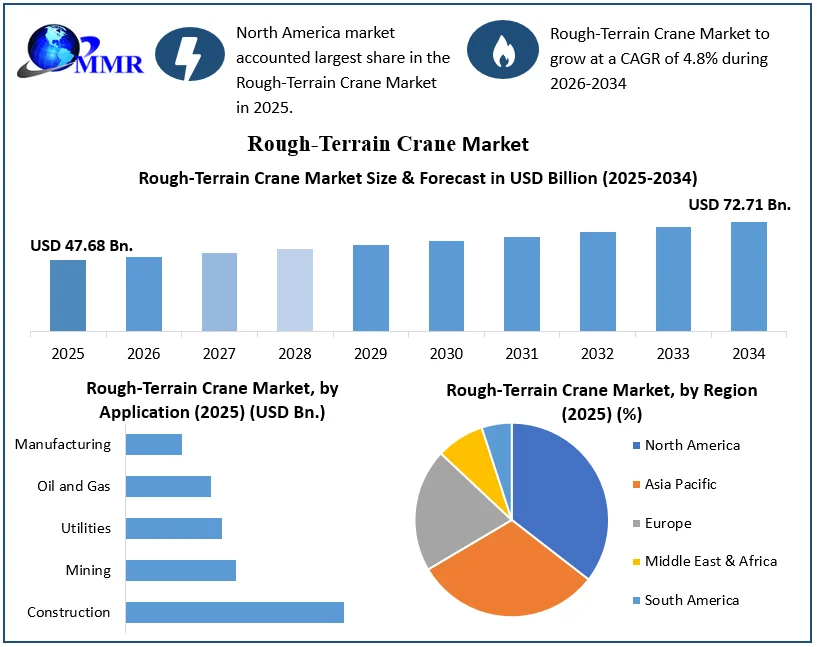
The Global Rough-Terrain Crane Market was valued at USD 47.68 Billion in 2025 and is projected to reach USD 72.71 Billion by 2034, growing at a CAGR of 4.8% during the forecast period 2026–2034.
| Parameter | Value |
| Market Size (2025) | USD 47.68 Billion |
| Market Size (2034) | USD 72.71 Billion |
| CAGR | 4.8% |
| Historical Period | 2020 to 2025 |
| Forecast Period | 2026 to 2034 |
Rough-Terrain Crane Market Overview:
The Rough-Terrain Crane Market is a dynamic industry that involves the production, consumption, and research of mobile machinery used in elevating and transporting materials on rough uneven grounds. These cranes comprise large tyres, four-wheel drive, and telescoping booms that allow for the lifting of substantial weights at worksites, quarries, mineral oil industries, and projects. Rough-terrain cranes are suitable for heavy lifting in the mining sector, steel constructions, material handling, and various industries. With the increase in infrastructure development, mining, and petroleum industries, the demand for these cranes increases. Moreover, the market size for Rough-terrain cranes is influenced by the growing need for construction equipment and its extensive utilization in the industries.
The demand for Rough-Terrain crane equipment is growing since manufacturers are developing cranes with electrical power, hybrid powerplants, and advanced technologies. This market’s primary consumers are construction, mining, petroleum, equipment leasing, and infrastructure industries. Demand for these machines is driven by the need for equipment with a higher lifting capacity, reduced sizes, and enhanced mobility. On the other hand, there exists a gap in the market due to insufficient supply of affordable mining equipment, high fuel costs, and expensive maintenance of the cranes. Therefore, the market gap can be filled by manufacturers that can provide mining equipment with high energy efficiency, affordable equipment for hire, and specialized machinery. Additionally, there is a growing need for remote control and high precision in the lifting equipment. Thus, market research reports show that the demand for rough-terrain cranes will grow due to the need for heavy lifting equipment.
North America is the leading region for rough-terrain cranes due to the high rates of infrastructure construction, mining, and petroleum industries in the United States and Canada. Moreover, the market gap is high in the region due to increased needs in crane equipment. The Asia Pacific region has a significant market potential for the crane equipment as the mining, steel, construction, and petroleum industries are growing in China, India, Japan, and Australia. The market participants in this industry are Tadano Ltd, The Manitowoc Company (Grove), KATO WORKS, SANY Group, and Link-Belt Cranes among others. These players utilize the large size of the market to gain competitive advantages over the smaller firms. For instance, Tadano Ltd produces rough-terrain cranes with telescoping jibs and advanced technologies while Grove manufactures compact rough-terrain cranes used in construction and industrial projects. The Maximize Market Research (MMR) study entails other significant market players, market size, and market share, the demand for Rough-Terrain cranes in different regions, and the trends that will influence the Crane equipment market in the future.
Rough-Terrain Crane Market Growth and Share Analysis
To Know About The Research Methodology :- Request Free Sample Report
Rough-Terrain Crane Market Dynamics
Infrastructure and Energy Development Projects Augment Demand for Rough-Terrain Cranes
Infrastructure development and energy projects augment the demand for rough-terrain cranes as construction firms utilize them for building bridges, roads, power plants, and large-scale industrial complexes. The equipment is appropriate for worksites with uneven ground due to wide tyres, hydraulic outriggers, and telescoping jib. For instance, 50 to 100 tons rough-terrain cranes with extended radius reach help install steel beams, pipes, and generators in energy plants depending on the specifications of the lifting objects and ground bearing capacity (Ahlstrom, 2019). The oil and gas sector also rely on these cranes for lifting and lowering equipment during drilling operations. Moreover, government and private entities increase spending on infrastructure projects, which impacts the need for mobile cranes with exceptional lifting capabilities. Therefore, the growing construction industry in emerging economies propels the market size and growth of the rough-terrain crane industry. Additionally, market analysts predict a rise in the utilization of this type of crane by infrastructure developers and heavy industry engineering firms.
Large-Scale Construction Projects Inhibit the Growth of the Rough-Terrain Crane Market
The high equipment costs and operational expenditures impede the development of the rough-terrain crane market due to the need for substantial investment in machinery and fuels (Ahlstrom, 2019). For instance, construction companies acquire cranes with a lifting capacity of 50 to 100 tons depending on the weight of objects they intend to carry and the height of the construction site. The equipment also requires adequate maintenance to guarantee consistent performance and prevent breakdowns during operations. Moreover, most independent construction firms and small-scale contractors hesitate to buy this type of crane due to its limited utilization in some projects because of its high acquisition costs. Alternatively, they can explore the option of renting the machinery from owners or leasing companies for a specific period. Therefore, the need for affordable lifting equipment and flexible payment plans impedes the growth of the rough-terrain crane market as manufacturers compete to meet the demands of these independent organizations. Additionally, the costs of transporting the machinery from one worksite to another is expensive due to the absence of standard road vehicles that can carry it.
Growth of Construction Equipment Rental Industry Generates Demand for Lifting Machines
The growth of the equipment rental industry presents substantial opportunities for the manufacturers of rough-terrain cranes due to the flexibility it offers to independent construction firms and large-scale organizations. For instance, the firms can rent the machinery for a specific period and utilize its lifting power, weight capacity, and extended outreach to complete their projects (Ahlstrom, 2019). Small-scale cranes with a capacity of 25 to 60 tons can serve secondary infrastructure worksites, industrial maintenance, and energy projects. Therefore, the increased need for compact rough-terrain cranes presents an opportunity for manufacturers to generate more revenue and expand their competitive advantage. Moreover, the companies can capitalize on the growth of the construction industry in emerging markets to supply rental firms with machines ideal for the needs of infrastructure developers and energy producers. Additionally, they can create demand for the new generation of compact and flexible rough-terrain cranes suitable for lifting objects in confined spaces and with enhanced fuel efficiency to minimize operational costs. Thus, the manufacturers can elevate the market share and forecast growth of the rough-terrain crane industry.
Unstable Ground Conditions Hamper Operations of Heavy-Duty Rough-Terrain Cranes
The unstable grounds present significant challenges in the utilization of rough-terrain cranes, which limits the market share of some manufacturers. Even though they operate on uneven grounds, these machines require stable surfaces for lifting objects with the radius reach, the boom’s angle, and the outriggers’ extension. Slopes, soft ground, muddy areas, and confined workspaces also present difficulties during the operation of this equipment. Moreover, the operators must interpret the load chart to avoid overloading the crane with weight beyond its capacity. For instance, a 100-ton crane should not lift objects at a radius larger than its vertical reach to prevent overturning to the front or side. Therefore, the crane operators should have proper training on the specifications and utilization of this equipment. Additionally, the proper maintenance of rough-terrain cranes is necessary to minimize the risk of malfunctioning and assure consistent performance. Independent construction firms and mining companies face a shortage of skilled workers such as machine operators and technical staff, which can impede the utilization of this machinery. The scarcity of technical expertise also increases the likelihood of breakdowns and additional costs of repairs, especially in remote mining and energy production facilities. Notably, the market challenges associated with the unstable grounds and short supply of skill impede the capacity of manufacturers to meet the rising demand for rough-terrain cranes as customers search for reliable suppliers and sellers of the equipment. Thus, the leading companies in this domain should invest in research and development activities to produce cranes with advanced technology and safer operations to enhance the safety and utilization period of their machines.
Smart Crane Technology Improves Operational Efficiency and Business Performance
Smart crane technology can help construction and industrial companies improve their lifting capabilities. Innovations in technology can enable the use of advanced sensors that track lifting activities, usage, and equipment status to improve performance. Safety monitoring systems can be used to enhance the safety features of a crane as well. A digital maintenance platform can also be applied to support the company in managing the equipment and avoiding repairs. The technology can increase asset productivity, minimize operational disruptions, and ensure that lifting needs are met at construction sites. Smart cranes can also help improve overall productivity and promote customer satisfaction. As a result, smart lifting technology and other related services can create new opportunities and increase market potential for the Rough-Terrain Crane Market in the future.
Rough-Terrain Crane Market Segment Analysis:
Global Rough-Terrain Crane Market, by Type
The Rough-Terrain Crane Market is segmented based on type into Up to 25 Ton, 26 Ton-74 Ton, 75 Ton-100 Ton, and Above 100 Ton. Notably, the market share of 26 Ton-74 Ton segment is high due to its significant demand in various industries. Cranes with capacity of less than 25 tons are used in construction and maintenance work while those with 75 Ton-100 Ton capacity are demanded for large-scale construction and energy projects. The market share for Rough-Terrain Crane above 100 Ton is also considerable as it addresses specific needs of crane users in terms of carrying large capacities. Due to the high equipment cost, there is a market gap for cost-effective rough terrain cranes. Increasing infrastructure spending and demand for efficient Rough-Terrain Crane will increase the market size. The market forecast shows potential for market growth since the industry is poised to witness a rise in demand for novel and efficient cranes.

Global Rough-Terrain Crane Market, by Feature
The Rough-Terrain Crane Market is divided into All-Terrain Capability, Telecommunication Features, and Enhanced Control Systems. All-Terrain Capability is the key segment in the market due to its high demand in the construction industry for its ability to traverse on muddy grounds and rough surfaces. Telecommunication features are being increasingly adopted in the crane industry as they allow remote tracking and monitoring of the equipment. Enhanced Control Systems ensure precision in the lifting process and are crucial for ensuring that operations are carried out safely. The market domain is highly volatile due to the high demand for smart cranes. However, the need for low-cost cranes creates a market gap since most All-Terrain Capability cranes are highly sophisticated and therefore expensive. It is anticipated that there will be a significant rise in the adoption of telecommunication-equipped cranes as users are being forced to invest in more efficient and safer machines. The market forecast for the Rough-Terrain Crane features segment shows promise for manufacturers and users due to the rising need for smart cranes.

Rough-Terrain Crane Market Regional Insights:
North America Holds Maximum Share in the Rough-Terrain Crane Market
North America holds a leading position in the Rough-Terrain Crane Market, supported by infrastructure development, oil and gas projects, and equipment rental demand in the United States and Canada. Increasing expenditure on construction equipment and industrial modernization supports regional market size and market share. Companies such as Tadano, Grove, and Link-Belt strengthen regional competition through advanced lifting solutions. Growing demand for high-capacity cranes creates new market opportunities.
Asia Pacific to Record a Strong Demand for Rough-Terrain Cranes
Asia Pacific is estimated to a hike in the demand for rough-terrain cranes from the construction, mining, and industrial sectors in China, India, Japan, and Australia. An increase in the number of infrastructural projects, such as the construction of highways, bridges, and power plants, and the growth of the manufacturing sector in the countries of the Asia Pacific region are the factors that would augment the demand for rough-terrain cranes. Moreover, the competition among key market players, including SANY, XCMG, and Tadano, will promote the market growth in this region.
Europe to See a Surge in Demand for Rough-Terrain Cranes
Europe is projected to a remarkable demand for rough-terrain cranes from the industrial and construction sectors. This demand is primarily driven by the rise in the procurement of electric cranes and modern equipment by companies in Germany, France, the UK, and Italy. The increase in the adoption of advanced and energy-efficient cranes by the energy and construction sectors creates a conducive environment for market growth in this region. The market players in this region are focusing on the production of advanced equipment that provides an enhanced workability and control mechanism. The rising capital intensity of the equipment compels the key players to provide affordable products, thus, making the demand for rough-terrain cranes rise.
Middle East & Africa to See a Surge in Demand for Rough-Terrain Cranes
The Middle East & Africa is composed to observe an increase in demand for rough-terrain cranes from the energy, mining, and construction sectors. The Middle East & Africa region has a significant potential for the market growth with an increase in demand for machinery from countries like Saudi Arabia, UAE, and South Africa. Although the market growth in this region is hindered by the high prices of the equipment and the lack of technical expertise, factors like a rise in the mining and energy sectors offer lucrative opportunities to the key players in the market.
South America to See a Rise in Demand for Rough-Terrain Cranes
South America is projected to a rise of demand from the mining, construction, and energy sectors in Brazil, Chile, and Argentina. The market growth in this region is primarily driven by the rise in the adoption of equipment by the mining companies and the need for heavy-duty equipment by the industrial sector. Moreover, the demand for the rental of rough-terrain cranes increases the potential of the market to flourish in this region. The market players can witness a rise in sales if they can provide durable and high-performance machinery at affordable prices.
Global Rough-Terrain Crane Market Recent Development
| Published Date | Recent Development |
| August-2026 | XCMG Group announced the expansion of its crane business distribution network in Australia through a strategic partnership with TRT. The new agreement will see XCMG’s rough-terrain, all-terrain, crawler cranes, and other products distributed in the country to meet the growing demand for its products. |
| July--2026 | Liebherr Group announced the delivery of its first LRT 1130-2.1 rough-terrain crane to Rocksure International in Ghana. The new 130-tonne crane will support mining activities in the region as Liebherr continues to strengthen its position as a leading supplier of mining equipment in Africa. |
| July--2026 | Link-Belt Cranes announced the expansion of its distribution agreement with Doggett Equipment to southeast Texas, including Houston. The new agreement allows Doggett Equipment to distribute not only rough-terrain cranes but also other mobile equipment. In addition, the agreement covers the provision of spare parts, maintenance, inspections, and technical support. |
| April-2026 | Raimondi Group announced the launch of a new tele crawler crane, the TTC 70, through its Terex Rough Terrain Cranes brand. The new product will be marketed in the United States, Canada, and Europe. However, the company states that it is not introducing a rough-terrain wheeled crane but expanding its product line of crawler cranes. |
| January-2026 | Tadano Ltd. announced the launch of its 70-ton CREVO700 G5 rough-terrain crane with an optional battery power supply, e-PACK. The new equipment is scheduled to go on sale in Japan on 21 January 2026. In its electric mode, the e-PACK system enables the crane to operate without direct emissions, supporting the company’s decarbonization initiatives in the crane market. |
Global Rough-Terrain Crane Market Competitive Insight
Companies are launching new crane models with improved capacity and enhanced safety to improve their product portfolio and strengthen their position in the market. Companies are also focused on developing cost-efficient rough-terrain cranes to improve their sales in emerging economies such as India, China, and others. Moreover, companies are also making a strategic partnership with distributing companies to improve their range across the globe. For instance, in 2018, Chinese manufacturer Sany announced a strategic partnership with Equipment Depot to improve its sales in the American market.
Rough-Terrain Crane Market Scope: Inquiry before Buying
| Rough-Terrain Crane Market | |||
|---|---|---|---|
| Report Coverage | Details | ||
| Base Year: | 2025 | Forecast Period: | 2026-2034 |
| Historical Data: | 2020 to 2025 | Market Size in 2025: | 47.68 USD Billion |
| Forecast Period 2026-2034 CAGR: | 4.8% | Market Size in 2034: | 72.71 USD Billion |
| Segments Covered: | by Type | Up to 25 Ton 26 Ton - 74 Ton 75 Ton - 100 Ton Above 100 Ton |
|
| by Features | All-terrain Capability Telecommunication Features Enhanced Control Systems |
||
| by Application | Construction Utilities Mining Oil and Gas Manufacturing |
||
Rough-Terrain Crane Market, by Region
North America (United States, Canada and Mexico)
Europe (UK, France, Germany, Italy, Spain, Sweden, Austria and Rest of Europe)
Asia Pacific (China, South Korea, Japan, India, Australia, Indonesia, Malaysia, Vietnam, Taiwan, Bangladesh, Pakistan and Rest of APAC)
Middle East and Africa (South Africa, GCC, Egypt, Nigeria and Rest of ME&A)
South America (Brazil, Argentina Rest of South America)
Rough-Terrain Crane Market Key Players:
1. Tadano Ltd.
2. The Manitowoc Company, Inc. (Grove)
3. Link-Belt Cranes
4. SANY Heavy Industry Co., Ltd.
5. XCMG Group
6. Zoomlion Heavy Industry Science and Technology Co., Ltd.
7. KATO WORKS CO., LTD.
8. Kobelco Construction Machinery Co., Ltd.
9. Liebherr Group
10. Terex Corporation
11. Broderson Manufacturing Corp.
12. Locatelli Crane S.r.l.
13. RIGO S.r.l.
14. TIL Limited
15. Action Construction Equipment Limited (ACE)
16. Escorts Kubota Limited
17. PowerPlus Group
18. Sinoway Industrial (Shanghai) Co., Ltd.
19. Xuzhou Jiufa Construction Machinery Group (XJCM)
Frequently Asked Questions:
1. Which region has the largest share in Global Rough-Terrain Crane Market?
Ans: North America region held the highest share in 2025.
2. What is the growth rate of Global Rough-Terrain Crane Market?
Ans: The Global Rough-Terrain Crane Market is growing at a CAGR of 4.8% during forecasting period 2026-2034.
3. What is scope of the Global Rough-Terrain Crane Market report?
Ans: Global Rough-Terrain Crane Market report helps with the PESTEL, PORTER, COVID-19 Impact analysis, Recommendations for Investors & Leaders, and market estimation of the forecast period.
4. Who are the key players in Global Rough-Terrain Crane Market?
Ans: The important key players in the Global Rough-Terrain Crane Market are – Manitex International Inc., TIL Limited, ENTREC Corporation, Xuzhou Construction Machinery Group Co., Ltd., Broderson Manufacturing Corporation, SANY GROUP, Maxim Crane Works, L.P., Liebherr Group, The Manitowoc Company, Inc., Terex Corporation, Tadano Ltd., Kato Works Co., Ltd..
5. What is the study period of this Market?
Ans: The Global Rough-Terrain Crane Market is studied from 2020 to 2034.